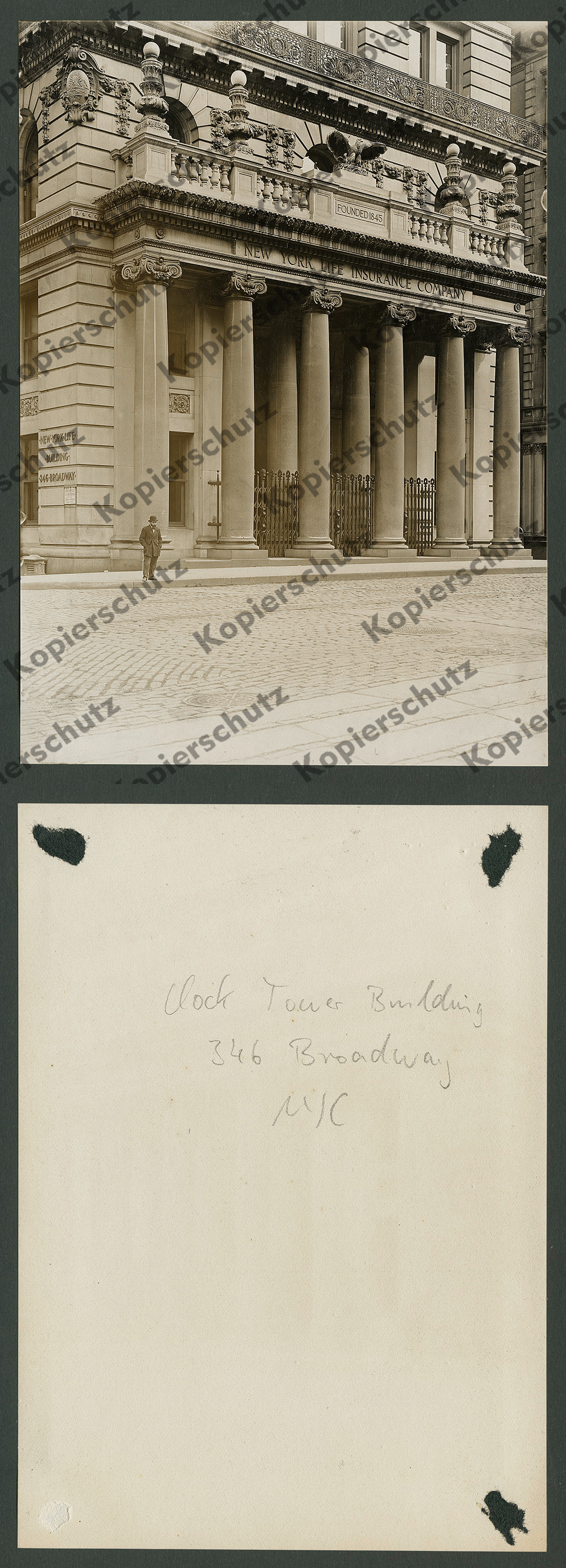
Clock Tower Building in New York (früher New York Life Insurance Company Building, 346 Broadway).
100% Original-Fotoabzug aus dem Jahr 1908.
Auf der Rückseite handschriftlich bezeichnet.
Größe: 122 x 168 mm.
Mit minimalen Alterungs- und Gebrauchsspuren, auf der Rückseite mit vier kleinen schwarzen Kleberesten von einer Aufklebung auf schwarzem Karton, sonst sehr guter Zustand.
Hervorragende Bild-Qualität – extrem selten!!!
100%-Echtheitsgarantie – kein späterer Abzug, kein Repro, kein Nachdruck!!!
Besichtigung jederzeit möglich.
100% guarantee of authenticity - not a later print, not a reproduction, not a reprint!
Visit any time.
Bitte warten, hier kommt gleich ein großes Bild!!!
Aus großem Film- und Fotoarchiv, weitere Angebote in meinem ebay-shop!
Out of a large film- and photo-archiv, more offers in my ebay shop!
Das Original-Foto wird als Sammlerstück verkauft - Urheberrechte sind im Kauf ausdrücklich NICHT enthalten!!!
Photo is sold as a collector's item only and no copyrights are being sold here.
Weitere historische Original-Fotografien finden Sie in meinem ebay-shop!!!
For more original historical Vintage-Prints please take a look in my ebay-shop!!!
Versand ausschließlich per Einschreiben.
Zu Rückgabe und AGB bitte mich-Seite beachten. Die dort hinterlegten Informationen sind verbindlicher Bestandteil dieses Angebots/dieser Artikelbeschreibung!1908, 20. Jahrhundert, Amerika, Bromsilber, Fotografie, historische Bilder, Lichtbild, New York, Nordamerika, Ortskunde, Photographie, Silbergelatineabzug, Silver bromide, silver gelatine print, Topographie, US-NY 10010 New York City, NYC, Big Apple, USA, Vereinigte Staaten von Amerika, Vintage Print, Manhattan, Großstadt, Metropole, Fotografie, Photographie, Lichtbild, Bromsilber, Silbergelatineabzug, Silver bromide, silver gelatine print, Vintage Print, Kulturgeschichte, Neorenaissance, Renaissance Revival architecture New York Life Insurance Company (NYLIC) is the third-largest life insurance company in the United States, the largest mutual life insurance company in the United States and is ranked #71 on the 2019 Fortune 500 list of the largest United States corporations by total revenue. NYLIC has about $593 billion in total assets under management, and more than $25 billion in surplus and AVR. In 2007, NYLIC achieved the best possible ratings by the four independent rating companies (Standard & Poor's, AM Best, Moody's and Fitch). Other New York Life affiliates provide an array of securities products and services, as well as institutional and retail mutual funds. History Early history New York Life Insurance Company first opened in Manhattan's Financial District as Nautilus Mutual Life in 1841, 10 years after the first life insurance charter was granted in the United States. Originally chartered in 1841, the company also sold fire and marine insurance. The company's first president, James De Peyster Ogden, was appointed in 1845. Nautilus renamed itself New York Life Insurance Company in 1845 to concentrate on its life insurance business. In its early years (1846–1848) the company, along with other insurance companies of the day including Aetna and US Life, insured the lives of slaves for their owners. By 1847 these accounted for one‑third of New York Life's policies. The board of trustees voted to end the sale of insurance policies on slaves in 1848. The company also sold policies to soldiers and civilians involved in combat during the American Civil War and paid claims under a flag of truce during that time. In the late 1800s, the company began employing female agents. New York Life continued to grow throughout its first 100 years as the national population and the market for life insurance increased. New York Life's growth was in part fueled by its introduction of a system by which the company used agents to find new business. In 1892, company President John A. McCall introduced the branch office system: offices that served as liaisons between New York and field agents. In 1894, the company became the first US-based insurance provider to offer life insurance to women at the same cost as men; social reformer Susan B. Anthony was one of the company's first female policyholders. In 1896, New York Life became the first company to insure people with disabilities or in hazardous occupations. 20th century The New York Life Building at 51 Madison Avenue in Manhattan, designed by American architect Cass Gilbert, opened in December 1928. The company moved into the 34-story skyscraper in 1929. Later that year, New York Life's assets survived the stock market crash; state regulation and company investing policy had led New York Life to invest in government bonds and real estate, not common stocks. Following World War II, New York Life further diversified; it invested in real estate development in the late 1940s and launched a mortgage-loan program for veterans in 1946. In 1957, New York Life hired one of the industry's first black agents, Cirilo McSween. In the 1970s, New York Life began selling annuities and mutual funds. In the late 1990s and early 2000s, as other mutual life insurance companies became publicly traded corporations, New York Life remained a mutual company. New York Life entered the Mexican market in 1999 when it acquired Seguros Monterrey from Aetna. Recent history New York Life, along with other insurance companies, relaxed the claims process for missing persons in the wake of the September 11 attacks. Fearful of the stability of the market during the two years prior to the financial crisis of 2007–2008, New York Life moved its cash into other investments such as treasury bonds. In the ensuing financial crisis, New York Life Insurance Company rejected assistance from the U.S. Treasury Department. Following the 2013 acquisition of Dexia Asset Management, later renamed Candriam Investors Group, New York Life Investments became one of the largest asset managers worldwide, with access to markets in Europe, Asia and Australia, in addition to the United States. Operations As of 2016, New York Life Insurance Company was the country's third-largest life insurance company. A mutual insurance company, New York Life is owned by its policyholders and has no outside shareholders. As a mutual, New York Life distributes a portion of its earnings to eligible policyholders as annual dividends. As of 2016, the company has paid a dividend every year since 1854. Through Seguros Monterrey New York Life, the company offers insurance in Mexico. New York Life's core product is whole life insurance, a type of life insurance offering lifelong protection that builds cash value over time. New York Life also sells term life insurance, universal life insurance, variable universal life insurance, long-term care insurance and annuities. The company operates New York Life Direct, selling direct-to-consumer policies, and is the exclusive life insurance partner of the AARP. Asset management businesses New York Life's global asset management business serves both institutional and retail clients. New York Life Investments ranks No. 26 by total worldwide institutional assets under management, according to Pensions & Investments' Largest Money Managers Survey 2017. The group manages money through independent investment boutiques. These boutiques include: Ausbil, an Australian investment boutique specializing in equities Candriam Investors Group, which focuses on high yield, absolute return, emerging debt, sustainable investments and asset allocation strategies Credit Value Partners, which specializes in opportunistic, distressed debt and high-yield corporate credit GoldPoint Partners, a private equity firm IndexIQ, which specializes in exchange-traded funds and alternative investment strategies MacKay Shields, an asset management firm that focuses on income generation and offers capital growth through mutual and hedge funds Madison Capital Funding, which provides financing to private equity firms Private Advisors, an asset manager specializing in hedge funds and private equity funds Charitable efforts New York Life Foundation is the insurance company's philanthropic arm. Its areas of focus include childhood bereavement. New York Life Foundation first became involved in childhood bereavement programs when it supported the Comfort Zone Camp in 2007. Its partners and programs include the National Alliance of Grieving Children, Grief Reach, Coalition to Support Grieving Students, Camp Erin/Moyer Foundation, Tragedy Assistance Program for Survivors and Boys and Girls Clubs of America. It sponsored the HBO documentary One Last Hug. The company also emphasizes giving to various cultural communities, including the African-American community. The company also funded a $10 million endowment to the Colin Powell Center for Policy Studies at the City College of New York called the New York Life Endowment for Emerging African-American Issues in 2006. Ratings and rankings In June 2018, New York Life ranks No. 69 on the Fortune 500. In 2017 Fortune named New York Life among its Most Admired Companies in the life insurance industry. Forbes ranked New York Life #364 among America’s Best Employers for 2017. As of 2019, New york Life ranks No. 71 on the Fortune 500. By the end of 2019, New York Life had earned the highest financial strength ratings from major four rating agencies: A++ from A.M.Best, AAA from Fitch Ratings, Aaa from Moody and AA+ from Standard & Poor's. The Former New York Life Insurance Company Building, also known as the Clock Tower Building, is a structure located at 346 Broadway (with a secondary address of 108 Leonard Street) between Catherine Lane and Leonard Street, in Tribeca, Manhattan, New York City. Constructed in two stages, from 1868 to 1870 and from 1894 to 1899, it is a New York City Landmark and is listed on the U.S. National Register of Historic Places. History Original building, before being extended, and then replaced Office building The New York Life Insurance Company's headquarters building was originally built in 1868-1870. It needed to be expanded eastward to Lafayette Street and Stephen Decatur Hatch was engaged for the job. Hatch designed the extension in 1894, but died before construction could be completed. The firm of McKim, Mead & White took over the work, and completed the extension in 1898, following Hatch's design. The company then decided to replace the original building as well, and McKim, Mead & White provided an Italian Renaissance Revival style "palazzo-like" design with a clock tower whose clock was manufactured and installed by the E. Howard Clock Company. The building's prominent clocktower was topped with 33-foot tall, eight ton, sculpture made by Philip Martiny, who studied under Augustus Saint-Gaudens. The piece consisted of four, 11-foot tall, crouching figures of Atlas, on whose shoulders rested a 15-foot diameter hollow globe, which was topped off with a 7-foot-tall eagle. The gigantic statue was removed in the late 1940s and has been lost ever since. New York Life left for the New York Life Building on Madison Square Park in 1928. In 1967, the City of New York acquired the building and moved several city agencies along with the Criminal Court, Summons Part, into the building. The building was added to the National Register of Historic Places in 1982, and the exterior, interior and historic 1895 E. Howard & Co. No. 4 tower clock mechanism (and connecting components) were all designated New York City landmarks in 1987 by the New York City Landmarks Preservation Commission. The building is also included in the AIA Guide to New York City in which the clock is described as a "wonderful Classical clock overlooking Broadway." Residential/hotel use In January 2013, the City of New York sold the building to developers Elad Group and the Peebles Corporation for $160 million. In 2014, the Elad Group and Peebles Corporation began construction to convert the landmark building into a boutique hotel and private apartment condominiums. The clock was stopped at 10:25 am sometime after March 2015. The clock faces were to be preserved and electrified, but the landmarked, 1895 E. Howard clock mechanism (the largest clock mechanism in the United States) was to be decommissioned and removed. The New York Landmarks Preservation Commission granted a Certificate of Appropriateness, approving plans to close off the tower to the public and to allow the developers to destroy the clock. Opponents, including Save America's Clock, the Historic Districts Council, and the Tribeca Trust filed an Article 78 proceeding in New York Supreme Court to prevent the conversion of the clock tower into a private residence and to save the clock. The reasons cited are that the clock tower has always been open to the public and that the clock mechanism is one of city's (and the nation's) few remaining mechanical clocks. Moreover, the clock mechanism itself is designated as a landmark. Since 1979, NYC Clock Master, Marvin Schneider and later his assistant, Forest Markowitz, have wound the clock on a weekly basis. On March 31, 2016, Justice Lynn R. Kotler, of New York State Supreme Court ruled in favor of the Appellants and revoked the New York Landmarks Preservation Commission's Certificate of Appropriateness. According to the ruling, the Landmarks Preservation Commission has the authority to require the building owners to maintain the mechanical mechanism, and to issue a violation if the clock is transitioned to electrical workings. The case was heard by the Appellate Division of the Supreme Court, First Judicial Department on February 23, 2017. On November 30, 2017, the Appellate Court, in a 3-2 decision, upheld the lower court's ruling against the developers and the City of New York. The appellate decision affirmed the lower court's decision to prevent of the developers from electrifying or removing the landmarked clock and closing off the landmark clock tower from the public. The developers and the City of New York have filed another appeal in the New York Court of Appeals. Restoration of the historic exteriors by New York firm HLZA included cleaning the marble, replacing damaged portions of the roof parapet, and restoring the 7,000-pound sculptural eagles perched on the roof.