1904 antique NATIVE AMERICAN INDIAN ethnology PUEBLO PAWNEE HAKO MAYAN 2v SET
SCROLL DOWN for MORE PHOTOS in DESCRIPTION
Click HERE to view or search ANTIQUE.COTTAGE listings.
AI-assisted description created from the item and photos to highlight key details. Please review all photos carefully, as they are part of the description and condition.
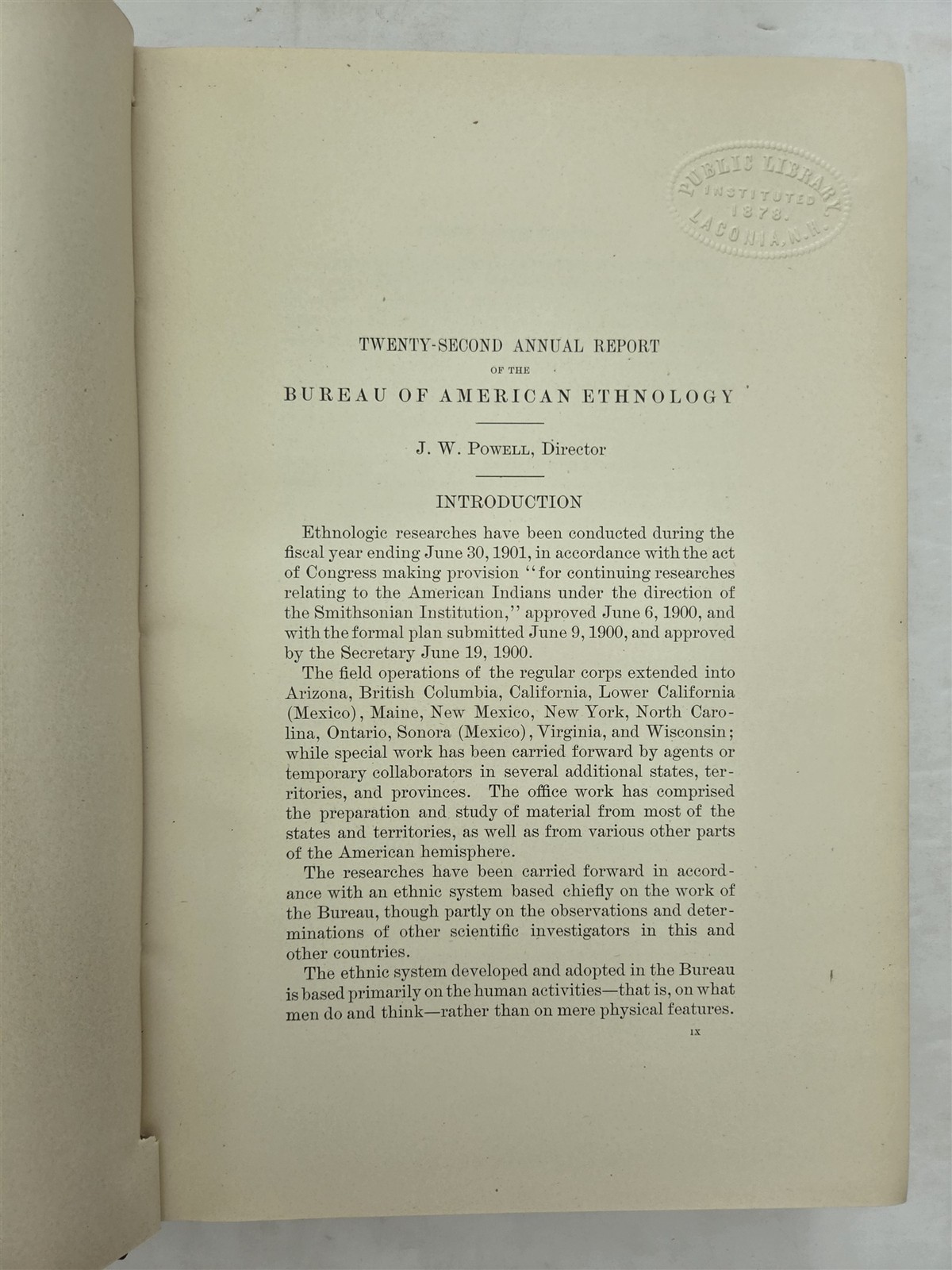
Original 1904 two-volume set of the Twenty-Second Annual Report of the Bureau of American Ethnology to the Secretary of the Smithsonian Institution, 1900–1901, under J. W. Powell, Director, published in Washington by the Government Printing Office. These are substantial matching government-bound volumes in the original olive/green cloth, containing an important collection of early American archaeological and ethnological studies devoted to Pueblo archaeology, Maya calendar systems, and Pawnee ceremonial life. Please see the photographs for the exact measurements previously shown, as well as the considerable size and thickness of the two volumes.
The Smithsonian's bibliography confirms this as a two-part work totaling XLIV + 320 pages in Part I and 372 pages in Part II, with 91 plates and 181 figures.
PART I
Part I contains several major studies:
“Two Summers' Work in Pueblo Ruins” — Jesse Walter Fewkes
Pages 3–195, with 70 plates and numerous figures. Fewkes documents archaeological work among prehistoric Pueblo sites of the American Southwest, particularly in Arizona. The work includes extensive material on excavations, architecture, ruins, pottery, artifacts, ceremonial structures, and Pueblo material culture. The Smithsonian describes this section as containing illustrations, some in color, as well as a map.
The numerous archaeological illustrations and plates are a particularly desirable feature of the set and include views of ruins, site plans, architectural details, artifacts, pottery and other archaeological material.
“Mayan Calendar Systems—II” — Cyrus Thomas
Pages 197–305, with plates and numerous figures devoted to the interpretation and study of Maya calendrical systems and glyphic material.
Part I concludes with its index.
PART II — THE HAKO
The entire second volume is devoted principally to:
“The Hako: A Pawnee Ceremony” — Alice C. Fletcher
Assisted by James R. Murie, with the music transcribed by Edwin S. Tracy.
This important ethnographic study occupies pages 5–368, followed by the index. The Smithsonian identifies it as part of this Twenty-Second Annual Report and confirms Fletcher's authorship and 1904 publication.
The volume provides an exceptionally detailed early account of the Pawnee Hako ceremony, including ritual sequences, prayers, songs, translations, explanations, ceremonial objects, symbolism, lodge arrangements and diagrams.
Especially notable are the numerous pages of Pawnee ceremonial music, with musical notation and transcriptions by Edwin S. Tracy. The text records original words together with translations and extensive explanations of their ceremonial meanings.
Illustrated material shown in this copy includes striking plates depicting ceremonial objects such as “Mother Corn,” as well as the wildcat skin and crotched ceremonial stick with feathered stems, together with diagrams showing the arrangement of participants within ceremonial lodges.
The Hako section also discusses ceremonial concepts involving the Father and Son, Mother Corn, eagle feathers, sacred stems, water, smoke offerings, visions, stars and celestial powers, ritual journeys, children, naming, blessing and other elements of Pawnee ceremonial belief and practice.
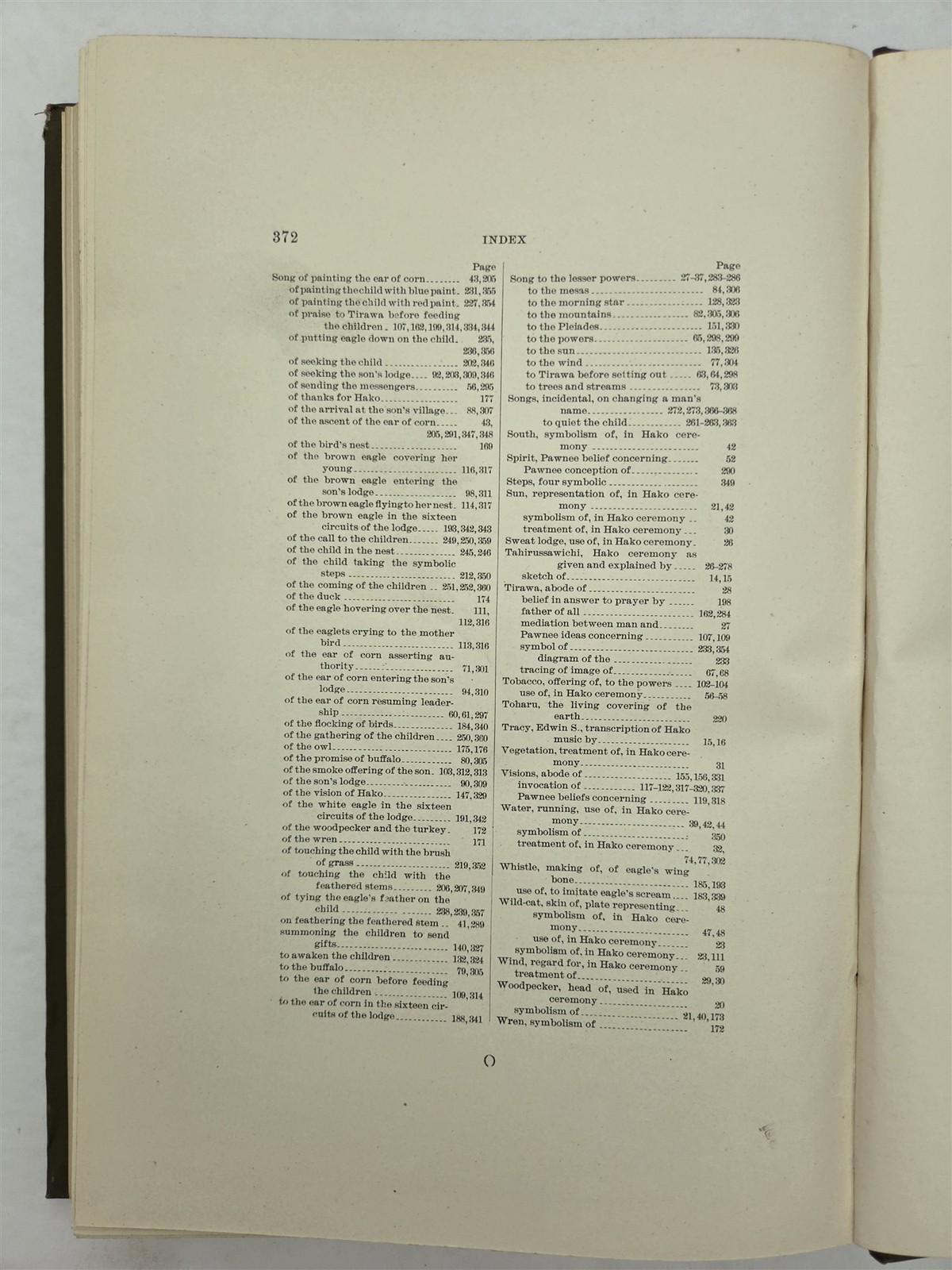
The detailed index runs through page 372, demonstrating the remarkable range of subjects covered.
ILLUSTRATIONS / COLLECTIBILITY
This is much more than a routine government report. Across the two volumes are 91 plates and 181 figures, including archaeological material, Pueblo ruins and architecture, pottery and artifacts, Maya-related material, Pawnee ceremonial objects, diagrams and musical notation.
The set is consequently of interest to collectors and researchers in:
Native American history and ethnology; American anthropology; archaeology; Pueblo culture; Arizona and Southwestern archaeology; Maya studies; Native American ceremonial music; Pawnee history and religion; Smithsonian Institution history; Bureau of American Ethnology publications; and early 20th-century government publications.
Authentic period piece related to family, history or local heritage - well-suited for historical collections, genealogical /genealogy research, or museum acquisition. Vintage or Antique.
CONDITION: See listing description and photos.





- International buyers are responsible to pay VAT or other Taxes to their countries as required.
- eBAY collects and remits sales tax on behalf of several states. If you are a dealer, you can write to eBay to file a form to become tax exempt.
LOC:
LOC2: BIGS-WHITE.SHELF-TMKTK-E26DS0803BDBB0

Powered by SixBit's eCommerce Solution