1 x Universal Strawfoam PENOSIL 265
Multipurpose insulation straw foam
PENOSIL Universal Strawfoam 265 is a multipurpose one-component polyurethane straw foam for filling and insulating interior and exterior gaps, joints, holes and penetrations. Adheres well to most common building materials such as wood, concrete, stone, plaster, metal, PVC and polystyrene.
VALUES
- High post-expansion (<150%)
- Excellent airtightness
- High thermal and sound insulation properties
- Good filling properties
- Non-shrinking
- Prevents thermal bridges
- Low curing pressure (<1.5 kPa)
- Suitable for interior and exterior use
APPLICATION AREAS
- Filling and insulating openings, cracks, gaps and penetrations (cable and pipe penetrations).
- Filling plasterboard joints.
- Enhancing thermal and sound insulation.
- Reducing the impact of thermal bridges.
ADHERES TO
- Wood
- Concrete
- Masonry
- Bricks
- Stone
- Plaster
- Plasterboard
- Metals
- PVC
- Polystyrene
- Roof tiles
- EPS
PACKAGE

Aerosol can 1000 ml, content 750 ml
1 pcs per box
USAGE INSTRUCTIONS
Surfaces must be clean from dust, loose particles and oil stains.
Moisten dry surfaces with water mist to ensure a faster curing time and better end results.
Shake the can vigorously at least 20 times. Remove the cap. Hold the foam can in an upright position with the valve up. Screw the straw applicator tightly onto the foam can valve. Hold the can upside down when extruding the foam. Foam output can be adjusted with the applicator trigger.
Fill the joints up to approx. 50%. In the case of larger joints, apply foam in several layers and moisten slightly between each layer. Excess foam can be cut after it has fully cured.
TIPS
- Air temperature during use: +5°C to +30°C.
- Protect adjacent surfaces with paper, plastic film or other suitable material.
- Due to the wide variety of construction materials, we recommend a preliminary compatibility test.
- Working at low temperatures, the foam can must be prewarmed to room temperature (around +20°C).

- Does not adhere to polyethylene (PE), PTFE (Teflon®) or silicone surfaces.
- Do not use at temperatures below +5°C.
- Cured foam needs to be covered with a suitable material to protect against UV rays.
- Due to high post-expansion, lighter construction elements must be firmly fixed prior to foam application.
- Do not cover before the foam has fully cured.
SAFETY INFORMATION (CLP AND REACH)
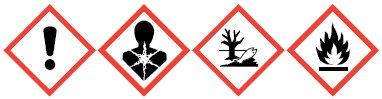
DANGER
H222 – Extremely flammable aerosol.
H229 – Pressurised container: May burst if heated.
H315 – Causes skin irritation.
H317 – May cause an allergic skin reaction.
H319 – Causes serious eye irritation.
H334 – May cause allergy or asthma symptoms or breathing difficulties if inhaled.
H335 – May cause respiratory irritation.
H351 – Suspected of causing cancer.
H362 – May cause harm to breast-fed children.
H373 – May cause damage to organs through prolonged or repeated exposure.
H400 – Very toxic to aquatic life.
H410 – Very toxic to aquatic life with long lasting effects.
P101 If medical advice is needed, have product container or label at hand.
P102 Keep out of reach of children.
P210 Keep away from heat, hot surfaces, sparks, open flames and other ignition sources. No smoking.
P211 Do not spray on an open flame or other ignition source.
P251 Do not pierce or burn, even after use.
P271 Use only outdoors or in a well-ventilated area.
P280 Wear protective gloves/ face protection/ protective clothing/ respiratory protection/ protective footwear.
P304+P340 IF INHALED: Remove person to fresh air and keep comfortable for breathing.
P305+P351+P338 IF IN EYES: Rinse cautiously with water for several minutes. Remove contact lenses, if present and easy to do. Continue rinsing.
P410+P412 Protect from sunlight. Do not expose to temperatures exceeding 50 °C/ 122°F.
P501 Dispose of contents/ container in accordance with local/ regional/ national/ international regulation.
EUH204 Contains isocyanates. May produce an allergic reaction.
Substances that contribute to the classification: Alkanes, C14-17, chloro; 4,4´-methylenediphenyl diisocyanate, isomers and homologues
As from 24 August 2023 adequate training is required before industrial or professional use.
Persons already sensitised to diisocyanates may develop allergic reactions when using this product.
Persons suffering from asthma, eczema or skin problems should avoid contact, including dermal contact, with this product.
This product should not be used under conditions of poor ventilation unless a protective mask with an appropriate gas filter (i.e. type A1 according to standard EN 14387) is used.