
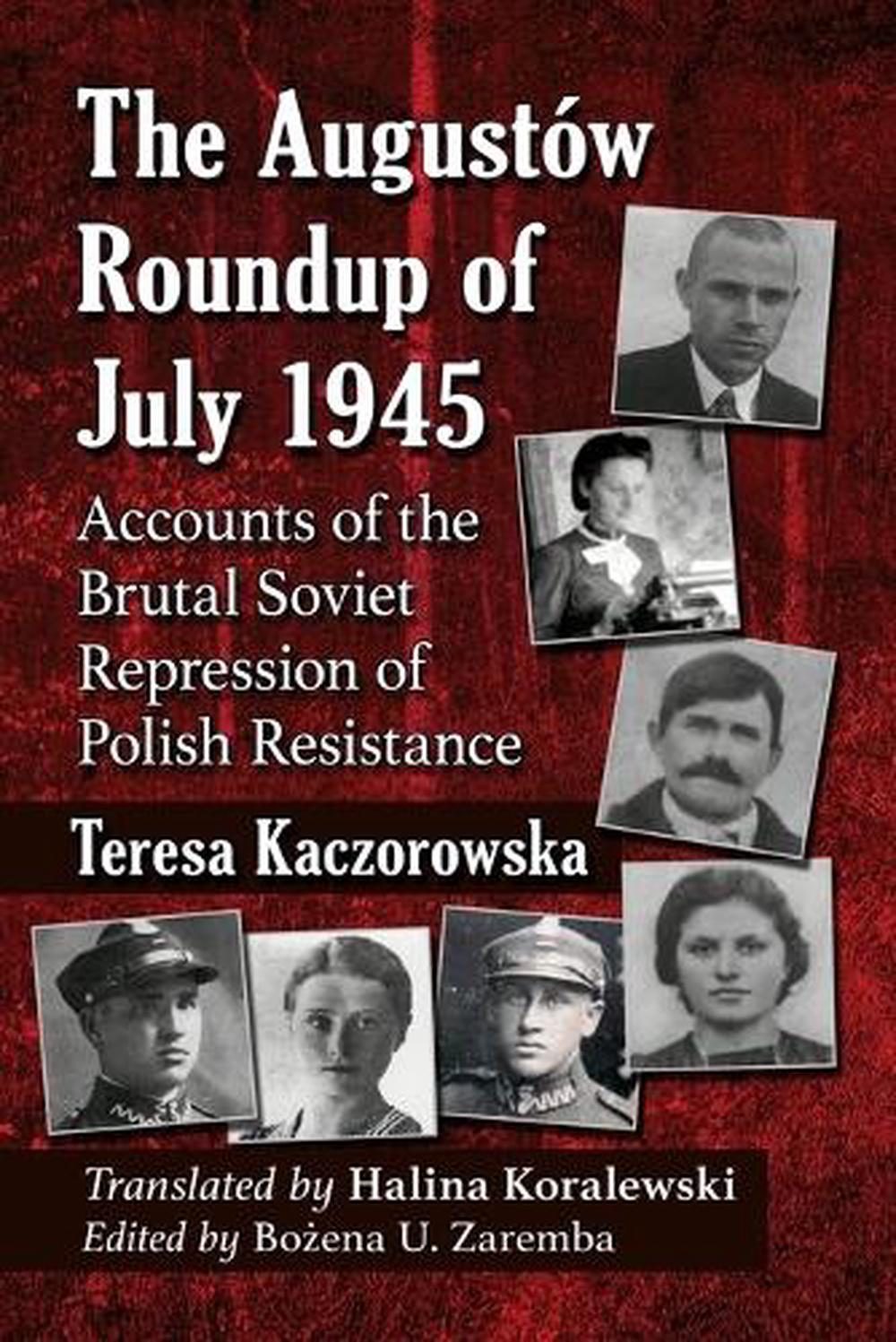
The Augustow Roundup of July 1945
by Teresa Kaczorowska, Halina Koralewski, Bożena U. Zaremba
Remnants of the Polish Home Army re-formed to counter brutal Soviet repressions. In July 1945, more than 7,000 HA freedom fighters were arrested in the northeastern Augustow region and were beaten and tortured. This book examines the fateful events of the Augustow Roundup (a.k.a. 'little Katyn') through eyewitness testimonies.
Paperback
English
Brand New
Publisher Description
In 1945, remnants of the Polish Home Army re-formed to counter brutal Soviet repressions. In July of that year, more than 7,000 HA freedom fighters were arrested in the northeastern Augustow region and held in barns, pigsties and warehouses where they were beaten and tortured. Two thousand of them were never seen again--their whereabouts remain a mystery. Seventy-five years later, their relatives still search for answers and the location of their mass burial. This book examines the fateful events of the Augustow Roundup (a.k.a. "little Katyn") through eyewitness testimonies.
Table of Contents
Table of Contents
From the Author
From the Translator: Historical Backdrop to the Augustów Roundup
Marian Tananis (Sejny): "Traitors are the worst"
Krystyna wierzbiska (Augustów): "When we came back from Siberia, my father was gone"
Fr. Stanisaw Wysocki (Suwaki): "Our farm was an oasis for the insurgency"
Tadeusz Jagowski (Augustów): "Our parents waited for their son's return until their death"
Józef Kucharzewski (Giby): "I heard the moans of my tortured sister"
Marian Buko (Augustów): "Our family is waiting for the explanation of this crime"
Teresa Stakiewicz (Augustów): "The Augustów Roundup is still alive"
Afterword—Why Is This Book Needed?
Afterword—The Augustów Roundup: Crime with No Statute of Limitations
Notes
Selected Sources
Index
Review
"The painstaking research that stands behind The Augustów Roundup of July 1945 deepens our knowledge of Soviet crimes against humanity, personally ordered by Jozef Stalin and then administered by the Soviet oppression apparatus. The heart-wrenching testimonies of the survivors and victims' relatives are a chilling reminder that mass murder was practiced in the U.S.S.R. on a shockingly large scale, and that countless victims disappeared without a trace. While few Americans know about this horrible crime, more should, certainly in light of Russian butchery in Ukraine. This highly readable book could not be more timely."—Allen Paul, author, Katyn: Stalin's Massacre and the Triumph of Truth
"Augustów Roundup of July 1945 by Teresa Kaczorowska teaches us the essential lesson of all wars. They have no beginning and no end. In a series of interviews with survivors of the Soviet action against Poles after the end of WWII, she eloquently and memorably reminds us of the terror and grief war causes, terror and grief that goes on for generations. This book will stand with the great books about what Eastern Europe was like after the Russians took over following the end of the war."—John Guzlowski, author of Echoes of Tattered Tongues, winner of the Eric Hoffer Montaigne Award
"The Augustów Roundup was the clearest illustration of the new regime of communist terror that replaced the brutality of German occupation. This new English translation of Teresa Kaczorowska's Augustów Roundup of July 1945 is an important addition to our understanding of the communist rule, which rested on a foundation of murder, torture, and repression. The stories of victims and their families are a needed corrective to those who seek to deny or whitewash the fundamentally criminal nature of the Polish People's Republic."—John Radzilowski, director, Polish Institute of Culture and Research at Orchard Lake and a professor of history, University of Alaska
"The little-known 'Augustów Roundup' of 1945 carried out by Stalin's Soviet Union against the Home Army resistance forces of Poland has frequently been called a 'little Katyn'—thousands of Polish soldiers arrested, hundreds murdered without a trace, the crime long falsified and covered up, with the suppressed truth emerging slowly in the face of great obstacles. These vivid, harrowing collected testimonies of one who survived the Roundup and family members of others who did not told with first-person immediacy, help to fill in the blank pages of a historical incident that reveals much about the brutality of the Soviet takeover of Poland."—Neal Pease, professor of history (emeritus), University of Wisconsin-Milwaukee
Review Quote
"The painstaking research that stands behind The August
Details
