
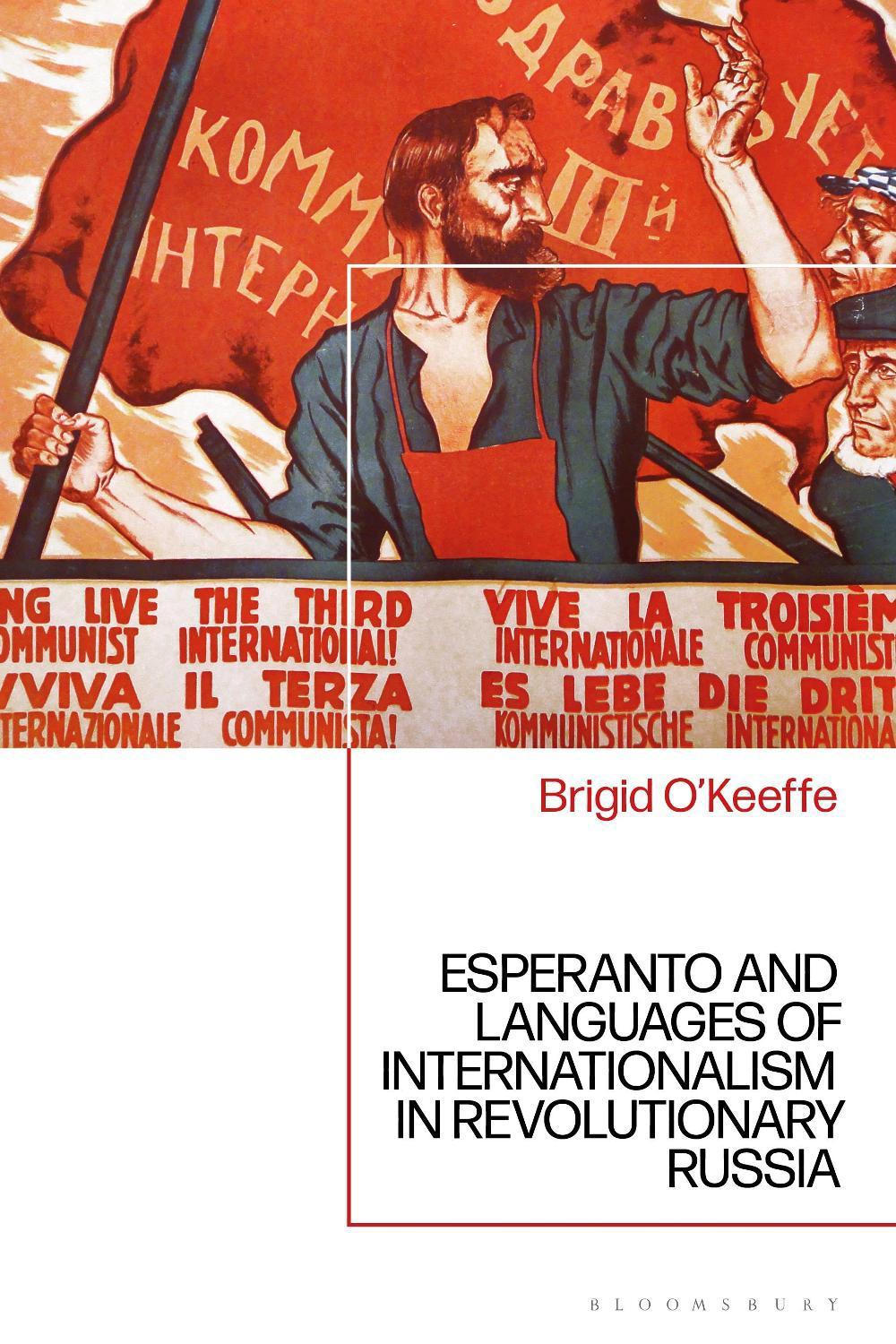
Esperanto and Languages of Internationalism in Revolutionary Russia
by Brigid O'Keeffe, Associate Professor Brigid O'Keeffe
Winner of the 2022 Ab Imperio Award
Hoping to unite all of humankind and revolutionize the world, Ludwik Zamenhof launched a new international language called Esperanto from late imperial Russia in 1887. Ordinary men and women in Russia and all over the world soon transformed Esperanto into a global movement. Esperanto and Languages of Internationalism in Revolutionary Russia traces the history and legacy of this effort: from Esperanto's roots in the social turmoil of the pre-revolutionary Pale of Settlement; to its links to socialist internationalism and Comintern bids for world revolution; and, finally, to the demise of the Soviet Esperanto movement in the increasingly xenophobic Stalinist 1930s. In doing so, this book reveals how Esperanto – and global language politics more broadly – shaped revolutionary and early Soviet Russia.
Based on extensive archival materials, Brigid O'Keeffe's book provides the first in-depth exploration of Esperanto at grassroots level and sheds new light on a hitherto overlooked area of Russian history. As such, Esperanto and Languages of Internationalism in Revolutionary Russia will be of immense value to both historians of modern Russia and scholars of internationalism, transnational networks, and sociolinguistics.
Paperback
English
Brand New
Table of Contents
Acknowledgements
List of Illustrations
A Note on the Text
Introduction
1. A Universal Language for a Globalizing World
2. Pen-Pals, Dreamers and Globetrotters
3. Bolshevik Tower of Babel
4. Comrades With(out) Borders
5. Language Revolutions and Their Discontents
Epilogue: The Death of Esperanto
Bibliography
Index
Review
Brigid O'Keeffe's book on the history of Esperanto is a fascinating read ... In remarkable detail, the book tells a comprehensive history of Esperanto as a language hegemony countermovement. It should be of great interest to anyone working on topics related to language and collective identity. * Ab Imperio *
[T]his book is an excellent addition not only to the study of Soviet history, but also to that of sociolinguistics. * Eurasian Geography and Economics *
[The book] is the first work to examine the history of and changing attitudes towards Esperanto in Soviet Russia through the use of archival records. This well-written investigation of a little-known topic is of particular interest to sociolinguists and researchers [examining] the areas of transnational networks and internationalism. * International Journal of Russian Studies *
The trajectory of [the book] constitutes a highly compelling theme from a historical, socio-cultural and anthropological sociolinguistic point of view, intertwined with far-reaching issues pervading the Eurasian continent in an era of expanding communication and advancing globalisation. ... O'Keeffe's book sheds light on little-known aspects of the emergence of the Esperanto * Europe-Asia Studies *
Esperanto and Languages of Internationalism in Revolutionary Russia should be obligatory reading for anyone interested in language politics, internationalism, or Russian history. In this beautifully written, highly engaging book, O'Keeffe reveals how the Russian Empire shaped the development of Esperanto, and how Soviet Esperantists' dreams of a harmonious, united, international community eventually collided with Stalinist xenophobia and chauvinism. * Rachel Applebaum, Assistant Professor of Modern Russia and Eastern European History, Tufts University, USA *
Heeding the calls to globalise the study of Russian and Soviet history, Brigid O'Keeffe has produced a pioneering study of the rise and fall of Esperanto at its birthplace, Imperial Russia, from the age of the Great Reforms to the violent repression as the language of treason during the Stalinist Purges. Drawing on extensive archival materials, O'Keeffe is able to examine and reconstruct Esperanto as a movement driven by genuine grassroot internationalism. She demonstrates how it served as a means of self-expression and self-transformation for its proponents, enabling them to build up transnational networks, real and imagined communities, and transcend the borders in the age of rampant nationalism. Prodigiously researched and lucidly argued, this remarkable study of transnational ideals and activism shows that the Esperanto movement should not be treated as a quirky footnote in history, a tragic story of naïve dreams and their predictable failure, but one that can re-vitalise our understanding of globalisation at the fin-de-siècle and the global politics of language in revolutionary Russia. O'Keeffe has produced a book of great humanity, insight, and scholarly discovery. * Matthias Neumann, Senior Lecturer of Modern Russian History, University of East Anglia, UK *
Promotional
A historical examination of Esperanto, the language politics of revolutionary and early-Soviet Russia, and the relationships that existed between all three.
Prizes
Winner of Ab Imperio Award for Best Book 2022 (United States)
Review Quote
" Esperanto and Languages of Internationalism in Revolutionary Russia should be obligatory reading for anyone interested in language politics, internationalism, or Russian history. In this beautifully written, highly engaging book, O'Keeffe reveals how the Russian Empire shaped the development of Esperanto, and how Soviet Esperantists' dreams of a harmonious, united, international community eventually collided with Stalinist xenophobia and chauvinism." -- Rachel Applebaum, Assistant Professor of Modern Russia and Eastern European History, Tufts University, USA "Heeding the calls to globalise the study of Russian and Soviet history, Brigid O'Keeffe has produced a pioneering study of the rise and fall of Esperanto at its birthplace, Imperial Russia, from the age of the Great Reforms to the violent repression as the language of treason during the Stalinist Purges. Drawing on extensive archival materials, O'Keeffe is able to examine and reconstruct Esperanto as a movement driven by genuine grassroot internationalism. She demonstrates how it served as a means of self-expression and self-transformation for its proponents, enabling them to build up transnational networks, real and imagined communities, and transcend the borders in the age of rampant nationalism. Prodigiously researched and lucidly argued, this remarkable study of transnational ideals and activism shows that the Esperanto movement should not be treated as a quirky footnote in history, a tragic story of na
Promotional "Headline"
A historical examination of Esperanto, the language politics of revolutionary and early-Soviet Russia, and the relationships that existed between all three.
Feature
The first book to show how Esperanto influenced later Soviet approaches to the Cold War contest
Details
