| USAF F-35A LIGHTING II JOINT FIGHTER vêlkrö PATCH:⭐DRAGON GENERIC SQN AGGRESSOR⭐ | ||
This is a very special Original USAF F-35A LIGHTING II JOINT FIGHTER vêlkrö PATCH:⭐DRAGON GENERIC SQN AGGRESSOR⭐. You will receive the item as shown in the first photo. Please note that there are color variations due to settings on different PCs/Monitors. The color shown on your screen may not be the true color. Personal checks are welcomed.The F-35A Lightning II Demonstration Team is a United States Air Force flight demonstration team under the 388th Fighter Wing currently stationed at Hill Air Force Base in Davis County, Utah. The team flies the USAF's F-35A fighter jet at airshows performing air maneuvers that demonstrate the supermaneuverability of the F-35A. Examples of these demonstrations include the minimum radius turn to high alpha loop, weapons bay door pass, pedal turn, slow speed to power climb and tactical pitch. The demonstration team was founded in late 2018 and was originally stationed at Luke Air Force Base in Arizona, It moved to Hill Air Force Base in 2019. The most recent demo pilot and commander of the demo team was Major Kristin "BEO" Wolfe. She was also the first female demo pilot of the U.S. Air Force. Major Wolfe retired after her last flight on October 29, 2023 at the Orlando Sanford International Airport. Mission The F-35A is the U.S. Air Force’s latest fifth-generation fighter. It will replace the U.S. Air Force’s aging fleet of F-16 Fighting Falcons and A-10 Thunderbolt II’s, which have been the primary fighter aircraft for more than 20 years, and bring with it an enhanced capability to survive in the advanced threat environment in which it was designed to operate. With its aerodynamic performance and advanced integrated avionics, the F-35A will provide next-generation stealth, enhanced situational awareness, and reduced vulnerability for the United States and allied nations. Features The conventional takeoff and landing (CTOL) F-35A gives the U.S. Air Force and its allies the power to dominate the skies – anytime, anywhere. The F-35A is an agile, versatile, high-performance, 9g capable multirole fighter that combines stealth, sensor fusion and unprecedented situational awareness. The F-35A’s advanced sensor package is designed to gather, fuse and distribute more information than any fighter in history, giving operators a decisive advantage over all adversaries. Its processing power, open architecture, sophisticated sensors, information fusion and flexible communication links make the F-35 an indispensable tool in future homeland defense, Joint and Coalition irregular warfare and major combat operations. Because logistics support accounts for two-thirds of an aircraft's life cycle cost, the F-35 is designed to achieve unprecedented levels of reliability and maintainability, combined with a highly responsive support and training system linked with the latest in information technology. The Autonomic Logistics Information System (ALIS) integrates current performance, operational parameters, current configuration, scheduled upgrades and maintenance, component history, predictive diagnostics (prognostics) and health management, operations scheduling, training, mission planning and service support for the F-35. Essentially, ALIS performs behind-the-scenes monitoring, maintenance and prognostics to support the aircraft and ensure continued health and enhance operational planning and execution. The F-35’s electronic sensors include the Electro-Optical Distributed Aperture System (DAS). This system provides pilots with situational awareness in a sphere around the aircraft for enhanced missile warning, aircraft warning, and day/night pilot vision. Additionally, the aircraft is equipped with the Electro-Optical Targeting System. The internally mounted EOTS provides extended range detection and precision targeting against ground targets, plus long range detection of air-to-air threats. The F-35’s helmet mounted display system is the most advanced system of its kind. All the intelligence and targeting information an F-35 pilot needs to complete the mission is displayed on the helmet’s visor. The F-35 contains state-of-the-art tactical data links that provide the secure sharing of data among its flight members as well as other airborne, surface and ground-based platforms required to perform assigned missions. The commitment of JSF partner nations to common communications capabilities and web-enabled logistics support will enable a new level of Coalition interoperability. These capabilities allow the F-35 to lead the defense community in the migration to the net-centric war fighting force of the future. The F-35’s engine produces 43,000 lbs of thrust and consists of a three-stage fan, a six-stage compressor, an annular combustor, a single-stage high-pressure turbine, and a two-stage low-pressure turbine. The F-35 is designed to provide the pilot with unsurpassed situational awareness, positive target identification and precision strike in all weather conditions. Mission systems integration and outstanding over-the-nose visibility features are designed to dramatically enhance pilot performance. With nine countries involved in its development (United States, United Kingdom, Italy, Netherlands, Turkey, Canada, Denmark, Norway and Australia), the F-35 represents a new model of international cooperation, ensuring U.S. and Coalition partner security well into the 21st Century. The F-35 also brings together strategic international partnerships, providing affordability by reducing redundant research and development and providing access to technology around the world. Along these lines, the F-35 will employ a variety of US and allied weapons. The F-35 is designed to replace aging fighter inventories including U.S. Air Force F-16s and A-10s, U.S. Navy F/A-18s, U.S. Marine Corps AV-8B Harriers and F/A-18s, and U.K. Harrier GR.7s and Sea Harriers. With stealth and a host of next-generation technologies, the F-35 will be far and away the world’s most advanced multi-role fighter. There exists an aging fleet of tactical aircraft worldwide. The F-35 is intended to solve that problem. On October 26, 2001, Under Secretary of Defense for Acquisition, Technology and Logistics Edward C. "Pete" Aldridge Jr. announced the decision to proceed with the Joint Strike Fighter (JSF) program. This approval advanced the program to the System Development and Demonstration (SDD) phase. The Secretary of the Air Force James G. Roche announced the selection of Lockheed Martin teamed with Northrop Grumman and BAE to develop and then produce the JSF aircraft. During this SDD phase, the program will focus on developing a family of strike aircraft that significantly reduces life-cycle cost while meeting operational requirements. The requirements represent a balanced approach to affordability, lethality, survivability and supportability. The program will use a phased block approach that addresses aircraft and weapons integration and provides a validated and verified air system for Initial Operational Capability requirements. Manufacturer: Lockheed Martin
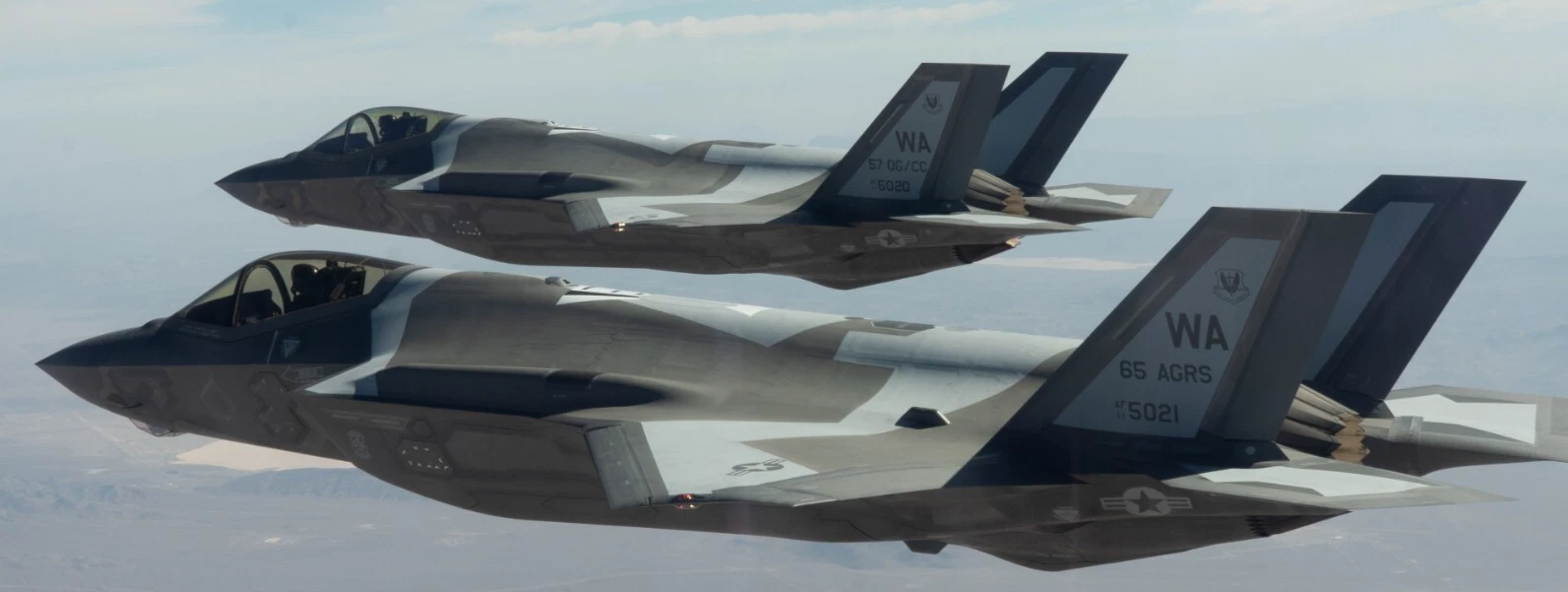
The F-35C Lightning II is the U.S. Navy’s first low-observable carrier-based aviation platform. The F-35 is being purchased to replace the F/A-18C/D Hornet as the carrier strike group’s primary offensive fighter for aerial defense and close air support. The U.S. Navy and Marine Corps' carrier variant has larger wings and more robust landing gear than the other variants, making it suitable for catapult launches and fly-in arrestments aboard naval aircraft carriers. Its wingtips fold to allow for more room on the deck on the carriers while deployed. The CV has the greatest internal fuel capacity of the F-35 variants, and, like the F-35B, the C-variant uses probe and drogue refueling. Following an intense four-year competition, the U.S. Department of Defense on 26 October 2001, named the Lockheed Martin lead Joint Strike Fighter (JSF) team as the winner of the contract to develop the F-35 JSF. The F-35C is the first and world’s only long-range stealth strike fighter designed and built explicitly for Navy carrier operations. It’s configuration, embedded sensors, internal fuel and weapons capacity, aligned edges, and state of the art manufacturing processes all contribute to the F-35’s unique Very Low Observable stealth performance. This enables pilots to evade enemy detection and operate in anti-access and contested environments, improving lethality and survivability. The Active Electronically Scanned Arrays (AESA) radar, Distributed Aperture System (DAS), Electro Optical Targeting System (EOTS) and Helmet Mounted Display System allow the pilot to see everything in the battlespace with unprecedented situational awareness. The F-35 can operate as an intelligence, surveillance and reconnaissance asset and battle manager, sharing information to all networked ground, sea and air assets in the battlespace. This ensures men and women in uniform can execute their mission and come home safe. The F-35C carries nearly 20,000 lbs of internal fuel and has a range of greater than 1,200 nm. The enables F-35C pilots to fly further and remain in a desired battlespace longer before refueling is necessary. The design of the F-35C’s wings and landing gear make it suitable for catapult launches and fly-in arrestments aboard naval aircraft carriers. Its wingtips also fold to allow for more room on the carrier’s deck while deployed. The F-35C can reach speeds of 1.6 Mach (~1,200 mph) even with a full internal weapons load. With its fuel and internal weapons load, the F-35C can fly faster with no drag associated with external tanks and weapons required for legacy fighters. The F-35C can carry more than 5,000 lbs of internal weapons, or more than 18,000 lbs of combined internal and external weapons. This allows the Navy to operate in stealth when necessary, or increase lethality with additional weapons externally when the air space is permissive. Naval Air Station Lemoore is home to the Navy’s Joint Strike Fighter Wing. The U.S. Marine Corps is also acquiring F-35C aircraft along with their F-35BSs. Lockheed Martin leads the F-35 industry team with Northrop Grumman, BAE Systems and Pratt & Whitney. The program is managed by the Department of Defense’s F-35 Joint Program Office. More than 1,900 suppliers build and sustain the F-35 program in 48 U.S. states and in more than 10 countries. An Aggressor Squadron or adversary squadron (in the US Navy and USMC) is a squadron that is trained to act as an opposing force in military wargames. Aggressor squadrons use enemy tactics, techniques, and procedures to give a realistic simulation of air combat (as opposed to training against one's own forces). Since it is impractical to use actual enemy aircraft and equipment, surrogate aircraft are used to emulate potential adversaries. The first formal use of dissimilar aircraft for training was in 1969 by the United States Navy Fighter Weapons School (better known as "Topgun"), which used the A-4 Skyhawk to simulate the performance of the MiG-17. The success of formalized dissimilar air combat training (DACT) led to transition of Navy Instrument Training Squadrons equipped with the A-4 into Adversary Squadrons at each master jet base. The United States Air Force followed suit with their first aggressor squadrons at Nellis AFB equipped with the readily available T-38 Talon.Aggressor squadrons in the US armed forces include the USAF 18th Aggressor Squadron at Eielson AFB, the 64th, the 65th Aggressor Squadrons at Nellis AFB, the US Marine Corps' VMFT-401 at MCAS Yuma and the US Navy's VFC-12 at NAS Oceana, VFC-13 at NAS Fallon, VFC-111 at NAS Key West and VFC-204 at Naval Air Station Joint Reserve Base New Orleans, as well as the famous "TOPGUN" Naval Fighter Weapons School (US Navy) which is not a squadron per se, but operates F-16A, F/A-18A/B, and F/A-18E/F aircraft as part of the Naval Strike and Air Warfare Center (NSAWC) at NAS Fallon. With the exception of the NSAWC aircraft, all the US Navy and US Marine Corps adversary squadrons are Reserve Component units and aircraft belonging to the Navy Reserve and the Marine Corps Reserve. The 65th Aggressor Squadron is a United States Air Force unit currently operating the F-35A Lightning II. It is assigned to the 57th Operations Group at Nellis Air Force Base, Nevada. The squadron was reactivated in September 2005, flying F-15Cs and F-15Ds as the 65th Aggressor Squadron with 24 aircraft assigned. The aircraft were painted in camouflage schemes identical to those observed on Russian-manufactured Sukhoi Su-27 fighters and operated in conjunction with the 64th Aggressor Squadron, which performs a similar task using F-16 Fighting Falcons. The 65th annually participated in the USAF Red Flag and Canadian Forces Maple Flag exercises, provided USAF Weapons School syllabus support, priority test mission support, and "road shows" that visited various units throughout the US to support Air Combat Command (ACC) and ACC-gained Air Force Reserve Command and Air National Guard units for training. On 30 July 2008, one pilot was killed and another injured when their F-15 crashed into the ground during a training mission. The Air Force inactivated the unit on 26 September 2014 due to Fiscal Year 2015 budget constraints imposed upon the Air Force that zero-lined the squadron's budget.[4][5] Its fleet was maintained by Flanker Aircraft Maintenance Unit, a section of the 757th Aircraft Maintenance Squadron. On 9 May 2019 US Air Force announced it planned to reactivate the 65th Aggressor Squadron with new aircraft, F-35A Lightning II. The squadron was formally reactivated on 9 June 2022. Nellis Air Force Base planned to further upgrade its fleet with more F-35s and F-22s to replicate adversaries' capabilities, specifically the Chinese fifth-generation fighters. The USAF also operated Aggressor squadrons in the UK and in the Philippines. The 527 AS was a USAFE unit that first operated out of the former RAF Alconbury near Cambridge, England, then later from the former RAF Bentwaters near Ipswich. The 527th initially flew F-5s, then later switched to F-16s. They trained over the North Sea and in Germany, Spain and Italy. The PACAF counterpart, the 26th Training Aggressor Squadron, operated F-5s out of the former Clark Air Base near Angeles City, Philippines. General Characteristics
You will receive the item as shown in the first photo. Other items in other pictures are for your reference only, available in my eBay Store. They will make a great addition to your SSI Shoulder Sleeve Insignia collection. You find only US Made items here, with the same LIFETIME warranty. 20121401 **eBay REQUIRES ORDER BE SENT WITH TRACKING, PLEASE SELECT USPS GROUND ADVANTAGE w/TRACKING** 
 **eBay REQUIRES ORDER BE SENT WITH TRACKING, PLEASE SELECT USPS GROUND ADVANTAGE w/TRACKING** 
FREE 30-day No-Question return ALL US-MADE PATCHES HAVE LIFETIME WARRANTY We do not compete price with cheap import copies. Watch out for cheap import copies with cut-throat price; We beat cheap copies with Original design, US-Made Quality and customer services. Once a customer, a LIFETIME of services   |
