|
Greek Coin of
Seleukid Kingdom
Antiochos VII Sidetes
- King: 138-129 B.C.
Bronze 12mm (1.67 grams) Antioch on the Orontes mint
Reference: HGC 9, 1106 (R1); SC 2069
Ship's ram left.
ΒAΣIΛΕΩΣ ANTIOXOY, Pilei (caps of dioscuri)
surmounted by stars.
You are bidding on the exact item pictured,
provided with a Certificate of Authenticity and Lifetime Guarantee of
Authenticity.
Around the 8th century BC,
ramming began
to be employed as war galleys were equipped with heavy bronze
rams.
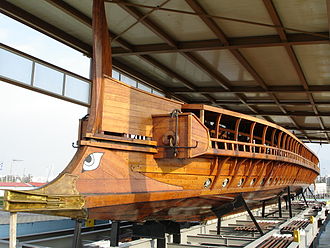 Records
of the
Persian Wars in the early 5th century BC by the Ancient historian
Herodotus
(c. 484-25 BC) show that by this time ramming tactics had evolved among the
Greeks. The formations adapted for ramming warfare could either be in columns in
line ahead, one ship following the next, or in a line abreast, with the ships
side by side, depending on the tactical situation and the surrounding geography.
The primary methods for attack was either to break through the enemy formation
or to outflank it. Ramming itself was done by smashing into the rear or side of
an enemy ship, punching a hole in the planking. This did not actually sink an
ancient galley unless it was heavily laden with cargo and stores. With a normal
load, it was buoyant enough to float even with a breached hull. Breaking the
enemy's oars was another way of rendering ships immobile, rendering them easier
targets. If ramming was not possible or successful, the on-board complement of
soldiers would attempt to board and capture the enemy vessel by securing it with
grappling irons, accompanied by missile fire with arrows or javelins. Trying to
set the enemy ship on fire by hurling incendiary missiles or by pouring the
content of fire pots attached to long handles is thought to have been used,
especially since smoke below decks would easily disable rowers. Rhodes was the
first naval power to employ this weapon, sometime in the 3rd century, and used
it to fight off head-on attacks or to frighten enemies into exposing their sides
for a ramming attack.
Records
of the
Persian Wars in the early 5th century BC by the Ancient historian
Herodotus
(c. 484-25 BC) show that by this time ramming tactics had evolved among the
Greeks. The formations adapted for ramming warfare could either be in columns in
line ahead, one ship following the next, or in a line abreast, with the ships
side by side, depending on the tactical situation and the surrounding geography.
The primary methods for attack was either to break through the enemy formation
or to outflank it. Ramming itself was done by smashing into the rear or side of
an enemy ship, punching a hole in the planking. This did not actually sink an
ancient galley unless it was heavily laden with cargo and stores. With a normal
load, it was buoyant enough to float even with a breached hull. Breaking the
enemy's oars was another way of rendering ships immobile, rendering them easier
targets. If ramming was not possible or successful, the on-board complement of
soldiers would attempt to board and capture the enemy vessel by securing it with
grappling irons, accompanied by missile fire with arrows or javelins. Trying to
set the enemy ship on fire by hurling incendiary missiles or by pouring the
content of fire pots attached to long handles is thought to have been used,
especially since smoke below decks would easily disable rowers. Rhodes was the
first naval power to employ this weapon, sometime in the 3rd century, and used
it to fight off head-on attacks or to frighten enemies into exposing their sides
for a ramming attack.
A successful ramming was difficult to achieve; just the right amount of speed
and precise maneuvering were required. Fleets that did not have well-drilled,
experienced oarsmen and skilled commanders relied more on boarding with superior
infantry (such as increasing the complement to 40 soldiers). Ramming attempts
were countered by keeping the bow towards the enemy until the enemy crew tired,
and then attempting to board as quickly as possible. A double-line formation
could be used to achieve a breakthrough by engaging the first line and then
rushing the rearguard in to take advantage of weak spots in the enemy's defense.
This required superiority in numbers, though, since a shorter front risked being
flanked or surrounded.
 The
pileus (Greek
πῖλος - pilos, also pilleus or pilleum in
Latin
) was a brimless,
felt cap worn in
Ancient Greece
[1]
and surrounding regions, later also introduced in
Ancient Rome
. The Greek πιλίδιον (pilidion)
and Latin pilleolus were smaller versions, similar to a skullcap.
The
pileus (Greek
πῖλος - pilos, also pilleus or pilleum in
Latin
) was a brimless,
felt cap worn in
Ancient Greece
[1]
and surrounding regions, later also introduced in
Ancient Rome
. The Greek πιλίδιον (pilidion)
and Latin pilleolus were smaller versions, similar to a skullcap.
The pileus was especially associated with the
manumission
of
slaves
. who wore it upon their liberation. It
became emblematic of
liberty
and freedom from bondage. During the
classic revival of the 18th and 19th centuries it was widely confused with the
Phrygian cap
which, in turn, appeared
frequently on
statuary
and
heraldic
devices as a "liberty cap."
Greece
The pilos (Greek: πῖλος, felt) was a common conical
travelling hat in
Ancient Greece
. The pilos is the brimless
version of the
petasos
. It could be made of felt or
leather. Their pilos cap identifies the
Dioscuri, Castor and Pollux
, in sculptures,
bas-reliefs and vase-paintings; their caps were already explained in Antiquity
as the remnants of the egg from which they hatched. The pilos appears on
votive figurines
of boys at the sanctuary of
the
kabeiri
at
Thebes
, the Kabeirion.
In warfare, the pilos type helmet was often worn by the
peltast
light infantry, in conjunction with the
exomis
, but it was also worn by the heavy
infantry.
The pilos helmet was made of bronze in the same shape as the pilos
which was presumably sometimes worn under the helmet for comfort, giving rise to
the helmet's conical shape. The first widespread adoption of the pilos helmet
occurred in Sparta towards the end of the 5th century BC.
Rome
 In
Ancient Rome, a slave was freed in a ceremony in which a
praetor
touched the slave with a rod called a
vindicta and pronounced him to be free. The slave's head was shaved and a
pileus was placed upon it. Both the vindicta and the cap were considered
symbols of Libertas
, the goddess representing liberty.
In
Ancient Rome, a slave was freed in a ceremony in which a
praetor
touched the slave with a rod called a
vindicta and pronounced him to be free. The slave's head was shaved and a
pileus was placed upon it. Both the vindicta and the cap were considered
symbols of Libertas
, the goddess representing liberty.
This was a form of extra-legal manumission (the manumissio minus justa)
considered less legally sound than manumission in a court of law.
One 19th century dictionary of classical antiquity states:
- Among the Romans the cap of felt was the emblem of liberty. When a slave
obtained his freedom he had his head shaved, and wore instead of his hair an
undyed pileus (πίλεον λευκόν,
Diodorus Siculus
Exc. Leg. 22 p. 625, ed.
Wess.; Plaut.
Amphit. I.1.306;
Persius
, V.82). Hence the phrase servos
ad pileum vocare is a summons to liberty, by which slaves were
frequently called upon to take up arms with a promise of liberty (Liv.
XXIV.32). The figure of Liberty on some of the coins of
Antoninus Pius
, struck A.D. 145, holds this
cap in the right hand.
 Gemini
is one of the
constellations
of the
zodiac
. It was one of the 48 constellations
described by the 2nd century AD astronomer
Ptolemy
and it remains one of the 88 modern
constellations today. Its name is
Latin
for "twins,"
and it is associated with the twins
Castor and Pollux
in
Greek mythology
. Its symbol is
Gemini
is one of the
constellations
of the
zodiac
. It was one of the 48 constellations
described by the 2nd century AD astronomer
Ptolemy
and it remains one of the 88 modern
constellations today. Its name is
Latin
for "twins,"
and it is associated with the twins
Castor and Pollux
in
Greek mythology
. Its symbol is
 (Unicode ♊).
In
Greek
and
Roman mythology
,
Pollux and Castor or Polydeuces were twin brothers, together known as the
Dioskouri. Their mother was
Leda
, but Castor was the mortal son of
Tyndareus
, the king of Sparta, and Pollux the
divine son of Zeus
, who seduced Leda in the guise of a swan.
Though accounts of their birth are varied, they are sometimes said to have been
born from an egg, along with their twin sisters
Helen of Troy
and
Clytemnestra
.
In Latin the twins are also known as the Gemini or Castores.
When Castor was killed, Pollux asked Zeus to let him share his own immortality
with his twin to keep them together, and they were transformed into the
constellation
Gemini
. The pair were regarded as the patrons
of sailors, to whom they appeared as
St. Elmo's fire
, and were also associated with
horsemanship.
They are sometimes called the Tyndaridae or Tyndarids, later
seen as a reference to their father and stepfather
Tyndareus
.
Demetrius III (d. 88 BC), called Eucaerus ("well-timed"
possibly a misunderstanding of the derogative name Akairos, "the untimely
one") and Philopator, was a ruler of the
Seleucid kingdom
, the son of
Antiochus VIII Grypus
.
By the assistance of
Ptolemy IX Lathyros
, king of Egypt, he recovered part of his father's
Syrian
dominions
ca 95 BC, and held his court at
Damascus
,
from where he tried to enlarge his dominions. To the south he defeated the
Maccabean
king
Alexander Jannaeus
in battle, but the hostility of the
Jewish population
forced him to withdraw. While attempting to dethrone his brother,
Philip I Philadelphus
, he was defeated by the
Arabs
and Parthians
, and taken prisoner. He was kept in confinement in Parthia by
Mithridates II
until his death in 88.
|
Demetrius III Eucaerus
Seleucid dynasty
Born:
Unknown
Died:
88 BC |
Preceded by
Seleucus VI Epiphanes
|
Seleucid King
95 BC
with
Antiochus X Eusebes
Antiochus XI Epiphanes
Philip I Philadelphus
|
Succeeded by
Philip I Philadelphus
or
Antiochus XII Dionysus
|
Seleucid
Empire
Σελεύκεια
Seleúkeia |

|
312 BC–63 BC |
↓
|
|
|
The Seleucid Empire in 301 BC.
|
The Seleucid Empire
was a
Hellenistic
state ruled by the Seleucid dynasty
founded by
Seleucus I Nicator
following the division of
the empire created by
Alexander the Great
. Seleucus received
Babylonia
and, from there, expanded his
dominions to include much of Alexander's
near eastern
territories. At the height of its
power, it included central
Anatolia
, the
Levant
,
Mesopotamia
,
Kuwait
,
Persia
,
Afghanistan
,
Turkmenistan
, and northwest parts of
India
.
The Seleucid Empire was a major center of
Hellenistic
culture that maintained the
preeminence of
Greek
customs where a Greek-Macedonian
political elite dominated, mostly in the urban areas. The Greek population of
the cities who formed the dominant elite were reinforced by emigration from
Greece
. Seleucid expansion into
Anatolia
and Greece was abruptly halted after
decisive defeats
at the hands of the
Roman army
. Their attempts to defeat their old
enemy
Ptolemaic Egypt
were frustrated by Roman
demands. Much of the eastern part of the empire was conquered by the
Parthians
under
Mithridates I of Parthia
in the mid-2nd century
BC, yet the Seleucid kings continued to rule a
rump state
from
Syria
until the invasion by
Armenian
king
Tigranes the Great
and their ultimate overthrow
by the Roman
general
Pompey
.
|


