
This beautiful purse is a unique and one-of-a-kind piece crafted by skilled artisans in Peru. The intricate embellishments and etchings on the gourd make it a stunning accessory to add to your collection. The purse features a sturdy strap for easy carrying and is perfect for holding your essentials while adding a touch of cultural flair to any outfit. Its handmade quality ensures that each piece is unique and adds a special touch to your wardrobe.
Small
Measures 4-1/4" high x 3-3/4" wide x 2-1/2" deep.
Will vary slightly due to being a natural product
Inside Measures 3" x 3"
Large
- Measures 6" high x 5-1/2" wide x 4" deep.
***may vary slightly due to being a natural product***
Inside Measures 4" Deep x 5" Wide
These Purses can carry the following items:
ID / Debit Cards / etc...
Loose Cash
Keys
Small Personal items
Change Pouch
In the Large Purse Older Style Cell Phones WILL FIT (Touch screen smart phones and overall larger flat style phones do NOT fit)
Handmade in Peru and fair trade imported.
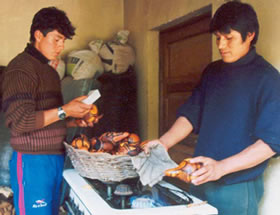
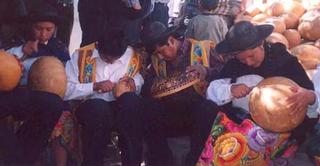
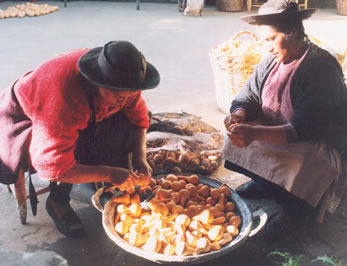
Artesanias Peru - Esperanza and Raquel Artisan Story
Peru
 Cochas
Chico and Coches Grande, twin farming villages nestled in the Andean
mountains of Huancayo Peru, are home to a rich tradition of gourd
carving. It's also home to Esperanza Palomino and Raquel Sabastian
Rojas, two women who have established small fair-trade businesses to
help create new jobs for the artisans in their village. Besides creating
new jobs for artisans aged ten to sixty, both women manage work
distribution from the main office to give priority to the families with
the greatest need.
Cochas
Chico and Coches Grande, twin farming villages nestled in the Andean
mountains of Huancayo Peru, are home to a rich tradition of gourd
carving. It's also home to Esperanza Palomino and Raquel Sabastian
Rojas, two women who have established small fair-trade businesses to
help create new jobs for the artisans in their village. Besides creating
new jobs for artisans aged ten to sixty, both women manage work
distribution from the main office to give priority to the families with
the greatest need.
Esperanza carves her gourds wearing the colorful and traditional Huanca skirts, and its quite common to find her carving surrounded by her husband, sons, brothers, nephews and brothers-in-law. "My biggest dream is that all will have work and that all the families will have a better future," she says.
Raquel's workshop also creates work for about fifteen families and manages orders from the main office. Like Esperanza's workshop, Raquel's artisans share the work so that parents, children and grandparents collaborate together on large orders. "This craft we inherited from our ancestors, grand parents, and parents to the present," Raquel tells us. "Each generation improves the art and it continues to grow with future generations."
"If we have fun in our work, it will teach us to know more of our culture," Esperanza adds. "Through the created drawings we are inspired to do many things. The tradition of gourd carving helps to shape the culture and customs of the town."
The Process of Gourd Carving
After the gourds are harvested, the
artisan removes the outer green skin with a dull knife to expose the
lighter brown color underneath. This will become his/her canvas. The
gourds are cleaned and dried in the hot Peruvian sun.
After drying, the artisan draws his/her initial design in pencil, then uses a carving tool to remove small pieces of gourd, creating a 3-dimensional version of the original design. Next, the artisan burns the pattern with a glowing ember, usually a feather-shaped piece of Quinual wood that's been heated over a fire, to establish contrast between the carvings and the gourd. The artisan can vary the intensity of the heat by blowing on the ember; the harder the artist blows, the darker the burn.
Having obtained the color, the artisan washes the gourd to remove the pencil marks and polishes the finished piece with a natural wax. Sometimes, the artisan applies an oil/charcoal mixture to the gourd's carved surface. The dye adheres any part of the gourd where the outer skin has been removed, yet wipes clean from the gourd's smooth surfaces. This is why some carved gourds have a black background.