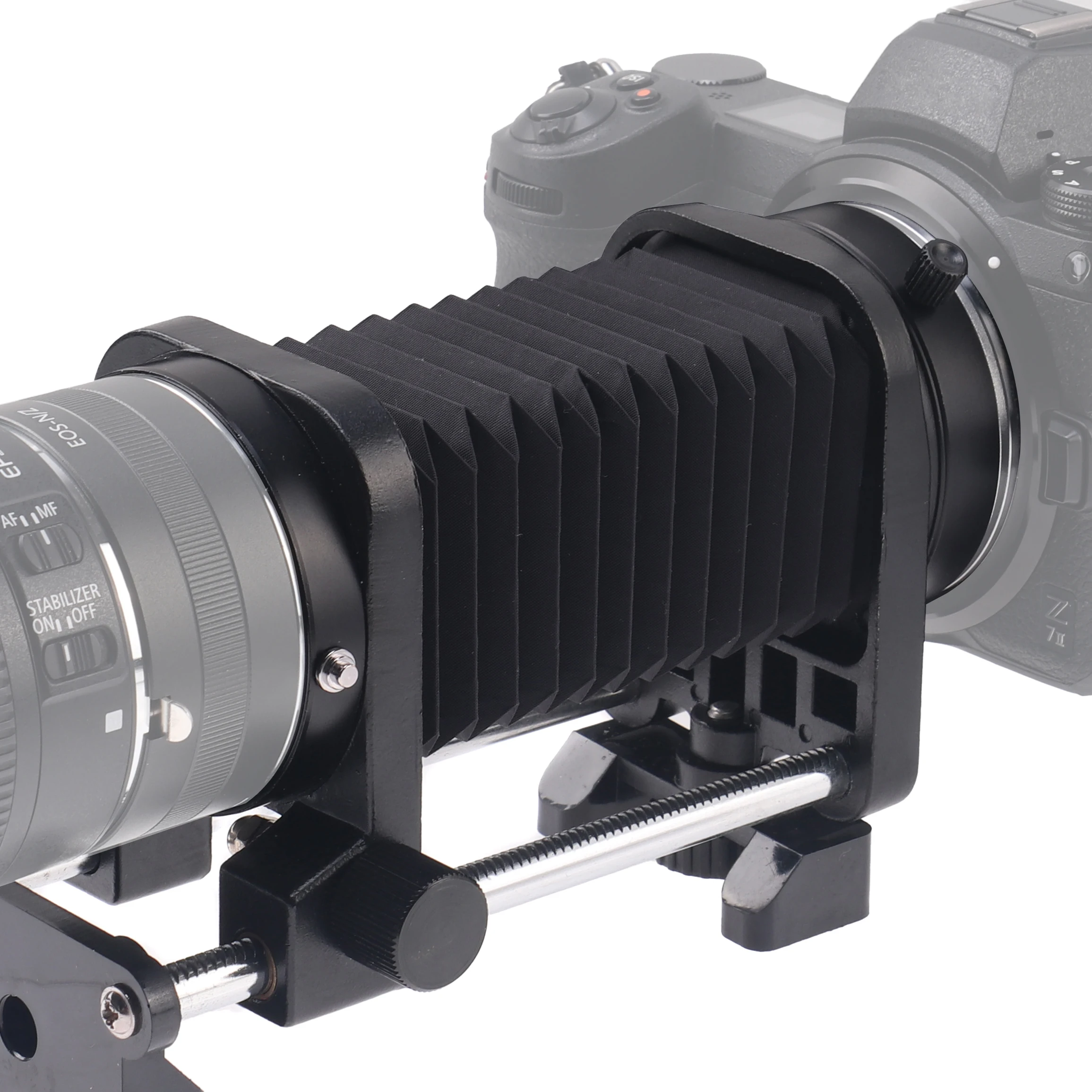
Description:
for Nikon Zf Z5 Z6 Z7 Z50 Z6II Z7II Z Mount Cam
Product specifications:
Telescopic size (mm): 37~144
Focusing method: built-in ruler on the moving track
Other features: remake stand jack, 1/4" tripod hole
Volume (mm) : WxHxL 100 x 106 x 160
Weight (g) : about 450
3. There are many kinds of close-up adapters for sale on the market. The original ones are not much and are more expensive, but there are many sub-plants, and the price is relatively low. Now the most common ones are the Kenko brand. The machining of these close-up adapters Accuracy is good.
Common close-up adapters are sold in sets, generally a set of 3 sections, with different lengths, which can be selected according to the magnification you need.
The close-up ring can be divided into two categories: with/without the aperture lever connection, the former can be linked with the aperture, and the latter cannot. Generally, the close-up ring with the aperture lever is also equipped with corresponding electrical contacts according to the different bayonet mounts to ensure that the TTL internal metering can work.
For different lenses, how long do you need to use the skin cavity/connector to achieve the magnification you need? From the previous description, the magnification can be calculated as:
Magnification = [Cavity/Cover Length] / Lens Focal Length
In theory, any lens can be used for macro photography using the close-up skin cavity/close-up adapter. But see, with a 400mm focal length lens, if you need to achieve 1:1 magnification, then the length of the skin cavity/mounting ring needs to be 400mm long! Obviously this combination is unrealistic.
In addition, if the length of the ring in hand is 50mm, if a 50mm standard lens is connected, the magnification ratio will reach 1:1; if a 24mm lens is connected, the magnification ratio will exceed 2:1.
Connection method: Take off the lens, connect the close-up skin cavity/close-up ring to the body, and then screw the lens to the bayonet on the skin cavity/connection ring.
The characteristics of this method are:
1. The aperture is divided into linked and non-linked, which works for some models of light metering; if the original leather cavity is used, the aperture can be linked, but the price is too high;
2. For AF body and AF lens, when the magnification is relatively high, due to insufficient light input, even if there is an AF transmission mechanism, AF is often slow and ineffective;
3. When focusing, if the magnification is determined, move the body to roughly adjust the focus, and adjust the focus ring to fine-tune; when focusing, the aperture should be fully opened, and the aperture should be manually closed when shooting;
4. The magnification can be adjusted, up to 1:1 or more; it can be adjusted within a certain range;
5. There is obvious field curvature when the aperture is large, and the effect of shrinking the aperture is not obvious.
6. If there is no metering, exposure compensation should be added, and the compensation coefficient is calculated by (1+M)2;
7. The image quality is only related to the lens.