Includes Two Plastic Syringes For Controlled Dispensing
It is an excellent resin system for dome coating pictures, printed emblems and logos, stickers and other images.
Upon cure, MAX CLR A/B creates a hard coating over the applied image that is very clear and glossy.
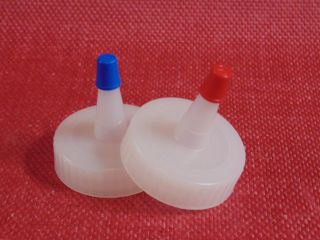
This Kit Includes A Set Of Yorker Caps For Controlled Dispensing
Available Kit Sizes
MAX CLR LOW VISCOSITY 24 OUNCE KIT https://www.ebay.com/itm/311955541111
MAX CLR LOW VISCOSITY 48 OUNCE KIT https://www.ebay.com/itm/311947320101
MAX CLR LOW VISCOSITY 96 OUNCE KIT https://www.ebay.com/itm/222625329068
MAX CLR LOW VISCOSITY 1.5 GALLON KIT https://www.ebay.com/itm/312432570345
USE AND APPLICATION
Mix the resin and curing agent to a uniform consistency.
View the mixing video demonstration video below
The substrate must be prepared for the intended purpose of the application.
Remove any contaminants that may prevent adhesion of the MAX CLR resin system.
Mixing Instructions

Best Epoxy Resin Mixing Method -Avoid Tacky Spots \u0026 Less Air Bubble -Improve Cured Epoxy Performance
Video will open in a new window
Using the eBay App? Paste link into a browser window:
Surface
Preparation Before Mixing The Resin And Curing Agent
Resin retraction due is caused by
improper surface wetting, also called 'Crawling', yields poor applied
appearance and cured adhesion. The quality of adhesion depends on how well the
surface is prepared. The resin system must be able to properly 'wet out' the
surface to form a continuous film.
Surfaces demonstrating poor wettability prevent the liquid resin from spreading
into a stable continuous film. Retraction or crawling is caused by a mismatch
of surface tension between the coating and the substrate to which the coating
is applied. Upon cure, it delaminates and peels from the
surface since the applied coating did not wet the surface enough to create a
strong adhesion.
A general statement is that wetting becomes more critical when the substrate's surface energy is low and/or when the liquid paint's surface tension is high.
A substrate with low surface energy is called hydrophobic, implying that its surface cannot interact with the applied coating or adhesive. Unmodified plastics, for example, have low surface energy or LSE, causing the applied resin to retract. Poor substrate wetting yields poor adhesion, causing the cured resin to peel or delaminate.
Use This Water Bead Test To Determine
If The Substrate
Is Suitable For The Mixed Resin Application
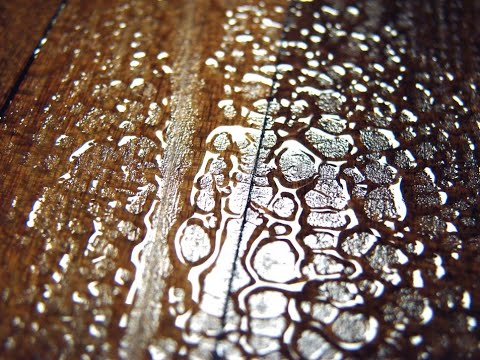
Avoid Coating Retraction Or Crawling \u0026 Improve Bond. Test \u0026 Prepare Surfaces Before Applying Epoxy.
Video will open in a new window
Using the eBay App? Paste link into a browser window:
Surface Preparation Procedure For Various Substrates
Etch Concrete- Use
commercially sold concrete etching solution (hydrochloric acid based works
best). Neutralized per instructions, rinse and allow to dry thoroughly.
Sodium Dichromate | 4 Parts By Weight |
Sulfuric Acid | 10 Parts By Weight |
Water | 30 Parts By Weight |
The solution is held at 160°F (71°C), and the parts left immersed for 5 to 7 minutes. Rinse – remove metal parts from etching bath and rinse with clean water; distilled water is recommended.
ALTERNATE
PROCEDURE
Degrease, scour and dry – Often etching as outlined above is not practical. The
metal surfaces may be cleaned by degreasing as noted above, scouring
with an alkaline cleanser followed by rinsing and drying.
Degrease and dry –
Degrease the surface as noted above, sand or sandblast the surface lightly but
thoroughly. Rinse with acetone or Methyl Ethyl Ketone (MEK), and dry.
GLASS
Degrease – With MEK as above, or with a good grade household
detergent. Avoid touching the cleaned glass surface with bare hand after cleaning.
WOOD
Sand –Surfaces should be sanded thoroughly to remove all external
contamination.
Clean – Carefully remove all dust, or particles of wood from sanded areas. A
stiff and clean brush or compressed air can be used.
PLASTIC
Clean – Remove all dirt, oil, or other surfaces contaminated with detergent
soap or degreasing solvent and water, followed by thorough rinsing and drying.
A solvent that does not have a detrimental effect may also be used.
Sand – Surfaces to be bonded should be sanded lightly.
Clean – Carefully remove all dust or particles of plastic from the sanded area.
A clean brush, lint-free cloth, or compressed air may be used.

Epoxy Dome Coating Application On Decals, Stickers, And Printed Images. MAX CLR A/B
Video will open in a new window
Using the eBay App? Paste link into a browser window:
Other MAX CLR Applications Wood Coatings
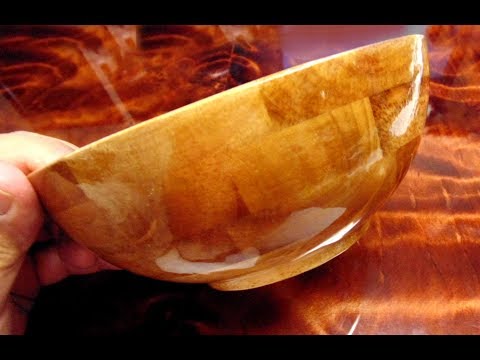
Wood Lathe Turned Bowl Watch Video
Video will open in a new window
Using the eBay App? Paste link into a browser window:
Physical Properties
|
Density |
1.10 G/CC |
|
Foam and Color |
Clear Liquid |
|
Mixed Viscosity |
800 – 1,200 cPs @
25ºC Mixed |
|
Mix Ratio |
2:1 By Weight Or Volume |
|
Working Time |
45–50 Minutes @ 25ºC
(100 gram mass) |
|
Peak Exotherm |
70ºC (100 gram
mass) |
|
Handle Time |
5.5 Hours |
|
Full Cure Time |
36 Hrs. Minimum @
25ºC |
Cured Mechanical Properties
|
Hardness |
72 ± 5 Shore D
@25°C |
|
Tee-Peel Strength |
5.7 Lbs. Per Inch
Width @25°C |
|
Tensile Shear
Strength |
1,300 psi @ 25ºC |
|
|
800 psi @ -80ºC |
|
|
550 psi @ 100ºC |
|
Elongation |
9.0% @ 25ºC |
|
Compressive
Strength |
2,100 to 2,500 psi
@25°C |
|
Heat Distortion
Temp. |
80ºC |
Electrical And Thermal Conductivity
|
Volume Resistivity |
4.7 X 10¹³ Ohms-Cm |
|
Dielectric Strength |
510 Volts/Mil 60 Cycles |
|
Dielectric Constant |
4.0 (10 kHz) |
|
Dissipation Factor |
0.014 (10 kHz) |
|
Thermal Conductivity 40°-45°C |
0.25 W/mK |
Chemical Resistance Properties
Specimen Cure - 7 days @ 25ºC plus 1 hours at 100ºC
Full Immersion at 22°C
Specimen Size - 1 Cubic Inch
Percent Change In Weight After Immersion
|
REAGENT |
3 days |
28 days |
|
Deionized Water |
0.01% |
0.01% |
|
Sea Water |
0.01% |
0.98% |
|
Toluene |
0.40% |
2.86% |
|
Ethanol 50% (100 Proof) |
0.04% |
0.04% |
|
Xylene |
0.14% |
1.25% |
|
Acetone |
0.30% |
0.31% |
|
MEK |
2.7% |
2.7% |
|
10% Lactic Acid |
0.11% |
0.42% |
|
10% Acetic Acid |
0.11% |
0.45% |
|
70% Sulfuric Acid |
0.08% |
0.14% |
|
50% Sodium Hydroxide |
0.1% |
0.1% |
|
30% Sodium Hypochlorite |
0.51% |
1.36% |
Cured Performance Tests
Impact testing is one of the most revealing test methods that demonstrate a material's ability to resist and withstand a high-rate of pressure loading, its behavior during and after the impact can define its maximum mechanical property and conditional limits upon its destruction.
Why is Impact Testing Important?
The impact resistance of an object provides the ultimate measure of its resistance to its definitive destruction. Governed by the many laws and dynamics of physics, a skilled chemist or materials engineer can determine the design equilibrium and ultimate performance by careful analysis of the material’s disassociation and the manner of its destruction.
With this knowledge, other aspects of mechanical performance can be accurately derived and through skillful engineering, one can determine:
- The impact energies the part can be expected to see in its lifetime
- The type of impact that will deliver that energy, and then
- A material that will resist such assaults over the projected lifespan.
Casting, Shape Sanding, Polishing
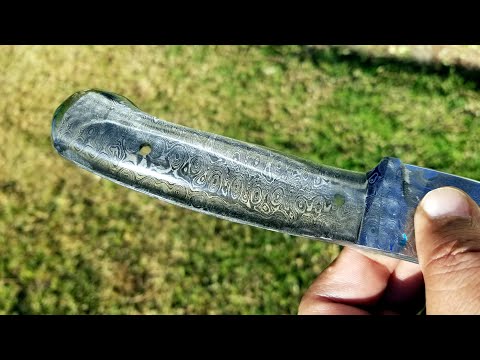
Transparent Clear Knife Scale. High Impact Resistant, Epoxy Knife Handle Casting With MAX CLR A/B
Video will open in a new window
Using the eBay App? Paste link into a browser window:
Adding Color To The MAX CLR A/B Epoxy Resin
MAX COLOR PIGMENT PASTE KIT
5 Colors In One Convenient Kit
Black - White - Red - Yellow - Blue
2 Ounces Per Color Concentrate
 High Color Pigment Concentration
Precision Milled For Uniform Color Dispersion
Specially Formulated For Epoxy Resin Compatibility
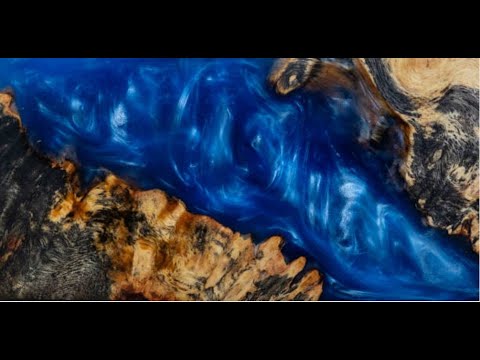
Complies With FDA Mandates For Food Contact ApplicationsSpecial effects pigments such as glitter, pearlescent powder pigment, color refracting pigments can also be added to create a multitude of color effects. 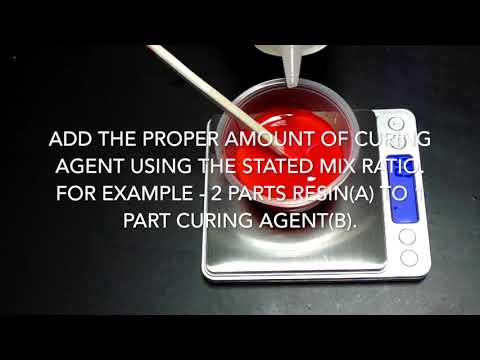
Color pigment addition to an epoxy resin system with a scale - YouTube
Video will open in a new window
Using the eBay App? Paste link into a browser window:
Pearlescent Silver Mica Powder
https://www.ebay.com/itm/311948312839

Pearlescent Gold Mica Powder https://www.ebay.com/itm/222646250679 
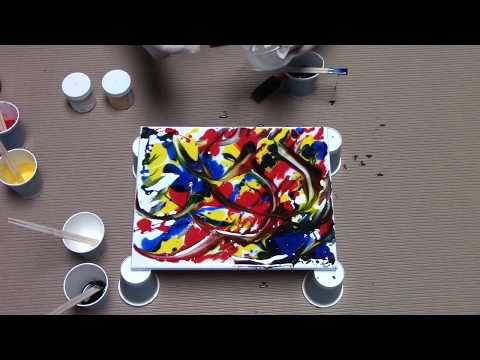
MAX EPOXY RESIN ART ON GLASS


MAX EPOXY RESIN ART ON CANVAS

Click To View Video Demonstration
EPOXY FIBERGLASS CARBON FIBER HAND LAY-UP TECHNIQUE MAX CLR-HP A/B
Video will open in a new window
Using the eBay App? Paste link into a browser window:
PLEASE CHECK OUT OTHER AVAILABLE RESIN SYSTEMS AT OUR eBay STORE For our complete listing, please Visit our eBay store!
IMPORTANT NOTICE
Your purchase constitutes the acceptance of this disclaimer. Please review before purchasing this product.
The user should thoroughly test any proposed use of this product and independently conclude the satisfactory performance in the application. Likewise, if the manner in which this product is used requires government approval or clearance, the user must obtain said approval.
The information contained herein is based on data believed to be accurate at the time of publication. Data and parameters cited have been obtained through published information, PolymerProducts and Polymer Composites Inc. laboratories using materials under controlled conditions. Data of this type should not be used for a specification for fabrication and design. It is the user's responsibility to determine this Composites fitness for use.
There is no warranty of merchantability for fitness of use, nor any other express implied warranty. The user's exclusive remedy and the manufacturer's liability are limited to refund of the purchase price or replacement of the product within the agreed warranty period. PolymerProducts and its direct representative will not be liable for incidental or consequential damages of any kind. Determination of the suitability of any kind of information or product for the use contemplated by the user, the manner of that use and whether there is any infringement of patents is the sole liability of the user.
Transparent Clear Knife Scale. High Impact Resistant, Epoxy Knife Handle Casting With MAX CLR A/B
Video will open in a new window
Using the eBay App? Paste link into a browser window:
Adding Color To The MAX CLR A/B Epoxy Resin
MAX COLOR PIGMENT PASTE KIT
5 Colors In One Convenient Kit
Black - White - Red - Yellow - Blue
2 Ounces Per Color Concentrate
Precision Milled For Uniform Color Dispersion
Specially Formulated For Epoxy Resin Compatibility
Complies With FDA Mandates For Food Contact Applications
Color pigment addition to an epoxy resin system with a scale - YouTube
Video will open in a new window
Using the eBay App? Paste link into a browser window:
Pearlescent Silver Mica Powder
https://www.ebay.com/itm/311948312839
MAX EPOXY RESIN ART ON GLASS
MAX EPOXY RESIN ART ON CANVAS
Click To View Video Demonstration
EPOXY FIBERGLASS CARBON FIBER HAND LAY-UP TECHNIQUE MAX CLR-HP A/B
Video will open in a new window
Using the eBay App? Paste link into a browser window:
IMPORTANT NOTICE
Your purchase constitutes the acceptance of this disclaimer. Please review before purchasing this product.
The user should thoroughly test any proposed use of this product and independently conclude the satisfactory performance in the application. Likewise, if the manner in which this product is used requires government approval or clearance, the user must obtain said approval.
The information contained herein is based on data believed to be accurate at the time of publication. Data and parameters cited have been obtained through published information, PolymerProducts and Polymer Composites Inc. laboratories using materials under controlled conditions. Data of this type should not be used for a specification for fabrication and design. It is the user's responsibility to determine this Composites fitness for use.
There is no warranty of merchantability for fitness of use, nor any other express implied warranty. The user's exclusive remedy and the manufacturer's liability are limited to refund of the purchase price or replacement of the product within the agreed warranty period. PolymerProducts and its direct representative will not be liable for incidental or consequential damages of any kind. Determination of the suitability of any kind of information or product for the use contemplated by the user, the manner of that use and whether there is any infringement of patents is the sole liability of the user.