HIGHLY DETAILED OO9 SCALE MODEL KIT
Talyllyn Railway Carriages 19 and 20 - Double Pack
This is a detailed scale model kit for adult collectors. Not for children under 14 years old.
This model kit is of carriages 19 and 20, as running on the Talyllyn Railway in the early 2020s. These were amongst the first bogie coaches to work on the preserved railway, built in 1968/9. Carriage 19 is in much the same form as it was built, with two first class compartments in the centre of the carriage, and third compartments at each end. Carriage 20 was originally built as a full third, but was rebuilt in the mid-90s to include a access/observation saloon at the east (Abergynolwyn) end. Following Talyllyn Railway tradition, the vehicles only have passenger doors and a footboard on one side, and the model represents them post installation of air brakes.
The kit includes three main components - the body side assembly, internal detail and frame, and roof. Custom Talyllyn Railway bogies are also supplied, with PECO Hardlon wheels. Clear perspex is provided with the model to use as glazing. You will need modelling tools (such as a craft knife, cutting board, files and micro-drills) adhesive and paints to assemble the kit.
Due to the length of these buffered vehicles, these kits come with the choice of two couplings to fit:
- Custom black-printed narrow hook and look coupling, which is compatible with NEM pockets. These allow the carriages to negotiate 12" radius curves. These are printed couplings, and the hoops are delicate, so we recommend only one end be fitted with the hoop for best performance.
- Fixed Close Couplings (similar to those in our Ffestiniog 'Barn' series) are also included, for permanent fixed coupling of multiple vehicles.
The carriages can traverse sharper curves than 12", but some modification may be required. For example, at 9" radius, the inside of the buffers will need removing to prevent them fouling the couplings. Further work may be required to allow the bogies to pivot sufficiently.
This is a highly detailed scale kit built using our in house machines, with High Definition resin and build layers just 50 microns (0.05mm) thick. Whilst there is 'stepping' visible on the parts up close, this is not discernible once the kit is painted and/or from usual viewing distances. The parts have their main supports removed, though detailing and structural supports will remain to protect the parts in transit, and require removing prior to assembly. Some polishing and filing of the parts is required to ensure they fit together without a seam.
The carriage includes representation of the interior, including luggage racks, detailed panels and first class upholstery. Brake pipes and electrical connectors are also present at the correct ends and sides of the vehicles, and the underside includes detailed representation of the brake cylinders, linkages, air reservoir and triple valve. Handles and grab rails are fully detailed, and not moulded to the body.
The pack contains both coaches, and the required bogies.
Fourdees Limited is not liable for any breakages of parts during assembly of the kit. If parts arrive damaged, please provide photographic evidence and we shall replace the damaged component. If you require spares or accessories, please contact us for a quote for replacements.
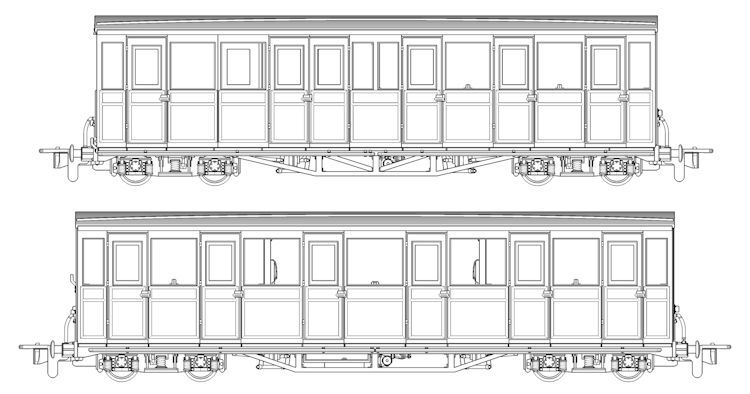
Length over buffers: 132mm and 124mm (19 and 20 respectively)
Length over bodies: 121mm and 113mm (19 and 20 respectively)
Length over couplings: 139mm and 131mm (19 and 20 respectively)
Width: 25mm
Height: 35mm
Prototype Manufacture: Raymond Tisdale and Co.
Prototype Railway: Talyllyn Railway
Prototype Gauge: 2' 3"
The model comes packaged in a collector's box.