HR GIGER

TASCHEN XXL EDITION
New for 2024 - JUST RELEASED
If you are looking for the Baby Sumo Edition they are now out of print. I do have an EXTREMELY RARE copy of an Artists Proof available which can be found
HERE!
“At its essence, Giger’s art digs down into our psyches and touches our very deepest primal instincts and fears. His art stands in a category of its own. The proof of this lies in the intensity of his work and imagination, which I can only compare to Hieronymus Bosch and Francis Bacon in their powers to provoke and disturb.”
—Ridley Scott
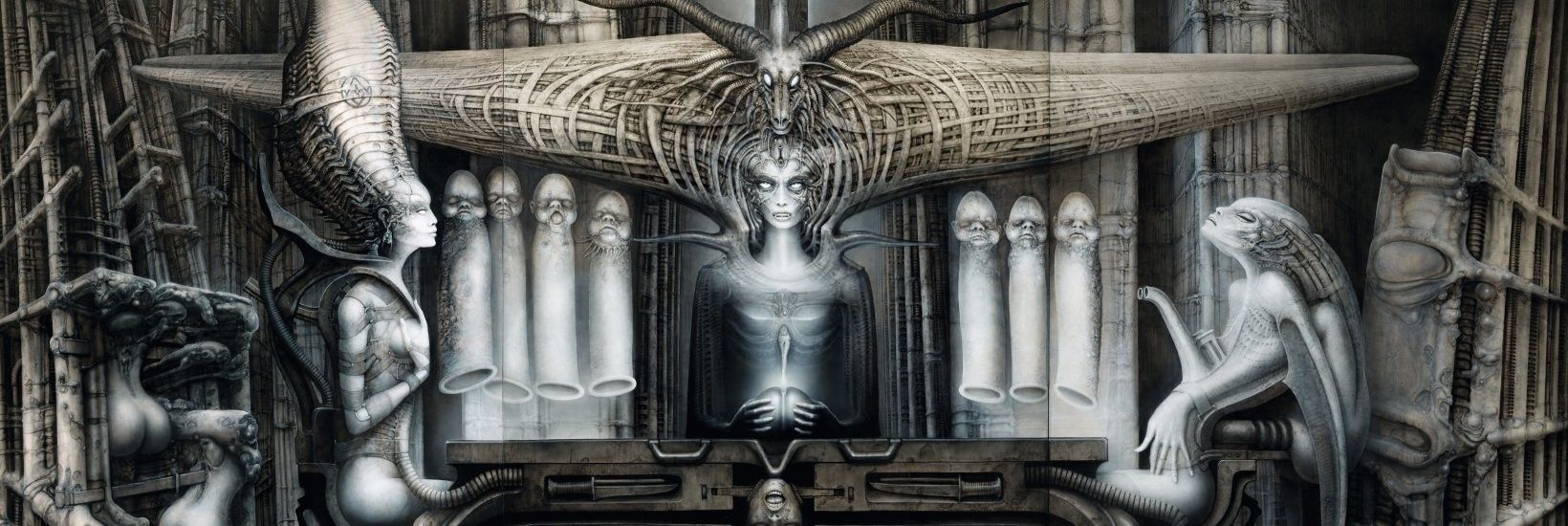
NOTE: The above picture as a double fold out is actually in the Baby Sumo edition - the picture IS included as a two page spread.
New for 2024 - JUST RELEASED
If you are looking for the Baby Sumo Edition they are now out of print. I do have an EXTREMELY RARE copy of an Artists Proof available which can be found HERE!
“At its essence, Giger’s art digs down into our psyches and touches our very deepest primal instincts and fears. His art stands in a category of its own. The proof of this lies in the intensity of his work and imagination, which I can only compare to Hieronymus Bosch and Francis Bacon in their powers to provoke and disturb.”
—Ridley Scott
NOTE: The above picture as a double fold out is actually in the Baby Sumo edition - the picture IS included as a two page spread.

- “H.R. Giger was the Hieronymus Bosch of modern times. A giant in every sense of the word.” - Rolling Stone
“A disturbingly beautiful tribute to H.R. Giger’s nightmarish work.” - Wired
The biomechanical art of HR Giger
Swiss artist HR Giger (1940–2014) is most famous for his creation of the space monster in Ridley Scott’s 1979 horror sci-fi film Alien, which earned him an Oscar. In retrospect, this was just one of the most popular expressions of Giger’s biomechanical arsenal of creatures, which consistently merged hybrids of human and machine into images of haunting power and dark psychedelia.

The visions drew on demons of the past, as well as evoking mythologies for the future. Above all, they gave expression to the collective fears and fantasies of his age: fear of the atom, of pollution and wasted resources, and of a future in which our bodies depend on machines for survival.

This book was begun shortly before the artist’s untimely death and shows the complete story of Giger’s life and art, his sculptures, film work, and iconic album covers as well as the heritage he left us in his own artist’s museum and self-designed bar in the Swiss Alps.


“Since choosing to pursue art, it has been like an LSD trip—with no return. I feel like a tightrope walker and no longer differentiate between work and leisure. I suddenly realize that ‘making art’ is a vital activity for me to keep from going insane.” —HR Giger, 1987
In an in-depth essay, Giger scholar Andreas J. Hirsch plunges into the themes of Giger’s oeuvre and world while an extensive artist biography draws on contemporary quotes and Giger’s own writings.

 The following text is from "Alien and beyond - The opus magnum of HR Giger" by Andreas J. Hirsch. Pictures are from the book...
- "In the spring of 1978, having just turned 38 years old, HR Giger jotted these lines in his diary: 'May 18, 1978. Work on the film is in full swing. The construction of the spaceship is almost finished. It looks good. Small models of the landscape and the entrance area of the spacecraft were made. The people who built these have no clue about my architecture. I said that they should get bones and build a model with plasticine . . . '
At that time, HR Giger was already a successful painter whose bleak visions in a style that he termed biomechanics were widely distributed: in the form of popular poster editions that appeared in the late 1960s; in the large-format illustrated book Necronomicon, which he designed himself; and on album covers such as Emerson, Lake & Palmer’s 1973 release Brain Salad Surgery. 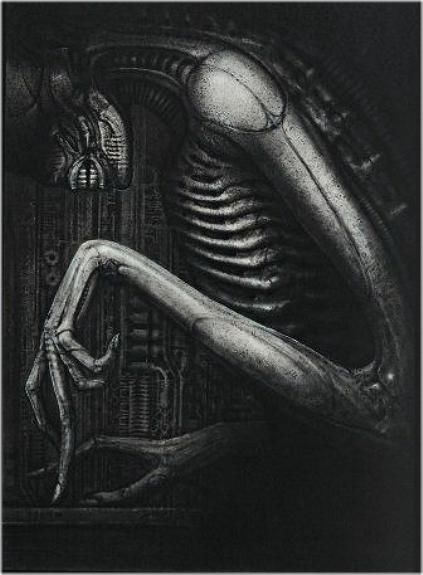 But the project he was now working on would make him both a worldwide cult figure and an Oscar winner. Director Ridley Scott had hired Giger to create the monster in the movie Alien. So the artist went to the Shepperton Film Studios near London to realize his designs for the world of the alien with his own hand.
One painting had immediately convinced Scott to get Giger involved in shaping the alien creature: Necronom IV (1976). It shows in profile the upper body of a being with only remotely humanoid traits. Its skull is extremely elongated, and its face is almost exclusively reduced to bared teeth and huge insect-like eyes. Hoses extend from its neck and its back is dominated by tubular extensions and reptilian tails. The male sexual organ is significantly extended and curved upwards over the head. It opens out into a transparent bulge in which a skeletonized being is visible like a little saint resting in a glass coffin. Only the powerful arms are still close to the human form, although wires and mechanical tracks are visible under their translucent skin and their material is less reminiscent of tissue than of the grain of medieval woodcarvings. The elegantly slender fingers contrast sharply with the creature’s merciless mien. Although there is no indication as to where the creature may be in space and time, it is still obvious that it cannot come from the world as we know it.

In order to turn this painted creature into a monster for a movie, the artist had to submit it to a complex transformation. Giger developed a complete “natural history” of the alien based on the screenplay, which ultimately produced the final monster of the film. The creature’s latent deadliness turns into a sort of applied lethality that it acts out through dynamic motion in the film.
 Between these two stages stood the creative and artistic process of designing and producing the necessary figures, which Giger did primarily by himself. The process results in a unique mixture of fascination and disgust. Giger’s monster represents a turning point in science fiction and horror movies, to which Alien brought a deadly lifeform from space that had never been seen before.
 The myriad traces that Giger’s work has left in so many different areas—painting and film, album covers and tattoo culture, as well as in the genres of science fiction and fantasy— make it like a Rosetta Stone combining several languages that still have to be decrypted. Seen in art-historical terms, we have an artist whose work, although inspired by Surrealism and Symbolism, was highly autonomous and ultimately difficult to classify and who already made a distinctive contribution to the Fantastic Art of the 20th century with his work before Alien. His biomechanical ideas are still developed independently in disciplines like media art and bio art, less as an aesthetic influence than as ideas influencing a conceptual approach.
Then there is the reading of Giger’s work focusing on mythology and psychology, which examines the role of individual and collective fears in his approach, which is not merely figurative and narrative, but can also be understood in a modern way as the creation of a mythology. A work that is so densely populated with archetypes and beings from a post-human future, which is well beyond accepted notions of reality and which is so rich in symbols, shapes, and themes from occult traditions, also calls for a reading that includes interpretations from the fields of alchemy, astrology, and magic. The diversity of the readings of these archetypal themes could easily fill a whole library—a “Bibliotheca gigeriana”—on the draftsman, painter, sculptor, filmmaker, and designer HR Giger.
The Birth of Biomechanics
HR Giger was born in 1940 in the small town of Chur in the Swiss canton of Graubünden and reports from his childhood already hint at the themes that would determine his later life: in the flat of his parents’ house, where his father also had a pharmacy on the ground floor, he built a ghost train. His target group was mainly girls, in whom little Hansruedi showed an early interest. While the others were at church on Sunday mornings, he headed for the basement of the local museum to look at the mummy of an Egyptian princess on display there and stood beside her in a mixture of horror and fascination. When a pharmaceutical company gave his father a human skull, the son took it for himself and pulled it behind him through the streets of Chur on a string. As a student in the second half of the 1950s, Giger did drawings with macabre topics and set up the so-called Black Room in his parental home— his first place for his own art and that of others, for performance and music.
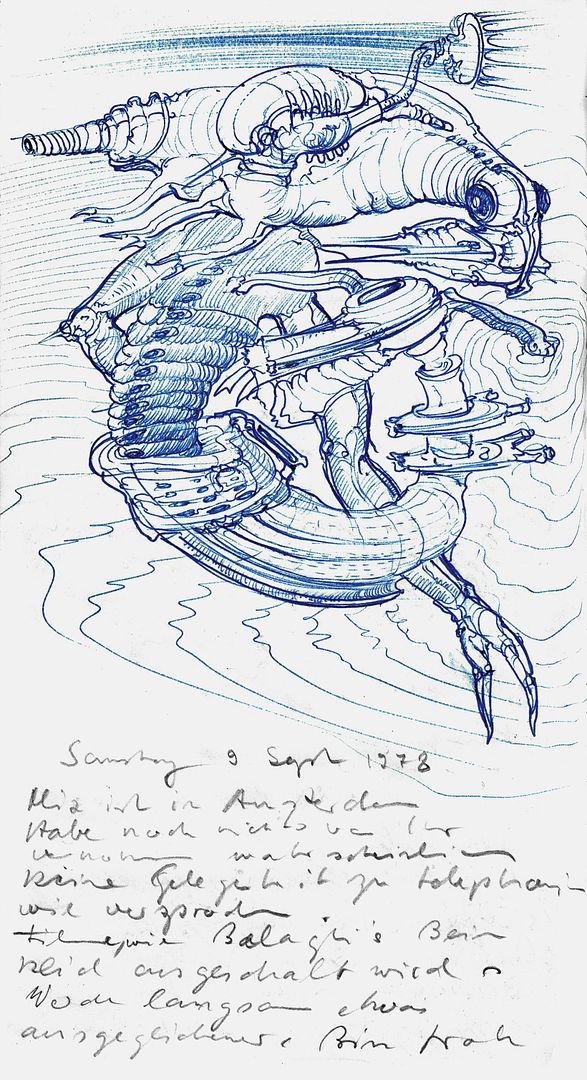 At the beginning of the 1960s, Giger published his ink drawings in Swiss underground magazines. In 1962, he entered the School of Applied Arts in Zürich. During his time there he created a group of tachistic paintings as well as pictures of huge empty stairwells. Giger’s early work deals very directly with the collective fears of the time. The world had just narrowly avoided a nuclear war over the stationing of Soviet nuclear weapons on Cuba, and in neutral Switzerland, which was working on its own nuclear weapons program, the very real possibility of a nuclear apocalypse was omnipresent. In several of his works, Giger designed a post-apocalyptic scenario showing the situation after a nuclear war. Other hotly debated issues such as the threat of global overpopulation and the advancing mechanization and automation of many aspects of life also found their way into his work. Atomkinder (Atomic Children, 1967–68) shows three posthuman figures in a stylized artificial landscape. The entire upper half of the picture is filled with an atomic “sun,” in front of which two one-legged beings loom. Giger is putting mutation, a long-term consequence of nuclear radiation at the genetic level, at the heart of the image. The two figures almost look like Siamese twins, but they are separate beings who touch each other only at a point of their backs because they need each other to walk upright. They no longer have arms, but masks and tubes leading away from them have become integral parts of their bodies. The tubes lead into the bases of their spines, which are open as if the figures were already on the autopsy table. Atomkinder, 1967–68, India ink on Transcop on paper on wood, 170 x 108 cm (67 x 42.5 in.).
 Little flesh encases their skeletons, and antenna-like projections stick out from their skulls. A third entity, barely a torso with feet, is sitting on the ground, a hose leading from his back to an opening in the floor. The big nuclear sun has numerous protuberances radiating in all directions. One of them runs into a tube such as the protagonists have. This tube is either disappearing into the ground or possibly into a fourth creature that we can only discern rudimentarily. The two nuclear children that dominate the picture are looking in different directions. There is no sign of panic or postapocalyptic despair— the nuclear children are clearly way beyond such emotions. The surface of the earth, if this is what it is about, has been abstracted into pure geometry: there is no longer any landscape that we might find familiar. This is where HR Giger developed what he would later call his “biomechanical style”: a fusion of biological and mechanical components and man and machine on both a factual and a metaphorical level. This visionary anticipation of the later phenomena of cyberculture, in particular the figure of the cyborg, goes way beyond the idea of using technology to compensate for the deficits of the human race. The artist has created a new form of existence, which has no utopian features but is rather portrayed with dystopian grimness.
At the same time, however, Giger himself has described biomechanics as a “harmonious fusion of technology, mechanics, and the living creature.” Because of the oppressive and threatening scenes, this element of harmony may strike an odd note, but it is created by the peaceful dozing that distinguishes his characters. Their apparent calm and balanced state alludes to an underlying concept of beauty that shares nothing with the premodern aesthetics of fantastic art, but is quite at home in a mechanistic and war-hardened modern age. Giger has repeatedly stressed that it would be wrong to see only the terrible things in his paintings because they contain just as much of the elegance that has always been important to him. Whatever their specific forms


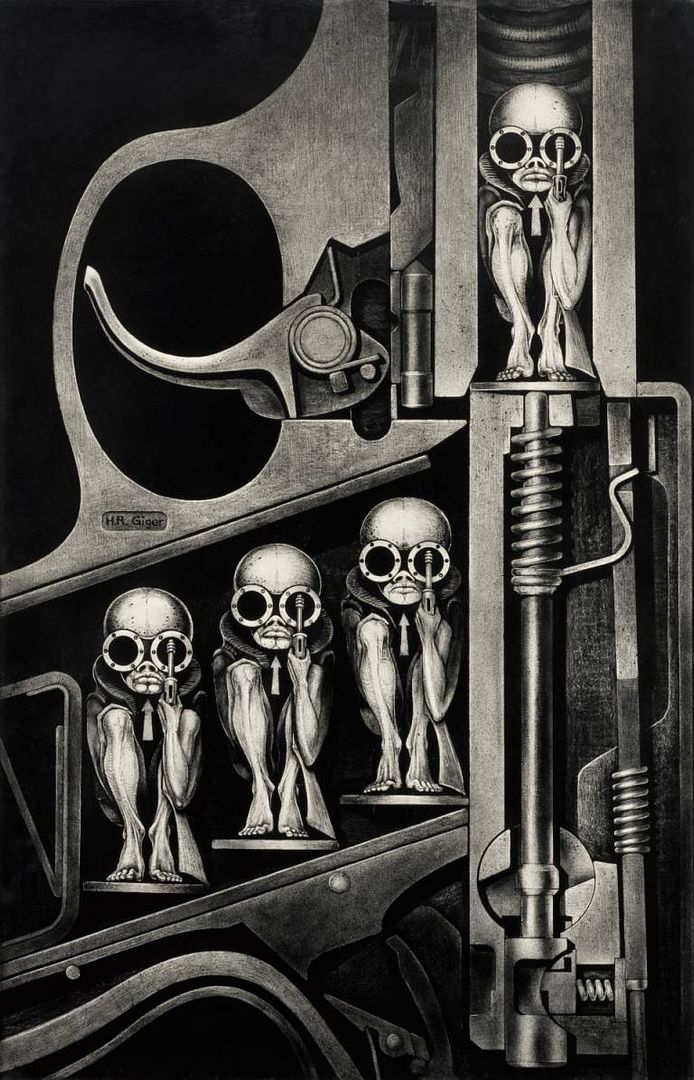
 In addition to sexual liberation and the Vietnam War, the 1960s also saw a collective theme in the specter of overpopulation, and this formed another strand in Giger’s work. The artist confronted the fear that Earth would soon no longer be able to support all of human life from the perspective of individual birth trauma. This is particularly evident in the motif of the Gebärmaschine (Birth Machine). Executed in the style of a sectional drawing, the best known version of this topic from 1967 presents a tool for killing— more specifically: a Walther P38 pistol— as an instrument of birth. The babies waiting expectantly in the gun’s chamber and magazine for their launch into an inhospitable world are already equipped with helmets, goggles, and weapons. The painting shows four such figures huddled into a cartridge form in great detail. The figures are totally without individuality, and their seriality is combined with a sense of fatalism.
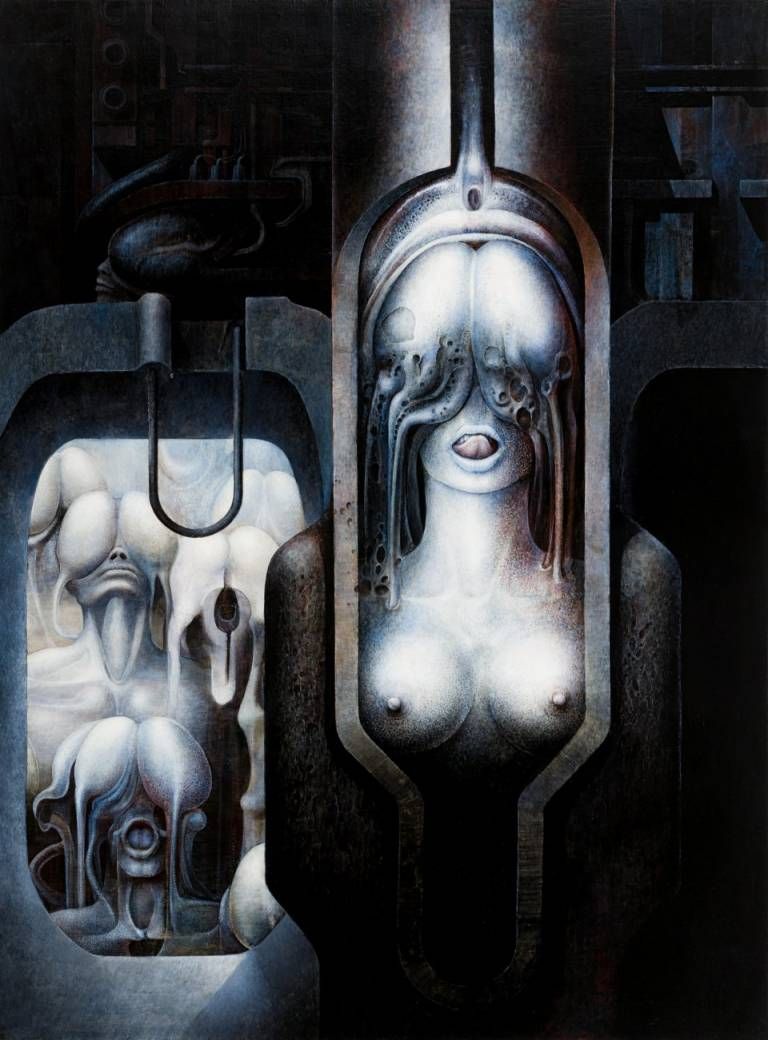
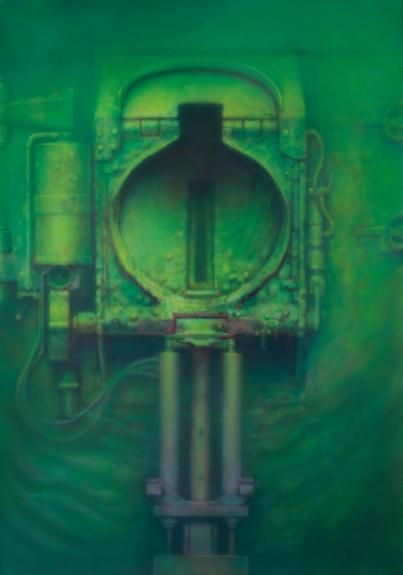
In 1971, the city of Cologne’s garbage collection service unexpectedly gave Giger the basis for the imagery of a complete series of paintings, titled Passagen (1971–73). The opening at the back of the garbage trucks where the bins were hooked up before being emptied into the interior of the truck reminded Giger of the female womb—especially in its evocation of the “mechanicalerotic act”—like a grammar of a complex mix of birth trauma, magical attraction, and fear of female sexuality. The strictly serially composed images were taken from a spontaneous photo of this “objet trouvé” the artist had taken, which he now varied by using many layers of color, building up the surfaces, and superimposing various symbolic and sometimes scenic layers and motifs.
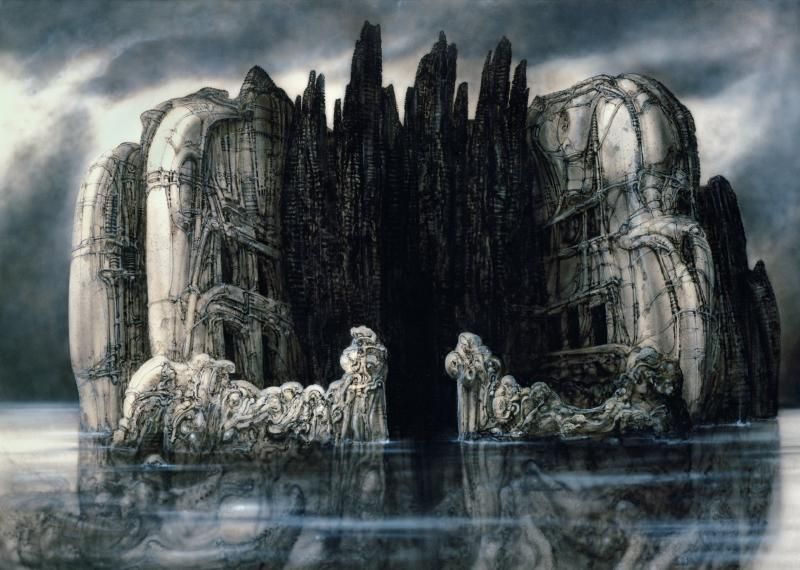 Giger was not to let go of the Passagen theme: he created the Passagen-Tempel (1974–75), four large paintings that together form a walkable environment. The temple is entered and left again through an opening in the form of an Egyptian sarcophagus in the first painting. This panel, which the visitor can only really see when leaving the temple, takes up the train as a motif: a carriage in the form of a sarcophagus moves through a biomechanical landscape representing growth and decay. The panel on the left, entitled Leben (Life), presents an erotic-biomechanical tableau permeated by the presence of violence, where sickly children jostle through an opening zipper and pile themselves up into the form of a giant phallus. On the right, Tod (Death) refers back to the main subject of the previous Passagen series—the opening of the garbage truck. It is flanked by body snatchers, who recall the shapes of the cypresses common in Italian cemeteries as also found in Arnold Böcklin’s painting Island of the Dead. The central panel of Giger’s temple, opposite the entrance, shows Weg des Magiers (The Way of the Magician): seven steps up to a throne bathed in light and flanked by biomechanical virgins. In a kind of synthesis of mutually corresponding images of life and death, the perfection of man is symbolized here as his elevation to the level of a god.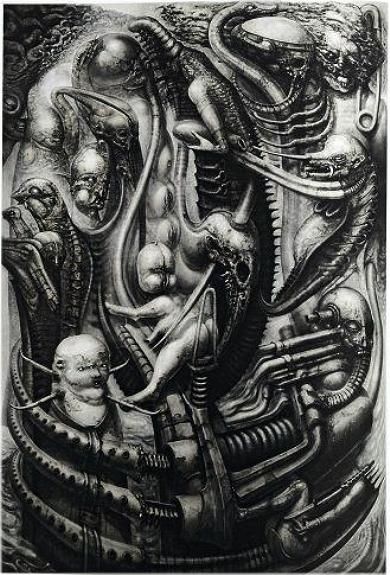
 Magical Narratives Passagen and the landscapes of our own unconscious were not the only sources that nurtured Giger’s imagery. The creation of his paintings was accompanied by an intensive reading of works of fantastic literature. Stories by authors such as Edgar Allan Poe, Gustav Meyrink, and Alfred Kubin had fascinated the artist since his youth. The writer H. P. Lovecraft, whoseNecronomicon provided the inspiration and title for Giger’s aforementioned Necronom series, had an especially complex effect on Giger. Lovecraft’s Necronomicon is a fictional book supposedly written by the Muslim poet Abdul Alhazred after ten years of solitude in the in southern Arabian desert. It is full of blasphemies by an author who has become alienated from the traditions of Islam. No one ever lay eyes on the book, though, because when Abdul Alhazred has finished writing it, invisible monsters punish him for his sacrilege and devour him in broad daylight in the central square of Damascus. Giger was not just influenced by Lovecraft’s narrative and the imaginative potential of his stories, but also by his exploration of the power of words and the magic of names— names that often may not be uttered without provoking a disaster. Something fascinated Giger in the sound of a name, which comes across to the viewers of his literary-semantically inspired works.
Giger also turned to books of hermetic literature and he studied Aleister Crowley and French author Éliphas Lévi, a 19th-century pioneer of the occult. Black magic symbols increasingly appeared in Giger’s paintings from the 1970s onward, e.g., in the cycle The Spell (1973–77), which centers around Baphomet as the Antichrist.
 The character was invented only in the 19th century, an androgynous cross of man and goat, horned and sporting the pentagram on its forehead. For Lévi, the figure is a symbol of the elevation of the spirit over matter, whereas Crowley sees it as symbolizing the union of opposites and it also occupies the position of the devil in his work.
  The texts Giger was reading and the images he was painting ultimately impart secret knowledge reserved only for the initiated. The opaqueness of hermetic texts and occult pictorial schemes represent a way of thinking that has challenged enlightened rationalist modernity since the Renaissance. Yet Giger himself was not an alchemist. Where alchemical symbols appear in his works, their meaning alludes to the symbolic and philosophical layer in which alchemy can be understood as a program for the development of man and a forerunner of psychoanalysis. In his art, he followed the same step that C. G. Jung had taken with his break from Sigmund Freud in his concepts of a “collective unconscious” and of “archetypes.” Jung had noticed that, “certain archetypal motifs that are common in alchemy appear in the dreams of modern individuals who have no knowledge of alchemical literature.” Giger’s art ultimately alludes to transpersonal ideas and images, from which it derives its mythical power."
Taschen's publishing history with HR Giger goes back to the mid-1980s and includes the limited editions Hologramm and wwwHRGIGERcom. Project work for this monograph dates back more than 10 years and included close curatorial and design collaboration with Hansruedi, as well as new photography of leading artworks held in private collections all over the globe. Due to his untimely death in 2014, Hansruedi was unable to witness the final printing and binding of his opus magnum, but it stands in his memory as testimony to his prolific output and extraordinary vision.


 XXL Hardcover in original box, 11.4 x 15.6 in., 13.11 lb unpacked, 506 pages
 Multilingual Edition: English, French, German.
For MORE TASCHEN books I have available, CLICK HERE! and I'll be happy to combine shipping for you!
- FOR MORE ILLUSTRATED and ART books I have listed (which is usually a lot!) CLICK HERE or go to the ADVANCED SEARCH in eBay and copy and paste the word yobinitziyobolo into the eBay search box, and then check the SEARCH TITLE AND DESCRIPTIONS box.
 AND JUST IN CASE you need a way to display this, Taschen also makes a VERY nice bookstand (which I also sell) shown right). You can find it HERE!. It is strong enough to display this or any large format book. USE THE ADD TO CART option and when you check out, you'll save money by paying for them both at the same time and combine the shipping!
 - FOR MORE ILLUSTRATED and ART books I have listed (which is usually a lot!) CLICK HERE or go to the ADVANCED SEARCH in eBay and copy and paste the word yobinitziyobolo into the eBay search box, and then check the SEARCH TITLE AND DESCRIPTIONS box.
- I accept Credit Cards, eChecks and electronic transfers with
 .
. - Unfortunately, direct bank transfers are not offered due to cost and security concerns.
- As I reside in the USA, all payments must be made in US Dollars & Cents.
SHIPPING ADDRESSES: IMPORTANT!! I can ONLY SHIP to the address as noted in PAYPAL'S "TRANSACTION DETAILS". If you want it shipped to an alternate location, you will need to register that address BEFORE paying or it will be shipped to the registered address.
SHIPPING COSTS: Shipping costs will be determined by weight & destination! You may click on the SHIPPING & PAYMENT tab found at the top of the page, just under the item's picture for all shipping options to all destinations both domestic and international. There you will find drop down boxes for your location and you can then use the shipping calculator to determine the correct cost for where you live.
REALLY, REALLY IMPORTANT INFO ABOUT SHIPPING TIMES: Media Mail (once known as 4th class mail) is a special class of postage for books, music, videos and other printed media available within the US and territories. It is far less expensive than Priority Mail, but - it ..... is ........... slooowwwww!!!! Despite USPS claims of 3-9 day delivery times, MEDIA MAIL CAN actually TAKE UP TO 3 WEEKS to arrive, and their tracking info is frequently not updated until it actually arrives, making that feature pretty useless! PLEASE remember this when you leave feedback scores as the choice is yours and not my fault if it takes a long time to get there! If you want it in a week or less, you are going to have to bite the bullet and pay for Priority Mail which will get it there in 2-3 working days, 99% of the time, but it is more expensive. Basically, the choice is yours, but if you choose media mail, please don't write to me in 5 days asking where your package is, because the post office will have it and most of the time, they don't have a clue!
- International deliveries usually arrive within 1-2 weeks but CAN take up to a month! Faster shipping is available on request, but expensive.
- Import duties, taxes and charges are not included in the item price or shipping charges. These charges are the buyer's responsibility. You can check with your country's customs office to determine what these additional costs will be prior to bidding/buying.
- Finally, we do not mark merchandise values below value or mark items as "gifts"; it is illegal and immoral.
Questions? Ask and I'll try to answer...
Please check out the other "lovely" items I have just waiting for you by
For any of the other hundreds of items I have available use the link at the bottom of the page. And if you have any requests, by all means, send me an email; if I have it, I'll list it right away for you (no off eBay sales...) About Me & This Item...
I am a private collector of art, books, music (10,000 records alone!) and "stuff" and am very picky about what I buy. I don't like surprises when I buy things from auctions any more than you do. I promise everything there is to know about this item is in this description. I also do not subscribe to "grading" as frankly, grading is totally inconsistent and most of the "graders" TRULY have no clue, so I will use plain English if it is OK with you... For over a decade, I have sold tens of thousands of items on eBay and have only received a handful of complaints about the accuracy in my descriptions. Having met eBay standards for excellence in trading, you may bid with confidence knowing you will get what you THINK you are bidding on! Please check my feedback. It is a record I am very proud of... I have LOTS of music items, and tons of books available for purchase. Please check my other offerings to see if there is anything else you might be interested in for combined shipping. There are links above and below and why not bookmark my site to make it easier to find at a later date!

PAYMENT TERMS: Pretty simple. Pay me, I send it, BUT ONLY TO A REGISTERED ADDRESS! Please do not ask to have it sent to an alternate location as I won't be able to comply per eBay policy. See below..
Why Are My Shipping & Handling Costs a Bit Higher than Other Sellers? Please Read on...
GUARANTEED DELIVERY OR YOUR MONEY BACK!
I really DO CARE about when and how your product gets to you. Because the post office is so incredibly inept, I ONLY SHIP domestic packages INSURED, which is AUTOMATICALLY INCLUDED in the shipping cost, and that is not free as the post office charges for it. If your parcel gets lost OR damaged in freight, your item will be replaced if one is available OR you will be completely refunded!
IMPORTANT MONEY SAVING TIP! If you are buying more than one of my items and would like to SAVE MONEY by COMBINING SHIPPING costs, I will be happy to do so, but eBay has now made it more difficult to get discounts by confusing people with "Buy it Now" and "Add to Cart" options on non-auction style pages. If you are buying one item from a seller use the Buy it Now. BUT IF YOU WANT COMBINED or FREE SHIPPING, DO NOT USE THE BUY IT NOW button! Instead, select ADD TO CART. Then use your BACK button on your browser and select the other items you want that qualify using ADD TO CART each time. When you are finished, look for the shopping cart icon at the top right corner of your eBay page and click on it. Find the blue button which reads COMMIT TO BUY & SEND REQUEST. Once done, the items will be held and I will create a single invoice with either combined or free shipping. NOTE: I cannot retroactively go back and combine items that are not purchased in this manner so PLEASE PAY ATTENTION.
Once you receive your invoice, payment is expected promptly! All of the payment info you need will be listed including multiple shipment options.
Since I am a legitimate business, California deliveries will require sales tax.
PAYMENT OPTIONS:
I really DO CARE about when and how your product gets to you. Because the post office is so incredibly inept, I ONLY SHIP domestic packages INSURED, which is AUTOMATICALLY INCLUDED in the shipping cost, and that is not free as the post office charges for it. If your parcel gets lost OR damaged in freight, your item will be replaced if one is available OR you will be completely refunded!
IMPORTANT MONEY SAVING TIP! If you are buying more than one of my items and would like to SAVE MONEY by COMBINING SHIPPING costs, I will be happy to do so, but eBay has now made it more difficult to get discounts by confusing people with "Buy it Now" and "Add to Cart" options on non-auction style pages. If you are buying one item from a seller use the Buy it Now. BUT IF YOU WANT COMBINED or FREE SHIPPING, DO NOT USE THE BUY IT NOW button! Instead, select ADD TO CART. Then use your BACK button on your browser and select the other items you want that qualify using ADD TO CART each time. When you are finished, look for the shopping cart icon at the top right corner of your eBay page and click on it. Find the blue button which reads COMMIT TO BUY & SEND REQUEST. Once done, the items will be held and I will create a single invoice with either combined or free shipping. NOTE: I cannot retroactively go back and combine items that are not purchased in this manner so PLEASE PAY ATTENTION.
Once you receive your invoice, payment is expected promptly! All of the payment info you need will be listed including multiple shipment options.
Since I am a legitimate business, California deliveries will require sales tax.
PAYMENT OPTIONS: