GABRIEL ARGY ROUSSEAU
VASE 'LION ET CHOUETTE'
'LION AND OWL'
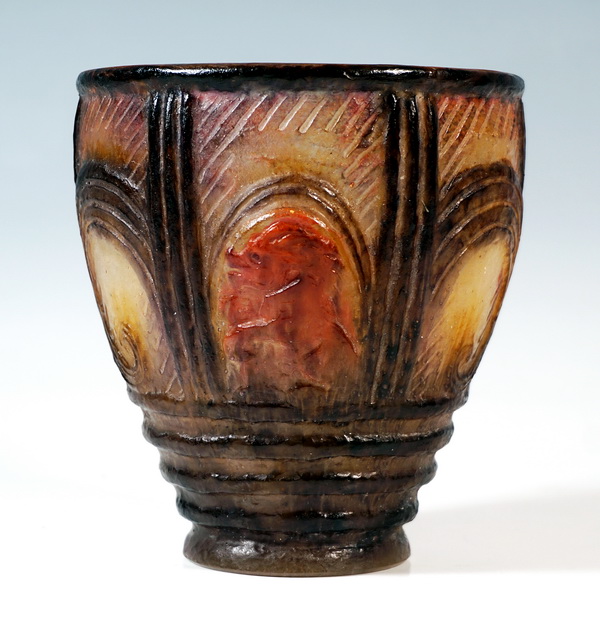
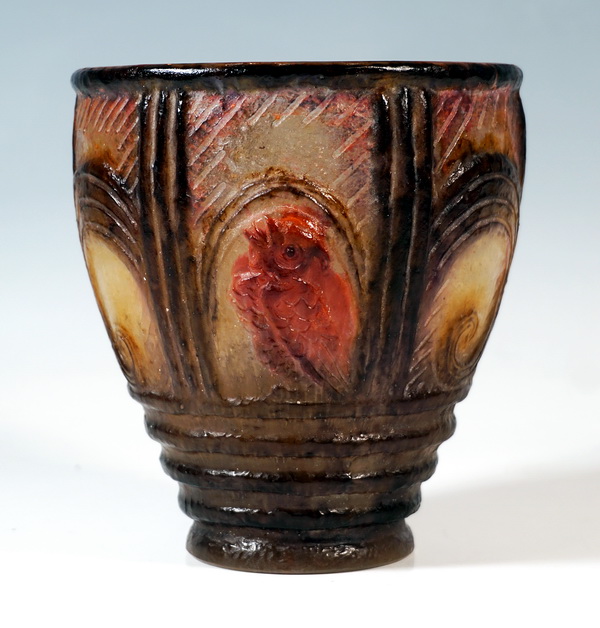
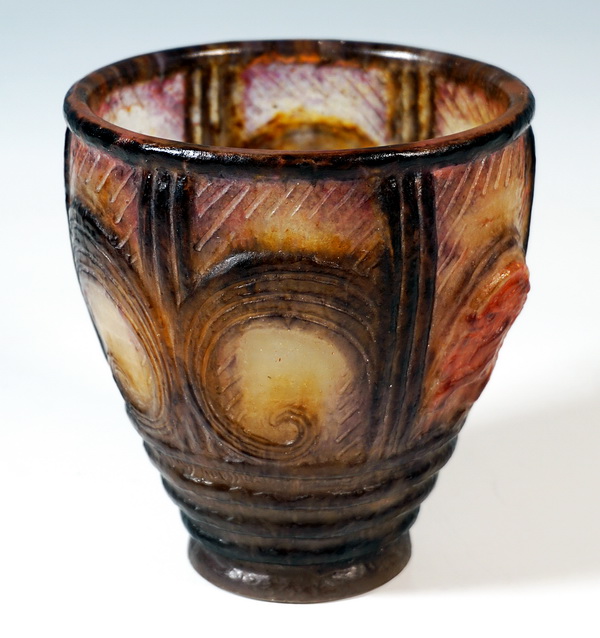
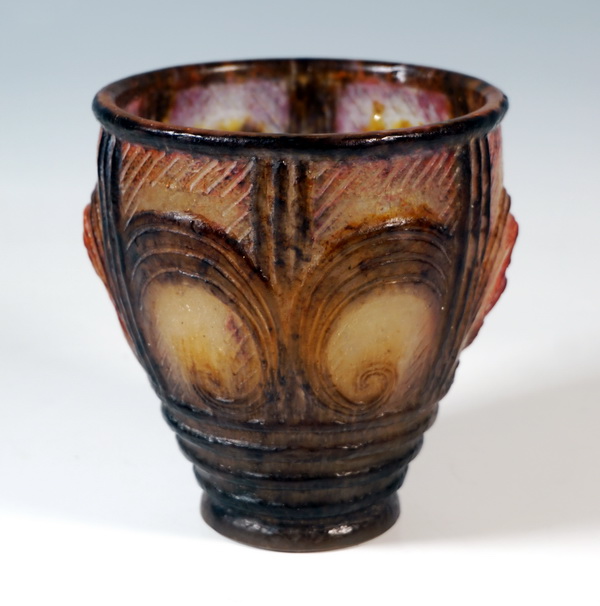
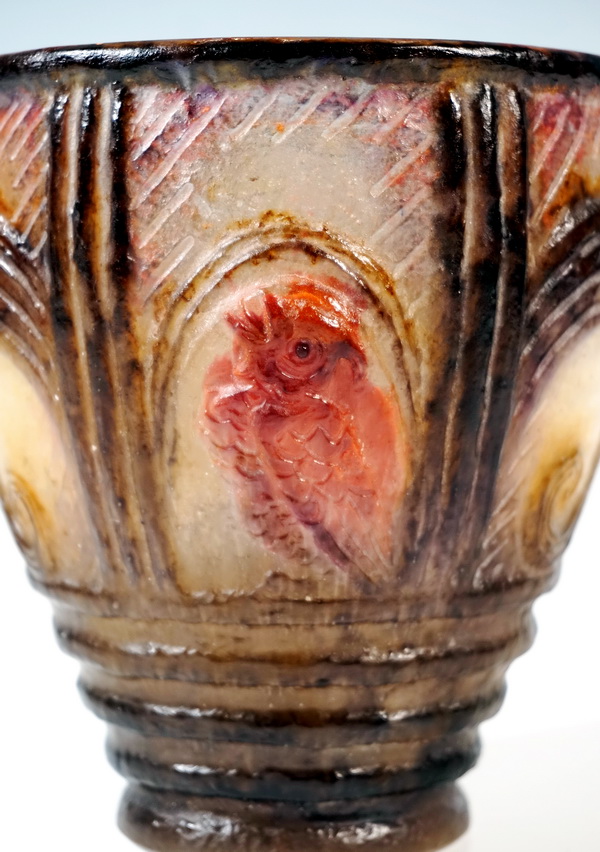
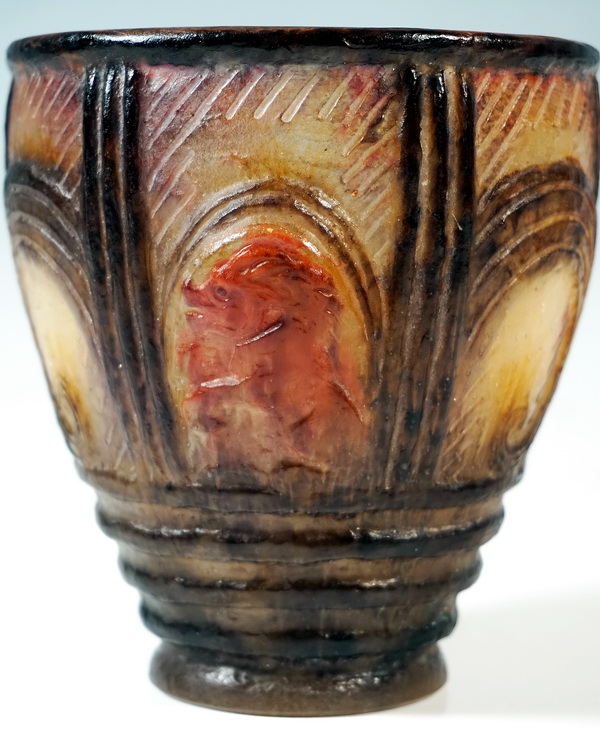
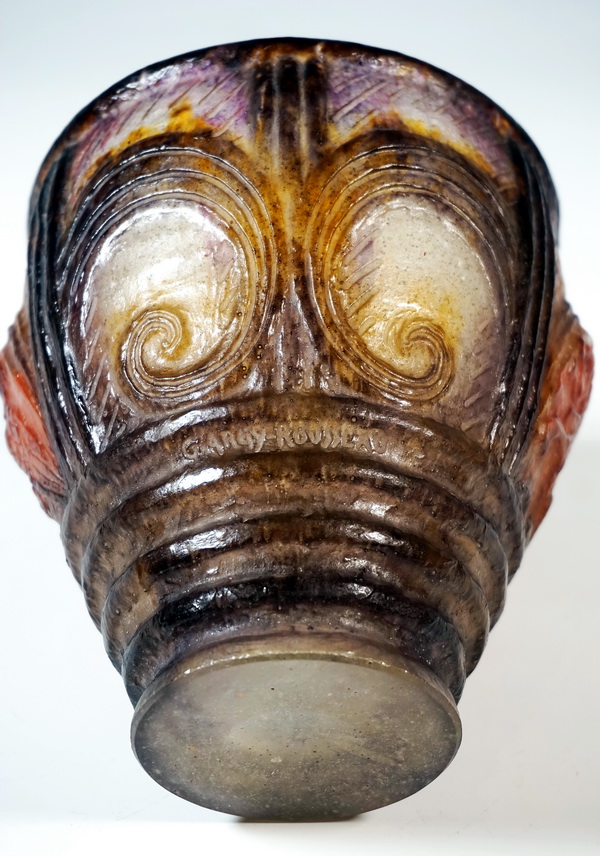
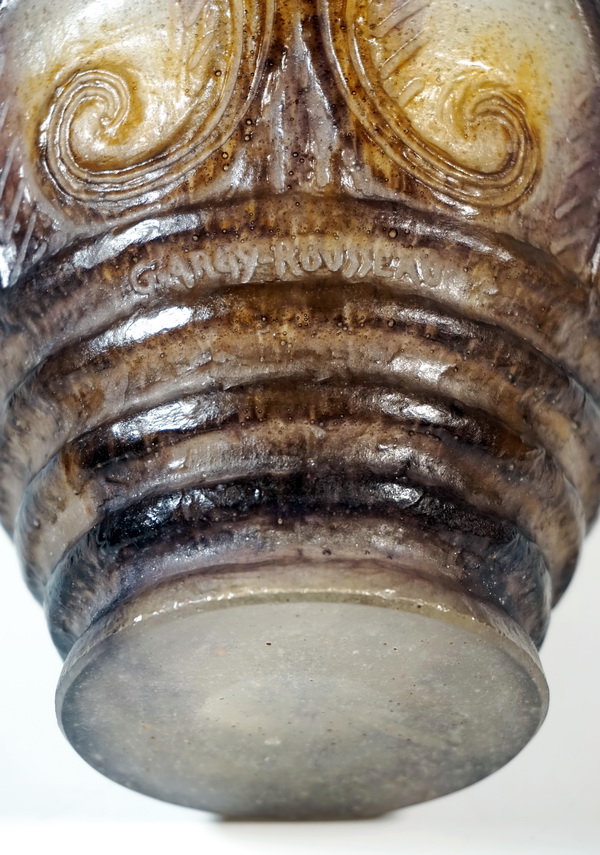
Funnel-shaped, curved vase on a round stand made of translucent pâte de verre with colored powder melts in black, yellow, burgundy red, and violet, 4-fold horizontally ribbed in the stand area, the wall above divided into 6 segments by 3-fold vertically ribbed supports, in each of which there are two mutually inclined 4-fold ribbed volutes, in between paste-applied motifs in red: lion and owl. Press marks 'G. Argy-Rousseau' on the wall between the upper horizontal ribs.
MANUFACTURE:
SOCIÉTÉ ANONYME DES PÂTES DE VERRE D'ARGY-ROUSSEAU, PARIS, FRANCE
DATING:
AROUND 1925
ARTIST:
GABRIEL ARGY-ROUSSEAU (1885-1953)
was a French Art Nouveau and Art Deco glass artist and ceramist. At the École Nationale des Céramiques de Sèvres (from 1902) he met the son of the pioneer of the pâte de verre technique, Henry Cros. He initially worked in a research laboratory to develop dental porcelain, after which he devoted himself exclusively to pâte de verre glass art. After his marriage, he took part of his wife's maiden name (Argyriadès) and from then on called himself 'Argy-Rousseau'. He took part very successfully in the Salons des Artistes Français in Paris, and in 1921 he met the gallery owner and glassworks owner Gustave Gaston Moser-Millot, with whom he founded the Société Anonyme des Pâtes de Verre d'Argy-Rousseau. Argy-Rousseau never revealed his method of making pâte de verre and retained exclusive rights. Nature was an important theme in his work, in which he primarily depicted flowers, insects, animals and female forms. Many of his vases were surrounded by flowers at the top. From 1917 onwards, the forms of his works became longer, reflecting the influence of Japanese art. Scenes from ancient mythology (such as in Le Jardin des Hespérides) were also common motifs. He often varied the thickness of the glass and, depending on the design, from semi-transparent to opaque.
TECHNOLOGY:
PÂTE DE VERRE
(German: glass paste) is a technique used in the production of multi-colored glass and one of the basic variants of the process known in modern German as fusing. A cold-formed paste made of glass powder and dyes is filled into a fireproof mold and then fired in a muffle furnace, melting the glass into the desired shape. To achieve polychrome color effects, the process is repeated with other colors.
The technique was already known in ancient Rome and Egypt. Especially in the Art Nouveau period and later in the Art Deco period, it found artistic use again in works by French glass artists such as Gabriel Argy-Rousseau, Henry Cros, Albert Dammouse, François Décorchemont, Amalric Walter, Émile Gallé and George Despret.
DIMENSIONS:
Height: 14.0cm
Diameter: 13.0cm
PROOF:
- Bloch-Dermant, Gabriel Argy-Rousseau, Paris 1990, p. 204, no. 07/25
- Carolus Hartmann, Glasmarken-Lexikon, Stuttgart 1997, signature number 3703 on page 177, and page 507: Argy-Rousseau, Joseph-Gabriel.
CONDITION:
VERY GOOD
GABRIEL ARGY ROUSSEAU
VASE 'LION ET CHOUETTE'
'LION AND OWL'
Funnel-shaped curved vase on a round base made of translucent pâte de verre with colored powder infusions in black, yellow, burgundy red, and violet, with four horizontal ribs in the base area, wall above divided into 6 segments by triple vertical ribbed bands, in these segments two pairs of volutes inclined towards each other, each with 4 ribs, between them motifs applied in paste in red: lion and owl. Press marks 'G. Argy-Rousseau' on the wall between the upper horizontal ribs.
MANUFACTORY:
SOCIÉTÉ ANONYME DES PÂTES DE VERRE D'ARGY-ROUSSEAU, PARIS, FRANCE
DATING:
CIRCA 1925
DESIGNER:
JOSEPH GABRIEL ARGY-ROUSSEAU (1885-1953)
was a French Art Nouveau and Art Deco glass artist and ceramist. In the École Nationale des Céramiques de Sèvres (from 1902) he met the son of the pioneer of the pâte de verre technique, Henry Cros. He first worked in a research laboratory to develop dental porcelain, after which he devoted himself exclusively to pâte de verre glass art. After his marriage, he took part of his wife's maiden name (Argyriadès) and henceforth called himself 'Argy-Rousseau'. He took part very successfully in the Salons des Artistes Français in Paris. In 1921 he met the gallery owner and glassworks owner Gustave Gaston Moser-Millot, with whom he founded the Société Anonyme des Pâtes de Verre d'Argy-Rousseau. Argy-Rousseau never disclosed its manufacturing process of pâte de verre and retained the exclusive rights. Nature was an important theme in his work, in which he primarily depicted flowers, insects, animals and female forms. Many of his vases were entwined with flowers at the top. From 1917 onwards, the forms of his works became longer, reflecting the influence of Japanese art. Scenes from ancient mythology (as in Le Jardin des Hespérides) were also common motifs. He often varied the thickness of the glass and, depending on the design, from semi-transparent to opaque.
TECHNIQUE:
PÂTE DE VERRE
(English: glass paste) is a technique used in the production of multi-colored glass. A cold-formed paste made of glass powder and dyes is filled into a refractory mold and then fired in a muffle furnace, whereby the glass melts into the desired shape. To achieve polychrome color effects, the process is repeated with other colors. The technique was already known in ancient Rome and Egypt. Particularly in the Art Nouveau period and later in the Art Deco period, she found artistic use again in works by French glass artists such as Gabriel Argy-Rousseau, Henry Cros, Albert Dammouse, François Décorchemont, Amalric Walter, Émile Gallé and George Despret.
SIZE:
Height: 5.51 in
Diameter: 5.11 in
BIBLIOGRAPHY:
- Bloch-Dermant, Gabriel Argy-Rousseau, Paris 1990, p. 204, no. 25.07
- Carolus Hartmann, Glasmarken-Lexikon ( = Encyclopedia of Glass Marks ), Stuttgart (Germany) 1997, Signature number 3703 on page 177, and page 507: Argy-Rousseau, Joseph-Gabriel.
CONDITION:
VERY GOOD
The goods we offer are subject to differential taxation according to the UstG. The sales tax included in the purchase price is not shown separately on the invoice.
The goods offered by us are subject to differential taxation according to the sales tax law. The sales tax included in the purchase price is not shown separately on the invoice.