 Additional Information


To contact our Customer Service Team, simply click the button here and our Customer Service team will be happy to assist.
© Botanical Archive

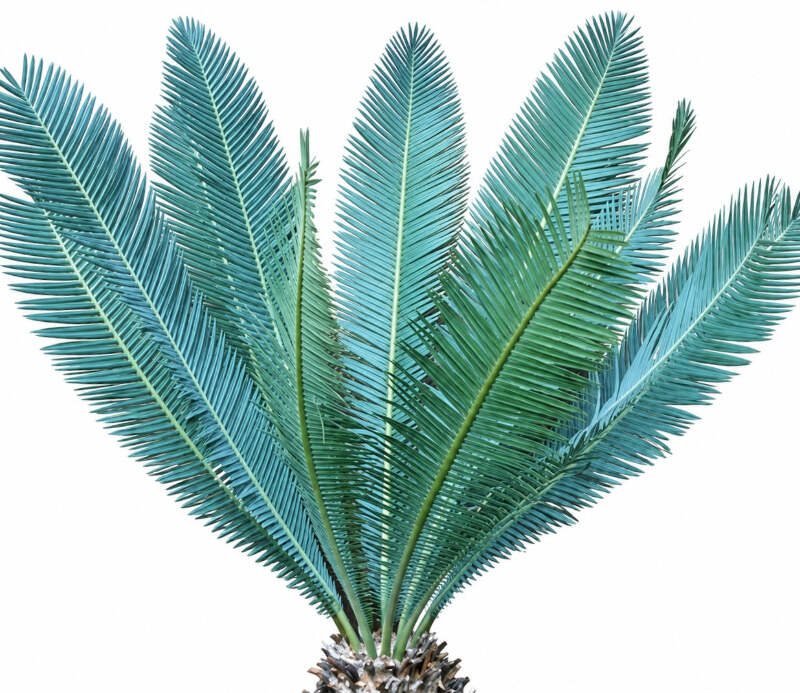
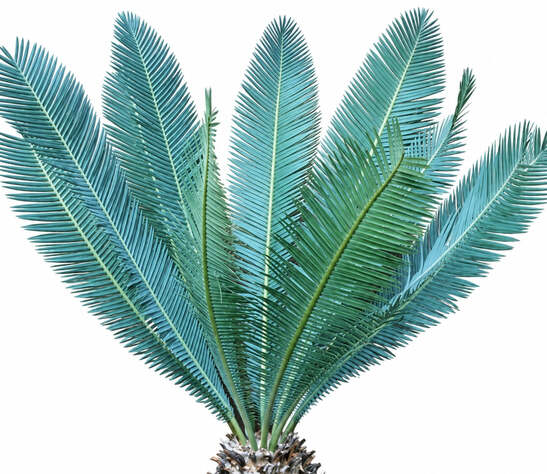
The Dioon edule "Querétaro" form is one of the most coveted blue-leaved expressions of the Dioon edule complex (family Zamiaceae), originating in the state of Querétaro at an altitude of about 1230 m (4000 ft). Its great appeal lies in the intense blue-gray colour of the emerging leaves, a glaucous, waxy bloom that lends each new flush a cool, almost metallic sheen prized by collectors worldwide. It should be noted that this glaucous coating is most vivid on freshly emerged foliage and gradually weathers away with age — a natural trait of the form rather than a defect — so that the plant is at its most spectacular with each new flush of leaves.
This is a medium-sized form, with stems reaching a maximum height of about 1.2 m (3.9 ft). The leaves are flat, slightly twisted and gently incurved, 0.7–1 m (2.3–3.3 ft) long and 200–225 mm (8–9 in) wide, carried in a symmetrical, feather-like rosette. The leaflets are 100–125 mm (4–5 in) long and 6–7 mm (0.3 in) wide, crowded and sometimes twisted, with strongly revolute margins that give the foliage its characteristic firm, sculptural texture. As in every member of the complex, the leaflet margins are entirely spineless at maturity — a key diagnostic of Dioon edule — with marginal spines restricted to seedling and juvenile foliage. Slow-growing and exceptionally long-lived, it develops into a striking architectural specimen over many years.
The reproductive structures are robust and handsome. Female cones are densely gray-brown tomentose, about 225 mm (9 in) long and 175 mm (7 in) in diameter, their sporophylls ending in short, blunt apexes; the subglobose seed has a sclerotesta of 20–25 mm enclosed in a bright-yellow sarcotesta. Male cones are about 190 mm (7.5 in) long and 70 mm (2.8 in) in diameter, lightly tan-tomentose and sometimes glabrous toward the apex. As a living representative of one of the most archaic surviving seed-plant lineages — the genus whose epithet edule recalls the traditional, carefully detoxified use of its starchy seeds — the "Querétaro" blue form unites rare ornamental colour with the resilience and longevity that define the Dioon edule lineage.
IMPORTANT: The pictures show the mother plant, which is not for sale. The offer includes a plant with the dimensions stated in the description.
| Plants: Pictures | Keep on mind that the plant may have grown since pictured. |
| Plants: Seasonality | Be aware that most plants change across seasons. If present foliage could have been fallen or change in its color. |
| Plants: Shipment | Plants will be sent bare roots and with no soil. |
| Plants: Phytosanitary Certificates | A phytosanitary certificate (for additional costs of 20,00 EURO) is necessary for export plants from Italy to ALL destinations out of EUROPEAN COMMUNITY. Among which: United Kingdom Turkey, South America, USA, Canada, Australia, Japan, Singapore, Philippines, South Korea, Thailand, etcetera. You can buy it in our eBay store. 1 single certificate can cover several plants purchase that are sent together in same shipment. If you will not buy the certificate and the plants, we will not be responsible for any capture by customs of destination. |
| Plants: Recognition and Nomenclature | Plants nomenclature has been done at our best knowledge, please see picture to see the product. |
| Seeds: Legal Purchases | We ship worldwide but please be sure that the seeds are legal in your country. We will not accept any claims in case the seeds are confiscated by your local authorities |
| Seeds: Shipment | Seeds are clean and each species is handled in a transparent small bag. Latin names of nomenclature are indicated in each bag of seeds. |
Click the Postage tab above the listing description for more info
Click the Postage tab above the listing description for more info!
 Additional delivery notes
PICK UP OPTION
Sorry, our items are NOT available for pick-up.

|
PAYING VIA PAYPAL |
We accept PayPal on our all our items so you can shop with confidence.
Simple choose the PayPal option when proceeding through the checkout.
To contact our Customer Service Team, simply click the button here and our Customer Service team will be happy to assist.
© Botanical Archive
Click the Postage tab above the listing description for more info
Accepted Payment Methods
Returns are accepted
Items must be returned within 14 days of the auction ending
Buyer will pay for return shipping.

