|

| |
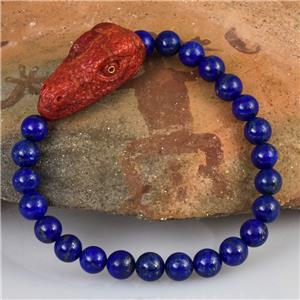
BRACELET CARVED RED SPONGE CORAL KOMODO LIZARD & LAPIS LAZULI BEADS
|
| |
Item # |
: |
340 0818
|
|
| |
Type of bracelet |
: |
A beaded Stretch (elastic) Bracelet with a precious and rare hand-carved Red Sponge Coral Komodo Lizard Head Design Bead and Lapis Lazuli gemstone beads.
Please do not overstretch the bracelet.
|
|
| |
Fauna & Flora Celebration Collection
|
: |
Our celebration collection features vibrant leaves and flowers, as well as captivating creatures, all inspired by nature.
Our passion for flora and fauna motivates us to craft these timeless creations.
Our collection is dominated by perennial favourites like flowers, leaves, and other natural creations.
Our collection has a natural appearance because of the methodical arrangement of colorful gems, carefully selected mother-of-pearl, and stones, which produce a balanced and elegant effect.
One of the most delicate and breathtakingly beautiful creatures in the world flutters into our collection. Some of our most magical jewelry is inspired by the butterfly, which is whimsically colorful and so light and graceful on the wing.
Pearls, Tsavorites, Rubies, Sapphires, Diamonds and other precious gemstones are prominently used in our creations.
|
|
| |
Material |
: |
Genuine natural Red Sponge Coral and natural color genuine Lapis Lazuli.
|
|
| |
Amount |
: |
1 (one) bracelet
* All photos were taken from the actual item *
|
|
| |
Quality |
: |
New and excellent
|
|
| |
Size of bracelet
|
: |
Inside circumference: approx. 15.24 cm = 6 inches
|
|
| |
Weight |
: |
approx. 30.42 grams
|
|
| |
Color of Sponge Coral Bead |
: |
Red with a fine orange-red hue.
The eyes are bezel-set genuine red Ruby gemstones.
|
|
| |
Gemstones |
: |
Two genuine natural Red Ruby gemstones ~ round 1.8 mm diameter, brilliant cut in excellent quality with just minor natural inclusions (si) ~ from Mozambique / Africa
|
|
| |
Dimensions of Red Sponge Coral bead |
: |
Length: approx. 37.96 mm = 1.49 inches
Width: approx. 18.58 mm (measured at the widest point)
Height / thickness: approx. 15.10 mm
|
|
| |
Perforation |
: |
This hand-carved Red Sponge Coral bead is fully perforated with an approx. 1.50 mm diameter drill hole.
|
|
| |
Origin |
: |
Aquaculture farms off the coast of Sumatra, Indonesia, are the source of the Red Sponge Coral that we use.
This carving is handcrafted in Bali (Indonesia) by our in-house Balinese master carvers.
|
|
| |
Size of Lapis Lazuli beads |
: |
Assorted from approx. 8.30 mm diameter.
|
|
| |
Perforation / hole size |
: |
Varies slightly from approx. 1.20 to 1.50 mm diameter.
|
|
| |
Origin of Lapis Lazuli beads |
: |
Afghanistan
|
|
| |
Quality |
: |
New and excellent
|
|
| |
Color |
: |
Various shades of blue
|
|
| |
Treatment of Lapis Lazuli |
: |
None ~ 100 % natural Lapis Lazuli without any enhancement or treatment.
|
|
| |
What is Red Sponge Coral ?
|
: |
Melithaea ochracea, commonly known as RED SPONGE CORAL, is a type of red coral with a reddish-orange hue. Although it looks like a sponge, it is not a sponge.
Common calcareous corals in the Melithaeidae family are called sponge corals. The Melithaeidae family of corals includes about 101 species that are found in the shallow seas of the Indo-Pacific area. In the wild, coral is more commonly referred to as sea fans because of its wide fan-like branches. The coral has a sponge-like appearance and is quite porous. It is divided between light yellow or brown keratinous nodes and orange-red calcareous internodes.
Typically, Red Sponge Coral is stabilized before being utilized in jewelry in various forms. It is sometimes referred to as "Red Spongy Coral" or "Congi."
Aquaculture farms off the coast of Sumatra, Indonesia, are the source of the Red Sponge Coral that we use.
Only naturally occurring Red Sponge Coral enhanced by the Zachary Process is used by us.
Since our Red Sponge Coral has undergone the "Zachary Process," it is challenging to distinguish it from untreated material. The procedure is intended to seal pores and reinforce the material.
We don't use any form of dye or color enhancement.
We utilize a deep red to orangey-red hue that comes from premium Red Sponge Coral. Usually, it has fine traces of orange or yellow variegation.
Since each Red Sponge Coral is distinctive, it is hard to determine which is more sought-after: the nonvariegated or somewhat variegated ones. But in terms of color, the more closely resemble pure red corals a Red Sponge Coral is, the more valuable it is.
For a very long time, Red Sponge Coral has been prized. Coral has been used in jewelry since prehistoric times, and jewelry enthusiasts still think highly of it.
It is most closely linked to Buddhism, wherein Buddhist texts list coral as one of the seven treasures.
Our Red Sponge Coral comes from aquaculture farms off the coast of Sumatra, Indonesia, and is not an endangered or protected species.
We only utilize naturally occurring, highly polished, vibrantly Red Sponge Coral from Indonesia that is ready for your jewelry design.
|
|
| |
Lapis Lazuli |
: |
About Lapis Lazuli - History and Introduction
Lapis Lazuli, often referred to as just 'Lapis', has been used as a gemstone for thousands of years. It has been mined from Afghanistan since the early 7th millennium BC, and it was discovered in ancient burial sites throughout the Caucasus, the Mehrgarh and even as far as the Republic of Mauritania. The funeral-mask for the ancient Egyptian pharaoh 'King Tut' was even discovered to have been decorated with Lapis Lazuli.
This historical stone has a name closely associated with its intense color. Its name was derived from the Latin word 'lapis' meaning 'stone', and from the Arabic and Persian word 'lazaward'. 'Lazaward" was the Persian name for Lapis stone, as well as the name of its mining location. In other parts of the world, words for 'blue' were named after the color of lapis, including the English word 'azure'; Italian 'azzurro'; Polish 'azur'; Spanish 'azur' and Romanian 'azuriu'. Today, Lapis Lazuli is still considered to be one of the most important opaque blue gemstones available.
Lapis usually forms in crystalline marble through the geological process of contact metamorphism and due to its composition, it is technically defined as a rock rather than a mineral. It is primarily composed of Lazurite, while the remaining composition is made up of Sodalite, Calcite, Pyrite and other various minor constituents. The varying composition is what influences its exact coloring.
Lapis Lazuli Origin and Gemstone Sources
Discovered 6000 years ago, the oldest lapis lazuli deposits are in the difficult terrain of the West Hindu-Kush Mountains in Afghanistan. Today, Afghanistan is known to produce the finest quality lapis lazuli and is also the most significant source. Other commercial deposits have been also found in Angola, Argentina, Canada, Chile (North of Santiago), India, Italy, Myanmar (Burma), Pakistan, Russia and the United States (California and Colorado)
Lapis Lazuli Color
Although the color of Lapis Lazuli is defined by its name, 'the blue stone', its colors can actually range from slightly greenish blue to violet, medium to dark and from low to highly saturated. The blue is owed to sulfur coloring agents. The finest stones exhibit an evenly distributed color and have no visible deposits of Calcite, although a moderate amount of Gold Pyrite flecks is considered acceptable. Too much Pyrite can result in a dull, greenish tint, while Calcite can predominate the mix, giving the stone an overall less appealing lighter blue shade.
An evenly distributed, highly saturated, slightly violet-blue color with little to no Pyrite or Calcite is the most prized; stones of this quality are sometimes referred to as 'Afghan' or 'Persian'. Lapis colors are often described using an adjective that refers to a specific locality, but that does mean the gem is from that area.
Lapis Lazuli Legends and Metaphysical Healing Properties
Lapis Lazuli is a real veteran in the illustrious history of gemstones. Indeed, it was used as jewelry as early as prehistoric times. In the Middle Ages it gained additional popularity as a pigment to produce ultramarine color for painters or to tint cloth. Some palaces, churches and mosques throughout the Middle East and Europe display wall panels and columns with Lapis Lazuli inlays. For people around the world, Lapis Lazuli is considered a stone of truth and friendship. The blue stone is reputed to promote harmony in relationships. Historians believe the link between Lapis Lazuli and human beliefs dates back over 6,500 years. The stone is believed to have been highly prized by many ancient civilizations, including Egyptian, Mesopotamian, Chinese, Roman and Greek.
In antiquity, as well as in the Middle Ages, people believed that the cosmos was reflected in gemstones. Lapis Lazuli is assigned to the planet Jupiter. The healing powers of gems remain a controversial issue, but have been mentioned for centuries by healers, shamans and medicine men around the world. Whether it's based on fact or is merely a placebo effect, it truly doesn't matter if it helps those in need. Lapis Lazuli is said to be of help for headaches, sore throats and varicose veins. It is also known to help with alleviating cramps, stiffness and fertility problems.
|
|
| |
Hand-carving |
:
|
Our shell carvings are all hand carved. This is not a machine mass produced item.
This item is handmade and each piece is made one by one.
We know you will enjoy using and wearing our shell carvings as much as we enjoyed making them.
|
|
| |
Hand-crafted |
: |
Our beads are made using ancient traditional techniques. Each piece is handmade and is not a mass-produced item.
|
|
| |
Remarks |
: |
Don’t miss this opportunity to own this beautiful, handcrafted bracelet |
|
|
Our photographs have been enlarged to show details. Most details shown in the large image are actually not visible to the naked eye. We have made the image as close as possible to the original item when viewed on our screen. Depending on the viewers monitor settings, these items may appear a few shades lighter or darker in comparison to the original object.
Why Shop with AGUSTUS-Collection
|
» eBay Seller since the Year 2000
» Very high Approval Rating
» Outstanding Collection
» Custom Orders & Wholesale
|
» Combine Shipping for 10 days
» Secure Packing & Shipping Services
» Secure Payment
|
» Items are guaranteed as described
» Clear Return Policy
» Fast Support Response
» Outstanding Customer Service
|
 |