
Product highlights
What's in the box
- Over-ear headphones
- 74" Audio cable (dual 2.5mm plugs on one end and 3.5mm plug on other end)
- Screw-on 3.5mm-to-6.35mm adapter (installed)
- Drawstring bag
- Safety Guide
About this item
Written by Crutchfield's Jeff Miller
Spacious and accurate — with an extra dash of "punch and sizzle"
Sennheiser's "HD 500" series headphones are a well-known gateway into high-end audio — for example, their HD 560S, which I've named the best wired headphone for " audiophiles on a budget." The new HD 550 is based on that same winning formula, but it mixes in a little more bass punch and high-end brilliance — attributes found in the company's legendary "HD 600" models.
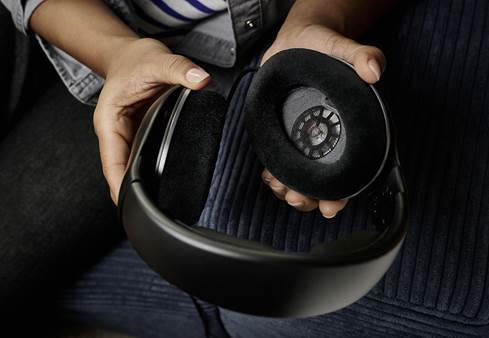
The high-performance drivers are angled and visible from the inner earcup.
By popular demand
To find inspiration for the HD 550 open-back wired headphones, Sennheiser leaned on feedback from the personal audio community. (Perhaps best exemplified by those who follow and attend events like CanJam.) To my ears, they've hit their mark.
I hear the same outside-the-head presentation that I enjoy in the HD 560S, but the bass feels faster and more impactful, without overwhelming the crucial midrange. High frequencies are distinct and detailed without sounding harsh. The 550 delivers that "reach out and grab you" Sennheiser sound popularized by headphones like the HD 660S2 — but with a little more space than that costlier model's intimate presentation. And it certainly rewards repeat listens.
Unapologetically wired and open-backed
Just to be clear: these are not the type of headphones you want to wear to the gym or on a flight. These are wired headphones, designed for focused listening, and their open-air design allows sound to flow in and out freely. This helps cut down on unwanted resonance and gives space for the high-performance drivers to do their thing.
Sennheiser shrewdly angled those drivers to control how the sound hits your ears, both with direction and timing. It's why the soundstage is wider and the imaging so well-defined. For peak performance, you'll want to connect to a separate headphone amplifier, and you have a couple of connection options — the included cable has a 3.5mm miniplug, and a 1/4" headphone plug adapter is included.
Lightweight design with a snug, nicely padded fit
Weighing just over eight ounces, these headphones are smaller and lighter than some of the heavyweights you'll find in this audiophile class. In fact, while the design closely resembles the HD 560S, Sennheiser has managed to shave off slightly more weight and distribute it even better.
They sport a snug, secure fit to keep the drivers properly aligned with your ears. But it feels like a lighter touch than the HD 560S to me, with less clamp. The headband and ear cups also have extra cushioning, including ear pads made of soft, velvety cloth.
My listening impressions
At 150 ohms, these headphones require a little extra power to hear them at their best — I had success connecting directly to the iFi Audio ZEN DAC 3 desktop DAC/amp. Given their slightly more upbeat and edgier tuning, I didn't feel the need to use iFi's bass boost settings, which I often use to get a little more low-end from the HD 560S headphones.
Tactile drum and bass
As their name might imply, the hip-hop group "clipping." has always been hard on speakers and drivers. Their sound can encompass everything from distorted synths and high-pitched bells to quick drums and deep sub-bass, often on the same track. That can expose the shortcomings of audio gear that's not up to handling all these extremes at once.
The HD 550 delivered all the sonic chaos of their 2025 album Dead Channel Sky with both musical cohesiveness and distinct separation. Bass thumped out with authority and quickness, establishing a grounded foundation to the spacey, sci-fi-inspired sounds and samples. Crunchy, electronic chords and metallic, mechanical strings panned from left to right — all while emcee Daveed Diggs' lightning-fast baritone sat dead center "between the ears."
Clear, well-blended vocals
Sometimes in headphones with a wider presentation, the vocals can come off as veiled or recessed. That's not what happened here. It's not as if the vocals are overly prominent and forward through the HD 550, they just occupy a distinct place in the mix — with plenty of clarity.
I listened to Neil Young's "lost" record Oceanside Country on Qobuz in 24-bit/192 kHz high-res (recommended by fellow writer Ned O., who said he had a mixtape of these country-folk B-sides years ago). On the track "Goin' Back," there's a delicious sting on the acoustic guitar transients, but it never overpowers Young's gentle, warbly vocals, even as they seem to emanate from the same place.