


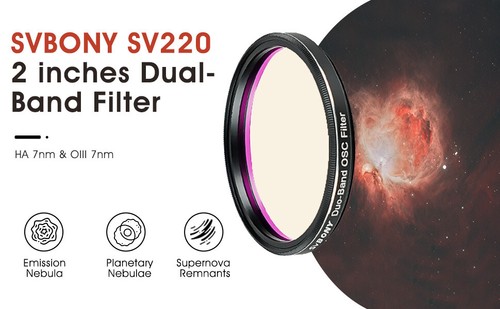


Package includes: SV220 H+O 7nm Duo-Band OSC Filter 2" | For Deep Space Astrophotography SVBONY SV220 H+O 7nm Duo-Band Filter is your all-in-one solution for stunning deep-space imaging. This 2" filter locks onto the two most important nebula wavelengths in a single shot, letting you cut through light pollution and capture crisp, colorful details from your backyard. SV231 2" Color Correction Filter for Planetary Visual / Astrophotography The filter is a filter specially used to correct chromatic aberration and color unevenness. It improves the color quality and contrast of the picture by eliminating chromatic aberration and enhancing color saturation.2 inch standard thread size; fits most telescopes; filter has the grooves needed to be softly screwed into the eyepieces lens easily. |

🌌 Capture Vibrant Nebula Color Without Multiple Filters The SVBONY SV220 H+O 7nm Duo-Band Filter is your all-in-one solution for stunning deep-space imaging. This 2" filter locks onto the two most important nebula wavelengths in a single shot, letting you cut through light pollution and capture crisp, colorful details from your backyard. ✨ Key Selling Points Dual-Band Precision: Simultaneously isolates H-Alpha (656.3nm, red) and OIII (500.7nm, blue-green) wavelengths, so you get both colors of emission nebulae in one exposure—no need to swap filters. 7nm Balanced Bandpass: Strikes the perfect balance between blocking light pollution and preserving fine details. It eliminates background noise without losing the subtle textures of nebulae. OD5+ Deep Blocking: Blocks 99.999% of city glow, moonlight, and unwanted UV/IR light (300-1000nm range). Shoot from your backyard, no dark-sky trip required. High Transmittance Efficiency: 85% single-point transmission and 94% peak transmission drastically reduce exposure times, lowering noise on entry-level cameras and making stacking faster. Universal 2" Fit: Featuring a large 44mm aperture and M48*0.75 standard thread, it is compatible with mid-to-high-end wide field-of-view/high-resolution astrophotography equipment. 🎯 Ideal Shooting Targets Emission Nebulae: Orion Nebula, Lagoon Nebula, Eagle Nebula, and Carina Nebula (vibrant red and blue-green details pop in one shot) Planetary Nebulae: Ring Nebula, Dumbbell Nebula (highlights the contrast between hydrogen and oxygen layers) Supernova Remnants: Veil Nebula (reveals faint filament structures in both H-Alpha and OIII) 👤 Who It’s For Beginner Astro Photographers: All-in-one design keeps things simple, no need to manage multiple filters. Urban/Suburban Imagers: OD5+ blocking crushes light pollution, so you can shoot from your backyard. OSC Camera Users: Perfect for one-shot-color cameras, capturing both key nebula wavelengths in a single frame. 2" Equipment Owners: Featuring a large 44mm aperture and M48*0.75 standard thread, it is compatible with mid-to-high-end wide field-of-view/high-resolution astrophotography equipment. Ready to simplify your deep-space imaging and get vibrant, noise-free shots with less effort? This filter turns your OSC camera into a nebula-capturing powerhouse. |
 | Joseph Milazzo I purchased the svbony sv220 dual narrow band filter. I am very pleased. The eagle nebula was only 20 -2 minute subs. The crescent was 47 2 minute subs. Scope was sv503ed 102 and ASI533 cam. |
 | Mj Magallon A Blazing Rendition of Horsehead and Flame Nebula Alnitak is a good test of how the SV220 performs. Svbony SV220 duo band filter Gain 100, 300-sec subs Sky Rover 72mm f/6 ED Apo, with 0,8x Reducer with flats, darks, and bias. |
 | Leo Yu Second take of the Bat / Eastern veil nebula. this time with a dual band filter. Post processed to push the OIII more and better framing 30x 300s Gain 191 Bortle 8 Astrotech 102ED Celestron AVX SVBONY SV405CC @ -5c SVBONY SV220 7nm dual band filter Pixinsight + BlurX + NoiseX LightRoom for final touchup |
 | Thanks to jupas_astrophotography for sharing. |
 | Thanks to astrophotobyd28 for sharing from Instagram. NGC6334 & NGC6357 (Cat’s Paw Nebula and Lobster Nebula) | 27.04.25 This image captures two amazing emission nebulae — NGC 6357 (Lobster Nebula) on the left and NGC 6334 (Cat’s Paw Nebula) on the right — glowing strongly in hydrogen-alpha light. • Camera: SV405cc Stacked with Siril and edited with Photoshop.
|

| Filter Link | Filter Model | Core Wavelengths | Bandwidth | Best For Scenarios & Targets | Ideal Users |
 | SV227 SHO 5nm | H-Alpha(656.3nm) + OIII(500.7nm) + SII(671.6nm) | 5nm | 1. Hubble Palette (SHO false-color) imaging 2. Emission nebulae, supernova remnants, planetary nebulae 3. Universal for Northern & Southern Hemisphere targets | 1. SHO palette enthusiasts 2. Advanced deep-sky imagers 3. Urban/suburban observers |
 | SV220 H+O 3nm | H-Alpha(656.3nm) + OIII(500.7nm) | 3nm | 1. Full-frame sensor imaging (no vignetting/halo) 2. High-contrast emission nebulae (Orion, Lagoon) 3. Heavy light pollution/moonlit conditions | 1. Full-frame camera users 2. Advanced users chasing extreme detail 3. Hardcore urban observers |
 | SV220 H+O 7nm | H-Alpha(656.3nm) + OIII(500.7nm) | 7nm | 1. Single-shot color (OSC) camera imaging 2. Balances light pollution rejection and detail retention 3. Fast results with entry-level gear | 1. Deep-space photography beginners 2. OSC camera owners 3. Budget-friendly suburban observers |
 | SV220 S+O 7nm | SII(672nm) + OIII(500.7nm) | 7nm | 1. Fine textures of supernova remnants (Veil Nebula, Cygnus Loop) 2. Contrast between oxygen & sulfur layers in nebulae 3. Moderate light pollution environments | 1. Supernova remnant enthusiasts 2. OSC/monochrome camera users 3. Imagers targeting faint, detailed structures |
 | SV240 Multi-Band | H-Alpha(656.3nm)+ OIII(500.7nm)+ H-Beta(486.1nm) | Multi-band 2" | 1. Bortle 8 heavy light pollution environments 2. Emission/reflection nebulae, galaxies, star clusters 3. Full-frame wide-field imaging | 1. Urban astronomers (city centers/bright suburbs) 2. 2" full-frame camera/telescope users 3. Versatile imagers avoiding filter swapping |
 | SV260 Multi-Broadband | H-Alpha, OIII, SII, H-Beta, N-II | Multi-band 2" | 1. Suburban light pollution reduction 2. Galaxies, reflection nebulae, globular star clusters 3. Natural color wide-field astrophotography | 1. Wide-field astrophotography lovers 2. 2" equipment owners seeking full-frame coverage 3. Casual-intermediate users targeting diverse deep-sky objects |
5 Quick Decision Tips
| |||||


Order Processing
Almost all of the standard orders are shipped within 1-2 business days, excluding weekends and holidays. The special orders for some customized products will take a little longer time, the specific time can be confirmed with our sales expert.
As soon as your order is ready, we’ll update the tracking number and inform you of the information. If the item you ordered is temporarily out of stock, our customer service team will reach out to you. You can choose to wait until the item is back in stock or cancel your order.
Delivery Time
Delivery time depends on destination, logistics mode and other factors.
If the products that you purchased are available in our local warehouses, we will ship them from there and it takes about 1-6 business days for delivery as usual.
If the product you purchased is in stock at our warehouse in China, we will ship it from there. Delivery time is usually 5-9 business days.
Thank you for choosing SVBONY! We have established a strict system to ensure product quality in a responsible manner. These products are safe and reliable, and you can buy them with confidence. Should you have any issues, feel free to contact us. Our professional customer support team will patiently help you resolve the problems. We sincerely apologize in advance for any trouble and inconvenience that caused you.
Return & Refund
We offer a 30-day unconditional return policy.
1. You can get a full refund when you return an undamaged product for any reason within 30 days. Just make sure all products are in original condition and provide us with relevant pictures or videos to prove it.
2. If you are not sure whether the product is in brand new condition, you can contact us first. We can help you confirm and provide a return label.
3. We will issue a refund immediately once the product arrives at our warehouse.Processing time usually takes 2-5 business days.
Warranty Time
We offer a 1-year warranty.
Guaranteed authentic, we are the official store of SVBONY brand, and the products sold are guaranteed to be authentic.
Guaranteed service, one-to-one exclusive customer service, answer all your questions and provide free professional technical support.
Guaranteed after-sales, all products purchased from SVBONY enjoy worry-free warranty, your product warranty period is one year.

If you have any questions or inquiries about our products or services, please feel free to contact us.


