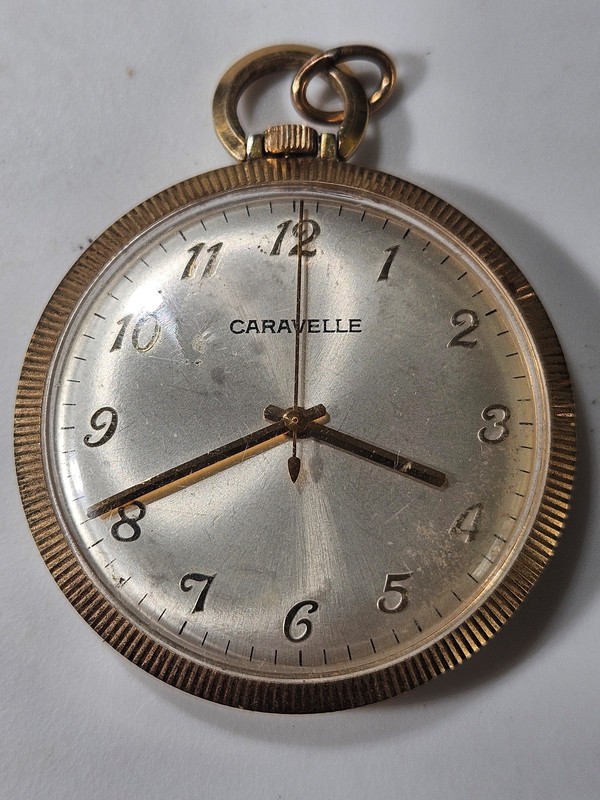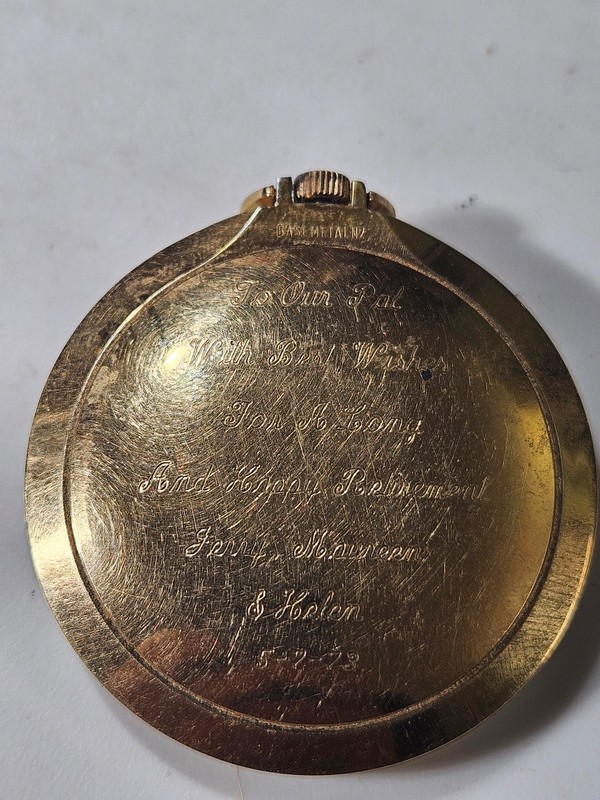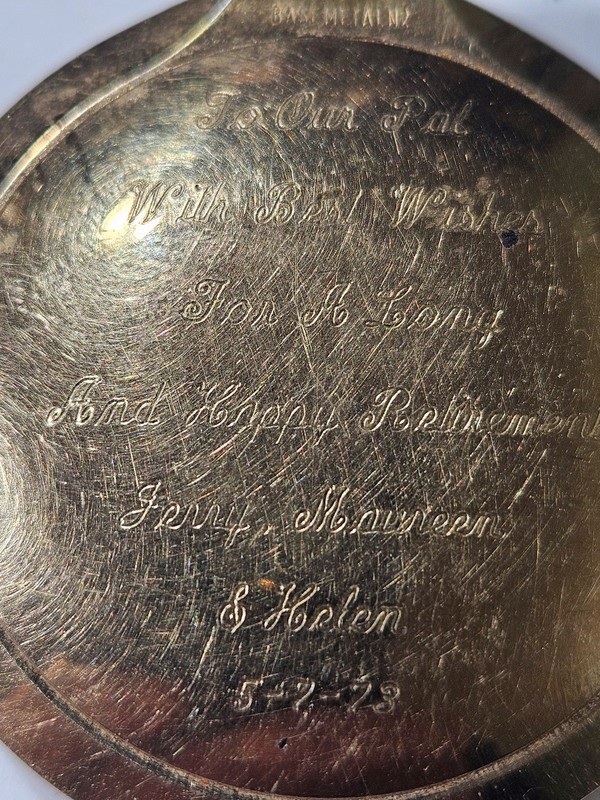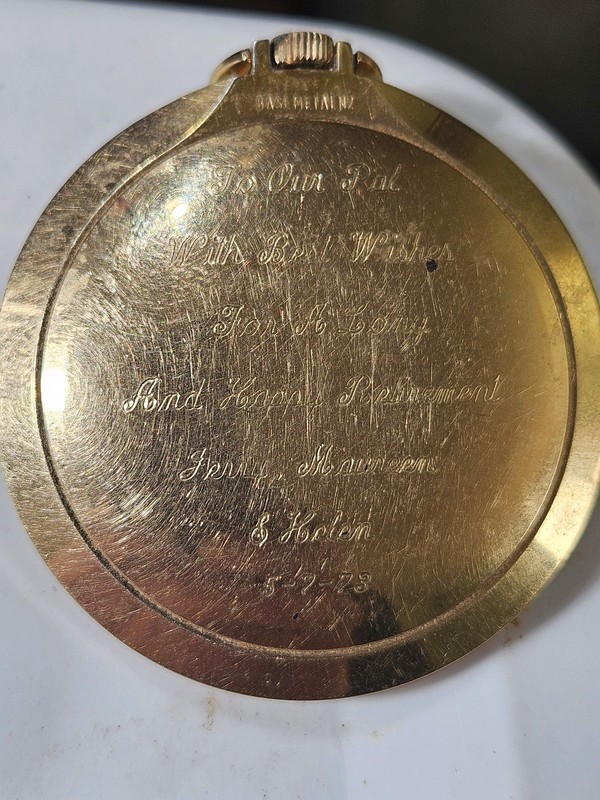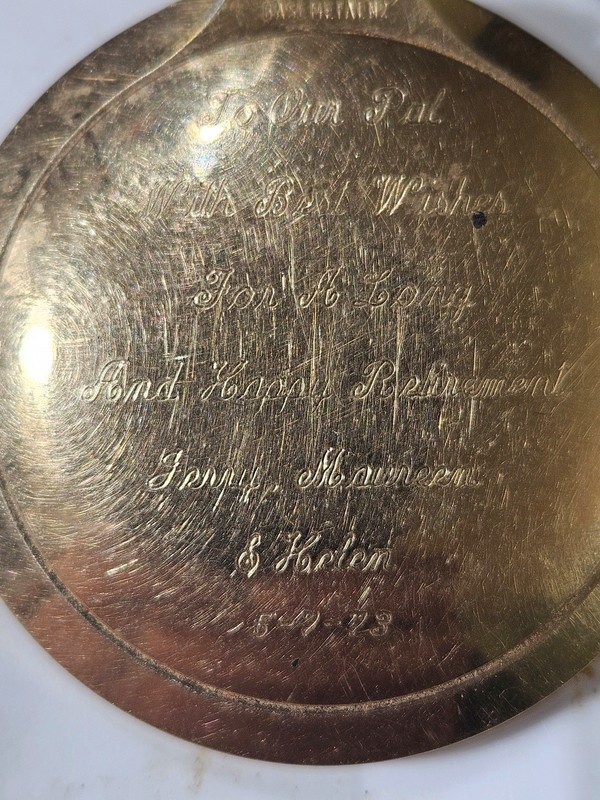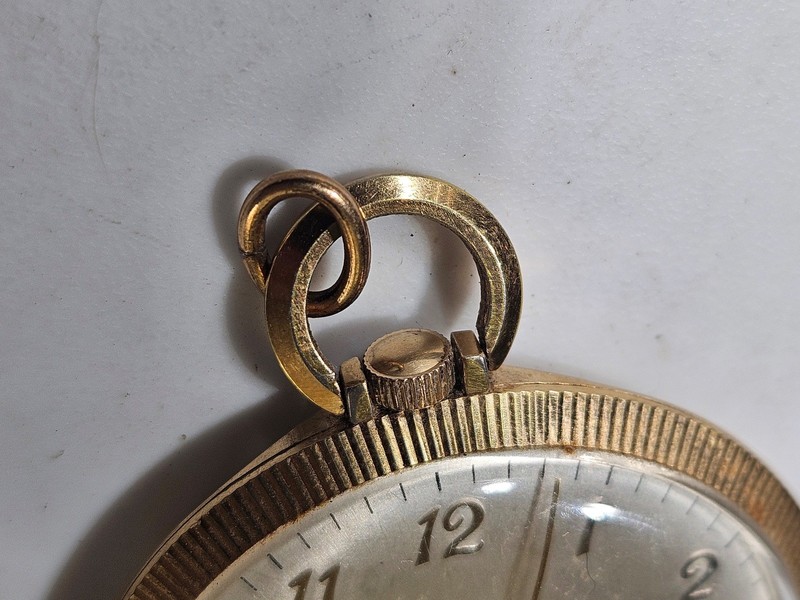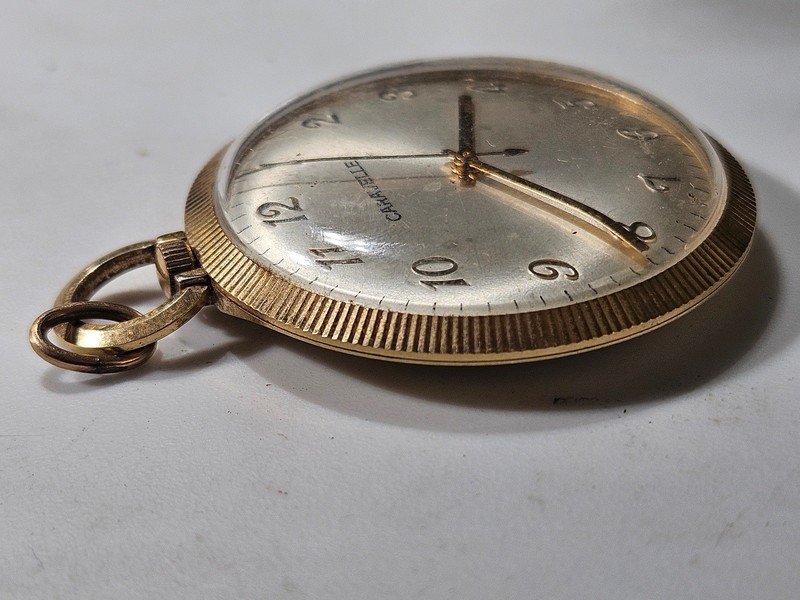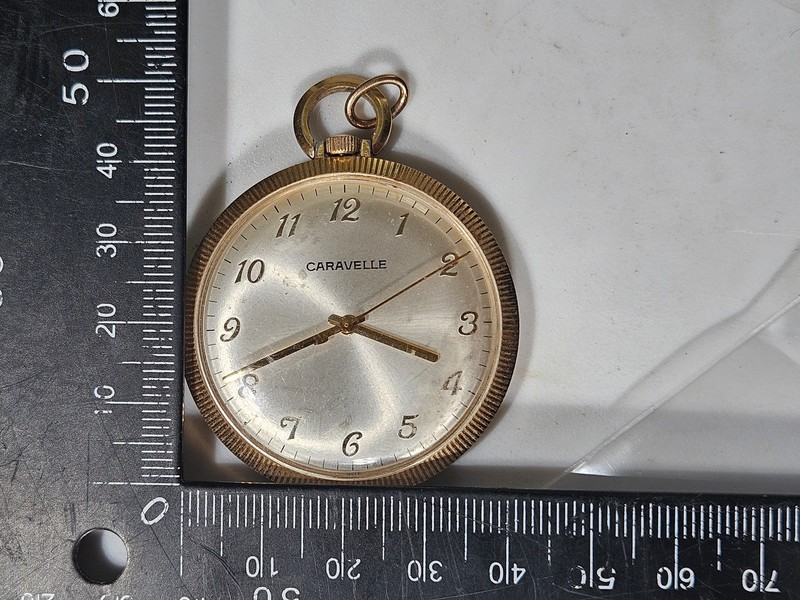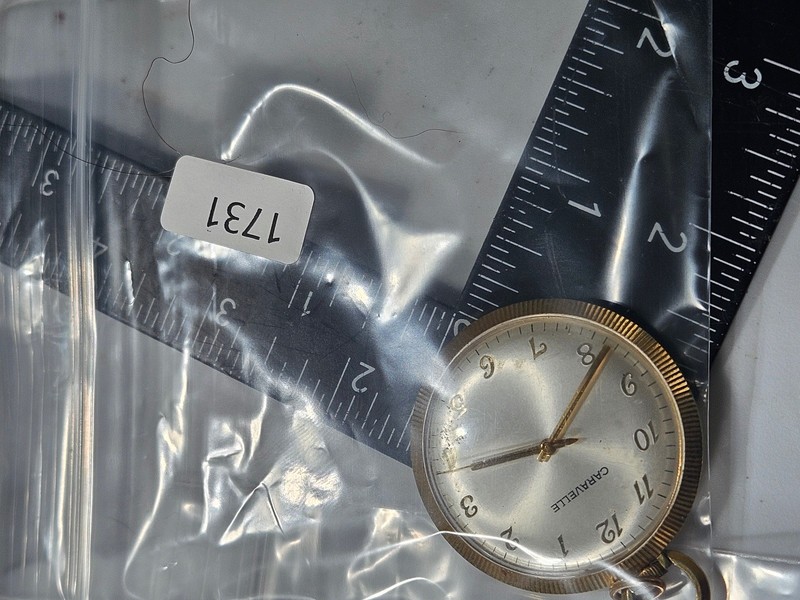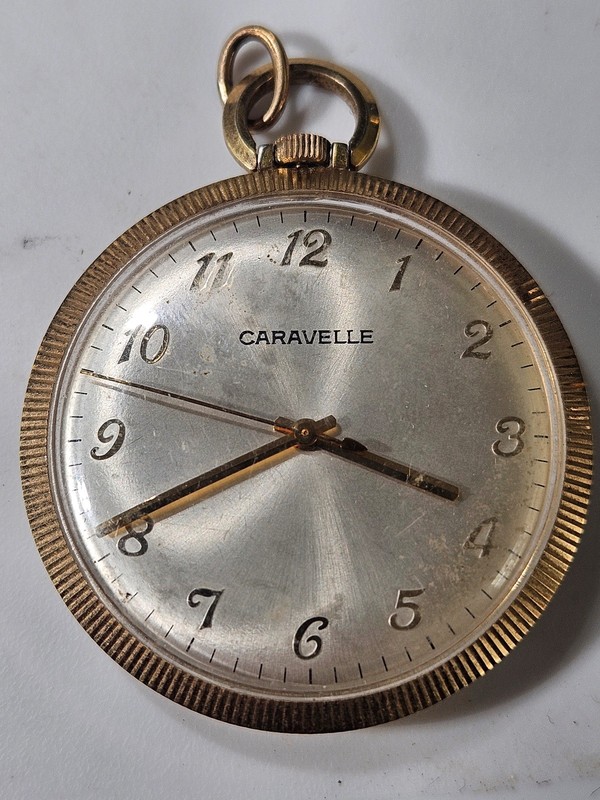
The watch is a Caravelle model, a sub-brand launched by Bulova in 1962 to offer affordable jeweled timepieces. Your images show a gold-tone open-face pocket watch with a silver dial, black Arabic numerals, and a sweep seconds hand. The case features a ribbed bezel, stem winding crown, and bow for chain attachment. The back engraving reads: "With Best Wishes Upon Retirement Benj. Wishner From The Board of Directors Jewish Home and Hospital for Aged S. Kolon 5-27-73." This dates it precisely to May 27, 1973, as a personalized retirement gift, likely from the Jewish Home and Hospital for the Aged (now part of Mount Sinai Health System in New York). The size is approximately 45mm in diameter, standard for pocket watches of the era. It's probably a manual-wind movement (Bulova's 11-series or similar), made in Switzerland or Japan, as Caravelle sourced components globally. No visible model number, but comparable to 1960s-1970s Caravelle pocket watches like the 11UTCD grade.
Comprehensive Overview of the Vintage Caravelle Pocket Watch
Historical Context and Brand Legacy
Caravelle, introduced by Bulova in 1962, was designed to bridge the gap between luxury timepieces and everyday affordability, retailing originally from $10.95 to $29.95. As a subsidiary of Bulova—a pioneering American watchmaker founded in 1875—Caravelle quickly became the largest jeweled-movement brand in the U.S. by 1968, emphasizing reliable Swiss or Japanese components in stylish designs. This particular pocket watch aligns with Caravelle's 1970s production, a period when pocket watches transitioned from daily essentials to collectible novelties amid the quartz revolution. The 1973 engraving ties it to a poignant moment in American history, reflecting post-WWII corporate culture where personalized watches symbolized loyalty and achievement. The Jewish Home and Hospital for the Aged, referenced in the inscription, was a key New York institution (now integrated into modern healthcare systems), adding layers of cultural significance for buyers interested in Jewish heritage or institutional memorabilia.
The watch's design—gold-tone case with ribbed bezel, silver dial, and simple yet elegant Arabic numerals—embodies mid-century minimalism, evoking an era when timepieces were heirlooms passed down generations. Unlike modern smartwatches, this mechanical marvel requires manual winding, a ritual that connects the owner to the past. Its open-face style, without a hunter cover, prioritizes functionality for quick glances, ideal for the professional it honored. Comparable models, such as the Caravelle 11UTCD or 16OA (based on Unitas 6498 movements), were produced from the 1960s to 1980s, often in gold-plated base metal for durability and shine. This example's engraving personalizes it, transforming a mass-produced item into a unique artifact of human story—Benj. Wishner's retirement after years of service, gifted by S. Kolon and the board.
Technical Specifications and Condition Assessment
Measuring about 45mm in diameter (based on the provided ruler image), the watch features a gold-plated case showing minor wear consistent with age, such as light scratches and patina that enhance its vintage charm. The crystal is acrylic, slightly domed for a retro aesthetic, and the dial remains clean with no major discoloration. Hands are gold-toned, with a sweep seconds for precise timekeeping. Likely housing a 17-jewel manual-wind movement (common in Caravelle pocket watches), it may be Swiss-made or Japanese-assembled, as Bulova outsourced during this era. The bow and chain loop suggest it was meant for fob attachment, though no original chain is included—buyers could pair it with a period-appropriate gold chain for display.
Condition appears solid: no deep dents, functional crown, and intact engraving. However, as with many vintage mechanical watches, it may require servicing (e.g., cleaning, oiling) to run accurately, costing $50-100 from a certified watchmaker. If operational, it could keep time within ±30 seconds per day, a testament to Bulova's engineering. Collectors note that engraved pieces like this are increasingly rare, as personalization reduces mass appeal but heightens emotional resonance—fewer than 10% of vintage Caravelle listings feature such inscriptions, per recent eBay data.