


Charger adapter to connect and charge your compatible Samsung device via USB. Genuine OEM Samsung Adapter & Data Cable. Adaptive Fast Charging Charges from 0 to 50% in about 30 minutes. Rapid Charger Charges at 2 Amps. Sync Files & Charge Your Device From a Computer Using Just The Data Cable.
Specifications:
Input 12-24VDC (Car)
Output 9.0 VDC 1.67A or 5.0 V 2.0A
Power 15W
Color Black
- Original product. Brand New
- Charge any devices that relys on micro USB for power. You name it...digital cameras, high tech accessories, PDA and mobile phones, etc....
- Fits all electronic appliances or all micro usb Interface mobile phones.
- Input:11-30V
- Output:9.0V-1.67 (Adaptive Fast Charging Supported devices only) or 5.0V-2A
- Usb Cable: 1.5m USB3.0 - ECB-DU4EWE
- Quick Charge / Fast Charge using Qualcomm 2.0 Stamdard
- Retail Packaging
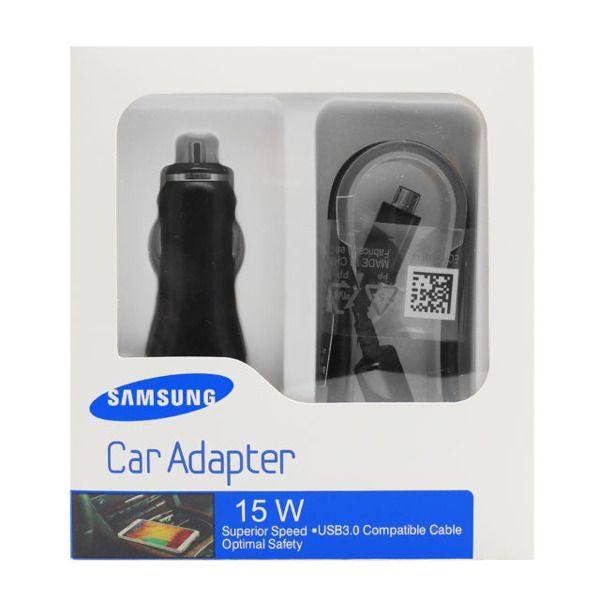
It makes use of a 9V/1.67A charger, which improved on the existing design, by offering up to 75% faster battery topping than conventional 5V, 1A chargers. That accounts for a maximum of 15W charging power.
The charging current is actually adaptive and smartphones can negotiate either regular 5V/2A current or the higher 9V/1.67A current. These chargers are safe for use with regular phones as well. It's up to the phone to determine the charging speed, which is one of the reasons why a more powerful charger does not automatically mean faster charging.
Plenty of the latest devices support Quick Charge 2.0 including the Moto X 2nd gen and the Nexus 6, the Samsung Galaxy Note 4 and Galaxy Note Edge, Sony's Xperia Z3 and Z3 Compact, the HTC One M8 and the Xiaomi Mi 4. Not to mention the more recent HTC One M9 and the LG G Flex2, which utilize Qualcomm's latest Snapdragon 810.
To put the technology in perspective, Qualcomm quotes a laboratory test that they've carried out where within a 30-minute charging window a smartphone with a 3300mAh battery would charge the following:
- from 0% to 60% with Quick Charge 2.0 (9 volt/1.67 amp)
- from 0 to 30% with Quick Charge 1.0 (5 volt/2 amp)
- from 0% to 12% with a conventional charger (5 volt/1 amp)
Power Source
- Car Lighter Slot
Color
- Black