


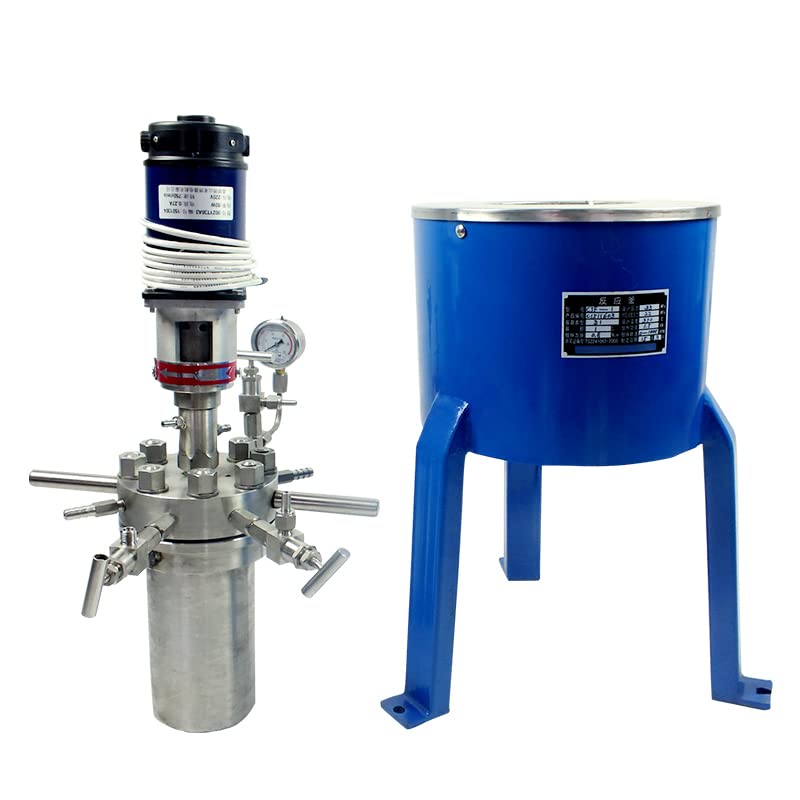


Characteristics and Uses:
- FCF/CJF series laboratory high pressure reaction kettle is gas-liquid,liquid-liquid, liquid-solid or gas-liquid-solid three-phase chemical materials for chemical reaction stirring reaction device,can make all kinds of chemical materials in high pressure, vacuum,temperature stirring fully, in order to strengthen the mass transfer and heat transfer process.
- The main features of this device are static seal structure, magnetic coupler is used to connect the agitator and motor drive, because of its non-contact torque transfer, static seal instead of dynamic seal, can completely solve the leakage problem of stirring, so that the whole medium and stirring components are completely in the state of absolute seal to work.
- The device are more suitable for a variety of flammable, explosive, highly toxic, valuable media and other chemical media with strong penetration.The product integrates stirring,heating and high-pressure reaction. It is a combination of Mechanical stirrer and stainless steel high-pressure reactor for reducing the cost of research unit. The equipment is more versatile and reduce costs for user and widely used in colleges and universities, environmental protection, biochemistry, medical treatment, scientific research and other fields.
Features of the product:
- Miniaturized design: Micro reactors are usually designed to be miniaturized, occupying less space and suitable for limited space in the laboratory. This also makes it more flexible and easier to transport in the laboratory.
- Low reaction volume: The reaction volume of microreactors is usually small, generally between a few milliliters and several liters, which reduces the amount of reagents and raw materials required when conducting experiments, reducing costs and resource consumption.
- Rapid heating and cooling: Microreactors usually have faster heating and cooling speeds, allowing reactions to be carried out and controlled faster, improving the efficiency of experiments.
- Precise control: Micro reactors are usually equipped with precise parameter control systems such as temperature, pressure and stirring, so that experimental conditions can be better controlled and adjusted, thereby ensuring the accuracy and reproducibility of experimental results.
- Versatility: Micro reactors usually have high versatility and can carry out various types of chemical reactions, such as solution reactions, gas phase reactions, solid phase reactions, etc. They can also be used for the synthesis of organic compounds, catalyst preparation, biological Chemical experiments and other fields.
- Safety: Micro reactors usually have good safety performance and are designed with explosion-proof, leak-proof and other safety devices, which reduce safety risks in experimental operations.
About item:
1. 304L/316L Stainless Steel: The main part of the lab stirrer high pressure reactor is made of 304L/316L stainless steel, which has stable performance and is resistant to high temperature and corrosion. Equipped with a temperature probe, it can penetrate deep into the interior of the reaction vessel to monitor the reaction temperature.
2. Explosion-Proof Valve: The high-pressure Mechanical stirring reactor adopts stainless steel explosion-proof valve, which is safe and reliable. Equipped with pressure gauge, the instrument indication is stable and clear, and the reaction pressure in the kettle can be monitored in real time.
3. Non-Leakage Design: Adopting Mechanical stirring mode to ensure that the medium and stirring components are in a sealed state, ensuring no leakage. The stainless steel reactor is equipped with an air inlet valve, a sampling valve, an exhaust valve to ensure the smooth progress of the reaction.
4. Split Design: Split design, the reactor body and the heater can be quickly separated to achieve the purpose of cooling, easier to disassemble and replace. And it adopts liquid crystal control panel with precise control and adjustable temperature and speed.
5. Wide Application: The lab reactor is suitable for various reactions such as gas-liquid reactions, liquid-liquid reactions and liquid-solid-gas reactions. More suitable for stirring reactions in highly permeable chemical media. It integrates stirring, heating, and reaction, with a wider range of applications.
Use and precautions:
1.The main sealing port of the autoclave adopts the line contact of the gasket or the tapered surface and the circular arc surface. By tightening the main nut, they are pressed against each other to achieve a good sealing effect. When tightening the nut, the angle must be symmetrical several times and tightened gradually. The force should be even. Do not allow the lid to tilt to one side to achieve a good sealing effect. Do not exceed the specified tightening torque 40~120nm range when tightening the main nut to prevent the sealing surface from being crushed or overloaded. The sealing surface should be specially taken care of. Wipe the upper and lower sealing surfaces with a softer paper or cloth before each installation. Pay special attention not to touch the sealing surface of the kettle body and the lid of the kettle. If reasonably operated, it can be used more than 10,000 times. Once the sealing surface is broken, it needs to be reworked to achieve good sealing performance. Lift the lid up and down slowly when removing the lid. It is forbidden to collide with the sealing surfaces between the kettle body and the kettle lid. If the seal type is gasketed (tetrafluoro, aluminum pad, copper, asbestos pad, etc.), a good sealing effect can be achieved by tightening the main nut.
2.The temperature of external heating during work is recommended not to exceed 220℃, the heating rate is ≤ 5℃/min, can be controlled by PID temperature control system, the cooling rate is ≤ 5℃/min. Safety pressure is 22 MPa.
3.The screw is symmetrically pressed after feeding.When the reaction is completed, the kettle body is naturally cooled to room temperature and then open the kettle cover.
4.Do not fill more than 80% in the kettle.
Note:
Our autoclave products support capacity, temperature, pressure or material customization, if you have customization needs, please contact us!
| Name | Teachnical Parameter | |||||||||
Hight Pressure Reactor | Reactor | Model | CJF-0.05 | CJF-0.1 | CJF-0.25 | CJF-0.5 | CJF-1 | CJF-2 | CJF-3 | CJF-5 |
| Volume | 0.05L | 0.1L | 0.25L | 0.5L | 1L | 2L | 3L | 5L | ||
| Material | Stainless Steel 304 or 316L | |||||||||
| Design Pressure | 22MPa | |||||||||
| Design Temperature | 350℃ | |||||||||
| Stirring | Sealing Method | static sealing , a type hard sealing | magnetic rotation, static sealing | magnetic rotation, a type hard sealing | ||||||
| Stirring Speed | magnetic mechanical sti | |||||||||
| Stirring Form | magnetic mechanical stirring,frequency control | |||||||||
| Heating Method | electrical machanical stirring,frequency control | |||||||||
| Heating Power | 110/220V 0.6KW | 110/220V 0.8KW | 110/220V 0.6KW | 110/220V 1.8KW | 110/220V 2KW | 110/220V 2.5KW | 220V 4KW | 220V 5.5KW | ||
| Motor Power | 140W | |||||||||
Temperature Control precision | ±1 | |||||||||
| Control | Speed regulation | |||||||||
| Temperature control | ||||||||||
| Temperature Display | ||||||||||
| Rotary speed display | ||||||||||
| Port | Gas phase Port is equipped with needle valve | Gas phase Port is equipped with needle valve | ||||||||
Vent Port is equipped with needle valve | Vent Port | |||||||||
Temparature measureing Port is equipped with probe | Tempareture measure | |||||||||
| N/A | Stirring Port is equipped with coupling | |||||||||
| N/A | Pressure safety anti-explosion Port is equipped with pressure gage and rupure disc | |||||||||
| N/A | Liquid phase Port is equipped with needle valve with bottom tube(used for sampling or dischaaarging) | |||||||||
