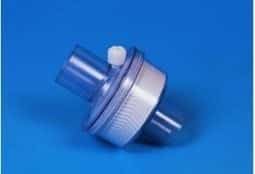
Heat and Moisture Exchanger New Branded (PACK OF 10 PIECES)
This product data sheet is originally written in English.
OVERVIEW
- Heat and Moisture Exchanger (HME)
- those in current use are generally combined with a microbiological filter, hence they are called HME filters (HMEF)
- when passive humidification using an HME is use, the circuit is termed a “dry circuit” as a opposed to a “wet circuit” using active humidification.
USES
- humidification, warming inspired gases and microbiological filtration
- best used in patients with few secretions, who are not hypothermic, do not have large air leaks and do not have high airway resistance.
DESCRIPTION
- Generally contains a layer of foam or paper embedded with a hydroscopic salt such as calcium chloride
- Bacterial and viral filters ideally have filtration efficiency of >99.9%
- HME with humidification efficiency >30mg.H2O/L
- connects to a standard 15mm connector on an endotracheal tube
METHOD OF INSERTION AND/OR USE
- placed in line between Y-piece of breathing circuit and ETT
OTHER INFORMATION.
Benefits
- ease of use
- light
- can retain their ability to humidify for up to 4 days with minimal change in resistance
- less cumbersome during transport
- lower staff workload
- lower costs
- decreases ventilatory acquired pneumonia (Kola et al, 2005)
Mechanism of heating and humidification
- contains a layer of foam or paper embedded with a hygroscopic salt such as calcium chloride
- expired gas cools as it crosses the membrane, resulting in condensation and release of the mass enthalpy of vaporisation to the HME layer
- on inspiration absorbed heat evaporates the condensate and warms the gas, the hygroscopic salt releases water molecules when the vapor pressure is low
- warming and humidification is thus regulated by the moisture content of the expired gas and patient’s core temperature
- a filter layer is also present, either an electrostatically charged or a pleated hydrophobic layer, the latter helps return moisture to the gas as condensation and evaporation occurs between the pleats
Mechanism of filtration
- Filtration is achieved for larger particles (>0.3 µm) by inertial impaction and interception
- Smaller particles(<0.3 µm) are captured by Brownian diffusion.
COMPLICATIONS/DISADVANTAGES
- inability to use with all patients (haemoptysis, tenacious secretions)
- increased airways resistance
- increased dead space
- potential for unrecognized airway obstruction if filter blocks
- less than full humidification and body temperature
- drying of secretions
- not appropriate for patients with large air leaks (e.g. bronchopleural fistulae) due extensive loss of inspired gas and inability to conserve heat and humidity