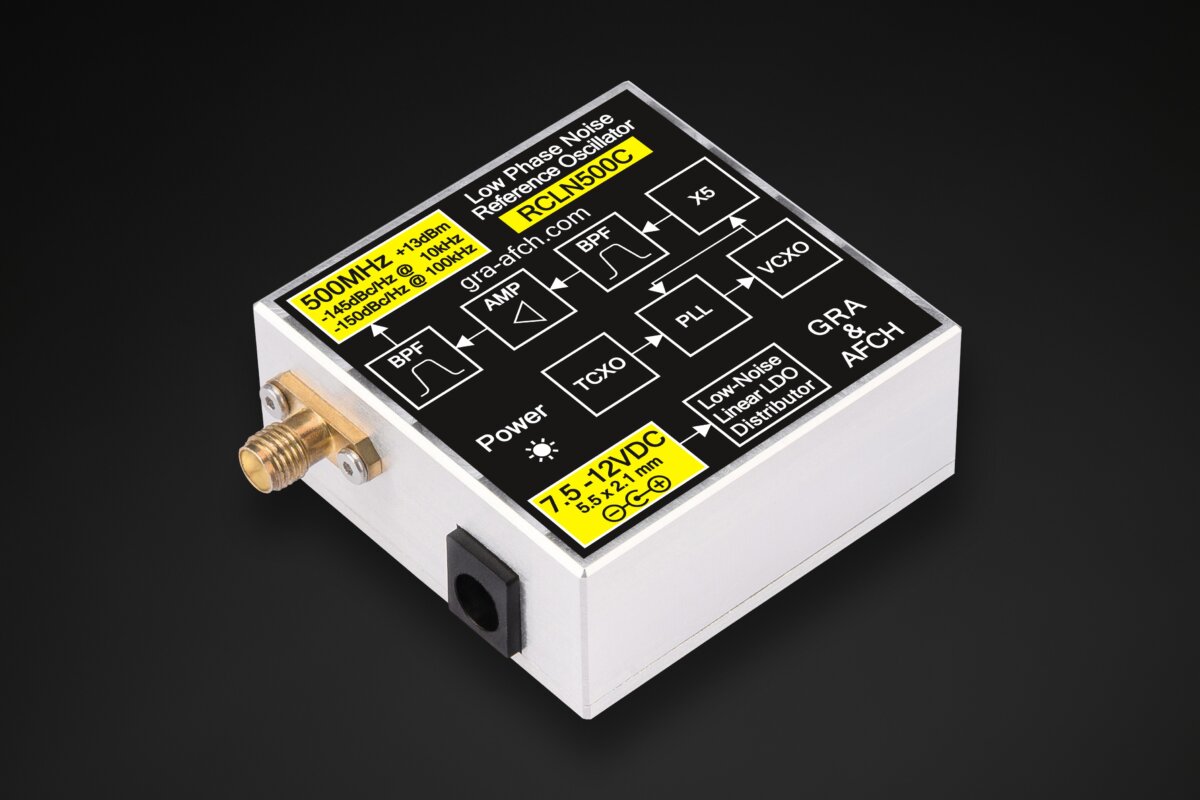
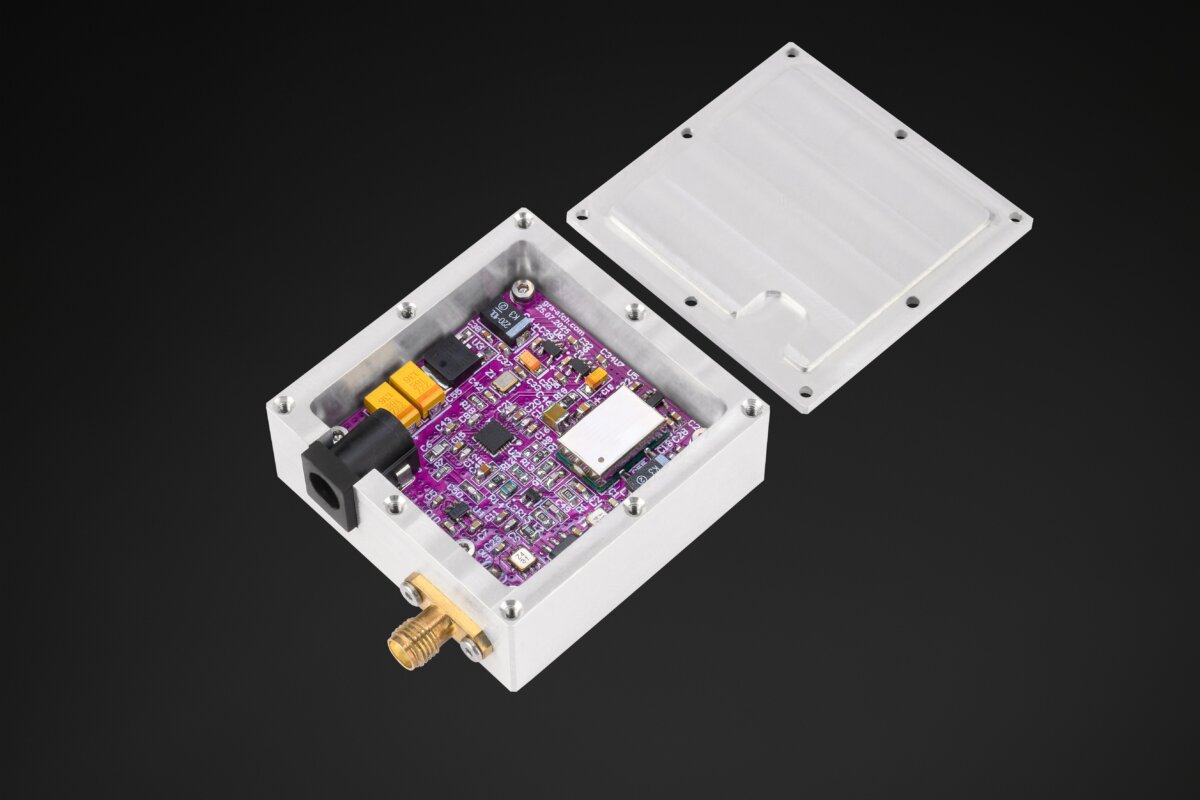
The RCLN500C Oscillator is built on a VCXO and a high-speed comparator
It generates clean rectangular CMOS signal
This approach enables precise odd-order frequency multiplication
In this design by a factor of 5, without introducing additional phase noise
To further improve frequency accuracy the oscillator incorporates a Phase-Locked Loop (PLL)
with a Temperature-Compensated Crystal Oscillator (TCXO) as the reference
ensuring outstanding stability and reliability across a wide temperature range
Listing includes:
Low Phase Noise Reference Oscillator RF Unit [RCLN500С] (500 MHz)
Aluminum Case [RCLN1000] (included with the Oscillator)
Dear customers! If you have ANY questions, PLEASE ASK us
General information:
RCLN500C is engineered as a high-performance reference source, delivering low phase noise, excellent spectral purity, and superior frequency stability.
With an affordable price, low phase noise, high temperature stability, and excellent noise immunity enabled by its thick aluminum housing this device stands out as an excellent choice among competing products.
Ideal for use with high-speed digital and mixed-signal systems such as DDS, ADCs, DACs, and other precision RF systems.
When it comes to Direct Digital Synthesizers (DDS), the quality of the output signal is directly determined by the characteristics of the reference clock source. In RF modules based on the AD9959, using an external low-phase-noise 500 MHz clock oscillator provides a significant advantage over the internal PLL frequency multipliers integrated within the DDS chips.
These internal PLLs are low-cost compromise solutions — for example, the built-in PLL in AD9959 typically exhibits a phase noise of around – 116 dBc/Hz at 10 kHz offset – and they introduce a considerable amount of spurious spectral components (spurs), degrading signal purity and preventing the DDS from reaching its full performance potential. Our RCLN500C oscillator, under the same conditions (at 500 MHz), is capable of delivering a signal with phase noise of -145 dBc/Hz at 10 kHz offset.
Key parameters of the reference clock source include phase noise (measured in dBc/Hz, where lower is better), frequency stability (in PPM), as well as minimal harmonic content and absence of spurious signals in the spectrum. All of these directly affect the output quality of the DDS: any spectral impurity or noise present in the reference clock will inevitably appear in the output signal spectrum of the synthesizer.
DDS9959 Phase Nose PLL vs External Clocking
The pursuit of achieving the lowest possible phase noise in the oscillator inevitably leads to increased cost. That is why we offer our customers a product line that is conditionally divided into two categories:
Base – Low Phase Noise, with typical performance in the range of approximately –136 to –139 dBc/Hz @ 10kHz offset Premium – Ultra-Low Phase Noise, with performance in the range of –140 to –150 dBc/Hz @ 10kHz offset
Description:
The core of RCLN500C oscillator is a specialized Voltage-Controlled Crystal Oscillator (VCXO) operating at 100 MHz with low phase noise of -168 dBc/Hz at 10 kHz offset.
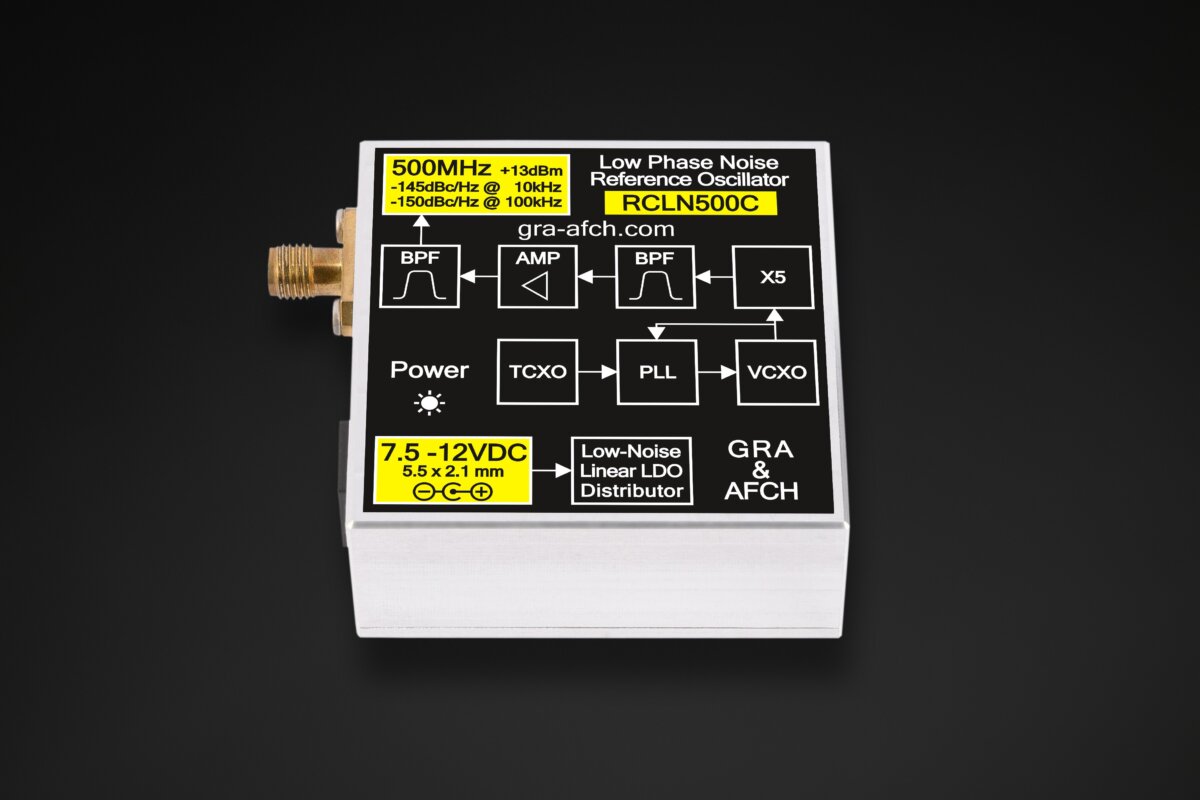
While VCXOs inherently provide low phase noise, they cannot directly operate at high frequencies without external frequency multipliers. Additionally, they are susceptible to temperature-induced instability— even small temperature variations can cause significant frequency drift. To address these challenges, we implemented CMOS-comparator-based frequency multiplier with amplification using low-noise monolithic RF amplifiers. Furthermore, we integrated a Phase-Locked Loop (PLL) system with a temperature-compensated crystal oscillator (TCXO) as a reference, achieving precise frequency stabilization via feedback control. Since PLL systems naturally introduce additional phase noise, we employed an ultra-narrow loop filter bandwidth of just 10 Hz to maintain the VCXO’s low phase noise without adding extraneous noise.
For suppression of unwanted harmonics, the design employs state-of-the-art, high-quality bandpass SAW filters. Filters are placed both after the multiplier and after the amplifier, while the amplifier ensures the output signal level reaches +13 dBm.
To minimize crosstalk between internal modules, the system utilizes five independent power lines, each regulated by a low-dropout (LDO) low-noise voltage regulator, ensuring minimal phase noise and maximum signal integrity.
The 500 MHz output frequency makes this oscillator an ideal solution for use together with the DDS9959 based on the AD9959 chip.
The block diagram of RCLN500C oscillator is as follows:
Specifications:
500 MHz Fixed Frequency
Low Phase Noise: -145 dBc/Hz @ 10 kHz
Spurious suppression: < -48 dBc
Output Power: +13 dBm
Supply Voltage: 7.5…12 VDC
Supply Current: 150 mA
Operating Temperature: 0°C to +70°C
Frequency Stability (0-70°С): ±0.5 ppm (±500 Hz)
Stability per degree: 0.004 ppm/°C (4 Hz/°C)
Case Material: Aluminum
Dimensions: 50х50х22 mm
Weight: 150 g
Power Connector: 5.5×2.1 mm (+ in center)
RF Connector: SMA
We are offering custom design development for this Unit for 1200$. This comes with condition that at least 10 pieces of them will be ordered then
Applications:
Frequency Synthesizers (DDS)
Local Oscillators
Receivers
Wireless Communications
SATCOM
Optical Communications
Actual Phase Noise Performance:
RCLN500C Phase Noise
This graph demonstrates the outstanding phase noise performance of the RCLN500C oscillator. Starting from a 10 kHz offset, the noise level confidently drops below -145 dBc/Hz, reaching -152 dBc/Hz at a 1 MHz offset. This confirms the exceptional signal quality and makes it a benchmark solution for the most demanding applications.
Spectrograms:
RCLN500C Spectrogram Span 100 MHz
RCLN500C Spectrogram Span 1.75 GHz
Phase Noise comparison Diagram for DDS9912 RF Unit output with RCLN Oscillators:
Phase Noise comparison Diagram DDS9912 output at 100MHz with RCLN(s) at 1GHz
Phase Noise comparison Diagram DDS9912 output at 400MHz with RCLN(s) at 1GHz
Applications:
Telecommunications:
Low phase noise oscillators are very important for modern telecommunication systems. They provide signal stability and accuracy under the conditions of transmitting large volumes of data. In mobile networks and fiberoptic communication systems frequency control accuracy is needed to prevent interference and ensure high data transmission speeds. Low phase noise allows for improved communication quality, especially in the high-frequency range, where interference can be particularly noticeable.
Radio Astronomy:
In radio astronomy low-phase noise oscillators are used in radio telescopes to enhance the quality of observations. This allows for improved accuracy of measurements and the quality of the obtained data. They are also used in complex systems, such as interferometers, where signals from different antennas need to be precisely synchronized.
Radar:
In radar systems low phase noise oscillators allow for improved accuracy in determining the distance to objects. The accuracy of frequency, as well as stability and low noise level, are important when locating objects. Lower phase noise can lead to more accurate location and identification of objects, especially at long distances.
RCLN500C Low Noise Reference Oscillator by GRA & AFCH:
Dear customers! If you have ANY questions, PLEASE ASK us


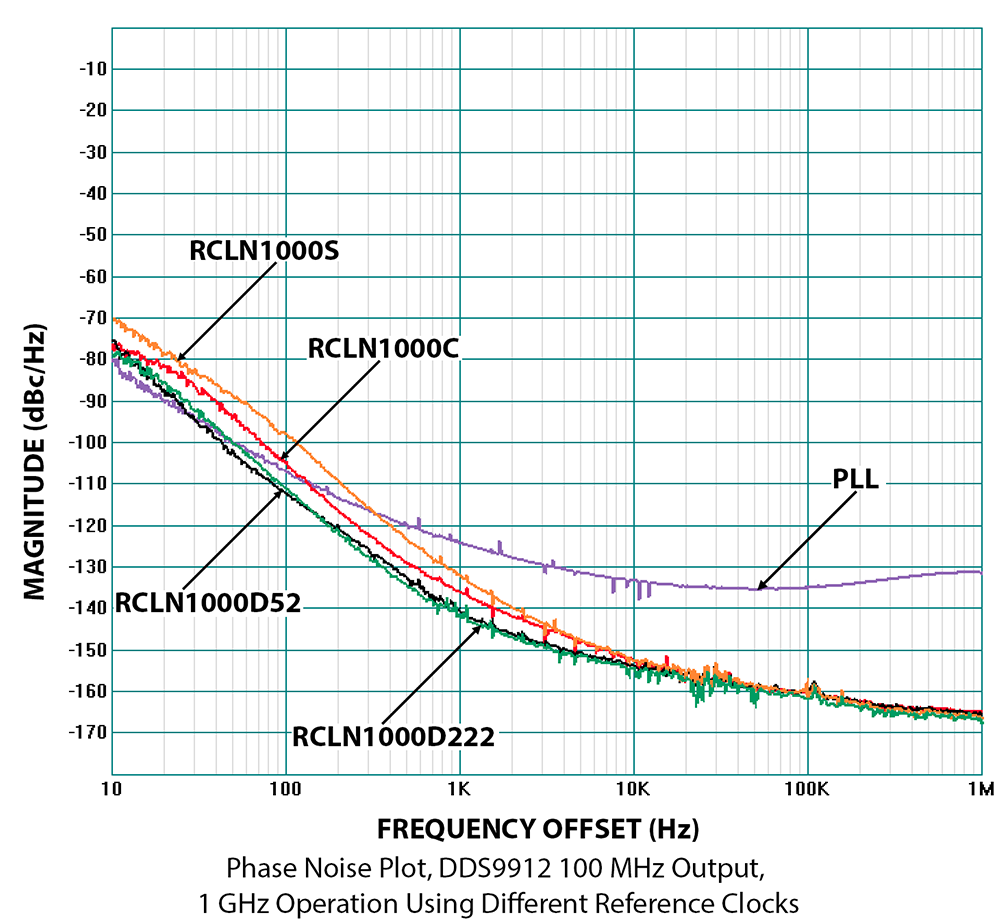 Phase Noise comparison Diagram DDS9912 output at 100MHz with RCLN(s) at 1GHz
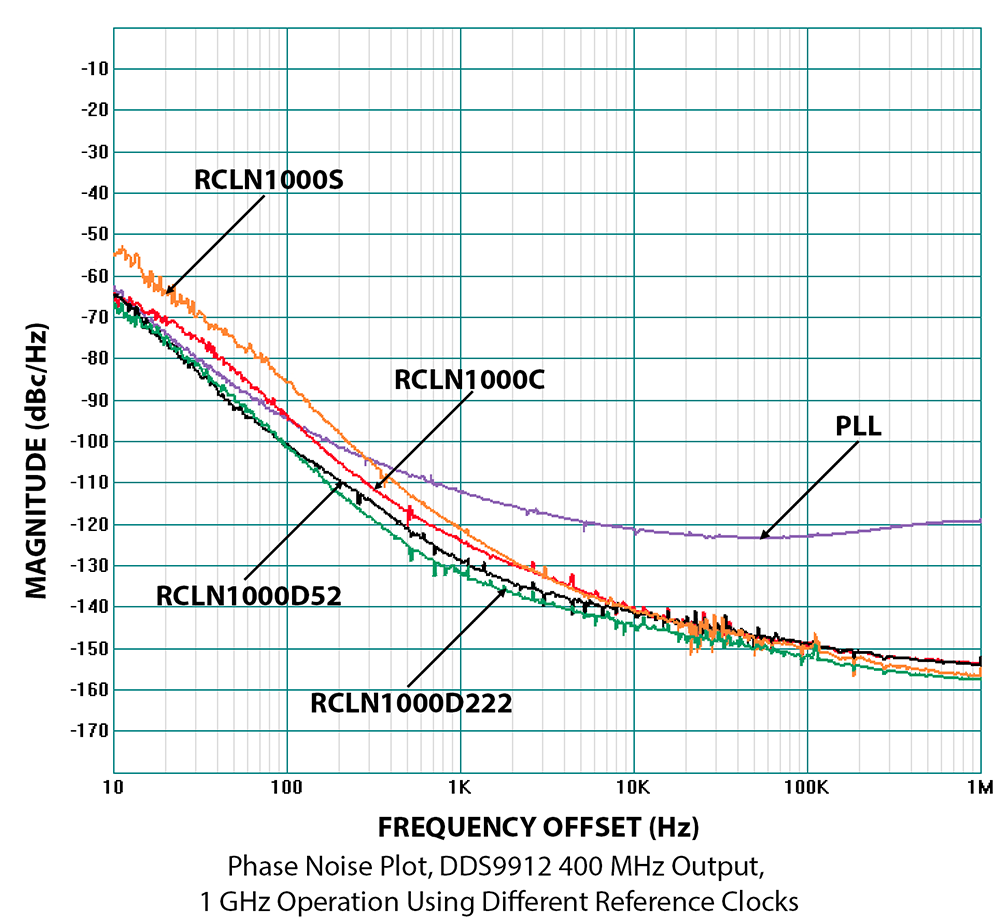 Phase Noise comparison Diagram DDS9912 output at 400MHz with RCLN(s) at 1GHz