I HAVE A GREAT SELECTION OF VINTAGE COLECTABLES. MANY UNIQUE VINTAGE GOLF ITEMS AND OTHER FINDS. OVER 100 VINTAGE GOLF BALLS AT A WIDE RANGE OF PRICES, 100s VINTAGE GOLF CLUBS, MONEY CLIPS, TEE, BADGES, MEDALS, DIVOT TOOLS, BALL MARKERS AND MORE. SEE MY STORE AND FOLLOW ME FOR OTHER GREAT UNITQUE GIFTS FOR YOUR FAMILY AND FRIENDS. THERE ARE OVER 800 UNIQUE GIFTS AND COLLETORS ITEMS. SEE THE HISTORY BELOW OF GOLF TEES AND GOLF BALLS, BOTH ARE VERY INTERESTING, BUY A PIECE OF HISTORY FOR YOUR OWN COLLECTION
ANTIQUE VINTAGE ADVERTISING GOLF TEES 4 1/2" PEN TEES GREAT COLLECTION, NO INK IN PEN
I HAVE TAKEN PICTURES AT DIFFERNT ANGLES TO REPRESENT THE CONDITION. LIGHTING MAY BE OFF WITH ITEM LIGHTER OR DARKER THAN PICTURES
Items are guaranteed as described or as pictured.
This is a great collectable that most people have never seen and is a great conversation piece or desktop display. If you are looking for more for your collection or for your man cave, check out my other items for sell.
I will combine
shipping on everything I sell, if items can be shipped in the same
package.
Please take a good look at the pictures to see condition for yourself.
I have been collecting for over 30 years and have a large antique and vintage golf collection. I will be selling a large selection of golf stuff over the next several months.
SOLD AS IS. PLEASE REVIEW ALL PICTURES BEFORE BIDDING. GOOD LUCK.
PLEASE MAKE SURE THIS IS THE ITEM OR ITEMS YOU WANT
HAVE ANY QUESTIONS ON THE ITEM OR ITEMS PLEASE CONTACT ME.
THANKS
The History of Golf Tees
The history of the golf tee dates back to the 1500?s. The practice of getting sand wet with a towel and mounding up earth to get the ball off the ground a little went on for some 300 years. The late 1800?s changed all that. This is the history of the golf tee.
The original rules of golf from 1744 state that your ball must be teed from the ground. Golfers were allowed to go within one club length of the original hole and use elements from the ground to tee it up. As time went on the game grew and there was a need to separate putting areas from teeing grounds. The first course to do this was St. Andrews when Old Tom Morris redesigned the course.
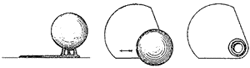
You could imagine the mess you had with just creating one tee. The wet towel and dirty hands gave way to the first golf tees. Golfers where in search of reuseable tees. Starting with paper then cork and rubber. The world's first patented golf tee was invented by two Scots: William Bloxsom and Arthur Douglas. Their patent document is dated 1889 and describes a small rubber plate with a raised ball support in the form of upright prongs or a hollow cylinder. This tee sat up on top of the ground and became cumbersome in windy conditions. There had to be a way to fix it to the ground.
The first invention to stop your ball from rolling away was the Perfectum. The Perfectum was patented in 1892 by Percy Ellis of Surrey, England. It was made of an iron spike base and round rubber pegs to hold the ball in place. The Perfectum was the first tee to be placed in the ground. In 1897, Scottish inventor PM Matthews patented a tee called the Vector with a metal spike and rubber cup to hold the ball which further held the ball in place.
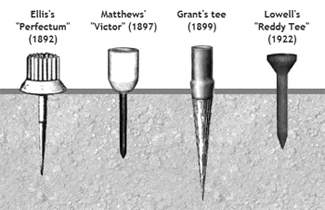
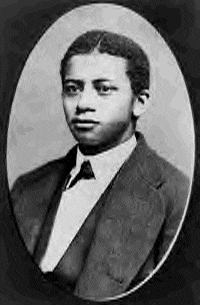
The first really famous patent for a golf tee came from inventor Dr. George Grant. A dentist from the Boston area and one of the first black graduates from Harvard Dental School, Grant invented the first American wooden golf tee. The tee consisted of a wooden peg attached to a rubber tube with a cup on the top to hold the ball. Grant designed the tee to be less rigid at the top and more stable at the bottom. Grant didn't announce, promote, or sell his work and was unnoticed for a long time. Although not the world's first golf tee Grant was credited by the USGA in 1991 as the original inventor of the wooden golf tee.
The first patented and marketed tee was invented by another dentist named Dr. William Lowell. Dr. Lowell's patented Reddy Tee is the first modern golf tee. The familiar one-piece wooden peg with hollowed out top became the standard even today. Dr. Lowell even had golf great Walter Hagen advertising his invention.
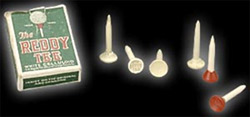
Although there were many other golf tee inventions, these are the main ones. Technology has brought golf a long way and the golf tee is no exception. What's next for the golf tee? It's all up to the Rules of Golf.
Early balls
It is
commonly believed that hard wooden, round balls, made from hardwoods such
as beech and box, were used for golf from the 14th through the 17th
centuries. Though wooden balls were no doubt used for other similar
contemporary stick and ball games, there is no definite evidence that they were
actually used in golf in Scotland. It is equally likely, if not more so,
that leather balls filled with cows' hair were used, imported
from the Netherlands from at least 1486 onward.
Featherie

"Featherie" golf balls
Then or
later, the featherie ball was developed and introduced. A
featherie, or feathery, is a hand-sewn round leather pouch stuffed with chicken or goose feathers and coated with paint,
usually white in color. A standard featherie used a gentleman's top hat full of
feathers. The feathers were boiled and softened before they were stuffed into
the leather pouch. Making a featherie was a tedious and time-consuming
process. An experienced ball maker could only make a few balls in one day, so
they were expensive. A single ball would cost 2–5 shillings, which is equivalent to US$10–20
today.
Guttie
 Three old golf balls,
from the 1919 book Fifty Years of Golf,
by Horace Hutchinson
Three old golf balls,
from the 1919 book Fifty Years of Golf,
by Horace Hutchinson
In 1848, the
Rev. Dr. Robert Adams Paterson(sometimes spelled
Patterson) invented the gutta-percha ball (or guttie, gutty). The
guttie was made from dried sap of the Malaysian sapodilla tree.
The sap had a rubber-like feel and could be made spherical by heating and
shaping it in a mold. Because gutties were cheaper to produce, could be
re-formed if they became out-of-round or damaged, and had improved aerodynamic
qualities, they soon became the preferred ball for use.
Accidentally,
it was discovered that nicks in the guttie from normal use actually provided a
ball with a more consistent ball flight than a guttie with a perfectly smooth
surface. Thus, makers began intentionally making indentations into the surface
of new balls using either a knife or hammer and chisel, giving the guttie a
textured surface. Many patterns were tried and used. These new gutties, with
protruding nubs left by carving patterned paths across the ball's surface,
became known as "brambles" due to their resemblance to bramble fruit (blackberries).
Wound
golf ball
The next
major breakthrough in golf ball development came in 1898. Coburn Haskell
of Cleveland, Ohio, had driven to nearby Akron, Ohio, for a golf date with Bertram Work, the
superintendent of the B.F. Goodrich Company. While he waited in the plant for
Work, Haskell picked up some rubber thread and wound it into a ball. When he
bounced the ball, it flew almost to the ceiling. Work suggested Haskell put a
cover on the creation, and that was the birth of the 20th-century wound golf
ball that would soon replace the guttie bramble ball. The new design became
known as the rubber Haskell golf ball.
For decades,
the wound rubber ball consisted of a liquid-filled or solid round core that was
wound with a layer of rubber thread into a larger round inner core and then
covered with a thin outer shell made of balatá sap. The balatá is a tree native to Central
and South America and the Caribbean. The tree is tapped and the soft, viscous
fluid released is a rubber-like material similar to gutta-percha, which was
found to make an ideal cover for a golf ball. Balatá, however, is relatively
soft. If the leading edge of a highly lofted short iron contacts a
balatá-covered ball in a location other than the bottom of the ball a cut or
"smile" will often be the result, rendering the ball unfit for play.
Addition of dimples
In the early
1900s, it was found that dimpling the ball provided even more control of the
ball's trajectory, flight, and spin. David Stanley Froy, James McHardy, and
Peter G. Fernie received a patent in 1897 for a ball with indentations; Froy
played in the Open in 1900 at the Old Course at St. Andrews with the first
prototype.
Players were
able to put additional backspin on the new wound, dimpled balls when using more
lofted clubs, thus inducing the ball to stop more quickly on the green.
Manufacturers soon began selling various types of golf balls with various
dimple patterns to improve the length, trajectory, spin, and overall
"feel" characteristics of the new wound golf balls. Wound,
balatá-covered golf balls were used into the late 20th century.
Modern
resin and polyurethane covered balls
In the
mid-1960s, a new synthetic resin, an ionomer of ethylene acid named Surlyn was introduced by DuPont as were new urethaneblends for golf ball covers, and these new materials
soon displaced balatá as they proved more durable and more resistant to
cutting.[12]
Along with
various other materials that came into use to replace the rubber-wound internal
sphere, golf balls came to be classified as either two-piece, three-piece, or
four-piece balls, according to the number of layered components. These basic
materials continue to be used in modern balls, with further advances in
technology creating balls that can be customized to a player's strengths and
weaknesses, and even allowing for the combination of characteristics that were
formerly mutually-exclusive.
Titleist's
Pro V1, Taylormade TP5, and Callaway Supersoft exemplify modern advancements in
golf ball aerodynamics. The Titleist Pro V1 boasts a tightly wound 388-dimple
design, minimizing gaps between dimples for better aerodynamics. On the other
hand, the Taylormade TP5 features a combination of circular and hexagonal
dimples to reduce drag. Lastly, Callaway balls showcase a sleek, completely
hexagonal design for straighter ball flights.
Liquid cores
were commonly used in golf balls as early as 1917. The liquid cores in
many of the early balls contained a caustic liquid, typically an alkali, causing eye injuries to children who happened to
dissect a golf ball out of curiosity. By the 1920s, golf ball manufacturers had
stopped using caustic liquids, but into the 1970s and 1980s golf balls were
still at times exploding when dissected and were causing injuries due to the
presence of crushed crystalline material present in the liquid cores.
In 1967,
Spalding purchased a patent for a solid golf ball from Jim Bartsch. His
original patent defined a ball devoid of the layers in earlier designs, but
Bartsch's patent lacked the chemical properties needed for manufacturing.
Spalding's chemical engineering team developed a chemical resin that eliminated
the need for the layered components entirely. Since then, the majority of
non-professional golfers have transitioned to using solid core (or
"2-piece") golf balls.
The
specifications for the golf ball continue to be governed by the ruling bodies
of the game; namely, The R&A, and the United States Golf Association (USGA).