|
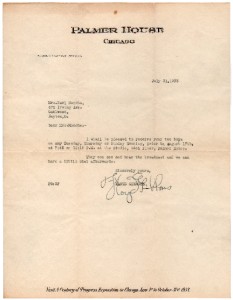
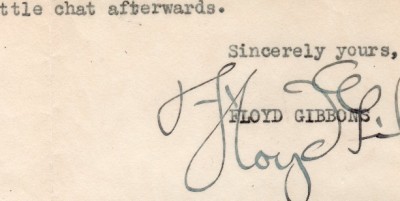
1933 Floyd Gibbons, War Correspondent - Typed Letter SIGNED Palmer House Chicago
Floyd Phillips Gibbons (1887 – September 1939) was the war correspondent for the Chicago Tribune during World War I. One of radio's first news reporters and commentators, he was famous for a fast-talking delivery style. Floyd Gibbons lived a life of danger of which he often wrote and spoke. Gibbons started with the Tribune in 1907. He became well known for covering the Pancho Villa Expedition in 1916, and for reporting on the 1917 torpedoing of the British ship Laconia, on which he was a passenger. As a World War I correspondent at the Battle of Belleau Wood, France, Gibbons lost an eye after being hit by German gunfire while attempting to rescue an American soldier. In August 1918, Gibbons was given France's greatest honor, the Croix de Guerre with Palm, for his valor on the field of battle. On June 21, 1941, Marine Corps League State Commandant Roland L. Young posthumously awarded Gibbons a gold medal, making him an honorary member of the Marine Corps. It was the first such civilian honor ever made in the history of the Marine Corps League. In the 1920s and 1930s, Gibbons was widely known as a radio commentator and narrator of newsreels, for which he received a star on the Hollywood Walk of Fame. In 1927 he wrote a biography of the Red Baron called The Red Knight of Germany. He also wrote the speculative fiction novel The Red Napoleon in 1929. Gibbons was the narrator for the documentary film With Byrd at the South Pole (1930). In 1929, he had his own half-hour radio program heard Wednesday nights on the NBC Red Network at 10:30, however competition from Paul Whiteman's show on CBS Radio brought the show to an end by March 1930. When Gibbons suggested that Frank Buck write about Buck's animal collecting adventures, Buck collaborated with Edward Anthony on Bring 'Em Back Alive which became a bestseller in 1930. Gibbons died of a heart attack in September 1939 at his farm in Pennsylvania. Condition: Letter has edge wear and creasing. Also has some yellowing due to age. (Please see pictures). Comes in a protective sleeve. #F3/S/E
Every autograph comes unconditionally guaranteed authentic. I do not sell copies. I work with reputable dealers and stand behind all my items. I will send an invoice for your records and if the item is discovered not to be authentic return it for a full refund. Please note-foreign orders are gladly welcome, however, as these are one of a kind originals, we shall ship Priority Mail International.
|