
アンバウンド・アンド・デンジャラス"
JAPAN ONLY HIGH QUALITY BLU-SPEC CD2 FORMAT
JAPAN ONLY "NEW MUSIC FRIDAYS" BLUE HYPE STICKER
Blu-spec CD2 made and printed in Japan
+ 1x JAPAN PREORDER ONLY LIMITED EDITION PROMO ("NOT FOR SALE") 24x24cm MEGAJACKET (メガジャケ)
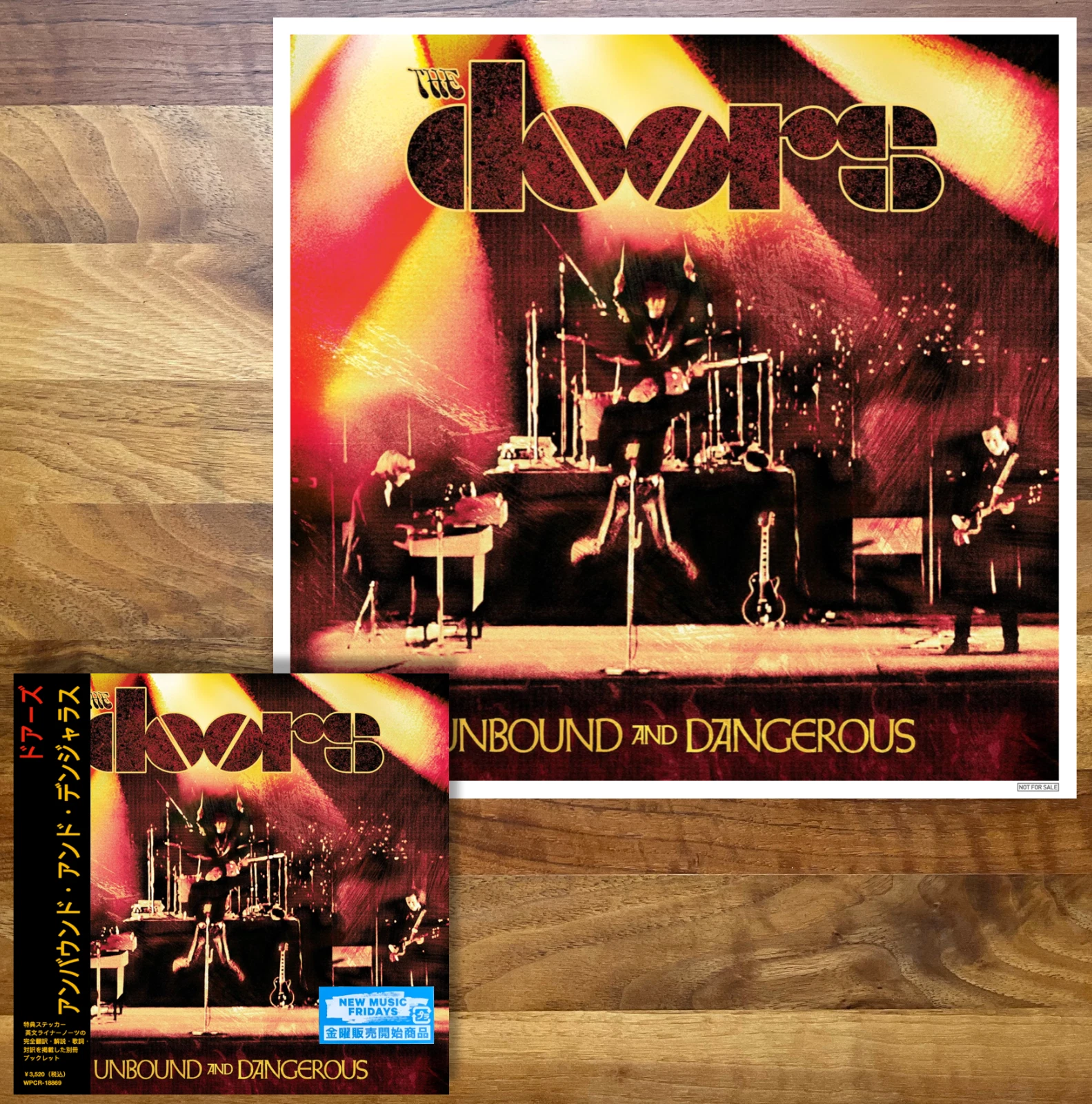
A new live album focusing on The Doors' 1970 tour, "Unbound and Dangerous," will be released worldwide on October 23rd!
The Doors' surviving members Robbie Krieger and John Densmore, along with their longtime engineer and mixer Bruce Botnick, have completed a new live collection, "Unbound and Dangerous," which revisits and oversees their 1970 Roadhouse Blues Tour. Focusing on hard rock performances, the collection captures The Doors at their most menacing and bluesy peak, with breathtaking tempos. The 16-track collection will be released on October 23rd as a Blu-spec CD2 in Japan, which includes a separate booklet with a complete translation of the English liner notes, commentary, lyrics, and translations, as well as a special sticker.
"Morrison Hotel," released in February 1970, became The Doors' fifth consecutive album to reach the top 10 of the US charts, reaching number 4 in the US and receiving critical acclaim for its raw mix of blues and rock. The Doors started their "Roadhouse Blues Tour" in New York in January 1970, playing 20 shows in the US and Canada, plus one show at the Isle of Wight Festival. Some of the recordings from this tour were made into the group's first live album, "Absolutely Live," released in July of the same year, which also became a top 10 hit.
Krieger, Densmore, and Botnick remixed these recordings with performances from New York, Philadelphia, Pittsburgh, and Detroit to create this work, "Unbound and Dangerous." "Soul Kitchen" is the only exception, taken from the second performance at the Aquarius Theatre in Hollywood on July 21, 1969.
This collection begins with "Dead Cats, Dead Rats" as an introduction, then launches into "Break On Through (To The Other Side)" with overwhelming force, and quickly shifts down to an epic psychedelic journey with "When The Music's Over." From there, the band doesn't slow down, powerfully performing rock songs like "Roadhouse Blues," "Five To One," and "Build Me A Woman," before concluding the show with a 15-minute apocalyptic version of "The End," which begins with Morrison repeatedly shouting "Bring out your dead!", and the band relentlessly plunges into the song's dark subconscious.
In the new liner notes by Krieger, Densmore, and Botnick, they compare Jim Morrison at the time to Henri Matisse, the Fauvist painter of the early 1900s whose work was so revolutionary that it was viewed as dangerous by the art world. Half a century later, The Doors gained a similar reputation with their album "Light My Fire." Three men who lived through that era discuss what that danger meant.
"From the start, we knew Jim was dangerous. Talented, and dangerous," says drummer John Densmore. "He wanted to try everything. And then there was his words. That's what attracted me... His words were about freedom. Freedom of speech, the freedom to be free. He wanted to liberate us all. What a gift. This live album captures his unrestrained spirit."
"I don't really understand why The Doors were seen as dangerous," says guitarist Robbie Krieger. "These guys in the '60s, anything goes. I didn't really think Jim was dangerous... When the Kennedy brothers were assassinated and the Vietnam War was dragging on, that was dangerous, not The Doors... The closest we came to danger was when the crowds were going wild in Miami or Cleveland."
"Danger is equivalent to excitement," Botnick says. "Thousands of fans came to Doors concerts seeking danger and excitement. Jim always read the atmosphere in the venue and knew how far he should push the boundaries... There was always a sense of tension, like, 'Is he going to do something really dangerous?'"

<収録内容>
01. イントロダクション / Introduction (Live, 1970) [2026 Mix]
02. デッド・キャット、デッド・ラット / Dead Cats, Dead Rats (Live, 1970) [2026 Mix]
03. ブレーク・オン・スルー / Break On Through (To The Other Side) (Live, 1970) [2026 Mix]
04. 音楽が終ったら / When The Music’s Over (Live, 1970) [2026 Mix]
05. ロードハウス・ブルース / Roadhouse Blues (Live, 1970) [2026 Mix]
06. アラバマ・ソング / Alabama Song (Whisky Bar) (Live, 1970) [2026 Mix]
07. バック・ドア・マン / Back Door Man (Live, 1970) [2026 Mix]
08. ファイヴ・トゥ・ワン / Five To One (Live, 1970) [2026 Mix]
09. ビルド・ミー・ア・ウーマン / Build Me A Woman (Live, 1970) [2026 Mix]
10. ペティション・ザ・ロード / Petition The Lord (Live, 1970) [2026 Mix]
11. ハートに火をつけて / Light My Fire (Live, 1970) [2026 Mix]
12. クローリング・キング・スネイク / Crawling King Snake (Live, 1970) [2026 Mix]
13. ソウル・キッチン / Soul Kitchen (Live, 1969) [2026 Mix]
14. ブリング・アウト・ユア・デッド / Bring Out Your Dead (Live, 1970) [2026 Mix]
15. ジ・エンド / The End (Live, 1970) [2026 Mix]
16. サンキュー・アンド・グッド・ナイト / Thank You And Good Night (Live, 1970) [2026 Mix]

ABOUT BLU-SPEC CD2
Blu-spec CD describes a Red Book Compact Disc manufactured by a proprietary process introduced by Sony Music Entertainment Japan in late 2008.Its name derives from the similar manufacturing process to that used to create Blu-ray Discs. Instead of a traditional infra-red laser, a blue laser is used for recording the pits on the CD master that is needed for disc replication. The blue laser creates more precise pits, which Sony claims reduces distortion in the optical read-out process.
On 28 September 2012, Sony Music Entertainment Japan announced "Blu-spec CD2" or BSCD2, a progression of the Blu-spec CD format which employs a more precise BD cutting machine, a master disc that is made from the same smooth material as silicon wafers for chip manufacture, and a different recording layer material for the master disc. Sony refers to this process as "Phase Transition Mastering".