
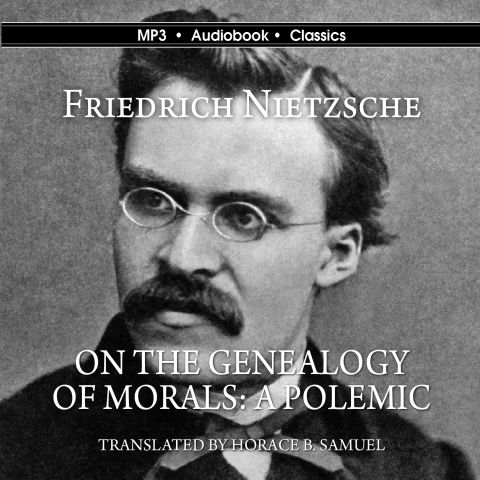
On the Genealogy of Morals
Friedrich Nietzsche
Friedrich Nietzsche set out to dig into “the origin of our moral prejudices” in On the Genealogy of Morals, also titled On the Genealogy of Morality: A Polemic. In doing so he carried forward his thinking expressed first in Human, All Too Human (1878) and more deeply in Beyond Good and Evil (1886). Consisting of a preface and three extended treatises, it is the most systematic of his works, and considered as his masterpiece by many scholars. The first treatise outlines two very concepts of good that eventually oppose one another. The first exists paired with “good and bad”, a dualism of pure power characterized by the Roman worldview, while the second exists in the “good and evil” dualism characterized by the “ressentiment” of the meek and powerless in the Judeo-Christian tradition. The second treatise delves into the roots of guilt and punishment in anger and the need for compensation, and poses the notion of “bad conscience” as will to power unnaturally turned inward. The third treatise deals with ascetic ideals from the several perspectives of artists, philosophers, women, priests, saints, and, more recently, scientists and historians. He fears that the “will to truth” which is fostered by the ascetic ideal may well foster a truth that then imperils its objective. By applying the historical technique of genealogy to the birth, scope and decline of ideologies over time, Nietzsche brings a Darwinian perspective to the evolution of ethics, and, by doing so, gives a deeper understanding of “the value of our values”.
Play sample:
Product Details
| Read by: | Jeffrey Church |
| Length: | 5 hours and 44 minutes |
| Type: | Solo reading |
| Media: | MP3 CD |
| Package: | CD jacket |
| Item No.: | CJ-1152 |
| EAN: | 0682550992341 |
| List Price: | $9.99 |
Credits
Production
Book Coordinator: Jeffrey Church
Meta Coordinator: Availle
Artwork
Cover: Friedrich Nietzsche circa 1875 by F. Hartmann, Basel.
Inset: Portrait of Friedrich Nietzsche, 1882, by photographer Gustav Schultze.
The Recordings
About MP3 Audio
This MP3 digital audiobook is duplicated on compact disc in the MP3 audio format and is designed to play on any computer. It will play on CD and DVD players that are designed with MP3 capability. The files contained in an MP3 CD can be imported and played on mobile devices such as the iPod, iPhone, iPad, Android tablets and smart phones and on PSP (Play Station Portable) and PDA (Personal Digital Assistant) devices. Your CD/DVD player or mobile device owner’s manual should specify whether the device has MP3 compatibility. If the device is not directly compatible with the MP3 Audio format, the files on the MP3 CD can be copied onto a computer drive and then played on the computer media player or transferred to a mobile device.
The Recordings
These recordings were made using the author’s original published work, which is in the public domain. The readings were recorded by members of Librivox.org, which has generously made the recordings available to the public domain. While Librivox condones the sale and distribution of these recordings, it is not associated with the management or operations of MP3 Audiobook Classics. The audio files have been lightly edited and have been engineered using professional audio tools for maximum sonic quality. We spend considerable time and effort to ensure the recordings are free of noise, equalized for maximum listener pleasure, and that tracks are leveled and normalized to provide a consistent listening experience.
Table of Contents
| Track | Section | Length |
| 1 | 00 - Preface | 22:23 |
| 2 | 01 - First Essay Part 1 | 38:02 |
| 3 | 02 - First Essay Part 2 | 36:10 |
| 4 | 03 - Second Essay Part 1 | 52:07 |
| 5 | 04 - Second Essay Part 2 | 42:34 |
| 6 | 05 - Third Essay Part 1 | 50:47 |
| 7 | 06 - Third Essay Part 2 | 48:54 |
| 8 | 07 - Third Essay Part 3 | 52:40 |
Terms and Conditions
Terms of Sale
|
Payments |
Shipping |
Returns |