
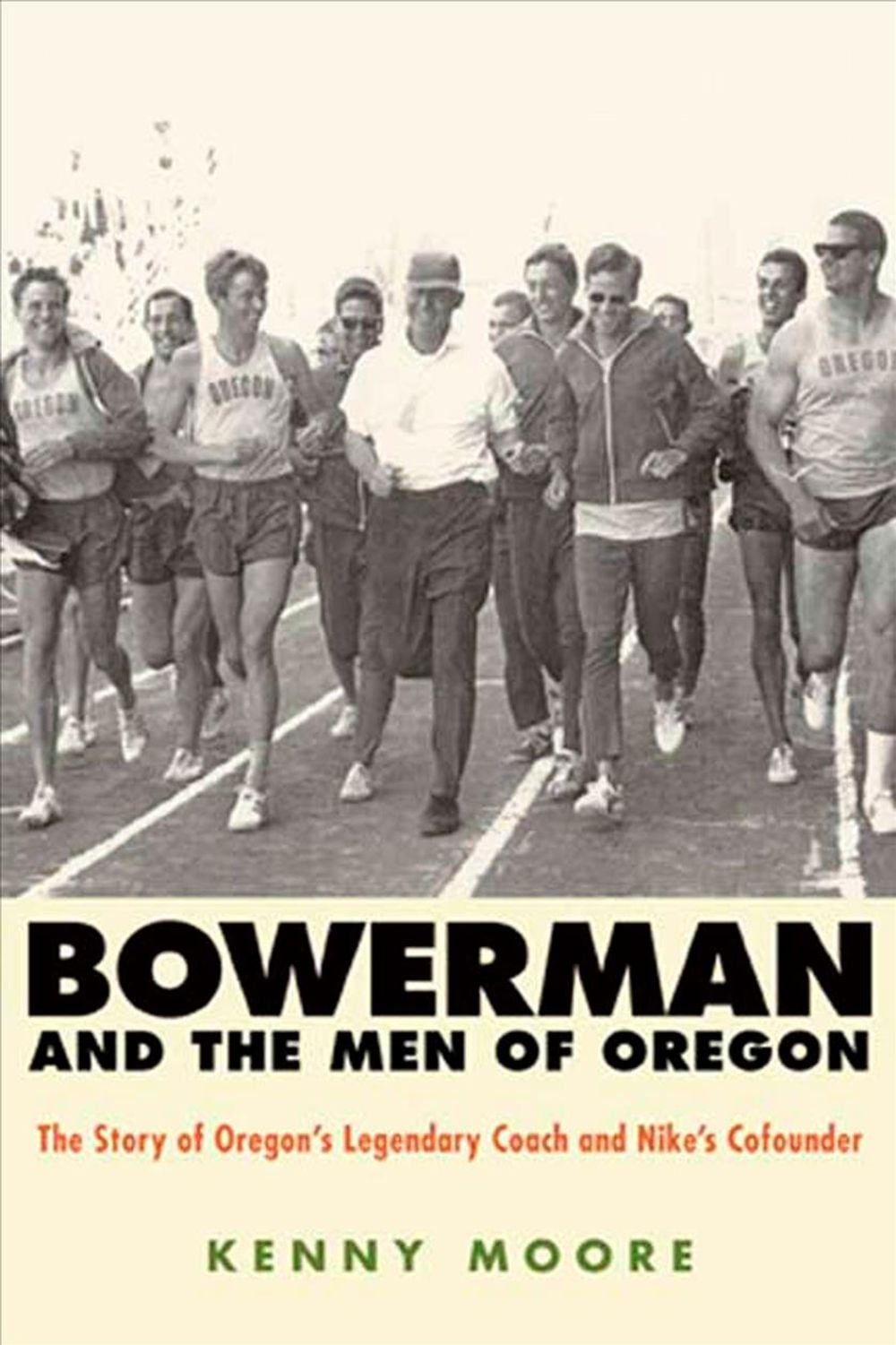
Bowerman and the Men of Oregon
by Kenny Moore
Moore, a marathon runner and one of Bill Bowermans Oregon men, tells the story of his mentor and hero, drawing on years of taped interviews and the full cooperation of the Bowerman family and Nike, the company that Bowerman helped to found.
Paperback
English
Brand New
Publisher Description
Bowerman and the Men of OregonNo man has affected more runners in more ways than Bill Bowerman. During his 24-year tenure as track coach at the University of Oregon, he won four national team titles and his athletes set 13 world and 22 American records. He also ignited the jogging boom, invented the waffle-sole running shoe that helped establish Nike, and coached the US track and field team at the 1972 Munich Olympic GamesWith the full cooperation of the Bowerman family and Nike, plus years of taped interviews with friends, relatives, students, and competitors, two-time Olympic marathoner Kenny Moore - himself one of Bowerman's champion athletes - brilliantly re-creates the legendary track coach's life.
Excerpt from Book
CHAPTER 1 That Wild Yearning BOWERMAN MAY WELL HAVE BEEN AN INTROSPECTIVE SOUL, BUT WHO COULD tell? He spent long hours in contented silence, solving a huge range of problems, and he was brutally eloquent when dissecting others'' psyches. Yet he kept the process of himself to himself. As Barbara Bowerman would recall, "I can''t tell you how frustrating it was to love him and trust him, and know he loved me and trusted me, and still he would never tell me what he was thinking." To get across what he deemed worth knowing, Bowerman''s instrument, blunt or pointed, was the story. So it is to his narrative tales--what they celebrate, what they mock and loathe--that we must look for clues to his character. In 1983, the editors of The Wheeler County History asked him to write about his family''s founding of the town of Fossil, his boyhood home and the seat of the smallest, poorest county in Eastern Oregon. Bowerman chose to tell the story of his mother''s grandfather, James Washington Chambers, who had grown up in Tennessee. Along with his parents, Thomas and Letitia, and his four brothers and two sisters, J. W. Chambers lived at The Hermitage, the plantation near Nashville where General Andrew Jackson bred and trained racehorses. Irish- born Letitia Chambers was Jackson''s cousin by marriage. The future president and his wife, Rachel, had no children of their own, but they took in family like laundry, turning out one starched, pressed relative after another. Bowerman bled for young J.W., subjected to such bark-bound, puritanical authority: "Being a very much younger brother in a family of Scotch-Irish," Bowerman wrote, "J.W. had plenty of opportunity to vent his rebellion." In 1828, Andrew Jackson was elected the seventh American president and two years later signed into law the Indian Removal Act of 1830. Henry Clay rightly called the act an eternal stain on the nation''s honor, but white settlers cheered and pushed greedily onto tribal lands. By the spring of 1832, the family member hungriest to go was fifteen-year-old J. W. Chambers. "What took him," Bowerman asked, "on his quest for the new, the romantic, the dangerous, to what became the Oregon Territory?" Bowerman could only guess, but judging by the words he chose, he must have felt the answer in his bones: "A wild yearning for perfect freedom." One day, young J.W. just up and left, saying (as Bowerman loved to tell the tale), "I''m a-headin'' West and just takin'' ma pony." The Chambers kid''s way with horses found him a place among the voyageurs and trappers who mapped the great routes. Every so often a crumpled letter would get back to his family, describing the fish, game, and topsoil beyond the Rockies. Thomas Chambers who had wanted to cross the plains since he''d read Lewis and Clark''s journals couldn''t rid his dreams of the bounty his son described. By the early 1840s he had moved his family to Morgan County, Missouri, where they began assembling a wagon train. In 1844, word of it reached the prodigal son. J.W., then twenty-seven, rode hell-for-leather to Missouri to lead the train, only to find a father who didn''t exactly kill the fatted calf in welcome. Bowerman put it this way: "As mountain men were wont to do when going to rendezvous, J. W. Chambers joined his buddies in a rip-roaring, trail''s-end wingding. The head-of-clan Chambers, exercising Puritan logic, ''splained to J.W. that he was not fit enough nor mature enough to lead the train." To test J.W.''s fitness, Thomas asked whether his son''s rebellious habits might accept something short of perfect freedom--namely, the settling influence of a wife. As Bowerman often told it, Thomas had someone specific in mind: "Meet the widow Scoggin," Thomas said. "And her five children. Husband died back East. Needs a man." One can imagine the poleaxed J.W. taking a long look at the widow''s fiercely bulging eye and hard-set jaw (she did look like Harry Truman) and growling, "By God, I''ll do her." They married in 1844, and the Chambers wagon train departed on April 1, 1845, with J.W. riding scout beside his father. And J.W. did her well, for eight months and three weeks later, on the banks of the Willamette, Mary Greene Scoggin Chambers would give birth to Bill Bowerman''s grandmother, Mary Jane. But first they had to cross two-thirds of a continent. Half a million people traversed the Oregon Trail between 1842 and 1860, a number so vast as to suggest it wasn''t all that hard. But it was bitterly hard. Men, women, children, animals, and wagons had to cover ten to fifteen miles a day for eight months or risk having a mountain pass named for them because they froze in it, like the Donners. One in ten died--50,000 in all--far more of them from cholera and accident than at the hands of Indians. Almost all those who traveled the Oregon Trail were on the only trip of their lives. They''d sold their farms to outfit their wagons and teams. If they made it to the valley of the Willamette, a married couple was entitled to 640 acres, but meanwhile, that acreage existed only in the haze of carnival-barker promises. The land and friends they''d left behind were heartbreakingly real. It was, as one historian put it, "the experience of giving all to gain all." It was a defining ordeal, a winnowing out of the nonindustrious, the nonen- during, the inflexible, the uncooperative. Those who completed the cross- country journey found that it concentrated traits in their new society that would last as long as the wagon tracks themselves, still plain to see today through the sage near Baker City in Eastern Oregon. If Bowerman was stubbornly ingenious, if Bowerman loved to tell a story, if Bowerman gloried in Oregon''s vistas and fertility, well, Bowerman was pioneer stock and had a right to cackle, as he did, that "The cowards never started and the weak died along the way." The 2,000-mile trek took the Chambers family seven months. On October 15, 1845, their train reached The Dalles, on the Columbia. They were less than a hundred miles from the mouth of the Willamette, but the way was blocked. The basalt cliffs where the Columbia Gorge slices through the Cascades north of Mt. Hood were impassable by wagon, and no flatboats were to be found. The family made their winter quarters about two miles from the Methodist Mission. After they had built huts and corrals, Thomas Chambers led an advance party, including J.W. and his gravid wife, Mary, downriver by boat to find their promised land. They selected loamy pastures on the Tualatin River, a tributary of the Willamette, near what would become Hillsboro. They filed Donation Land Claim #41 at the new capital, Oregon City, and it was there, on December 22, 1845, that Mary Jane Chambers was born. That winter, J.W. built the first flat-bottomed boat to make it through the Columbia rapids known as Cascade Falls and carried the families'' wagons and belongings in a complicated series of ferryings and portages down the Columbia and up the Willamette to their 642-acre homestead on the Tualatin. Western Oregon kept its promise. The grass stayed green all winter. The Chamberses were disoriented by the sight of their cows standing fat in the pastures in February. Once the weather cleared in June, the skies were cloudless until October. The Indians had used fire to keep much of the valley in grassland. The settlers'' fields produced so much wheat it was soon being used as a means of exchange. They had given all. They had gained all. They were home. Not that much peace crept upon the mind of J. W. Chambers. In the Willamette Valley, the Chambers family had come to a place with California summers and English winters. The rivers coiling past mistletoe- clotted oaks and dark, befirred hills were swollen by five months of cold rain. The bone-chilling wet that drove Lewis and Clark to clinical depression on the Oregon coast did the same for J.W. He called the Tualatin area a "swamp" and often rode out looking to find better. Indeed, his father, Thomas, and several family members moved to Puget Sound in Washington. But the "settling influence," as Bowerman put it, of J.W.''s wife and, eventually, seven children "partially took." For fifteen years, J.W. built warm, dry log homes and barns, helped his neighbors thresh their wheat, and reined in his wanderlust. He made a trip to the gold fields but didn''t stay, returning home instead to raise and race his beloved horses. And he used the profits from the farm to order up a spectacular symbol of making it to the new land without sacrificing the refinement of the old: a grand piano for each of his daughters. "They were shipped around Cape Horn before the Panama Canal was built," wrote J.W.''s great-granddaughter Patricia Hoover Frank in 1983. "The girls learned to play them at school. Mary Jane played quite well and sang very well too. She often entertained overnight travelers or guests." (According to Barbara Bowerman, "There''s a story that one of J.W.''s horses, named Foster, won $30,000 in a race. I don''t know if that''s apocryphal, but it would have financed the pianos and considerably more.") In 1864, when Mary Jane was eighteen, she accepted the hand of Thomas Benton Hoover, who had been five when he traveled the Trail with his parents in 1844. A photograph from that time shows Mary Jane to be comely and clear-eyed. Many desired her, even to a deranging degree. "The first night in their own home, one of Mary Jane''s former suitors set the cabin on fire," wrote Mary Jane''s great-granddaughter, Georgia Lee Hoover Stiles. "Obviously they got out, for we are all here." Barely. They lost all their belongings--except for the piano, which Tom and Mary Ja
Details
