
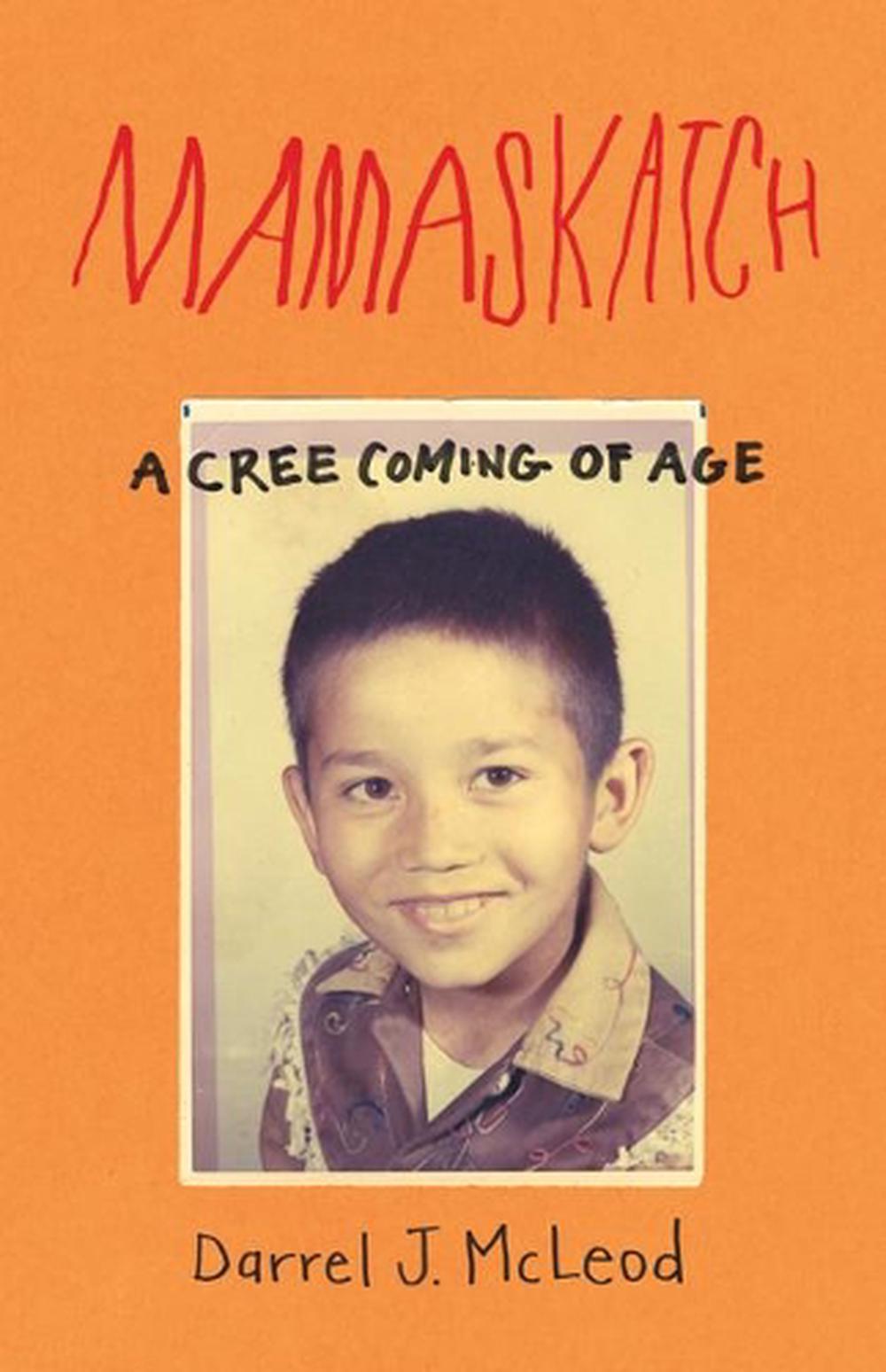
Mamaskatch
by Darrel J. McLeod
"Powerful and overdue . . . The hard and brilliant life breathing on [these] pages brought me to tears, to joy, and to grace." --TERESE MARIE MAILHOT, AUTHOR OF HEART BERRIES
Paperback
English
Brand New
Publisher Description
As a small boy in remote Alberta, Darrel J. McLeod is immersed in his Cree family's history, passed down in the stories of his mother, Bertha. There he is surrounded by her tales of joy and horror--of the strong men in their family, of her love for Darrel, and of the cruelty she and her sisters endured in residential school--as well as his many siblings and cousins, and the smells of moose stew and wild peppermint tea. And there young Darrel learns to be fiercely proud of his heritage and to listen to the birds that will guide him throughout his life. But after a series of tragic losses, Bertha turns wild and unstable, and their home life becomes chaotic. Sweet and eager to please, Darrel struggles to maintain his grades and pursue interests in music and science while changing homes, witnessing domestic violence, caring for his younger siblings, and suffering abuse at the hands of his brother-in-law. Meanwhile, he begins to question and grapple with his sexual identity--a reckoning complicated by the repercussions of his abuse and his sibling's own gender transition. Thrillingly written in a series of fractured vignettes, and unflinchingly honest, Mamaskatch--"It's a wonder!" in Cree--is a heartbreaking account of how traumas are passed down from one generation to the next, and an uplifting story of one individual who overcame enormous obstacles in pursuit of a fulfilling and adventurous life.
Table of Contents
Contents Spirals Hail Mary, Full of Grace Macimanitowi: Devils One Little Indian Boy Be Careful Little Eyes Madonna of the Athabasca Flying around the Maypole Prince Charming Long as I Can See the Light Indian Princesses Eddies of the Makhabn P
Review
Praise for Mamaskatch "Mamaskatch reminded me of my childhood and the Indigenous people I love dearly. The hard and brilliant life breathing on the pages brought me to tears, to joy, and to grace. Darrel J. McLeod tells a coming-of-age tale familiar to many Indigenous people, but our histories, and our families' truths, are mostly unwritten. The work he's doing is powerful and overdue."--Terese Marie Mailhot, author of Heart Berries "A haunting and joyful ode to the resilience of an often complicated, always extraordinary mother. Intimate and affecting, Mamaskatch asks complex questions about the legacies we inherit and the way in which self-invention is a crucial act of survival."--Esi Edugyan, author of Washington Black "Mamaskatch dares to immerse readers in provocative contemporary issues including gender fluidity, familial violence, and transcultural hybridity. A fast-moving, intimate memoir of dreams and nightmares--lyrical and gritty, raw and vulnerable, told without pity, but with phoenix-like strength."--Jury Citation, Governor General's Literary Award for Nonfiction "A profound and tender love song, an elegy to a wounded family, and an unsparing, exquisitely moving chronicle of growing up 'Nehiyaw' (Cree). Like the birdsong his mother taught him to understand, McLeod's voice is magical; it will lift and carry you through bone-breaking grief with grit, optimism and wry, life-saving humour. You will not leave this book unchanged."--Vancouver Sun "A powerful, unflinching work of non-fiction, one that isn't afraid to leave itself raw and unfinished, nodding to the stories that are yet to come. . . . The figures McLeod writes about in Mamaskatch shimmer in the best kind of way. . . . Nothing, however, appears as brightly or as darkly as Bertha. The parts of the book written from her perspective pulse with their own kind of intensity. . . . Mamaskatch embodies the recognition of the way stories can help to pull one through the darkest moments."--Quill & Quire "A heart-wrenching mîwâsin memoir full of vignettes that are so intricately woven that they guide you through with grace, sâkihiwêwin, humour, and maskihkîy. This is a narrative built through continuums that detail the lives of the McLeod family through their queer travails, trans realities, bannock and stew conversations, and a plethora of intergenerational traumas and triumphs. I can feel the warm embrace of the Three Sisters wrapping around me as I read this, that heart-drum beat resounding beneath its literary cadences, the frigidity of the Athabasca kissing my heels, and a narrator who teaches me from his very first passage in this memoir that a good story is a medicine song that re-members and re-animates, in true nehiyawewin fashion, those who have paved the way for us and those for whom we pave."--Joshua Whitehead, author of Jonny Appleseed "Honestly stunning. McLeod's clear writing lays bare his complicated ties to his family, his lovers and his country in a memoir that moved and haunted me."--Eden Robinson, author of Son of a Trickster "A compelling read that shows the heartbreaking results of imposed oppression. McLeod has identity problems of many kinds and the result is a life full of chaos. The gradual climb out of that dark place is touching."--Bev Sellars, author of They Called Me Number One: Secrets and Survival at an Indian Residential School "Reading the text was like diving into the eternity of dreams and being paralyzed by a nightmare. However, there is sunrise. Told candidly and with heartbreaking honesty, McLeod's memoir shows how survival beckoned and he held on to the spirit of his ancestors--the love that no one can ever sever. He lives for all of us."--Louise Bernice Halfe, author of Burning in this Midnight Dream
Review Quote
Praise for Mamaskatch "Mamaskatch reminded me of my childhood and the Indigenous people I love dearly. The hard and brilliant life breathing on the pages brought me to tears, to joy, and to grace. Darrel J. McLeod tells a coming-of-age tale familiar to many Indigenous people, but our histories, and our families'' truths, are mostly unwritten. The work he''s doing is powerful and overdue." --Terese Marie Mailhot, author of Heart Berries "A haunting and joyful ode to the resilience of an often complicated, always extraordinary mother. Intimate and affecting, Mamaskatch asks complex questions about the legacies we inherit and the way in which self-invention is a crucial act of survival." --Esi Edugyan, author of Washington Black "Mamaskatch dares to immerse readers in provocative contemporary issues including gender fluidity, familial violence, and transcultural hybridity. A fast-moving, intimate memoir of dreams and nightmares--lyrical and gritty, raw and vulnerable, told without pity, but with phoenix-like strength." --Jury Citation, Governor General''s Literary Award for Nonfiction "A profound and tender love song, an elegy to a wounded family, and an unsparing, exquisitely moving chronicle of growing up ''Nehiyaw'' (Cree). Like the birdsong his mother taught him to understand, McLeod''s voice is magical; it will lift and carry you through bone-breaking grief with grit, optimism and wry, life-saving humour. You will not leave this book unchanged." -- Vancouver Sun "A powerful, unflinching work of non-fiction, one that isn''t afraid to leave itself raw and unfinished, nodding to the stories that are yet to come. . . . The figures McLeod writes about in Mamaskatch shimmer in the best kind of way. . . . Nothing, however, appears as brightly or as darkly as Bertha. The parts of the book written from her perspective pulse with their own kind of intensity. . . . Mamaskatch embodies the recognition of the way stories can help to pull one through the darkest moments." -- Quill & Quire "A heart-wrenching m
Excerpt from Book
Spirals I am suspended in purgatory--that no man''s land between full sleep and wakefulness--when I hear her voice: "Darrel! I need to talk to you. Come down now. Puh-leeze..." One o''clock in the morning on a Monday, a school day ahead. All of the records have played through and my mother, Bertha Dora, has turned on the transistor radio in the kitchen. My nostrils twitch from the fumes of a freshly lit cigarette, and the smell of stale beer hangs in the air. Great. Provincial exams today. I catch snippets of the radio announcement: Janis Joplin heroin overdose. A driving rhythm on the bass guitar contrasts with Janis''s shrill and throaty voice as she exhorts someone she loves to rip out another piece of her heart. "Come ''n turn the records over, Son," Mother yells. "I love this woman''s voice, but they''re sayin'' she died." I know what will happen next if I don''t go. She will pound the broom handle on the first of the twelve stairs up to our bedroom, causing another restless night for my little sisters and brother. But I wait a few minutes more, hoping she will pass out or get distracted, and I pray the kids will sleep through it. They hate listening to me when I''m trying to get them ready for school: Gaylene and Holly, brush your hair. Travis, brush your teeth and put on your good clothes; you can''t wear those raggedy jeans and old runners to school. Gaylene, put the Cream of Wheat on, and besure to stir it this time. It''s even worse when they''re tired too. Then the agonizing starts. Oh my God, oh my God--I was wrong to talk Mother into bringing them out of the foster home. They were better off there, with the Milots. Three years we were apart: 1967 to 1970. But now it''s too late--we can''t send them back, and they''ve already seen so much. Gaylene and Holly cried every night of their first two weeks here, scared by the drunkenness and loud voices of partying strangers. They don''t know it was because of me Mother got them back, that I hounded and nagged her to take me for a visit, to go to court so they could live with us here in Athabasca. Well, it worked, and now here we all are in this shack behind the pool hall. "Darrel! Come here. Please, Son. I need to talk to you." Damn, she isn''t giving up. Her voice, which is usually a lilting alto, squeaks when she tries to force volume. I think of Tituba from The Crucible , which we studied recently in my Grade Nine drama class. Yes... this is like a play--think of it as a play--a cyclical drama with the scenes taking place in our living room or kitchen, with new characters every weekend. Last week it was Eddie Mullins--Mother called him Dad, then launched into a long explanation after seeing the puzzled looks on our faces. The props are altered in each scene, along with the costumes. Like that buckskin jacket that I love. Fantastic plots and intrigues--like last night at eight o''clock, Uncle Andy on all fours thinking he was an astronaut crawling on the moon after a successfulApollo mission. The play even has special effects: overwhelming new odours, a blue haze, the darkness of a power failure, the occasional flash of lightning and cats shrieking nearby. Mother''s cigarette smoke is getting to me. Her hoarse voice wails in unison with Janis Joplin''s, pleading earnestly with the Lord to buy her a Mercedes Benz. I doubt if Mother has even seen a Mercedes or a Porsche--I know I haven''t. Somehow it doesn''t matter. She loves this song and tries to outsing Janis. Mother''s rasp is almost as dramatic, but she can''t get the volume. Will she turn off the radio, get out the guitar and try it on her own? I sneeze, pull off the covers, roll out of bed and pull up my loose underwear. Grab a shirt, a pair of pants and socks to protect against the cold floor. My round thirteen-year-old face in the scratched hallway mirror--thick black hair sticking out every which way and faint purple bags under my eyes. I spit into my hands, slick my hair down and rub my eyes with closed fists. Where will her stories and songs take us tonight, and how many hours will pass before I can go back to bed? I trudge downstairs, turn off the radio and flip the records. Johnny Horton comes on first. "Whispering Pines." Oh boy, that''ll make her cry, but I don''t dare change it. I take my place in thekitchen chair opposite her. Mother lights yet another Rothmans tailor-made cigarette and sets it down in the clear glass ashtray. The bright red spark gradually burns up the tobacco to make a long grey ash that holds together until she picks it up. Then she starts. "That priest, Father Jal, came to see us a couple of months after your dad died, you know, just after you were born. It was a Saturday evening and you kids were asleep. We were staying with your great-grandfather, Mosom Powder, in his trapping cabin near Spurfield. There was nowhere else to go. No widow''s pension in those days, Son. One afternoon, there was a knock on the door. I opened it, and there he stood. He was in Spurfield to cel''brate mass the next day and said he wanted to see if we were okay. I was so impressed that he would come to console us, to pray for me, and for you--the new baby. I asked him to come in. He smiled and asked how we were doing, but before I could answer he stepped in closer. I thought he was going to pray--put his hands on your forehead or on mine. But a strange look came over him, and he turned toward me, put his back to you. I thought he was raising his arm to make the sign of the cross--to bless us and the cabin, but instead, he opened his hand wide, and he fondled my breast. With the other hand he started feeling me up." Jesus! I took catechism with Father Jal! I gasp at the image of the short and balding priest touching her like that with his pudgy hands. I clench my teeth. I breathe deeply to calm myself--afraid to get emotional. My eyes meet Mother''s for a second, but neither of us can handle the intensity of what we see. I wonder if the other priests I have known would have done the same--I only admire one of them, Father Fornier. After hearing this story, I understand why Mother cried the day I told her I wanted to be a priest when I grew up. We go quiet for a few minutes and stare at the kitchen floor. That night she tells me again about going to a residential school run by the Catholic Church at Grouard. About being taken from her mother when she was only six years old, having to sleep in a dorm with thirty-nine other little girls. She tells me about being forced to learn English along with her sisters. Then how her sisters Margaret and Agnes, her auntie Helen and several other aunties who were teenagers at the time escaped. Merle Haggard warbles the last line of "The Fightin'' Side of Me." The next record falls from the stack. The needle sets itself down and there is static. Elvis''s voice launches into "There Goes My Everything." Oh no, Mother sings that song almost every time she gets out her guitar. Will she go on again, telling me how it makes her think about Daddy dying, or my sister Debbie getting married at age fifteen? The pattern of my mother''s stories is different from the ones I hear at school. The timelines are never linear. Instead, they are like spirals. She starts with one element of a story, moves to another and skips to yet a different part. She revisits each theme several times over, providing a bit more information with each pass. At first I find it hard to follow, but I''ve learned that if I just sit back and listen without interrupting, she will cover everything and make each story complete. "Auntie Margaret and I grew up on the trapline. We moved around every season and camped in large canvas tents to be closer to the animals and birds. In the evening, we sat around the fire, Auntie Margaret across from me, sometimes cutting sheets of moose meat to make kakiwak --dried meat--other times scraping moose or beaver hides for tanning. I always sat right beside Mother, your Cucuum Adele. Oh, she used to get so upset when I had to go pee. It was a big deal. She had to walk in the bush with me till we found a fallen tree that I could sit on and hang my behind over." I smile inside at the notion of my strong mother with her man-hands being a dainty little girl. The detail in her stories and theintensity of her look as she tells them holds my attention, but the way she speaks as if it all took place yesterday or the day before troubles me. We both know that it happened years ago, and that it''s part of our family history that will soon be forgotten. "Auntie Margaret had her first baby, Chiq-iq, there on the trapline, you know. I loved that baby. There were no soothers then, so she would suck on my bottom lip between feedings--fall asleep that way. "The birds are messengers, Son. Sometimes they told me things that would happen in our family.
Description for Sales People
Author received the Governor General's Literary Award for Nonfiction in 2018 and is a finalist for the 2019 RBC Taylor Prize We expect strong blurbs, including from Terese Marie Mailhot, author of Heart Berries Author has been featured on national broadcast media outlets in Canada and has strong connection with Indigenous communities across North America Book's focus on colonization, poverty, family, community, LGBTQIA+ experiences, and Indigenous experiences provides opportunities for wider coverage, crossover into larger markets, and inclusion in national conversations surrounding these topics
Details
