
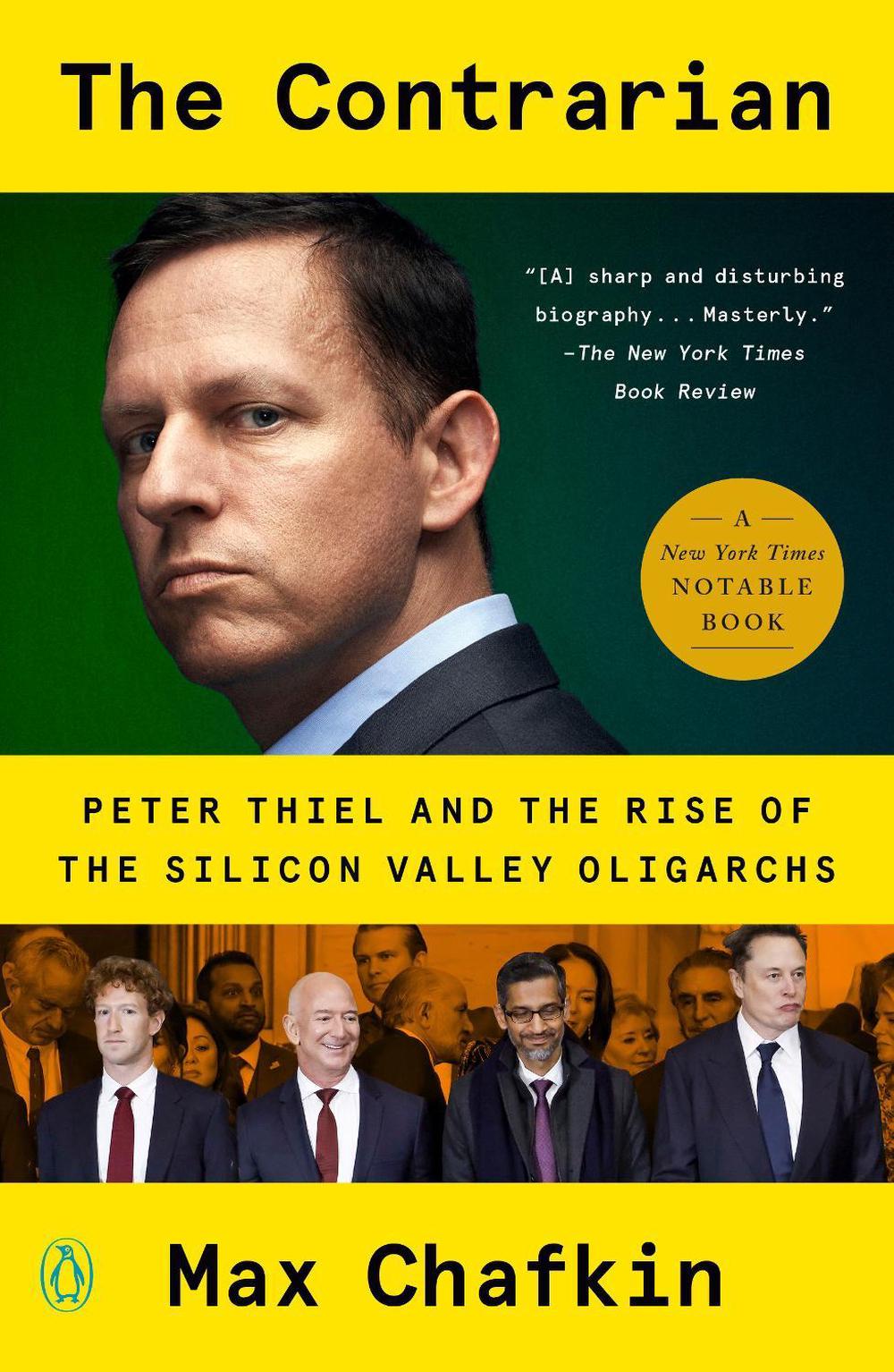
The Contrarian
by Max Chafkin
A New York Times Notable Book
A shocking and assiduously reported biography of venture capitalist and entrepreneur Peter Thiel, the enigmatic, controversial, and hugely inuential power broker whose techno-authoritarian worldview is coming to dominate our collective reality
"Max Chafkin's The Contrarian is much more than a consistently shocking biography of Peter Thiel, the most important investor in tech and a key supporter of the Donald Trump presidency. It's also a disturbing history of Silicon Valley that will make you reconsider the ideological foundations of America's relentless engine of creative destruction."—Brad Stone, author of The Everything Store and Amazon Unbound
Since the days of the dot-com bubble in the late 1990s, no industry has made a greater impact on the world than Silicon Valley. And few individuals have done more to shape Silicon Valley than Peter Thiel. The billionaire venture capitalist and entrepreneur has been a behind-the-scenes operator influencing count-less aspects of contemporary life, from the technologies that mediate our daily existence to the rise of the far-right effort among some of the most powerful people in Silicon Valley and Washington to untether the U.S. government from the established constitutional order. But despite his being one of the most important forces behind the tectonic shifts in America's sociopolitical landscape, no public figure is quite so mysterious.
In the first major biography of Thiel, Max Chafkin traces the trajectory of the innovator's singular life and philosophy, from his upbringing as the child of immigrant parents and years at Stanford as a burgeoning conservative thought leader to his founding of PayPal and Palantir, early investment in and SpaceX, and relationships with fellow tech titans Mark Zuckerberg, Elon Musk, and Eric Schmidt. The Contrarian illuminates the extent to which Thiel has sought to export his values to the corridors of power beyond Silicon Valley, including stren-uously backing outsider political candidates, notably a young Senate hopeful named JD Vance and the longshot 2016 presidential contender Donald Trump.
Essential reading for a post-2024 world, The Contrarian is a revelatory biography of a one-of-a-kind leader and a deeply insightful portrait of a tech industry whose explosive growth and power is both thrilling and fraught with peril.
Paperback
English
Brand New
Review
"A judicious biography. . . . Unfailing diligent. . . . The Contrarian isn't just about Thiel; it's about Silicon Valley's political coming-of-age, too." —New York Times
"In writing a biography of Thiel, the deck was stacked against Max Chafkin . . . who daringly took to the task. His new book . . . charts the billionaire's rise from his early days as a precocious chess champion who never quite fit in to a world-conquering tech visionary and political firebrand." —Fortune, "The Best Books of 2021"
"Peter Thiel is one of tech's most powerful people and one of its most enigmatic. That's why Max Chafkin's new biography of Thiel is so welcome. The Contrarian is a deep study of a Valley anomaly. . . . Chafkin digs deep to help us understand his subject." —Wired
"Max Chafkin takes a deep dive into the life and history of billionaire entrepreneur and Silicon Valley whisperer Peter Thiel. . . . What's striking to me about the book is the number of people who chose not to go on the record, out of fear of possible retaliation. A great read if you're looking to understand the nuances of PayPal's origin story and Thiel's contributions to Trump's 2016 election run." —Yahoo Finance, "The Best Business Books We Read in 2021"
"Chafkin has assembled a richly detailed portrait of an evasive subject." —The Baffler
"A sharp and disturbing biography. . . . Chafkin's chronicle of Thiel's wild abandon during the Obama years contains some of the most suspenseful passages in the book, as the narrative hurtles toward his acquisition of actual political power. . . . The Contrarian is chilling—literally chilling. As I read it, I grew colder and colder, until I found myself curled up under a blanket on a sunny day, icy and anxious. Scared people are scary, and Chafkin's masterly evocation of his subject's galactic fear—of liberals, of the U.S. government, of death—turns Thiel himself into a threat. I tried to tell myself that Thiel is just another rapacious solipsist, in it for the money, but I used to tell myself that about another rapacious solipsist, and he became president." —The New York Times Book Review
"There are enough juicy details in this portrait of the controversial tech billionaire Peter Thiel to keep you on the hook." —Vulture
"Max Chafkin's The Contrarian makes for deeply uncomfortable reading. This meticulous biography of big tech's leading conservative figure (Thiel was a prominent Trump backer, and spoke at the 2016 Republican convention) is full of moments that would startle those with the hardiest constitutions." —The Spectator
"Horribly fascinating. . . . Chafkin carefully documents a detestable man of extraordinary contradictions." —The Irish Times
"Punchy and caustic . . . an engrossing look at one of Silicon Valley's most eccentric and abrasive figures." —Publishers Weekly
"[Chafkin] does an excellent job of unpicking the disparate elements of the Thiel mythology. Nothing is quite what it seems." —London Review of Books
"A revealing portrait. . . . A savvy biography. . . . Chafkin deftly portrays his subject as a 'calculating operator,' 'nihilist,' and predator who has constructed an image 'so compelling that it has come to obscure the man behind it.' A brisk, well-researched life of an enigmatic billionaire." —Kirkus
"Max Chafkin's The Contrarian is much more than a consistently shocking biography of Peter Thiel, the most important investor in tech and a key supporter of the Donald Trump presidency. It's also a disturbing history of Silicon Valley that will make you reconsider the ideological foundations of America's relentless engine of creative destruction." —Brad Stone, author of The Everything Store
"The Contrarian is a captivating, incisive, rigorously reported examination of Silicon Valley's most mysterious and controversial powerbroker. Max Chafkin doesn't just illuminate the life of Peter Thiel and the unsettling world he has created. With peerless authority, he tells the broader story of our age, showing us how Silicon Valley's early utopianism was attacked from within, succumbing to largely unseen forces and giving rise to the darker, more dangerous world we inhabit today." —Joshua Green, author of Devil's Bargain
"In The Contrarian, Max Chafkin takes us on a fascinating journey into the life and mind of one of the most influential, and least understood, figures in business and politics." —Sheelah Kolhatkar, author of Black Edge
"Max Chafkin has taken on the daring task of profiling one of the most secretive and powerful men in the history of Silicon Valley. A dogged reporter and an entertaining writer, he weaves an epic tale filled with startling ambition, cold calculation, and a large helping of contrarian—and contradictory—opinions." —Emily Chang, author of Brotopia
"Whether you admire him or fear him, Peter Thiel's influence has been undeniable. In this deeply reported and gripping biography, Max Chafkin reveals the lessons behind Thiel's rise. It offers essential insights for anyone who wants to understand what Silicon Valley's global ascendance has wrought—and it's a really great read." —Charles Duhigg, author of The Power of Habit and Smarter Faster Better
Review Quote
"A judicious biography. . . . Unfailing diligent. . . . The Contrarian isn''t just about Thiel; it''s about Silicon Valley''s political coming-of-age, too." --New York Times "In writing a biography of Thiel, the deck was stacked against Max Chafkin . . . who daringly took to the task. His new book . . . charts the billionaire''s rise from his early days as a precocious chess champion who never quite fit in to a world-conquering tech visionary and political firebrand." -- Fortune "Peter Thiel is one of tech''s most powerful people and one of its most enigmatic. That''s why Max Chafkin''s new biography of Thiel is so welcome. The Contrarian is a deep study of a Valley anomaly. . . . Chafkin digs deep to help us understand his subject." -- Wired "Max Chafkin takes a deep dive into the life and history of billionaire entrepreneur and Silicon Valley whisperer Peter Thiel. . . . What''s striking to me about the book is the number of people who chose not to go on the record, out of fear of possible retaliation. A great read if you''re looking to understand the nuances of PayPal''s origin story and Thiel''s contributions to Trump''s 2016 election run." -- Yahoo Finance , "The Best Business Books We Read in 2021" "Chafkin has assembled a richly detailed portrait of an evasive subject." -- The Baffler "A sharp and disturbing biography. . . . Chafkin''s chronicle of Thiel''s wild abandon during the Obama years contains some of the most suspenseful passages in the book, as the narrative hurtles toward his acquisition of actual political power. . . . The Contrarian is chilling--literally chilling. As I read it, I grew colder and colder, until I found myself curled up under a blanket on a sunny day, icy and anxious. Scared people are scary, and Chafkin''s masterly evocation of his subject''s galactic fear--of liberals, of the U.S. government, of death--turns Thiel himself into a threat. I tried to tell myself that Thiel is just another rapacious solipsist, in it for the money, but I used to tell myself that about another rapacious solipsist, and he became president." -- The New York Times Book Review "There are enough juicy details in this portrait of the controversial tech billionaire Peter Thiel to keep you on the hook." -- Vulture "Max Chafkin''s The Contrarian makes for deeply uncomfortable reading. This meticulous biography of big tech''s leading conservative figure (Thiel was a prominent Trump backer, and spoke at the 2016 Republican convention) is full of moments that would startle those with the hardiest constitutions." -- The Spectator "Horribly fascinating. . . . Chafkin carefully documents a detestable man of extraordinary contradictions." -- The Irish Times "Punchy and caustic . . . an engrossing look at one of Silicon Valley''s most eccentric and abrasive figures." --Publishers Weekly "[Chafkin] does an excellent job of unpicking the disparate elements of the Thiel mythology. Nothing is quite what it seems." -- London Review of Books "A revealing portrait. . . . A savvy biography. . . . Chafkin deftly portrays his subject as a ''calculating operator,'' ''nihilist,'' and predator who has constructed an image ''so compelling that it has come to obscure the man behind it.'' A brisk, well-researched life of an enigmatic billionaire." --Kirkus "Max Chafkin''s The Contrarian is much more than a consistently shocking biography of Peter Thiel, the most important investor in tech and a key supporter of the Donald Trump presidency. It''s also a disturbing history of Silicon Valley that will make you reconsider the ideological foundations of America''s relentless engine of creative destruction." --Brad Stone, author of The Everything Store " The Contrarian is a captivating, incisive, rigorously reported examination of Silicon Valley''s most mysterious and controversial powerbroker. Max Chafkin doesn''t just illuminate the life of Peter Thiel and the unsettling world he has created. With peerless authority, he tells the broader story of our age, showing us how Silicon Valley''s early utopianism was attacked from within, succumbing to largely unseen forces and giving rise to the darker, more dangerous world we inhabit today." --Joshua Green, author of Devil''s Bargain "In The Contrarian , Max Chafkin takes us on a fascinating journey into the life and mind of one of the most influential, and least understood, figures in business and politics." --Sheelah Kolhatkar, author of Black Edge "Max Chafkin has taken on the daring task of profiling one of the most secretive and powerful men in the history of Silicon Valley. A dogged reporter and an entertaining writer, he weaves an epic tale filled with startling ambition, cold calculation, and a large helping of contrarian--and contradictory--opinions." --Emily Chang, author of Brotopia "Whether you admire him or fear him, Peter Thiel''s influence has been undeniable. In this deeply reported and gripping biography, Max Chafkin reveals the lessons behind Thiel''s rise. It offers essential insights for anyone who wants to understand what Silicon Valley''s global ascendance has wrought--and it''s a really great read." -- Charles Duhigg, author of The Power of Habit and Smarter Faster Better "In writing a biography of Thiel, the deck was stacked against Max Chafkin . . . who daringly took to the task. His new book . . . charts the billionaire''s rise from his early days as a precocious chess champion who never quite fit in to a world-conquering tech visionary and political firebrand." -- Fortune
Excerpt from Book
INTRODUCTION It may seem hard to remember, but there was a time when the world seemed ready to put Silicon Valley in charge of everything. This was 2016--the "Age of Unicorns," as business magazines called it, referring to tech companies that were growing so quickly, and had become so valuable, that they seemed almost mythical. Jeff Bezos had saved one of America''s great newspapers, Mark Zuckerberg was romancing San Francisco politicos, who''d just named a hospital after him, and transportation activists were showing up in major cities to protest in favor of the disruptions brought on by Uber. President Barack Obama, his term winding down, was musing about relocating to California and becoming a tech investor as his next act. Venture capital, he told to reporters that spring, sounded like it could be "very satisfying." But even as the zeitgeist--all the way up to ambitions of the leader of the free world--celebrated the promise and potential of Silicon Valley, one of Silicon Valley''s pioneers had already turned his attention well beyond it. Over the prior two decades, Peter Thiel had accumulated billions of dollars in wealth, backing some of the biggest and most successful tech companies, including , PayPal, and SpaceX. He''d built a network that gave him access to the best entrepreneurs and the wealthiest investors in the world, and he was idolized by a generation of aspiring startup founders. But Thiel wanted more than sway in Silicon Valley--he wanted real power, political power. He was about to be handed an opportunity to seize it. It came in the form of what appeared at first to be a minor scandal at , where Thiel had been an early investor. That May, the tech blog Gizmodo published a report claiming that the opinions of conservatives were being systematically suppressed by the social network. A small team of editors working on a new feature called Trending Topics said they''d been instructed to include stories from mainstream outlets such as CNN and The New York Times, but to leave out stories from right-wing media as well as those about fringe topics popular among conservatives, such as the unverified claim that the IRS had been targeting Tea Partyaffiliated nonprofits. The scoop was modest--Trending Topics had nothing to do with the regular news feed, which was curated by algorithm and was full of right- wing content--but it enraged conservatives, who saw it as proof that was biased in a broader way. The Drudge Report , which had been among the banned outlets, led with a giant and unflattering pic- ture of Zuckerberg''s deputy Sheryl Sandberg, the author of the book Lean In . not leaning in . . . leaning left! the headline screamed. under fire was the Fox News chyron. denied the allegations, but Zuckerberg sensed that this was a crisis to be managed, and he turned to Thiel to help him. On Wednesday, May 18, a group of sixteen prominent right-wing media personalities were summoned to Menlo Park for a meeting. They included talk show hosts Tucker Carlson, Glenn Beck, and Dana Perino; the presidents of the Tea Party Patriots, the American Enterprise Institute, and the Heritage Foundation; and a handful of others. Officially, they were there to see Zuckerberg and Sandberg, but Thiel was the reason many of them had made the trip. At forty-eight, he was more than a decade older than the founder, but the two men had much in common. Like Zuckerberg, Thiel was ruthlessly competitive and awkward in social situations. They''d been close--Thiel had been Zuckerberg''s mentor and his patron, the first out- side investor in his company and the first person in authority to grasp that Zuckerberg actually knew what he was doing. Years earlier, Thiel had seen in the founder--an abrasive, socially inept young man whose chief business qualification at the time was that he''d hacked together a way to rate the attractiveness of his female classmates at Harvard--something huge. After investing in , Thiel had set up Zuckerberg with absolute control over it, helping to transform the kid with the words "I''m CEO . . . Bitch" on his business cards into the fairly polished capitalist he would become. The relationship had made both men spectacularly rich, and though Thiel no longer owned much stock, he remained on the company''s board and was still very much invested in its influence. Zuckerberg and Thiel had drifted apart over the previous few years, as Thiel had become more entrenched in the world of conservative politics and Zuckerberg had embraced the spirit of the Obama era, starting a lobbying group aimed at promoting business-friendly immigration reform and pledging billions to the causes of "advancing human potential and promoting equality." But even as he cultivated Obama and others on the left, Zuckerberg had continued to rely on Thiel as a liaison to the American right. Thiel, according to Zuckerberg''s allies, was the company''s conservative conscience. "Mark wants to have a balance at between left and right," said a former executive. "He doesn''t think he can have a healthy debate if everyone''s a bleeding-heart Democrat." Zuckerberg''s critics saw Thiel''s influence on the company as more profound--and more pernicious. He was, in this view, the puppet master: pushing a younger, ideologically uncertain founder toward an alliance with an ex- tremist wing of the Republican party. As the group of conservative leaders arrived at ''s sprawling Frank Gehrydesigned headquarters, Thiel and Zuckerberg were a study in shifting generational attitudes toward the concept of business casual. The founder wore his usual uniform, a gray T-shirt and jeans. Thiel wore a dress shirt with the sleeves rolled up and a pair of hempsoled shoes. As usual, he carried himself as if braced for a collision--his shoulders hunched forward, his head tucked ever so slightly. The group sat down at a large table, and Zuckerberg and Sandberg led them through a dense, technical presentation designed to explain that ''s software, not editors, selected the vast majority of articles that appeared on . Zuckerberg asked if there were any questions-- which the pundits took as an invitation to light into , the company''s left-leaning employees, and the general sense that Silicon Valley favored liberal causes. "They were letting him have it," recalled Glenn Beck, the talk radio personality and former Fox News host known for his histrionic conspiracy theories and goofy on-camera antics. "He deserved some of it." Beck was one of a handful of the attendees whom Thiel had been quietly cultivating. After he''d left Fox News under tense circumstances--rumor had it that Wendi Deng, Rupert Murdoch''s wife, had demanded his ouster amid his show''s conspiratorial turn during the Obama administration--it was Thiel who''d convinced him to focus on streaming videos and podcasts. "You just have to decide if you are in the future or are you in the past," Thiel had told him. Beck was fond of Thiel and, in the meeting, assumed the role of Zuckerberg''s defender. "You''ve got thirty people who have spent decades defending freedom of speech," he said, addressing Zuckerberg and gesturing to his colleagues. "And you have this platform that has given hundreds of millions of people the freedom of speech." Zuckerberg seemed moved by Beck''s show of empathy. "We built to be a platform for all ideas," he wrote on his page after the group departed. "Our community''s success depends on every- one feeling comfortable sharing anything they want." The message to employees, and the outside world, was clear: intended to allow supporters of Donald Trump, who was by then the de facto Republican nominee, to say more or less whatever they wanted on its platform. Over the next several months, misinformation on --much of it in Trump''s favor--outperformed real news. The most popular election headline on during that period, according to one study, was pope francis shocks the world, endorses donald trump for president, which, of course, never happened. Another claimed falsely that Wikileaks emails revealed that Hillary Clinton had sold weapons to Islamic State terrorists. Zuckerberg would eventually apologize--sort of. "We didn''t take a broad enough view of our responsibility, and that was a big mistake," he''d later tell Congress when called to answer questions about the ways that had been used to manipulate the election campaign. But in the moment, the company denied that it was helping to spread misinformation, while downplaying the extent of the Russian government''s involvement. Two months after the meeting in Menlo Park, Thiel formally endorsed Trump, becoming the star of the Republican National Convention in Cleveland. Then, in mid-October, just days after the release of the Access Hollywood tape, in which Trump bragged about sexual assault, Thiel donated $1 million to Trump''s campaign. The move helped turn a tide of negative press and added to the coffers of a campaign that would buy a barrage of targeted advertisements as part of a voter suppression strategy designed to discourage potential Clinton supporters. After the election, Thiel was feted by Trump''s inner circle and given an office in Trump Tower, along with the latitude to install his allies in the new administration. "He was something unique," recalled Steve Bannon, who became CEO of the campaign in August. He praised Thiel for bringing intellectual credibility an
Details
