
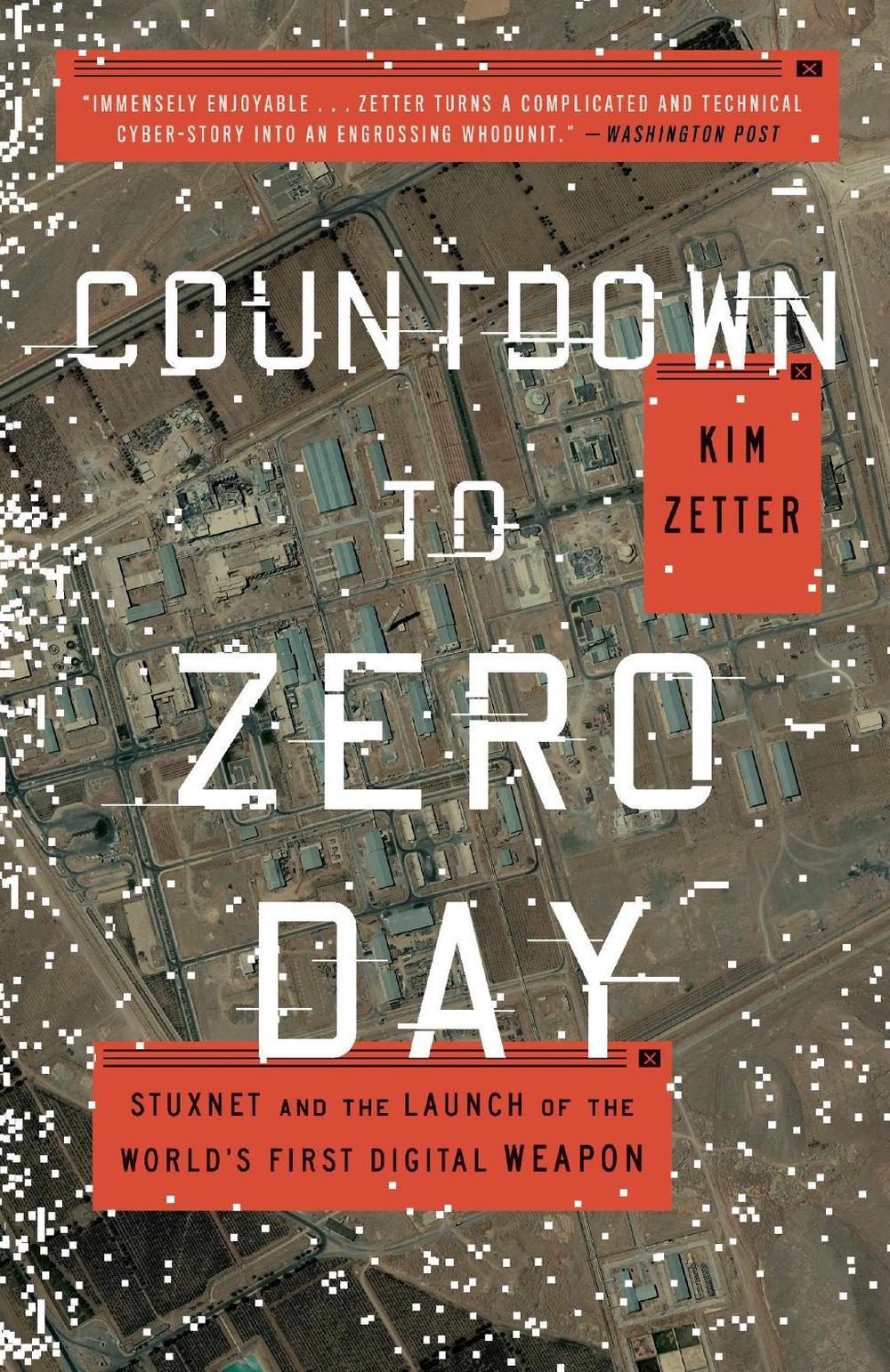
Countdown to Zero Day
by Kim Zetter
Stuxnet and the Launch of the Worlds First Digital Weapon. Top cybersecurity journalist Kim Zetter tells the story behind the virus that sabotaged Irans nuclear efforts and shows how its existence has ushered in a new age of warfareone in which a digital attack can have the same destructive capability as a megaton bomb.
Paperback
English
Brand New
Publisher Description
This story, by top cybersecurity journalist Kim Zetter, about the virus that destroyed Iran's nuclear centrifuges shows that the door has been opened on a new age of warfare--one in which a digital attack can have the same destructive capability as a megaton bomb dropped from an airplane.A top cybersecurity journalist tells the story behind the virus that sabotaged Iran's nuclear efforts and shows how its existence has ushered in a new age of warfare-one in which a digital attack can have the same destructive capability as a megaton bomb."Immensely enjoyable . . . Zetter turns a complicated and technical cyber story into an engrossing whodunit."-The Washington PostThe virus now known as Stuxnet was unlike any other piece of malware built before- Rather than simply hijacking targeted computers or stealing information from them, it proved that a piece of code could escape the digital realm and wreak actual, physical destruction-in this case, on an Iranian nuclear facility.In these pages, journalist Kim Zetter tells the whole story behind the world's first cyberweapon, covering its genesis in the corridors of the White House and its effects in Iran-and telling the spectacular, unlikely tale of the security geeks who managed to unravel a top secret sabotage campaign years in the making.But Countdown to Zero Day also ranges beyond Stuxnet itself, exploring the history of cyberwarfare and its future, showing us what might happen should our infrastructure be targeted by a Stuxnet-style attack, and ultimately, providing a portrait of a world at the edge of a new kind of war.
Notes
Cyber-security journalist tells the story behind the virus that sabotaged Iran's nuclear efforts.
Review
"An authoritative account of Stuxnet's spread and discovery . . . [delivers] a sobering message about the vulnerability of the systems—train lines, water-treatment plants, electricity grids—that make modern life possible."—Economist
"Exhaustively researched . . . Zetter gives a full account of this 'hack of the century,' as the operation has been called, [but] the book goes well beyond its ostensible subject to offer a hair-raising introduction to the age of cyber warfare."—The Wall Street Journal
"Part detective story, part scary-brilliant treatise on the future of warfare . . . an ambitious, comprehensive, and engrossing book that should be required reading for anyone who cares about the threats that America—and the world—are sure to be facing over the coming years."—Kevin Mitnick, New York Times bestselling author of Ghost in the Wires and The Art of Intrusion
"Unpacks this complex issue with the panache of a spy thriller . . . even readers who can't tell a PLC from an iPad will learn much from Zetter's accessible, expertly crafted account."—Publishers Weekly (starred review)
"A true techno-whodunit [that] offers a sharp account of past mischief and a glimpse of things to come . . . Zetter writes lucidly about mind-numbingly technical matters, reveling in the geekery of malware and espionage, and she takes the narrative down some dark electronic corridors. . . . Governments, hackers and parties unknown are launching ticking computer time bombs every day, all coming to a laptop near you."—Kirkus Reviews
"An exciting and readable story of the world's first cyberweapon. Zetter not only explains the weapon and chronicles its discovery, but explains the motives and mechanics behind the attack—and makes a powerful argument why this story matters."—Bruce Schneier, author of Secrets and Lies and Schneier on Security
Review Quote
"Immensely enjoyable...Zetter turns a complicated and technical cyber- story into an engrossing whodunit...The age of digital warfare may well have begun." -- Washington Post "An authoritative account of Stuxnet's spread and discovery...[delivers] a
Excerpt from Book
CHAPTER 1 EARLY WARNING Sergey Ulasen is not the sort of person you''d expect to find at the center of an international incident. The thirty-one-year-old Belarusian has close-cropped blond hair, a lean boyish frame, and the open face and affable demeanor of someone who goes through life attracting few enemies and even fewer controversies. One of his favorite pastimes is spending the weekend at his grandmother''s country house outside Minsk, where he decompresses from weekday stresses, far from the reach of cell phones and the internet. But in June 2010, Ulasen encountered something unusual that soon propelled him into the international spotlight and into a world of new stress.1 It was a warm Thursday afternoon, and Ulasen, who headed the antivirus division of a small computer security firm in Belarus called Virus-BlokAda, was seated with his colleague Oleg Kupreev in their lab in downtown Minsk inside a drab, Soviet-era building about a block from the Svisloch River. They were sifting methodically through suspicious computer files they had recently found on a machine in Iran when something striking leapt out at Kupreev. He sat back in his chair and called Ulasen over to take a look. Ulasen scrolled through the code once, then again, to make sure he was seeing what he thought he saw. A tiny gasp escaped his throat. The code they had been inspecting the past few days, something they had until now considered a mildly interesting but nonetheless run-of-the-mill virus, had just revealed itself to be a work of quiet and diabolical genius. Not only was it using a skillful rootkit to cloak itself and make it invisible to antivirus engines, it was using a shrewd zero-day exploit to propagate from machine to machine--an exploit that attacked a function so fundamental to the Windows operating system, it put millions of computers at risk of infection. Exploits are attack code that hackers use to install viruses and other malicious tools onto machines. They take advantage of security vulnerabilities in browser software like Internet Explorer or applications like Adobe PDF Reader to slip a virus or Trojan horse onto a system, like a burglar using a crowbar to pry open a window and break into a house. If a victim visits a malicious website where the exploit lurks or clicks on a malicious email attachment containing an exploit, the exploit uses the security hole in the software to drop a malicious file onto their system. When software makers learn about such holes in their products, they generally produce "patches" to close them up and seal the intruders out, while antivirus firms like Ulasen''s add signatures to their scanners to detect any exploits that try to attack the vulnerabilities. Zero-day exploits, however, aren''t ordinary exploits but are the hacking world''s most prized possession because they attack holes that are still unknown to the software maker and to the antivirus vendors--which means there are no antivirus signatures yet to detect the exploits and no patches available to fix the holes they attack. But zero-day exploits are rarely found in the wild. It takes time and skill for hackers to discover new holes and write workable exploits to attack them, so the vast majority of hackers simply rely on old vulnerabilities and exploits to spread their malware, counting on the fact that most computer users don''t often patch their machines or have up-to-date antivirus software installed, and that it can take vendors weeks or months to produce a patch for a known hole. Although more than 12 million viruses and other malicious files are captured each year, only about a dozen or so zero-days are found among them. Yet here the attackers were using an extremely valuable zero-day exploit, and a skillful rootkit, for a virus that, as far as Ulasen and Kupreev could tell, had only been found on machines in Iran so far. Something didn''t add up. THE MYSTERY FILES had come to their attention a week earlier when a reseller of VirusBlokAda''s security software in Iran reported a persistent problem with a customer''s machine in that country. The computer was caught in a reboot loop, crashing and rebooting repeatedly while defying the efforts of technicians to control it.2 VirusBlokAda''s tech-support team had scanned the system remotely from Minsk to look for any malware their antivirus software might have missed, but came up with nothing. That''s when they called in Ulasen. Ulasen had been hired by the antivirus firm while still in college. He was hired to be a programmer, but the staff at VirusBlokAda was so small, and Ulasen''s skills so keen, that within three years, at the age of twenty-six, he found himself leading the team that developed and maintained its antivirus engine. He also occasionally worked with the research team that deconstructed malicious threats. This was his favorite part of the job, though it was something he rarely got to do. So when the tech-support team asked him to weigh in on their mystery from Iran, he was happy to help.3 Ulasen assumed the problem must be a misconfiguration of software or an incompatibility between an application installed on the machine and the operating system. But then he learned it wasn''t just one machine in Iran that was crashing but multiple machines, including ones that administrators had wiped clean and rebuilt with a fresh installation of the operating system. So he suspected the culprit might be a worm lurking on the victim''s network, reinfecting scrubbed machines each time they were cleaned. He also suspected a rootkit was hiding the intruder from their antivirus engine. Ulasen had written anti-rootkit tools for his company in the past, so he was confident he''d be able to hunt this one down if it was there. After getting permission to connect to one of the machines in Iran and remotely examine it, Ulasen and Kupreev zeroed in on six suspicious files--two modules and four other files--they thought were the source of the problem.4 Then with help from several colleagues in their lab, they spent the next several days picking at the files in fits and starts, hurling curses at times as they struggled to decipher what turned out to be surprisingly sophisticated code. As employees of a small firm that mostly developed antivirus products for government customers, they weren''t accustomed to taking on such complex challenges: they spent most of their days providing routine tech support to customers, not analyzing malicious threats. But they pressed forward nonetheless and eventually determined that one of the modules, a driver, was actually a "kernel-level" rootkit, as Ulasen had suspected.5 Rootkits come in several varieties, but the most difficult to detect are kernel-level rootkits, which burrow deep into the core of a machine to set up shop at the same privileged level where antivirus scanners work. If you think of a computer''s structure like the concentric circles of an archer''s target, the kernel is the bull''s eye, the part of the operating system that makes everything work. Most hackers write rootkits that operate at a machine''s outer layers--the user level, where applications run--because this is easier to do. But virus scanners can detect these--so a truly skilled hacker places his rootkit at the kernel level of the machine, where it can subvert the scanner. There, it serves as a kind of wingman for malicious files, running interference against scanners so the malware can do its dirty work unhindered and undetected. Kernel-level rootkits aren''t uncommon, but it takes sophisticated knowledge and a deft touch to build one that works well. And this one worked very well.6 Kupreev determined that the rootkit was designed to hide four malicious .LNK files--the four other suspicious files they''d found on the system in Iran. The malware appeared to be using an exploit composed of these malicious files to spread itself via infected USB flash drives, and the rootkit prevented the .LNK files from being seen on the flash drive. That''s when Kupreev called Ulasen over to have a look. Exploits that spread malware via USB flash drives aren''t as common as those that spread them over the internet through websites and email attachments, but they aren''t unheard of, either. All of the USB exploits the two researchers had seen before, however, used the Autorun feature of the Windows operating system, which allowed malicious programs on a USB flash drive to execute as soon as the drive was inserted in a machine. But this exploit was more clever.7 Windows .LNK files are responsible for rendering the icons for the contents of a USB flash drive or other portable media device when it''s plugged into a PC. Insert a USB flash drive into a PC, and Windows Explorer or a similar tool automatically scans it for .LNK files to display the icon for a music file, Word document, or program stored on the flash drive.8 But in this case, the attackers embedded an exploit in a specially crafted .LNK file so that as soon as Windows Explorer scanned the file, it triggered the exploit to spring into action to surreptitiously deposit the USB''s malicious cargo onto the machine, like a military transport plane dropping camouflaged paratroopers onto enemy territory. The .LNK exploit attacked such a fundamental feature of the Windows system that Ulasen wondered why no one had thought of it before. It was much worse than Autorun exploits, because those could be easily thwarted by disabling the Autorun feature on machines--a step many network administrators take as a matter of course because of Autorun''s known security risk. But there is no way to easily disable the .LNK function without causing other problems for users. Ulasen searched a registry of exploits fo
Details
