Item Description
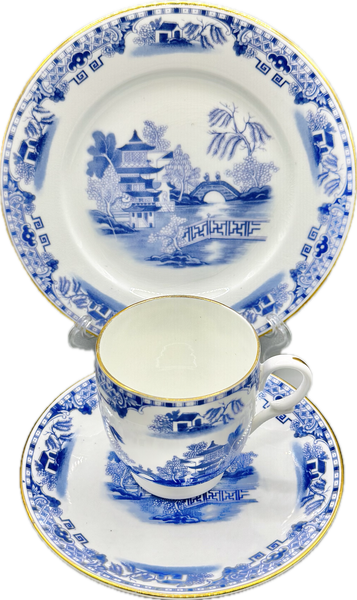
This Shelley Lomond shape trio is decorated in the Willow pattern, marked S.2085, with a classic blue and white scenic design enriched by fine gilt edging. The cup, saucer and side plate carry detailed Chinese inspired landscapes with buildings, trees, foliage, bridges and geometric border motifs, repeated across the three pieces to create a highly coordinated tea trio. The blue decoration ranges from strong cobalt areas to softer shaded transfer work, while the gilt rims add a refined finish. The Lomond shape is a distinctive Shelley form associated with the later 1920s. The cup base carries the Shelley shield style backstamp with Shelley and ENGLAND visibly printed. S.2085 is visibly hand written above the printed mark, while a further small black mark is present below it but cannot be reliably classified from the photograph. Shelley states that the majority of pattern numbers used before the Second World War were hand painted. Shelley records date the Lomond cup shape to 1926 through the late 1920s, supporting a late 1920s date for this trio.
Item Condition
The trio is in VERY GOOD - VINTAGE - USED CONDITION. The cup, saucer and side plate retain their blue Willow decoration, scenic imagery and gilt edging, presenting attractively for their age. The transfer decoration remains clear across the principal scenes and borders, while the gold rims remain visible. There are signs consistent with age and previous use, including light wear to decoration or gilding where present. No chips, cracks or repairs are visible in the supplied views, and no structural problem is apparent. The cup retains its handle and foot, while the saucer and side plate retain their original forms. One picture can speak more than a million words. The listing photographs show the actual trio, including the decorated surfaces and the underside of the cup with its Shelley marking and hand written pattern number. The condition is considered in relation to the late 1920s age of this Shelley Lomond trio. The photographs form an integral part of this condition description. If you have questions about the condition or any visible detail, please contact me before purchasing.
Manufacturer Info
Shelley Potteries Ltd. grew from the Wileman & Co. and Foley works and became officially associated with the Shelley name in 1925. Its artistic reputation was built through Art Directors including Frederick Rhead, Walter Slater and Eric Slater. Walter Slater succeeded Rhead in 1905 after working at Minton and Doulton, and oversaw fine tableware and innovative decorative work. His son Eric joined the pottery in 1919 at seventeen, trained for seven years at Staffordshire art schools and won Best Student of the Year in 1923. Eric later became Art Director and was a major force behind modern Shelley design in the 1920s and 1930s. The scale of the artistic operation was remarkable: in 1899 the factory was reported to employ 200 lady and girl artists, together with around 20 male designers. This skilled workforce helped Shelley combine fine bone china with intricate decoration, gilding and distinctive shapes. The Lomond shape belongs to the late 1920s period when Shelley was developing a sophisticated tea service vocabulary. Shelley Potteries Ltd. left a lasting legacy through its designers, decorators, patterns and distinctive shapes. Its surviving wares preserve the craftsmanship of an important Staffordshire manufacturer.
Did You Know?
Did you know that the handwritten S before a Shelley pattern number can carry a second piece of information about the china? Shelley records explain that letters placed before pattern numbers could identify the shape, and S was used for Empire late, Perth and Lomond shapes. On this trio the base visibly shows S.2085 written above the Shelley backstamp, while the piece itself is the Lomond shape. The prefix is therefore a compact factory identification clue linking the decoration number with the shape family. Shelley also records that the majority of pattern numbers used before the Second World War were hand painted rather than printed. The Lomond shape itself was produced from 1926 into the late 1920s, placing this Willow trio within a particularly interesting period of Shelley design development.