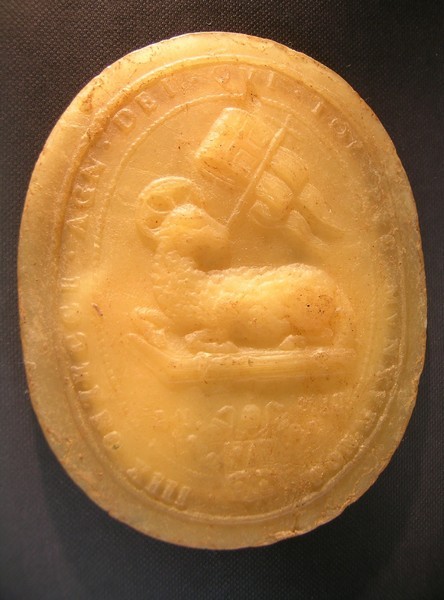
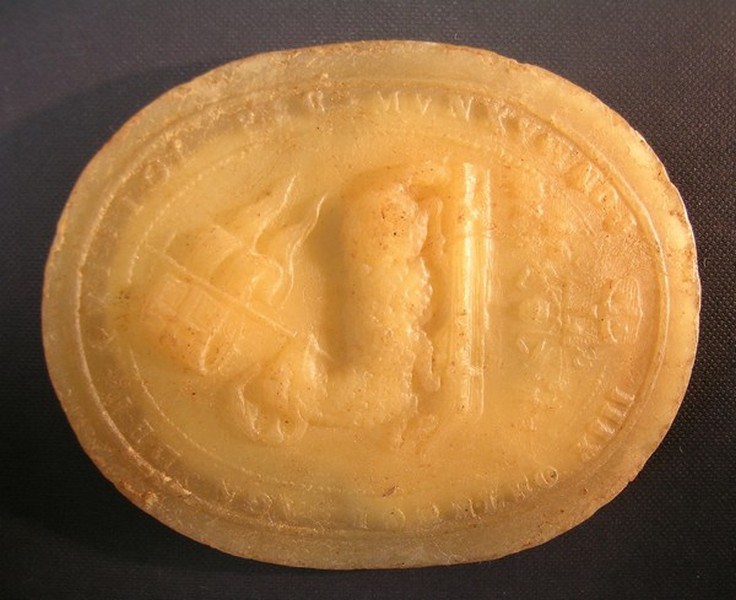
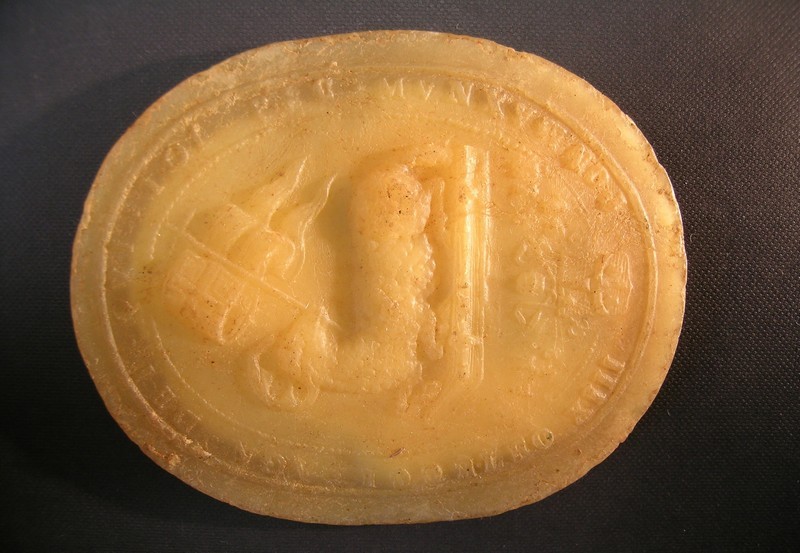
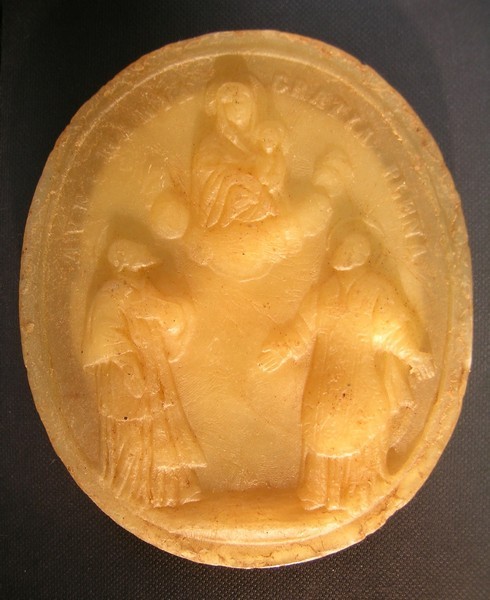
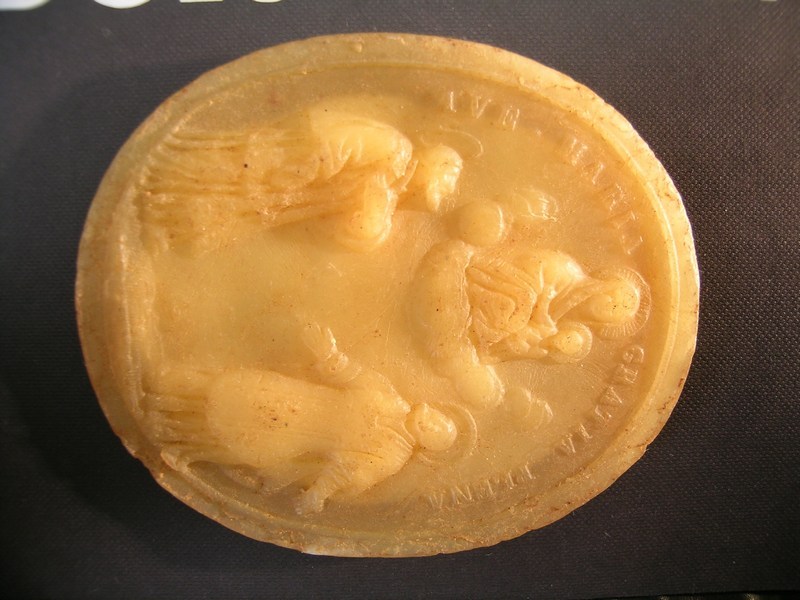
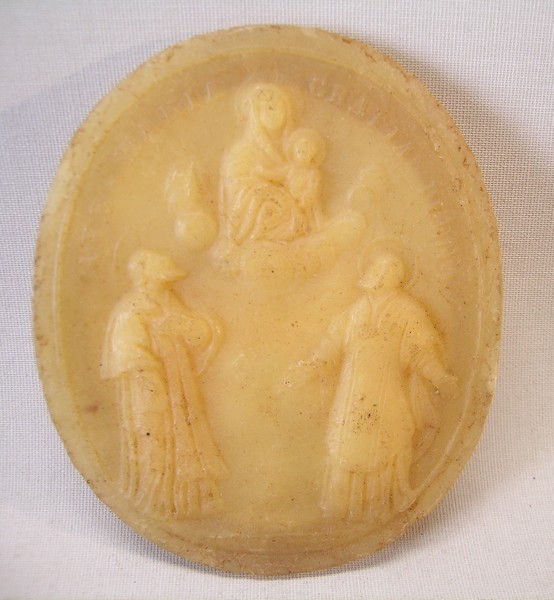
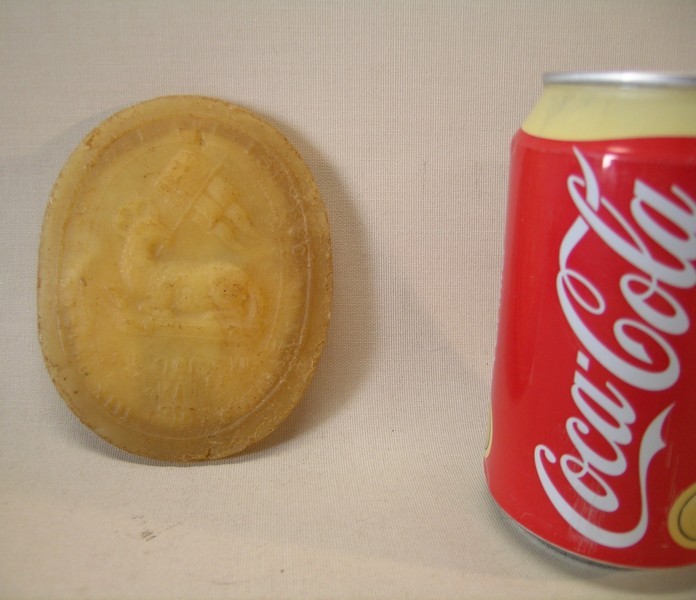
This is a large antique wax Agnus Dei, on the front
the Lamb of God, and the date 1891 (Pope Leo XIII). On the back probably (I am
not sure) Saint Simon Stock and Saint Ignatius of Loyola. Very detailed for it’s
age. Measures 4,5x3,6 inch. Comes from a convent in Belgium.Shipping and
handling US$ 39.00 by insured priority mail and tracking number. All my items
are securely packet, to avoid all possible damage ( look at my feedback).


Please contact me if you have any
questions. Items cannot be returned.

As per Ebay
policy,this reliquary does not contain human remains but only objects of
devotion.

The auction
is for the frame, the relic is a gift.

Please be carefull when buying relics online. Fake relics are
increasingly more and more of a problem. Most of the relics I sell are from
convents in Belgium and Italy. I have been collecting relics for more than 25
years. I consider myself an expert. Please contact me if you
have any questions.


Please see my other auctions for
more vestments,reliquary’s, relic’s and antiques items

I
only sell antique items and no copies or new made fakes!


Pope Leo XIII

Also known as
- Vincenzo Gioacchino Raffaele Luigi Pecci
Profile
Sixth of seven children born
to Count Dominico Ludovico Pecci and Anna Prosperi Buzzi; Vincenzo’s older
brother was Cardinal Giuseppe Pecci. Confirmed on 25
August 1817. Studied at the Jesuit College at Viterbo, Italy from 1818 to 1824,
then the Collegio Romano from 1824 to 1832,
the Pontifical Academy of
Ecclesiastical Nobles in Rome, Italy in 1832;
he received his doctorate in theology in 1836 from the
Archgymnasium of Rome, doctor of civil and canon law from La Sapienza University in Rome.
Appointed domestic prelate to the pope on 6 February 1837.
Referendary of the Tribunal of
the Apostolic Signature of Justice and of Grace on 16 March 1837.
Relator of the Congregation of
Good Government on 28 June 1837. Ordained on 31
December 1837. Apostolic delegate in Benevento, Italy on 17
February 1838. Apostolic delegate in Spoleto, Italy on 12
June 1841. Apostolic delegate in Perugia, Italy on 17
July 1841. Titular archbishop of Damietta on 27
January 1843. Apostolic nuncio to Belgium on 28
January 1843. Named papal assistant on 10 February 1843. Bishop of Perugia from 19
January 1846 till 1877. Created cardinal–priest on 19
December 1853. Camerlengo of the Church on 21
September 1877. Chosen 256th pope in 1878.
Leo’s election changed the course of
the papacy. He was a modern man of his times, and he worked, by preaching and writing,
to bring Catholic attitudes into the modern world without losing
the Christianity at it’s core. He managed to end Kulturkampf in 1887.
He tried to bring French Catholics to support the republic.
His 1885 encyclical Immortale
Dei explained the position of Catholics as citizens in
modern secular, democratic states. He refuted the French royalists’
claim that they were exceptional Catholics, and the French anti–Catholics contention
that the Church was politically reactionary; overall he supported and
vindicated Catholic democrats. He opposed the anti–Catholic government
of Italy. In Rerum
novarum in 1891, Leo explained the sad
deficiencies of Marxism and gave an early warning of the misery it
would inflict on the world. He countered intellectual attacks on Christianity by
advancing Thomism, with its insistence that there is no conflict between
science and faith; he wrote Aeterni
Patris in 1879 in which he declared the philosophy of Saint Thomas
Aquinas official, and required its study. He founded the institute of
Thomistic philosophy at the University of Louvain. He opened the
Vatican secret archives to scholars, and reminded Catholic historians
that nothing but the whole truth must be found in their work. He encouraged
Bible study, set up the permanent Biblical
Commission in 1902, and sponsored the Catholic University at
Washington, DC. Revitalized the Vatican Library and put the his
brother, Cardinal Giuseppe Pecci at its head. First pope to
have his voice recorded. The length of his reign, over 25 years, allowed him to
stock the college of cardinals with many excellent men; he elevated
147 of them.
Born
- 2 March 1810 in Carpineto Romano, diocese of
Anagni, Italy as Vincenzo
Gioacchino Raffaele Luigi Pecci
Papal Ascension
- elected on 20 February 1878
- crowned on 3 March 1878
Died
- 20 July 1903 in Vatican City of natural
causes
- buried in Saint Peter’s basilica
- re-interred in Saint John Lateran basilica on 22
October 1924
Saint Ignatius of Loyola
Also known as
- Inigo Lopez de Loyola
Memorial
- 31 July
Profile
Born to the Spanish nobility.
Youngest of twelve children. Page in the Spanish court of
Ferdinand and Isabella. Military education. Soldier, entering
the army in 1517, and serving in several campaigns. Wounded in
the leg by a cannonball at the siege of Pampeluna on 20 May 1521, an
injury that left him partially crippled for life. During his recuperation the
only books he had access to were The Golden Legend, a collection of biographies of the saints,
and the Life of Christ by
Ludolph the Carthusian. These books, and the time spent in
contemplation, changed him.
On his recovery he took a vow of chastity,
hung his sword before the altar of the Virgin of Montserrat, and
donned a pilgrim‘s robes. He lived in a cave from 1522 to 1523,
contemplating the way to live a Christian life. Pilgrim to Rome and
the Holy Land in 1523, where he worked to convert Muslims.
In 1528 he began studying theology in Barcelona and Alcala in Spain,
and Paris, France receiving his degree on 14 March 1534.
His meditations, prayers, visions and insights led to forming the Constitutions of the Society of Jesus on 15
August 1534; it received papal approval in 1541. Friend of
James Lainez, Alonso Salmerón, Nicholas Bobadilla, Simón Rodriguez, Blessed Peter
Faber, and Saint Francis Xavier, the group that formed the core of
the new Society. He never
used the term Jesuit,
which was coined as an insult by his opponents; the Society today uses the term with
pride. He travelled Europe and the Holy Lands, then settled
in Rome to direct the Jesuits. His health suffered in later
years, and he was nearly blind at death.
The Jesuits today have over
500 universities and colleges, 30,000 members, and teach over
200,000 students each year.
Born
- 1491 at Loyola, Guipuzcoa, Spain as Inigo Lopez de Loyola
Died
- 31 July 1556 at Rome, Italy of fever
Beatified
- 27 July 1609 by Pope Paul V
Canonized
- 12 March 1622 by Pope Gregory XV
Patronage
- Jesuits; Jesuit Order; Society of Jesus
- Spiritual Exercises (by Pope Pius XI)
- military ordinariate of the Philippines
- retreats (proclaimed on 25 July 1922 by Pope Pius
XI)
- soldiers
- World Youth Day 2011
- Baltimore, Maryland, archdiocese of
- Basque country
in Spain
- Álava
- Azpeitia
- Bilbao, diocese of
- Bizkaia
- Gipuzkoa
- Guipuscoa
- Guipúzcoa
- Vizcaya
Saint Simon Stock
Also known as
- Simon Anglus
- Simon the Englishman
Memorial
- 16 May
Profile
Little is known of his early life. Legend
says that at age twelve he began to live as a hermit in a hollow oak
tree; the name Stock is
believed derived from the old English for tree trunk. Itinerant preacher. Pilgrim to the
Holy Lands, but left when invading Muslims chased out Christians. Joined
the Carmelite Order soon after its arrival in England.
Simon lived and studied for several
years in Rome, Italy and Mount Carmel. Elected sixth
general of the Carmelites in 1247 around age 82. He helped
the Order spread through England, southern and western Europe.
Founded houses in Cambridge, England in 1248, Oxford in 1253, Paris, France in 1260,
and Bologna, Italy in 1260. Revised the Rule of the Order to
make them mendicant friars instead of hermits.
Regardless of these successes, the Order was
oppressed on all sides, including by the clergy and other orders. The
friars took their woes to their patroness, the Virgin Mary. Tradition
says that in answer, she appeared to Simon bringing him the brown Scapular
of Mount Carmel. “This shall be
the privilege for you and for all the Carmelites,” she told
him, “that anyone dying in
this habit shall be saved.” On 13 January 1252 the Order received
a letter of protection from Pope Innocent IV, protecting them from
harassment.
Born
- c.1165 in Aylesford, County Kent, England
Died
- 16 May 1265 in the Carmelite monastery at Bordeaux, France of
natural causes while on a visit
- skull transferred to the Carmelite friary
in Aylesford, England in 1951
Canonized
- never formally canonized
- venerated by the Carmelites since at
least 1564
- the Vatican has approved Carmelite celebration
of his feast
Patronage
- Aylesfort, England
- Bordeaux, France