Item Description
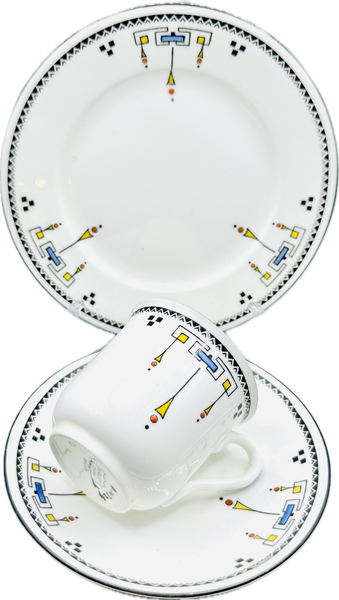
This Shelley trio carries the unnamed pattern D.11324 on the Vincent shape, combining a tall tapered cup with a matching saucer and side plate. Its decoration is strongly geometric: black angular borders frame repeated linear motifs, while small blocks of blue and yellow and tiny red enamel dots create sharp colour accents against the white bone china. The restrained palette and disciplined symmetry give the set a distinctive early Art Deco character. The cup's elegant loop handle and the repeated border across all three pieces make the trio especially cohesive as a complete place setting. The base carries the green Shelley China England shield backstamp together with the hand-painted D.11324 pattern notation. Shelley's documented shape-letter system identifies the prefix D with the Vincent shape. Vincent itself was introduced in 1916, while comparable numbered patterns immediately around 11324 are documented in the mid-1920s and the associated backstamp was used before 1926. Taken together, those identifiers support a manufacture date of circa 1924-1926.
Item Condition
This Shelley Vincent trio remains in very good vintage and used condition, with all three pieces clean, sound and well preserved. There are no chips, cracks, hairlines, structural damage or restoration, and no visible crazing. The black geometric decoration remains strong, while the blue, yellow and red enamel details retain good colour and definition. The black rim lines show light age-related rubbing and there are minor surface marks consistent with careful previous use. The cup handle and foot are secure, and the saucer and side plate both present well. The photographs form part of the condition record and show the decorated surfaces, rims, handle, foot, saucer, side plate and factory markings clearly. For an authentic Shelley trio dating from the mid-1920s, the level of preservation is very good and consistent with careful ownership over approximately a century. Minor manufacturing variations and gentle signs of age are expected in vintage fine bone china and are not structural faults. Questions about condition are always welcome before purchase.
Manufacturer Info
Shelley Potteries Ltd grew from the Foley works at Fenton, Staffordshire, where Joseph Shelley joined Wileman & Co in 1872 and the Shelley family gradually took control. The Shelley trade name came into use around 1910, and the business was incorporated as Shelley Potteries Ltd in 1929. Its reputation rested on exceptionally light fine bone china, precise decoration and recognisable shapes that moved from Art Nouveau into Art Deco. Eric Walter Slater became one of the firm's most important designers and later Art Director, helping establish the modern visual identity associated with Shelley. Vincent, the shape used for this trio, was introduced in 1916 and remained in production into the early 1940s. Collector research has identified more than 240 patterns and colour variations on Vincent alone, showing how extensively successful forms were developed. Shelley continued that design-led approach after the war, introducing 13 new cup shapes between 1950 and 1964. Shelley Potteries Ltd became Shelley China Ltd before Allied English Potteries took over in 1966. Its legacy remains one of Britain's most distinctive combinations of technical refinement, imaginative decoration and enduring ceramic design.
Did You Know?
Did you know that Vincent was not merely a decorative shape name? Shelley introduced it in 1916 and named it after Vincent Bob, one of Percy Shelley's sons. The shape became one of the factory's most adaptable tea ware forms, with more than 240 known patterns and colour variations recorded by collectors. More unexpectedly, there was no Vincent teapot to complete the service: Shelley paired Vincent tea wares with teapots from other established shapes instead. That makes this D.11324 trio part of a deliberately mixed-form system rather than a completely self-contained range. Its tapered cup and geometric decoration therefore tell two stories at once - the personal naming traditions of the Shelley family and the practical way the factory combined different mould families to build complete tea services.