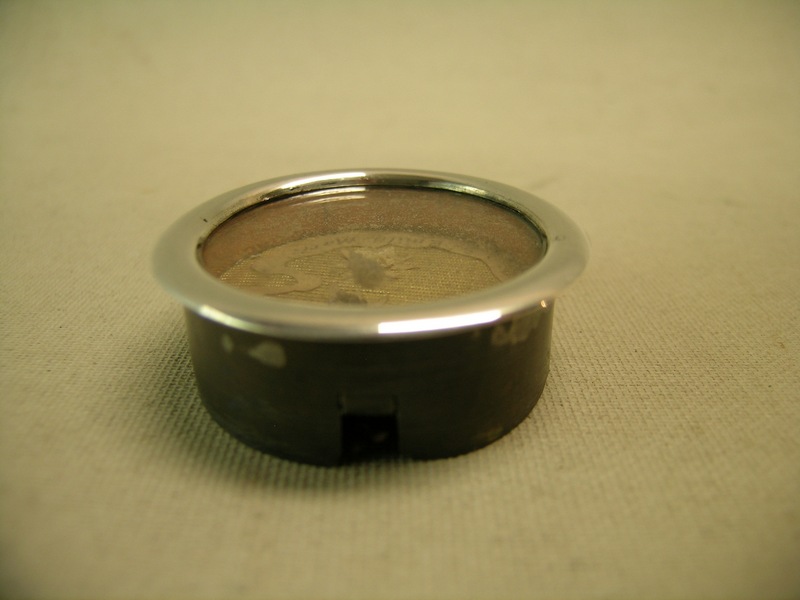
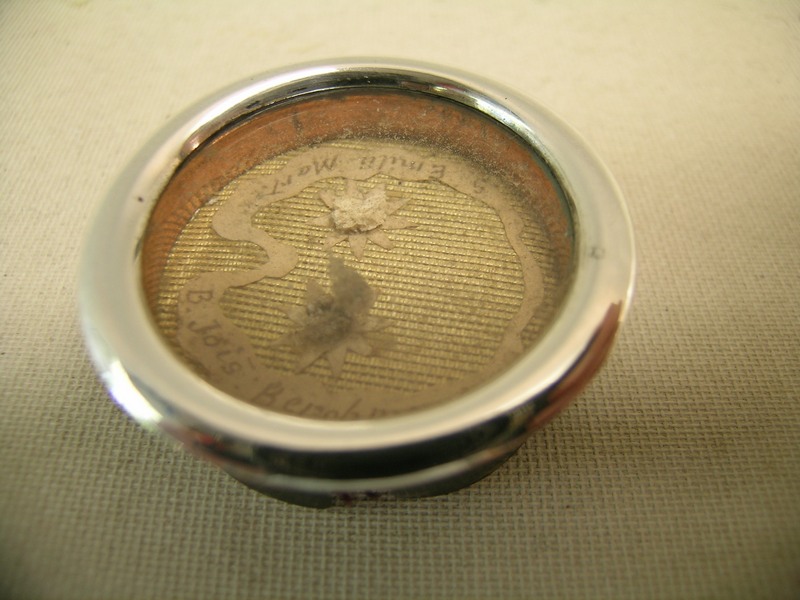
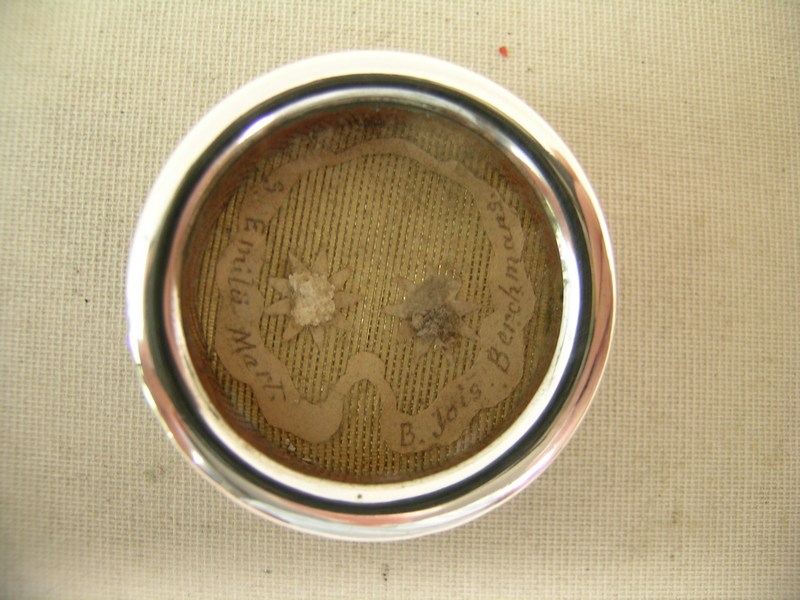
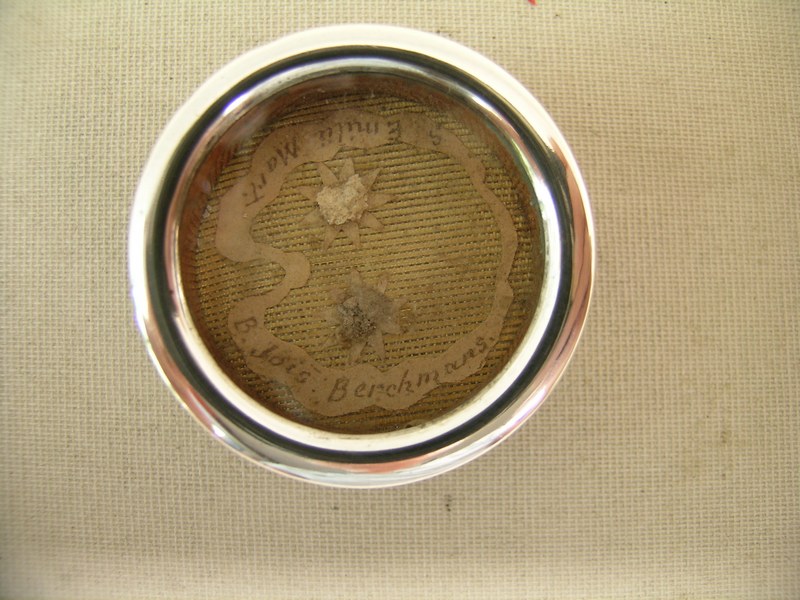
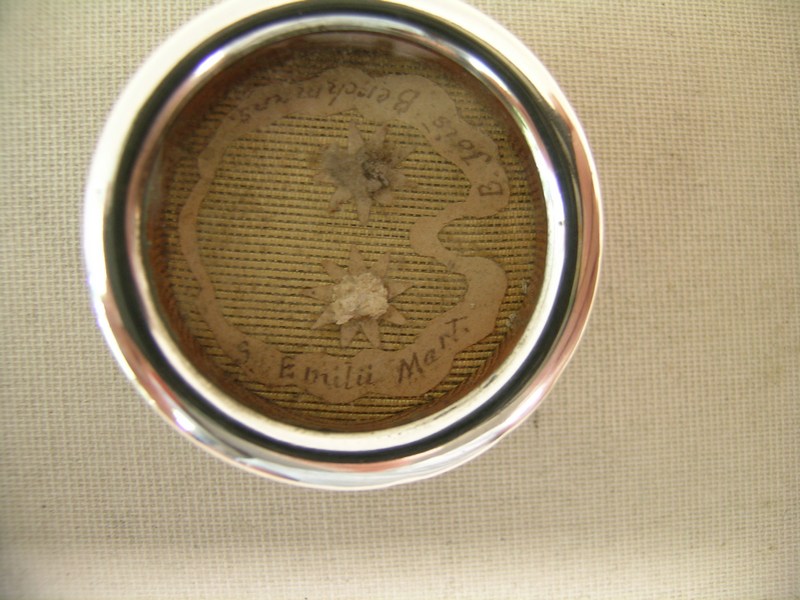
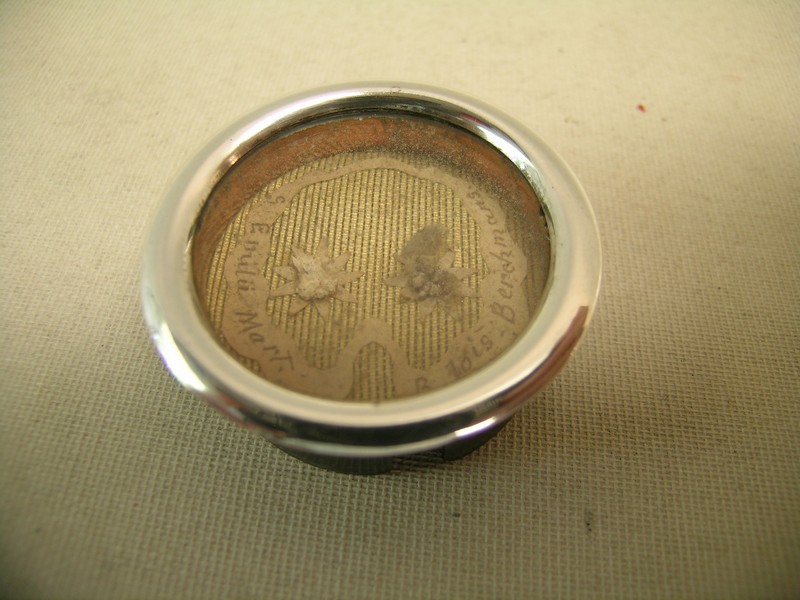
This is a
antique copper theca with silver front, inside two fc relics of Saint John
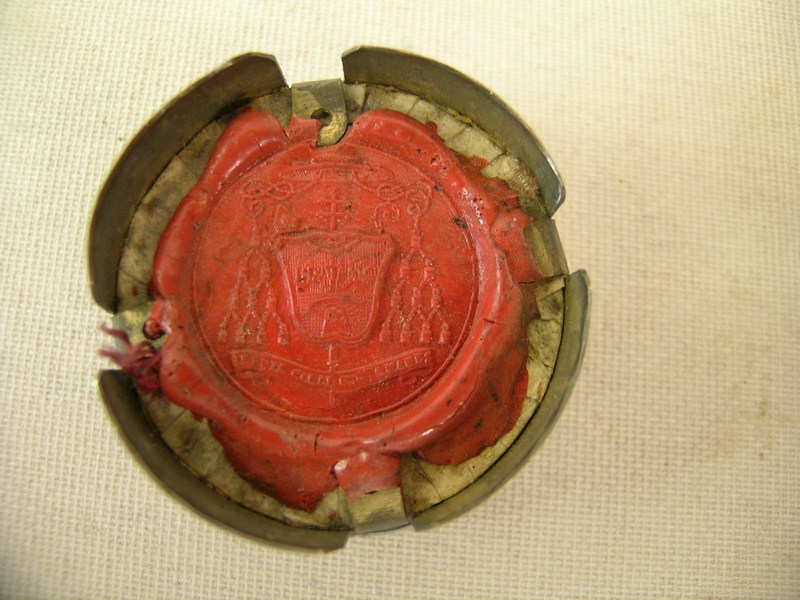
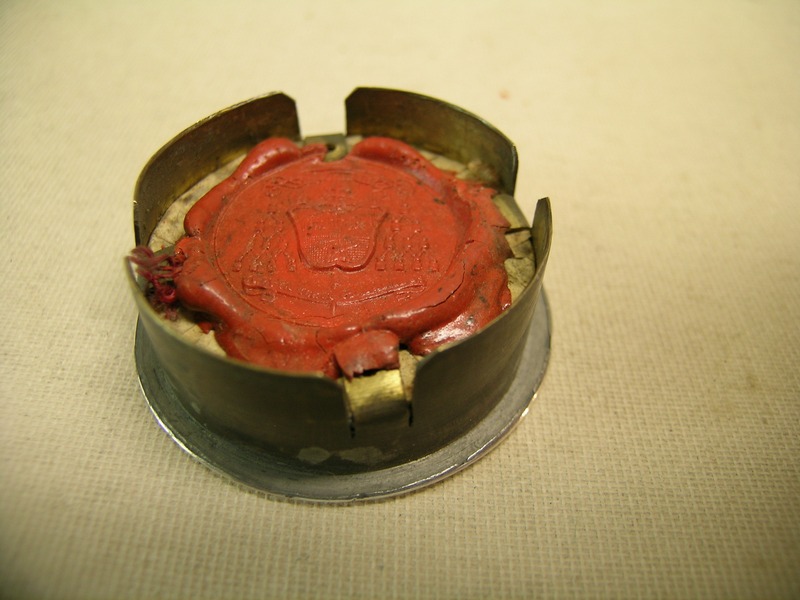
Berchmans and Saint Emiliius Martyr.Relics in place and wax seal and thtreads
intact. Diameter 1,5 inch.Sealed with the seal of Victor
Augustin Isidore Dechamps who was a Belgian Archbishop of Mechelen.
Comes from a
convent in Belgium.Shipping and handling US$ 39.00 by insured priority mail and
tracking number. All my items are securely packet, to avoid all possible damage
( look at my feedback).
Please contact me if you have any
questions. Items cannot be returned.
As per Ebay
policy,this reliquary does not contain human remains but only objects of
devotion.
The auction
is for the frame, the relic is a gift.
Please be carefull when buying relics online. Fake relics are
increasingly more and more of a problem. Most of the relics I sell are from
convents in Belgium and Italy. I have been collecting relics for more than 25
years. I consider myself an expert. Please contact me if you
have any questions.
Please see my other auctions for
more vestments,reliquary’s, relic’s and antiques items
I
only sell antique items and no copies or new made fakes!
Saint
John Berchmans
Also known as
- Jan Berchmans
Memorial
- 13 August
- 26 November on some calendars
- 27 November (Jesuits)
Profile
Son of a shoemaker, and one of
five children, three of whom entered religious life. John had great
devotion to his position as an altar boy. He spent much of his time caring
for his mother, who was in poor health. Jesuit noviate in 1616,
deciding to become a Jesuit after reading the life of Saint Aloysius
Gonzaga. Student at the Jesuit College at Malines, Belgium. Studied philosophy in Rome.
John had a dream of helping and teaching multi-lingual migrants,
and he studied all the chief languages of Europe. He wanted to
work in China after ordination. He died of unknown
causes following his participation in a public debate defending the faith,
and while clutching his rosary, crucifix, and rules of his order; he
did not live to be ordained.
John Berchmans was not noted for
extraordinary feats of holiness or austerity, nor did he found orders or
churches or work flashy miracles. He made kindness, courtesy, and constant
fidelity an important part of his holiness. The path to holiness can lie in the ordinary rather
than the extraordinary.
Born
- 13 March 1599 at Driest, Brabant, Belgium
Died
- 12 August 1621 at Rome, Italy
- relics at Saint Ignatius Church, Rome
Beatified
- 28 May 1865 by Pope Pius IX
Canonized
- 15 January 1888 by Pope Leo XIII
Patronage
- altar boys
- altar girls
- altar servers
- Oblate novices
- young people
Representation
- standing with hands clasped, holding
his crucifix, his book of rules, and his rosary
- the Rule of Saint Ignatius, a cross,
and rosary
Storefront
- medals
- rosaries
- hand painted medals
Victor
Augustin Isidore Dechamps (6 December 1810, in
Melle – 29 September 1883, in Mechelen) was a Belgian Archbishop of Mechelen,
Cardinal and Primate of Belgium.
He
and his brothers made rapid progress in science under their father's direction.
One, Adolphe Deschamps, entered on a political career. Victor pursued his
ecclesiastical studies first at the seminary of Tournai and then in the
Catholic University begun at Mechelen and afterwards transferred to Louvain.
Ordained
priest 20 December 1834, he entered the Congregation of the Most Holy Redeemer
in 1835, and made his vows 13 June 1836.[2] The next four years he spent at
Wittem as prefect of students and lector in dogmatic theology. In 1840 he began
his missionary life and in 1842 was nominated rector at Liège. He took an
active part in the founding of the Confraternity of the Holy Family, which he
considered his most salutary work. In the historic jubilee of Liège he had a
large share both by his "Le plus beau souvenir de l'histoire de
Liège", and by his preaching (1845–46).
He
visited England and saw the effects of the Tractarian movement. In 1849 he was
nominated consultor general of his congregation, and took up his residence at
Pagani near Naples just when Pope Pius IX was in exile at Gaeta. He had several
audiences with the pope and was instrumental in arranging the transfer of the
superior general from Pagani to Rome. This was not effected till 1855, when
Pius IX invited Father Dechamps to the first general chapter held in Rome. The
question of his appointment to the See of Liège was considered in 1852, but the
pope, touched by his personal appeal, did not insist. In 1865 Dechamps became
Bishop of Namur, whence he was transferred in 1875 to the Archdiocese of
Mechelen and made primate.
He
took an active part in the formation of the Pontifical Zouaves, and persuaded
General Lamoricière to offer his services to Pius IX. He battled for Catholic
schools and defended papal infallibility before and during the Vatican Council.
Cardinal Manning and Dechamps were indefatigable; and they became cardinals in
the same consistory, 15 March 1875. Cardinal Deschamps was appointed
Cardinal-Priest of San Bernardo alle Terme. Dechamps worked to the very end. He
said Mass on 28 September 1883, and died the day following in the arms of a
Redemptorist who happened to be present. He was buried, as he had desired, by
the side of Joseph Passerat at Rumilliers.
The
complete works of Dechamps, revised by himself, were published in seventeen
volumes at Mechelen. In presenting fourteen of the seventeen volumes to Pope
Leo XIII on 7 February 1879, the author writes: "There is one thing that
consoles me, Holy Father, in sending you my poor works: they are all
consecrated to the truths of our holy Faith... . Volume I is consecrated to the
truths of faith; II to Our Lord Jesus Christ; V to the Blessed Virgin Mary; III
and IV to the Church and St. Peter; VI to the pope and his infallibility; VII,
VIII, and IX to the refutation of modern errors; X, XI, XII, XIII, and XIV to
my preaching as bishop and to acts by which I governed my diocese." Of the
remaining volumes, XV, "Mélanges", deals with many important
questions; XVI and XVII contain letters on questions in philosophy, theology,
and other subjects.
Cardinal
Dechamps's brother, Adolphe Deschamps, served as minister of public works from
16 April 1843 to 30 July 1845, and as minister of foreign affairs until 12
August 1847.