Item Description
Shelley Jasmine pattern No. 2222 creamer and open sugar bowl set in the Strand shape, manufactured from fine bone china in Staffordshire, England. This is documented Shelley Seconds Ware, confirmed by the pattern number within the factory’s 2000-series and the clearly printed circled “2” beneath the sugar bowl. The set comprises a matching milk or cream jug and open sugar bowl. Both have softly rounded, tapering bodies raised upon circular feet. The jug incorporates a projecting pouring lip and an angular open handle, while the sugar bowl repeats the same balanced Strand profile without handles. Shelley produced the Strand shape from 1933 until approximately the mid-1940s. Jasmine No. 2222 features grouped orange and yellow flowers surrounded by elongated green and brown leaves. The decoration is placed against a softly shaded neutral ground, leaving much of the white bone-china body visible. A strong orange line follows the rims and jug handle, coordinating with the principal flower colour and emphasising the outlines of both pieces. Shelley introduced its Seconds Ware series in 1919 for china that did not satisfy the factory’s standards for best-quality ware. Seconds patterns occupied the 2000–2999 numbering range and could be marked with a “2” or “2nd”. Some used simplified decorations or lithographs selected specifically for economical production. The second-quality designation does not by itself identify structural damage; it records the factory’s original quality classification. The precise manufacturing variation responsible for this set’s classification is unconfirmed. No measurements or capacities have been estimated from the photographs. Please consult all listing images for the exact decoration, shape, underside marks and present appearance of both pieces.
Item Condition
Very good vintage used condition. This matching Shelley Jasmine creamer and open sugar bowl set has been carefully examined and presents attractively for its age. No cracks, repairs, hairlines or structural damage have been identified. Both pieces retain their Strand profiles. The jug’s pouring lip, open handle, rim and foot appear sound, as do the sugar bowl’s rim, body and circular foot. The orange, yellow, green and brown floral decoration remains clear and the coloured edging continues to define both pieces. The circled “2” and pattern number 2222 confirm that these are original Shelley Seconds Ware. Shelley used this classification for pieces that did not meet its standard for best-quality china. It is an original factory designation rather than evidence of subsequent damage. The exact production variation that led to this set being graded as second quality is unconfirmed and should not be guessed. Extremely minor surface wear or manufacturing variation may be visible upon close examination. Fine age-related crazing may exist but is not presently visible to the naked eye. Hand washing is recommended to protect the decoration and coloured trim. The listing photographs form an integral part of the description. A picture is worth a thousand words, and the images provide the clearest record of the exact pieces, their decoration, factory marks and present condition.
Manufacturer Info
Shelley’s connection with the Foley China Works began in 1872, when Joseph Ball Shelley entered partnership with James Wileman and the business traded as Wileman & Co. Following James Wileman’s retirement from the china works in 1884, the enterprise became controlled by the Shelley family while retaining the established Wileman name. Percy Shelley became sole proprietor in 1896. Under the Shelley family, the Staffordshire factory developed a strong international reputation for lightweight fine bone china, shaped tea services and decorative tableware. Artistic directors including Frederick Rhead, Walter Slater and Eric Slater helped establish a broad catalogue ranging from Art Nouveau pottery to geometric Art Deco forms and floral tea sets. The Shelley trademark was introduced in 1910, following a dispute over exclusive use of the Foley name. In 1919, the company began its Seconds Ware pattern series. These pieces had failed to satisfy the factory’s standards for best-quality production and were generally sold more economically. Their patterns occupied the 2000–2999 range and were often accompanied by a “2” or “2nd” mark. Some patterns were created specifically for this line. The company formally became Shelley Potteries Ltd in 1925. Strand was produced from 1933 until approximately the mid-1940s, placing it within Shelley’s celebrated interwar and wartime output. Shelley remained family controlled until its acquisition by Allied English Potteries in 1966. This Jasmine No. 2222 set preserves an important part of that history: genuine Shelley Seconds Ware presented on the distinctive Strand shape with its original circled “2” factory mark.
Did You Know?
Long before this Jasmine set was produced, Shelley’s predecessor created a decoration whose name borrowed the language of furniture making. Frederick Rhead joined Wileman & Co as Art Director in 1896 and introduced Intarsio, a term connected with the Italian word for inlaid work. A paper transfer supplied the outline on a biscuit-fired body; paintresses then filled each section with underglaze colour before the piece was glazed and fired. The result resembled coloured material set into the surface rather than ordinary painted decoration. Intarsio became one of Wileman’s largest Art Pottery ranges. Jasmine No. 2222 is not Intarsio, but its carefully arranged floral colour and hand-finished appearance belong to the decorative tradition that Rhead helped establish at the Shelley-controlled factory.
Multi-Buy
Save more when you purchase multiple items in the same order!Buy 2 items - SAVE 5% off the total items value!
Buy 3 items - SAVE 10% off the total items value!
Buy 4 items - SAVE 15% off the total items value!
When & How?
Option 1/Recommended/ : BEFORE PAYMENT
Option 2 : AFTER PAYMENT
Bespoke Custom Listings
Triple Saving!When & How?
Once you have decided which items you would like to purchase:
Combined Postage
Save more when you purchase multiple items qualifying for combined postage!When & How?
Option 1/Recommended/ : ITEMS PURCHASED TOGETHER IN ONE ORDER
Option 2 : ITEMS PURCHASED AS SEPARATE ORDERS
Postage
Every order is assessed individually due to the fragile nature of my items. The safety of your items always comes first.
When posting within the UK, we use eBay Simple Delivery, and for international postage we use eBay International Shipping. By using eBay's postage services, parcels are covered against loss or damage in transit, providing protection for both the buyer and the seller.
Within eBay's postage services, we always try to find the best available value-for-money postage option; in fact, this is almost always Royal Mail.
Returns
Due to the fragile and often irreplaceable nature of our collectable items, we ask that all purchases and returns are handled with particular care. Returns are accepted in accordance with our eBay return policy, eBay Buyer Protection and applicable consumer rights.
If you wish to return an item, please submit a return request through eBay within the applicable return period and follow the instructions provided. Items should be returned carefully and securely packaged, wherever possible using the original protective packaging, and in the same condition in which they were received.
If an item arrives damaged, faulty, incorrect or not as described, please contact us promptly through eBay so that the matter can be resolved in accordance with eBay's policies and your applicable consumer rights.
We always aim to approach every concern fairly and professionally. If you experience any problem with your order, please contact us through eBay and we will do our best to assist and resolve the matter promptly.
Postage Cost Guide
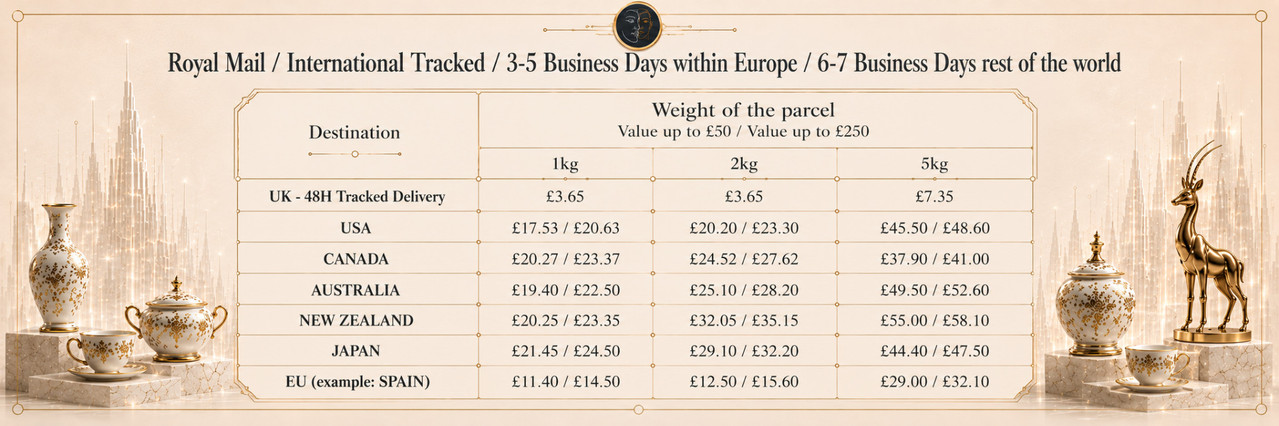
General Royal Mail postage cost guide based on 1 kg, 2 kg and 5 kg parcels and their destinations: