Item Description
Shelley Davies Tulip pattern No. 2267 creamer and open sugar bowl set in the Regent shape, manufactured from fine bone china in Staffordshire, England. Pattern 2267 belongs to Shelley’s factory Seconds Ware sequence and is documented by specialist records as Davies Tulip and Rose Floral. The set comprises a matching milk or cream jug and open sugar bowl. Both pieces have clean, angular Regent bodies with gently flared upper sections. The jug features a broad pouring lip and shaped loop handle, while the sugar bowl repeats the same modern geometric profile without handles. The Regent form is recognised as one of Shelley’s Art Deco shapes. Davies Tulip presents a compact mixed bouquet dominated by a yellow and burnt-orange tulip and a large pink rose. Smaller blue, purple, orange and yellow flowers are arranged among green leaves and fine stems. The coloured lithographed decoration contrasts with the white bone-china ground, while yellow edging and the jug’s yellow handle coordinate with the principal tulip. The name Davies identifies the commercial lithographic source associated with this Seconds Ware decoration. Shelley purchased lithographs from several specialist British and European suppliers, enabling floral designs to be applied economically across numerous shapes. Pattern 2267 has been recorded on Regent and several other Shelley forms. Shelley’s Seconds Ware series began in 1919 and used pattern numbers within the 2000–2999 range. These pieces did not meet the factory’s standard for Best Ware but remained genuine Shelley production. The designation does not itself establish structural damage, and the original grading reason for this set is unconfirmed. No measurements or capacities have been estimated from the photographs. Please inspect every image for the exact form, decoration, backstamp and current appearance.
Item Condition
Very good vintage used condition. This matching Shelley Davies Tulip creamer and open sugar bowl set has been carefully examined and presents attractively for its age. No cracks, repairs, hairlines or structural damage have been identified. Both pieces retain their angular Regent profiles. The jug’s pouring lip, shaped handle, flared rim and base appear sound, as do the sugar bowl’s rim, body and base. The colourful bouquets remain clearly defined, including the yellow and burnt-orange tulip, pink rose and smaller blue, purple, orange and yellow flowers. The pale-yellow edging and jug handle continue to complement the decoration. The Shelley Fine Bone China England backstamp remains legible. Pattern 2267 belongs to Shelley’s original Seconds Ware sequence. This factory classification indicates that the pieces did not meet the company’s Best Ware standard, but it does not itself denote later damage. The precise manufacturing variation responsible for the grading is unconfirmed. Extremely minor surface or production characteristics may be present. Fine crazing may exist but is not currently visible to the naked eye. The photographs form an integral part of the description. A picture is worth a thousand words and provides the clearest record of the exact set and its condition.
Manufacturer Info
Shelley’s history at the Foley China Works began in 1872, when Joseph Ball Shelley entered partnership with James Wileman and the china works traded as Wileman & Co. James Wileman retired from the china business in 1884, leaving it under Shelley family control while the recognised Wileman name continued in use. Percy Shelley became sole proprietor in 1896. He concentrated on improving quality, developing export markets and engaging skilled ceramic artists. Frederick Rhead, Walter Slater and Eric Slater subsequently helped the factory create wares ranging from Art Nouveau pottery to angular Art Deco tea services and post-war floral bone china. Following a dispute over exclusive use of the Foley name, the Shelley trademark appeared in 1910. Shelley’s Seconds Ware pattern sequence began in 1919. It enabled pieces that did not satisfy the factory’s Best Ware standard to be decorated and sold under separately numbered patterns rather than discarded. Pattern numbers generally occupied the 2000–2999 range. The company became Shelley Potteries Ltd in 1925. During the 1930s, Shelley developed recognisable Art Deco shapes including Mode, Vogue, Eve and Regent. These combined angular moulded bodies with geometric or stylised floral decoration. Shelley remained family controlled until 1966, when Allied English Potteries acquired the business and renamed the factory Montrose Works. Shelley production then ceased after outstanding orders were completed. This Davies Tulip No. 2267 set connects that history through its Regent form, commercial floral lithograph and documented Seconds Ware pattern.
Did You Know?
A persistent collector story claims Shelley’s original moulds were deliberately destroyed after the 1966 takeover, making its distinctive shapes impossible to reproduce exactly. The complete destruction claim is widely repeated but lacks firm documentary confirmation, so it should be treated as collector lore rather than established fact. What is verified is that Shelley production ceased, the works became the Royal Albert-producing Montrose Works, and most original factory buildings were later demolished. Shelley’s geometric Art Deco vocabulary was unusually recognisable: Mode, Vogue, Eve and Regent were names attached to sharply differentiated modern forms. This set uses Regent, proving that even an economical Seconds Ware floral pattern could be placed on one of Shelley’s most design-conscious shapes.
Multi-Buy
Save more when you purchase multiple items in the same order!Buy 2 items - SAVE 5% off the total items value!
Buy 3 items - SAVE 10% off the total items value!
Buy 4 items - SAVE 15% off the total items value!
When & How?
Option 1/Recommended/ : BEFORE PAYMENT
Option 2 : AFTER PAYMENT
Bespoke Custom Listings
Triple Saving!When & How?
Once you have decided which items you would like to purchase:
Combined Postage
Save more when you purchase multiple items qualifying for combined postage!When & How?
Option 1/Recommended/ : ITEMS PURCHASED TOGETHER IN ONE ORDER
Option 2 : ITEMS PURCHASED AS SEPARATE ORDERS
Postage
Every order is assessed individually due to the fragile nature of my items. The safety of your items always comes first.
When posting within the UK, we use eBay Simple Delivery, and for international postage we use eBay International Shipping. By using eBay's postage services, parcels are covered against loss or damage in transit, providing protection for both the buyer and the seller.
Within eBay's postage services, we always try to find the best available value-for-money postage option; in fact, this is almost always Royal Mail.
Returns
Due to the fragile and often irreplaceable nature of our collectable items, we ask that all purchases and returns are handled with particular care. Returns are accepted in accordance with our eBay return policy, eBay Buyer Protection and applicable consumer rights.
If you wish to return an item, please submit a return request through eBay within the applicable return period and follow the instructions provided. Items should be returned carefully and securely packaged, wherever possible using the original protective packaging, and in the same condition in which they were received.
If an item arrives damaged, faulty, incorrect or not as described, please contact us promptly through eBay so that the matter can be resolved in accordance with eBay's policies and your applicable consumer rights.
We always aim to approach every concern fairly and professionally. If you experience any problem with your order, please contact us through eBay and we will do our best to assist and resolve the matter promptly.
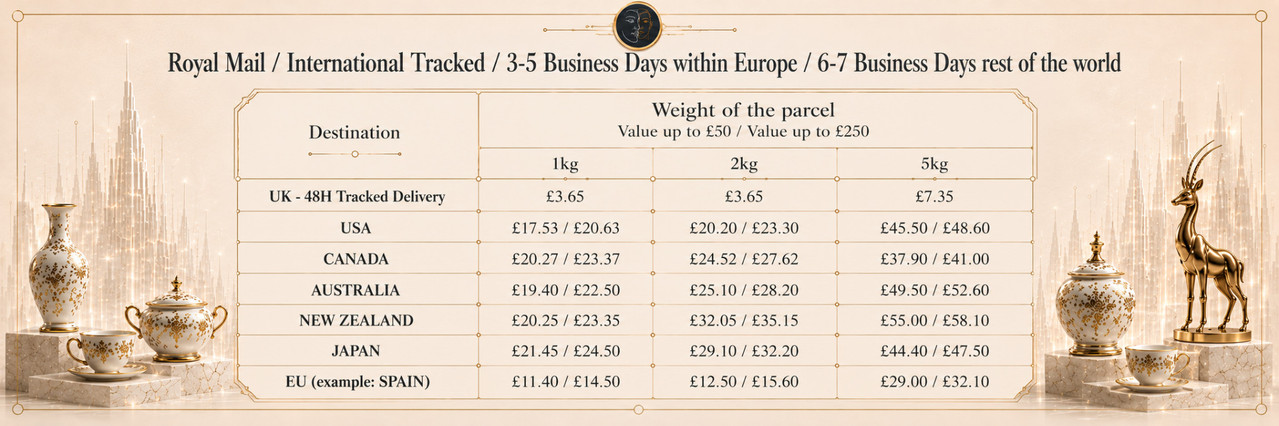
Postage Cost Guide
General Royal Mail postage cost guide based on 1 kg, 2 kg and 5 kg parcels and their destinations: