
Antico quadro mitologico grande dipinto fiammingo ad olio su tela arte XVIII
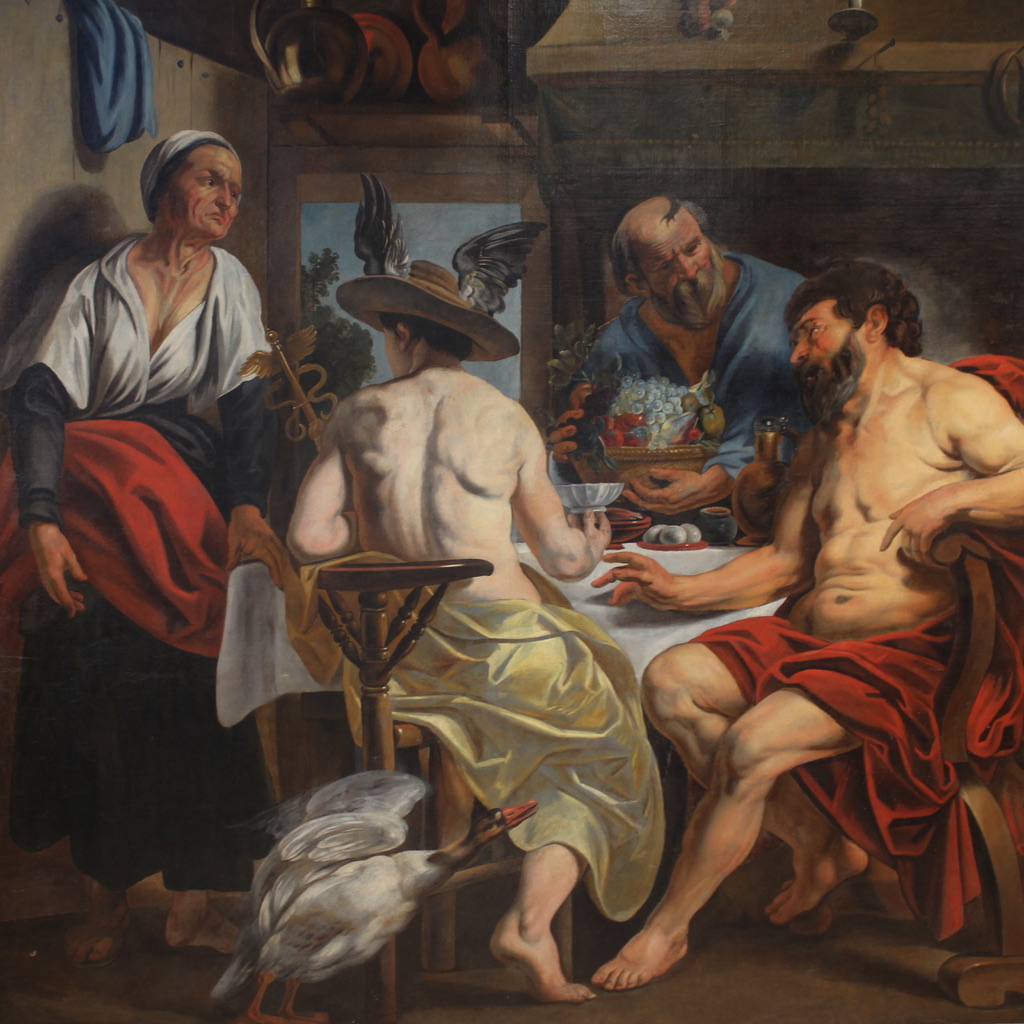
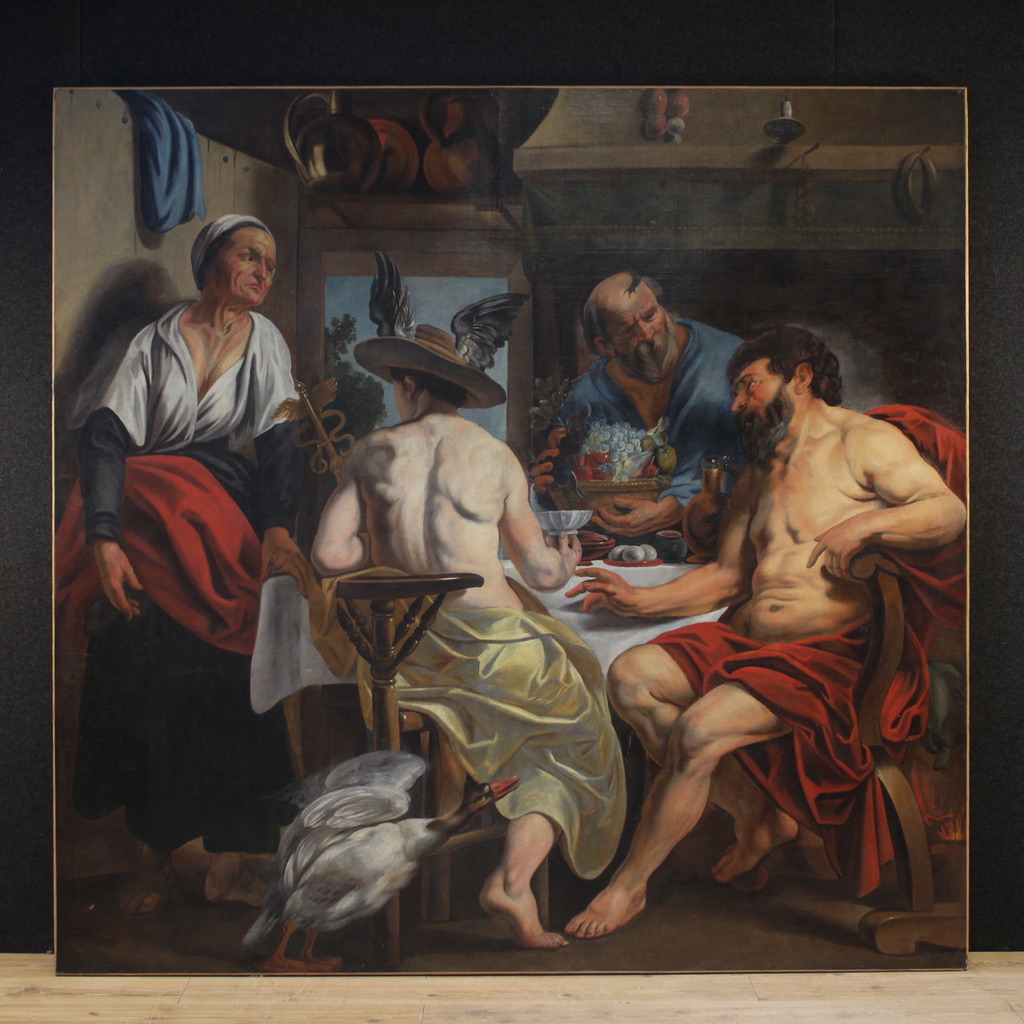
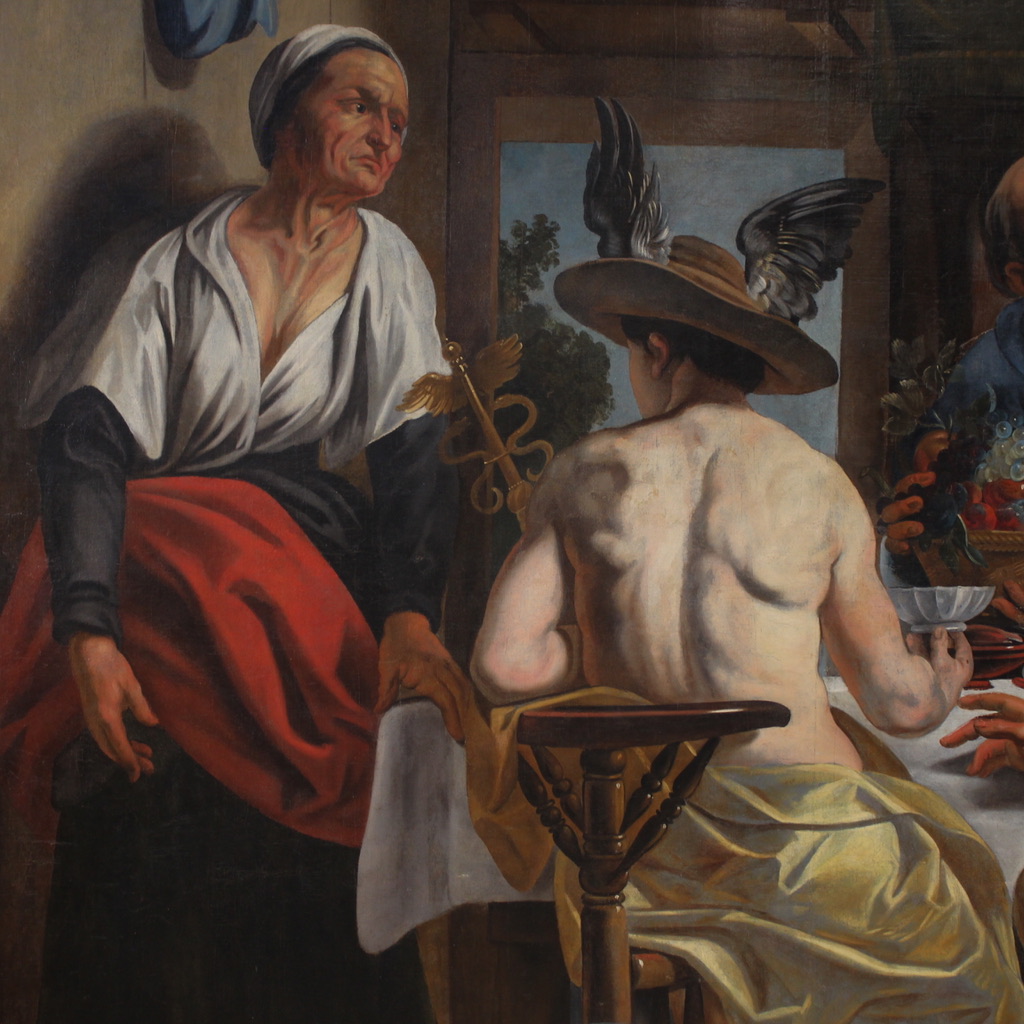
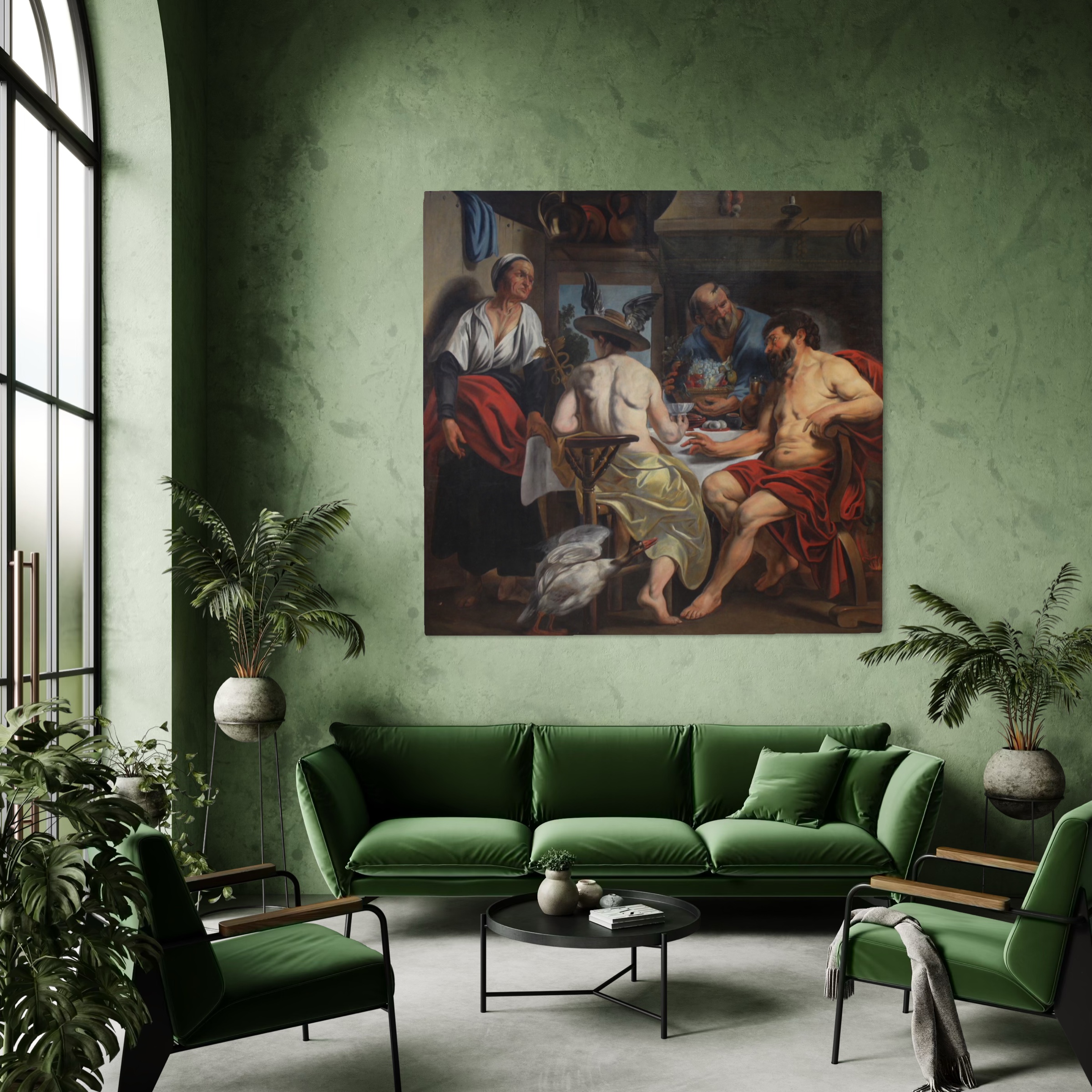
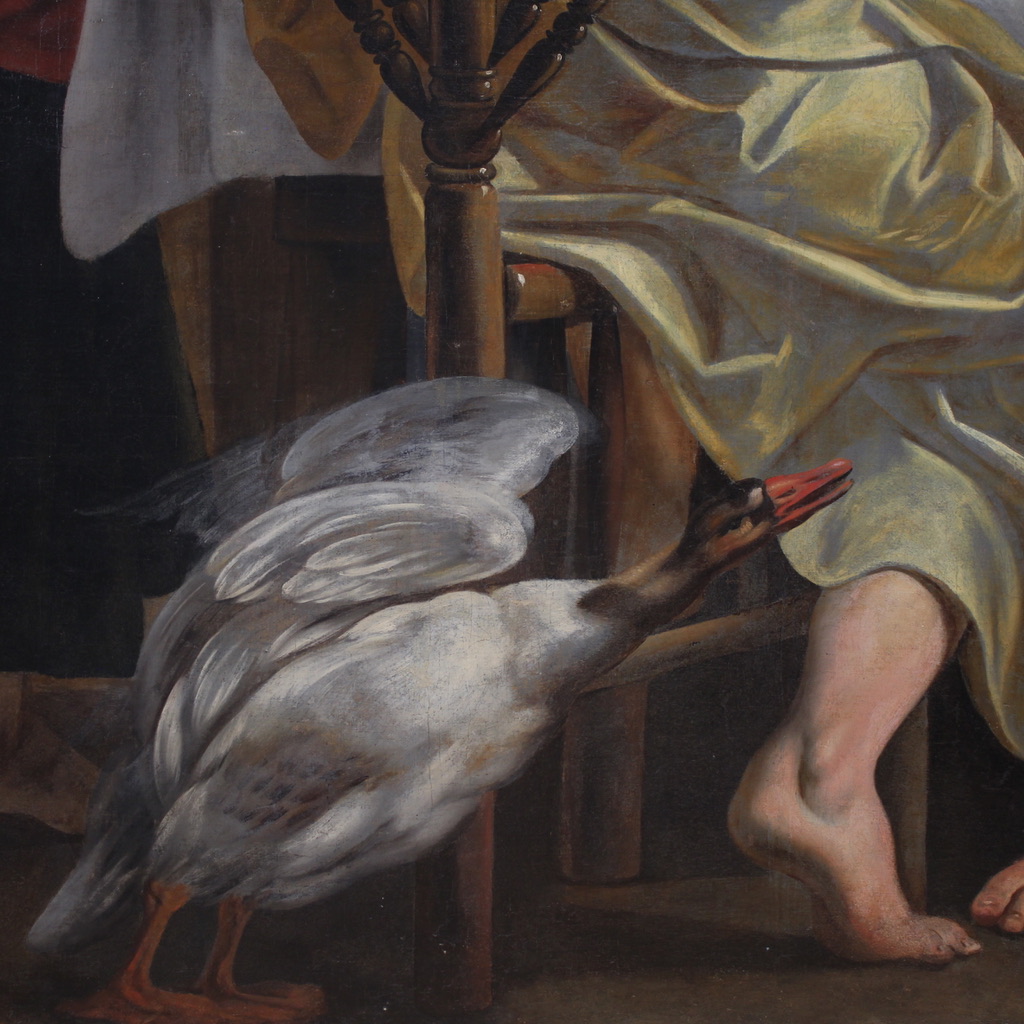
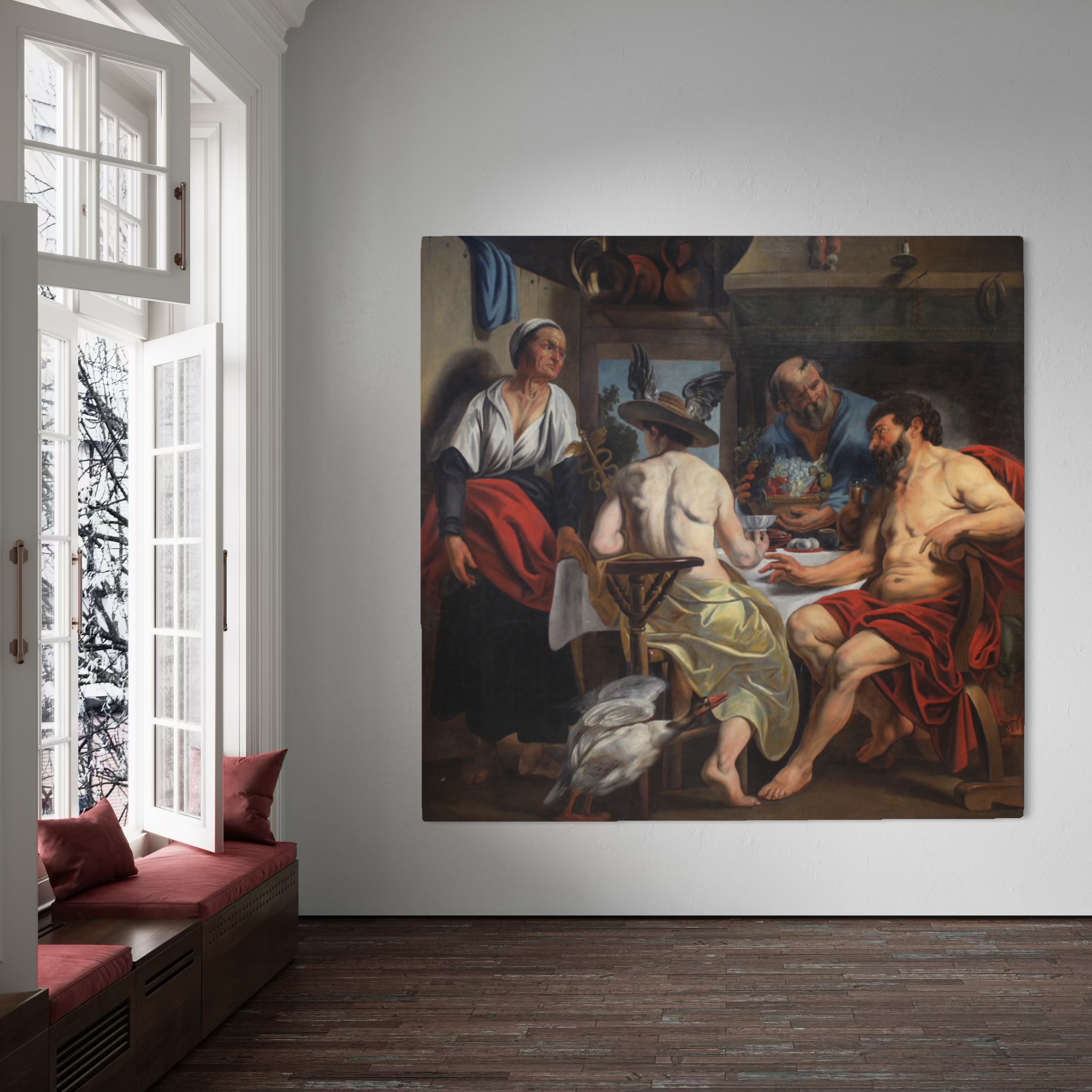
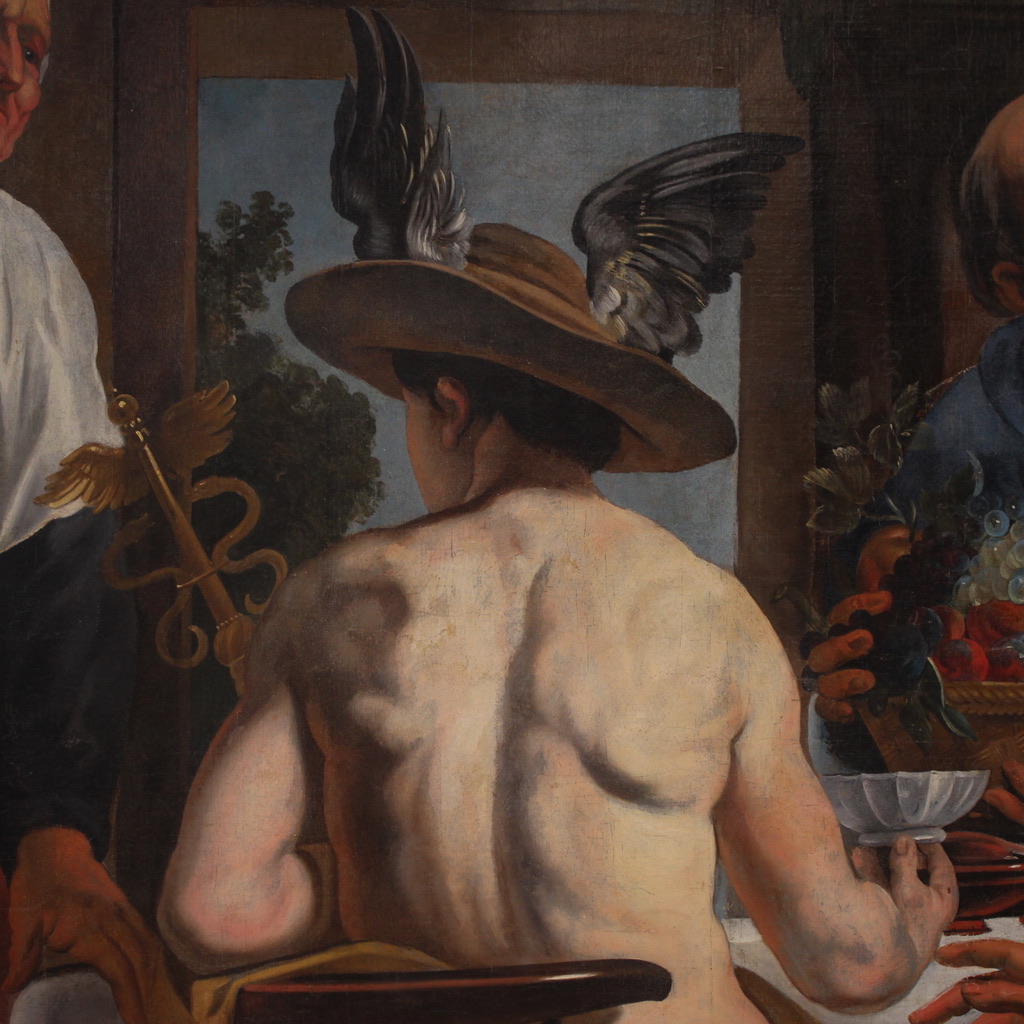
Grande quadro fiammingo della metà del XVIII secolo. Opera ad olio su tela raffigurante un celebre episodio narrato nelle Metamorfosi di Ovidio. Giove e Mercurio, travestiti da viandanti, vengono respinti da tutti gli abitanti di una regione tranne da una coppia di anziani contadini, Filemone e Bauci. A questo punto si manifesta il prodigio, il vino non si esaurisce, la mensa sembra rinnovarsi. Ai piedi della tavola compare l'oca, unico animale posseduto dalla coppia e che gli anziani vogliono comunque offrire.
Ma l'animale, rifugiandosi presso gli Dei, ne svela involontariamente la natura divina. E' in questo momento che Giove e Mercurio si rivelano: la loro casa verrà risparmiata dalla distruzione del villaggio e gli anziani potranno restare uniti per sempre, trasformati infine in due alberi intrecciati, simbolo di amore e fedeltà eterna. La composizione riprende chiaramente un celebre prototipo di Jacob Jordaens (1593-1678), maestro fiammingo tra i massimi interpreti della pittura narrativa seicentesca.
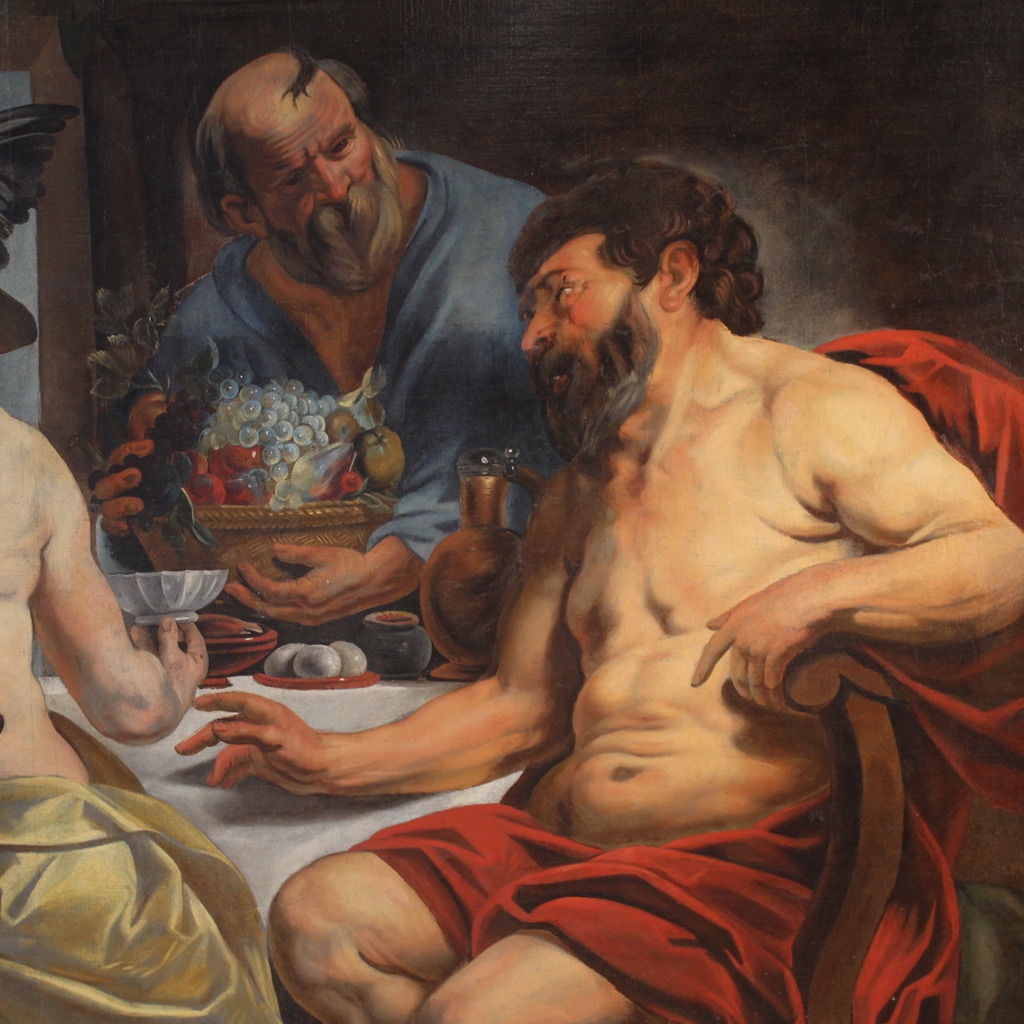
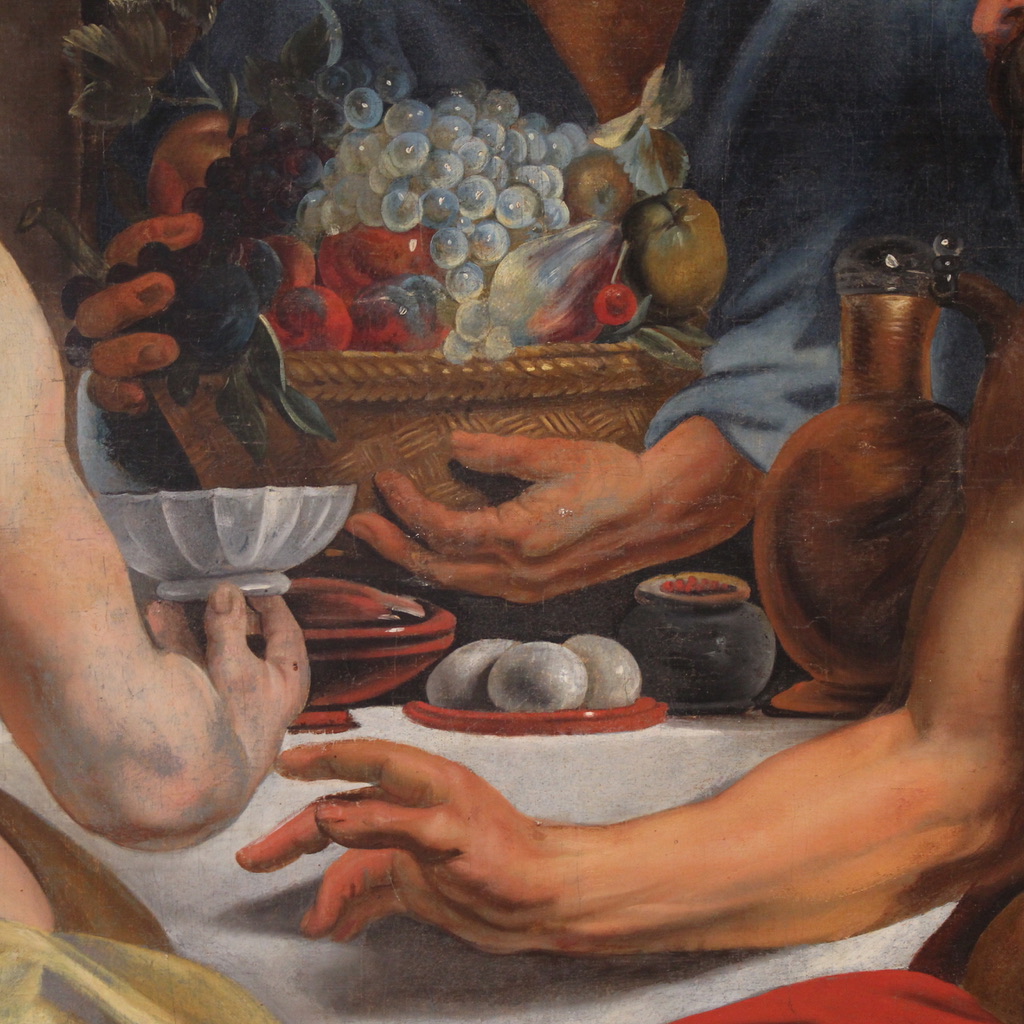
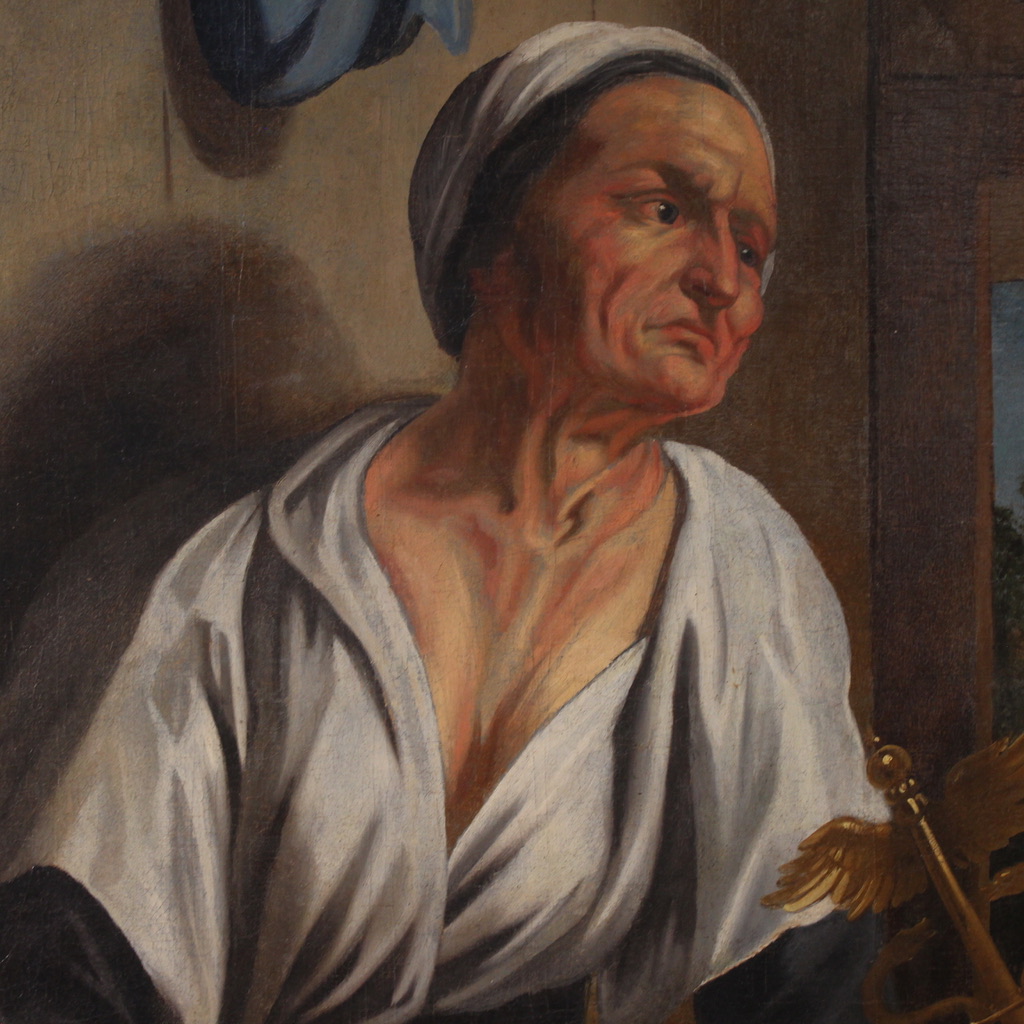
Opera di notevole qualità pittorica, ricca di minuziosi dettagli e caratterizzata da una tavolozza cromatica accesa. Da sottolineare la resa della natura morta sulla tavola imbandita e dell'incarnato, con corpi robusti e carnosi tipici del gusto nordico. Dipinto di notevoli dimensioni e di difficile reperibilità, ideale per un grande salone di rappresentanza o per una hall di un albergo.
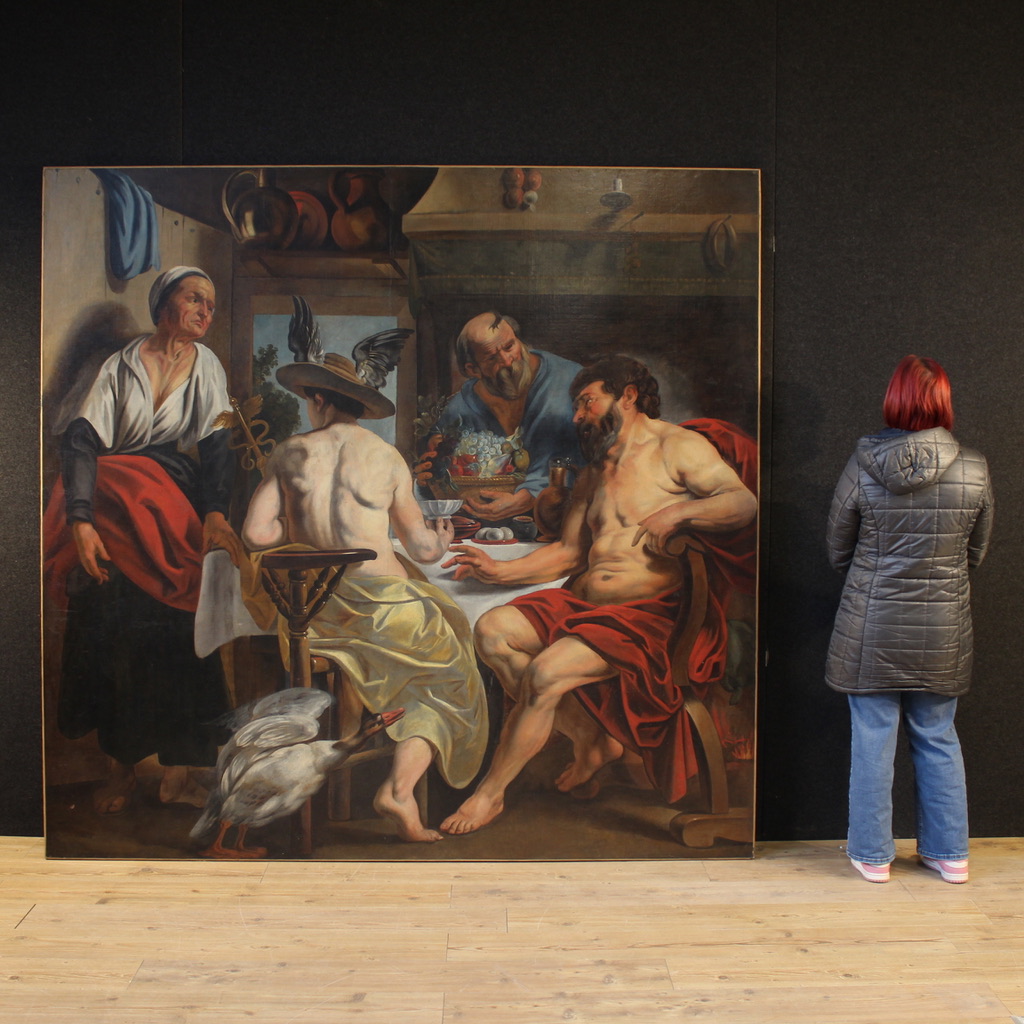
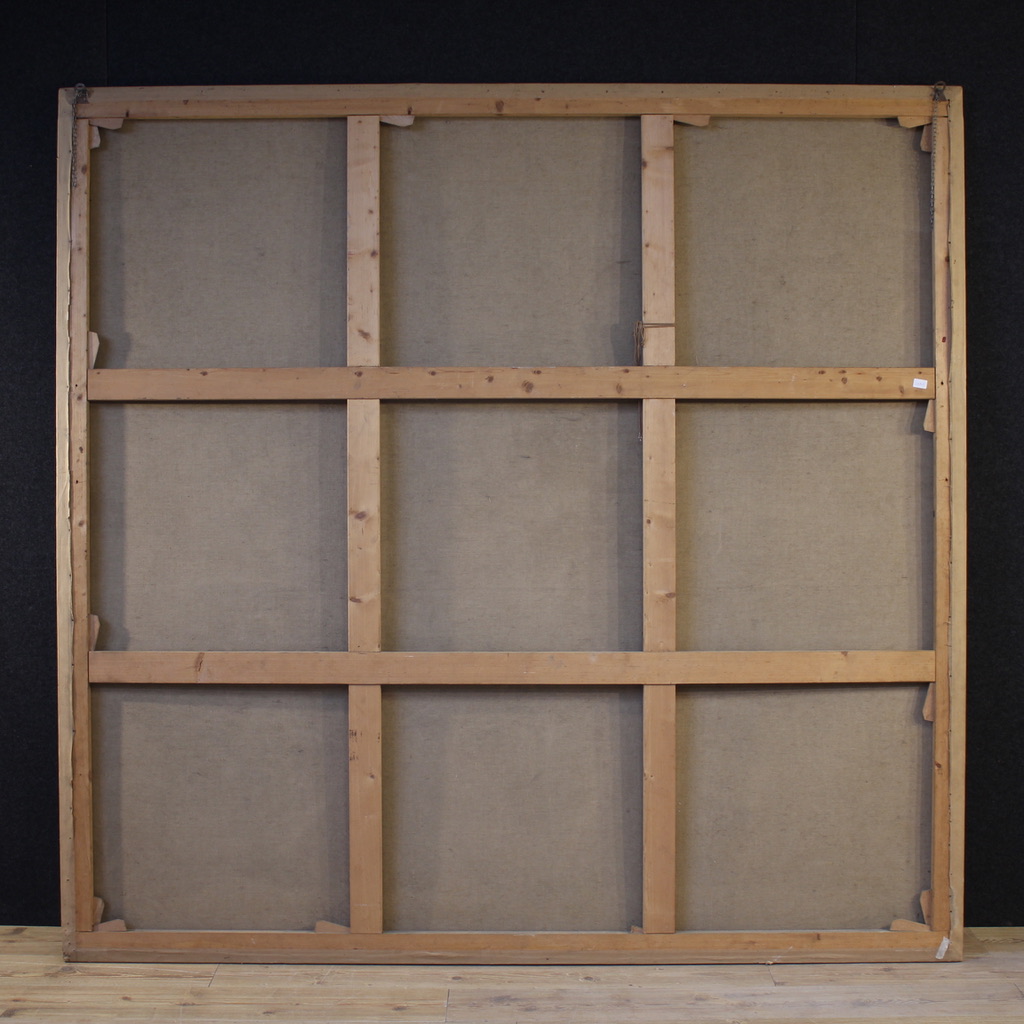
Perfetto per gli amanti della mitologia classica o per chi desidera un'opera scenografica che non passa inosservata. Quadro già restaurato con rintelo, sostituzione del telaio e ripresa del colore in piccoli punti, nel complesso in buono stato conservativo. H 221 x L 228 x P 3 cm
Il pagamento deve essere effettuato entro 7 giorni lavorativi dal momento dell'acquisto, in caso contrario l'articolo sarà considerato invenduto e rimesso in vendita. Ogni oggetto spedito sarà accompagnato da scontrino fiscale, se desiderate la fattura questa va richiesta al momento dell'acquisto. Si offre e si pretende la massima serietà nella transazione, siete pregati di fare offerte solo se seriamente intenzionati all'acquisto.
Great Flemish painting from the mid-18th century. Oil on canvas artwork depicting a famous episode from Ovid's Metamorphoses. Jupiter and Mercury, disguised as wayfarers, are rejected by all the inhabitants of a region except for an elderly peasant couple, Philemon and Baucis. At this point, a miracle occurs: the wine never runs out, and the table seems to be renewed. At the foot of the table appears the goose, the only animal the couple owns, which the elders nevertheless wish to offer.
But the animal, taking refuge with the Gods, inadvertently reveals its divine nature. It is at this moment that Jupiter and Mercury reveal themselves: their home will be spared from the destruction of the village, and the elders will be able to remain united forever, finally transformed into two intertwined trees, a symbol of love and eternal fidelity. The composition clearly recalls a famous prototype by Jacob Jordaens (1593-1678), a Flemish master among the greatest exponents of 17th-century narrative painting.
A painting of remarkable pictorial quality, rich in minute detail and characterized by a vibrant color palette. The still life on the laid table and the flesh tones, with robust, fleshy bodies typical of Nordic taste, are particularly noteworthy. This large and hard-to-find painting is ideal for a large reception room or hotel lobby.
Perfect for lovers of classical mythology or for those seeking a dramatic work that won't go unnoticed. The painting has already been restored with re-lining, replacement of the stretcher, and restoration of small areas of color, and is in overall good condition. H 221 x W 228 x D 3 cm
Großes flämisches Gemälde aus der Mitte des 18. Jahrhunderts. Öl auf Leinwand, das eine berühmte Episode aus Ovids Metamorphosen darstellt. Jupiter und Merkur, als Wanderer verkleidet, werden von allen Bewohnern einer Gegend abgewiesen, bis auf ein älteres Bauernpaar, Philemon und Baucis. Da geschieht ein Wunder: Der Wein geht nicht aus, und der Tisch scheint sich zu erneuern. Am Fuße des Tisches erscheint die Gans, das einzige Tier des Paares, das die Alten ihnen dennoch opfern wollen.
Doch das Tier, das bei den Göttern Zuflucht sucht, offenbart unabsichtlich seine göttliche Natur. In diesem Moment zeigen sich Jupiter und Merkur: Ihr Zuhause wird vor der Zerstörung des Dorfes bewahrt, und die Alten können für immer vereint bleiben, schließlich verwandelt in zwei ineinander verschlungene Bäume, ein Symbol der Liebe und ewigen Treue. Die Komposition erinnert deutlich an ein berühmtes Vorbild von Jacob Jordaens (1593–1678), einem flämischen Meister und einem der bedeutendsten Vertreter der narrativen Malerei des 17. Jahrhunderts.
Ein Gemälde von bemerkenswerter malerischer Qualität, reich an feinen Details und geprägt von einer lebendigen Farbpalette. Besonders hervorzuheben sind das Stillleben auf dem gedeckten Tisch und die Hauttöne mit ihren kräftigen, fleischigen Körpern, typisch für den nordischen Geschmack. Dieses große und seltene Gemälde eignet sich ideal für einen repräsentativen Empfangsraum oder eine Hotellobby.
Perfekt für Liebhaber der klassischen Mythologie oder für alle, die ein eindrucksvolles Werk suchen, das die Blicke auf sich zieht. Das Gemälde wurde bereits restauriert – inklusive Doublierung, Austausch des Keilrahmens und Ausbesserung kleinerer Farbflächen – und befindet sich in einem insgesamt guten Zustand. H 221 x B 228 x T 3 cm
Parino Antiquitätenhändler zeichnet sich auf dem Markt durch besten und kostenlosen Verpackungs- und Versandservice aus. Nach Eingang der Zahlung wir die Ware sofort bis vor das Haus verschickt.
Die Zahlung muss innerhalb von 7 Arbeitstagen nach dem Kauf erfolgen, andernfalls wird der Artikel als unverkauft erachtet und erneut zum Verkauf freigegeben. Jedem verkauften Objekt liegt eine steuergültige Quittung bei, sollten Sie eine Rechnung wünschen, teilen Sie das bitte gleich beim Kauf mit. Wir bieten und erwarten höchste Seriosität bei der Geschäftsabwicklung und möchten Sie daher bitten, nur Angebote zu machen, wenn Sie ernsthaft am Kauf interessiert sind.
Grand tableau flamand du milieu du 18ème siècle. Peinture huile sur toile illustrant un épisode célèbre des Métamorphoses d'Ovide. Jupiter et Mercure, déguisés en voyageurs, sont rejetés par tous les habitants d'une région, à l'exception d'un couple de vieux paysans, Philémon et Baucis. Un miracle se produit alors : le vin ne tarit plus et la table semble se renouveler. Au pied de la table apparaît l'oie, unique animal que possède le couple, et que les vieillards souhaitent néanmoins leur offrir.
Mais l'animal, se réfugiant auprès des dieux, révèle involontairement sa nature divine. C'est à cet instant que Jupiter et Mercure se révèlent : leur foyer sera épargné de la destruction du village et les vieillards pourront rester unis pour toujours, finalement transformés en deux arbres entrelacés, symbole d'amour et de fidélité éternelle. La composition rappelle clairement un célèbre prototype de Jacob Jordaens (1593-1678), maître flamand parmi les plus grands représentants de la peinture narrative du 17ème siècle.
Ce tableau d'une remarquable qualité picturale, riche en détails minutieux et caractérisé par une palette de couleurs vibrantes, est particulièrement remarquable. La nature morte sur la table dressée et les carnations, aux corps robustes et charnus typiques du goût nordique, sont particulièrement saisissantes. Cette grande toile, rare et recherchée, est idéale pour une vaste salle de réception ou un hall d'hôtel.
Parfaite pour les amateurs de mythologie classique ou pour ceux qui recherchent une œuvre spectaculaire qui ne passera pas inaperçue. Le tableau a déjà été restauré (rentoilage, remplacement du châssis et retouches de couleurs) et est en bon état général. H 221 x L 228 x P 3 cm
Le payement doit être effectué dans le délai de 7 jours ouvrables du moment de l'acquisition, dans le cas contraire, l'article sera considéré invendu et remis en vente. Chaque objet sera accompagné de ticket fiscal, si vous désirez la facture celle-ci doit être demandée au moment de l'acquisition. On offre et on exige le plus grand sérieux dans la transaction, vous êtes donc priés de faire vos offres seulement si sérieusement intentionnés à l'acquisition.

Inserzione realizzata con Store360