
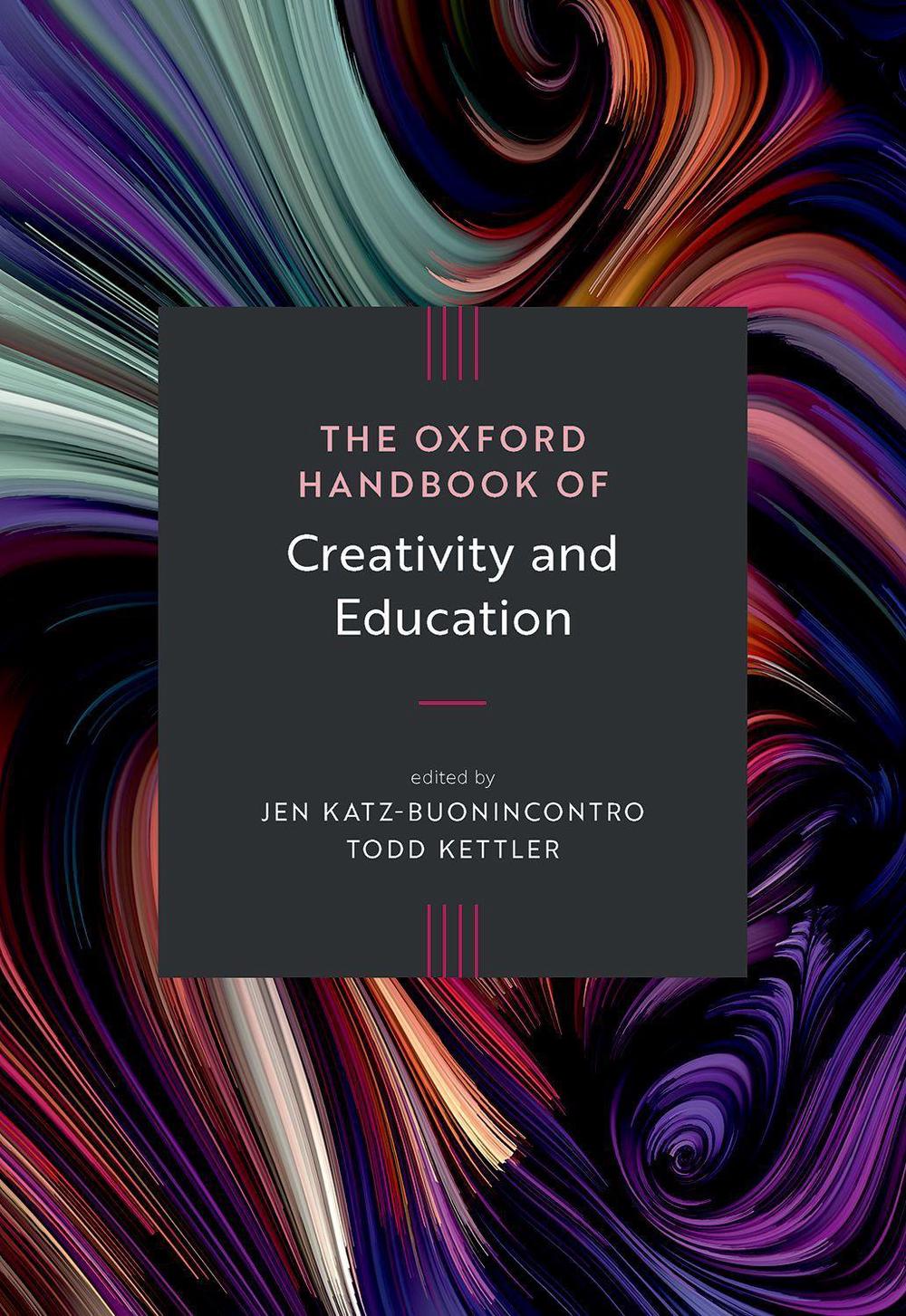
The Oxford Handbook of Creativity and Education
by Jen Katz-Buonincontro, Todd Kettler
"The modern science of creativity began with Guilford's presidential address to the American Psychological Association in 1950. Most of the early research following Guildford's address was in the field of psychology with a focus on measuring creativity and thus little or no overt connection to educational leadership"-- Provided by publisher.
Hardcover
Brand New
Publisher Description
The Oxford International Handbook of Creativity and Education brings together cutting-edge scholarship about the global trends and future directions of creativity in education. Diverse models and frameworks capture the state of the field with a focus on cognitive, social, and cultural areas of creativity in education. Barriers and supports to creativity are examined in educational policy, assessment, curriculum, classroom environments, and school contexts.This handbook is designed to propagate new research and applications in the field by helping students, researchers and program evaluators understand and apply these models of creativity to how students,teachers and leaders enact creativity in learning, teaching, and leading. The handbook will inspire new work to advance the study and practice of creativity in education. Section I provides an overview of creativity frameworks, models, and pedagogies of education to anchor the handbook. Research on creativity in students, teachers, and schools are discussed in Section II. Culture and communities of creativity are explored in depth in Section III. Section IV coverscreativity in academic disciplines like art, music, math, science, and engineering. Lastly, Section V provides thought-provoking chapters on researching education.
Table of Contents
IntroductionJennifer Katz-Buonincontro, Drexel UniversityTodd Kettler, Baylor UniversitySection 1: Frameworks, Models and Pedagogies for Creativity and Education1. Tracing the Arc of Creativity in Educational Philosophies: Broadening the Foundations for Research and PedagogyJennifer Katz-Buonincontro, Drexel UniversityTodd Kettler, Baylor University2. Teaching for Creativity Was the Right Answer to the Wrong Question: So, What Should We Have Asked?Robert Sternberg, Cornell University3. Seeing the Creativity in Talent Development ProcessesJeb Puryear, University of Montana4. Creativity Development in Adolescence and Emerging Adulthood: From Education Policies to the ClassroomBaptiste Barbot, Université Catholique Louvain, BelgiumDominik Golab, Université Catholique Louvain, Belgium5. Creative Problem-Solving: Processes, Strategies, and Skills for EducationMichael D. Mumford, The University of OklahomaMark W. Fichtel, The University of Oklahoma6. Creative Pedagogies in EducationLeon R de Bruin, University of Melbourne7. Designing for Creative Learning: How Instructional Designers Can Influence the 5 As of CreativityRichard E. West, Brigham Young UniversityJason K. McDonald, Brigham Young UniversityPunya Mishra, Arizona State UniversityMelissa Warr, New Mexico State University8. Self-Regulated Learning and Mind Wandering: The Embedded Paradox of the Creative ProcessLisa DaVia Rubenstein, Ball State UniversityGregory Boldt, University of ConnecticutJames Galliher, University of Indiana - Purdue University, Indianapolis9. Exploring the Intricate Relationship between Creativity, Learning, and Academic AchievementSelcuk Acar, University of North TexasJanessa Bower, University of North Texas10. Extracurricular Programs and Out-of-School Time Activities as Contexts Supporting Creativity and Problem-SolvingMegan L. Atha, Florida Gulf Coast UniversitySection 2: Creative Students, Teachers, and Schools11. What Do Teachers Need to Know about Teaching for Creativity? Myths and Suggested Practices of Creative EducationSue Hyeon Paek, University of Northern ColoradoEmily Romero, University of Northern ColoradoChelsea Miller, University of Northern Colorado12. Developing Creativity in Early Childhood: The Role of Pretend PlaySandra W. Russ, Case Western Reserve UniversityKerrigan Vargo, Case Western Reserve University13. Connecting Creativity with High-Impact Practices in Undergraduate EducationAngie L. Miller, Indiana University Bloomington14. Two Decades of Research on Creative Self-Beliefs: Implications for Educational PracticePaula Álvarez-Huerta, Mondragon UnibertsitateaInaki Larrea, Mondragon UnibertsitateaAlexander Muela, University of the Basque Country15. Are Creative Students More Successful in College?Jean E. Pretz, Elizabethtown CollegeMegan Kuczma, Elizabethtown College16. Benchmarking Creativity in OrganizationsRoni Reiter Palmon, University of Nebraska OmahaMeagan Millier, University of Nebraska Omaha17. The Intersection of Creativity and Leadership in EducationMolly Holinger, SUNY Buffalo StateGerard J. Puccio, SUNY Buffalo StatePeter Loehr, SUNY Buffalo StateSection 3: Culture and Communities of Creativity18. The Role of Openness to Experience in Finding Creative StudentsAlexandra Vuyk, Aikumby Center for Giftedness and Creativity, Universidad CatolicaNuestra Señora de la Asuncion; Asuncion, ParaguayBarbara Kerr, Center for Creativity and Entrepreneurship Education, The Universityof Kansas; Lawrence, KSMaureen Montanía, Aikumby Center for Giftedness and Creativity, UniversidadCatolica Nuestra Señora de la Asuncion; Asuncion, Paraguay19. Creativity, Culture, and Education: An Invitation to Think about the FutureMônica Souza Neves-Pereira, University of Brasilia - UnB - Brasília/DF - Brazil20. On Higher Education, Deliberative Encounters, and Play: Towards the Cultivation of Creative ActionYusef Waghid, Stellenbosch University21. Creativity and Equity: Dovetailing Pedagogies for Social JusticeSarah R. Luria, University of ConnecticutJames C. Kaufman, University of ConnecticutLihong Xie, University of Connecticut22. Family Influences on CreativityJiajun Guo, East China Normal UniversityJin Qian, East China Normal UniversityWeiguo Pang, East China Normal University23. Creativity in Gifted Education Policy and Assessment: An Introduction of a New Measure of Original Thinking in Elementary Students (MOTES)Grantham, Tarek .C., University of GeorgiaAcar, Selcuk., University of North TexasDumas, Denis., University of GeorgiaFox, Sonja, Duluth, Georgia24. Academically Gifted Black Males: Exploring Creativity Through Qualitative ResearchFred A. Bonner II, Prairie View A&M UniversityAlonzo Flowers, The University of Texas at San AntonioStella Smith, Prairie View A&M UniversityJerrel Moore, Prairie View A&M UniversityRamon Goings, University of Maryland, Baltimore CountyDave Louis, The University of HoustonWilliam Parker, Prairie View A&M UniversitySection 4: Creativity in the Disciplines25. Using Creative Writing to Fuel CreativityFrancis Gilbert, University of London26. Fostering Creativity through Design-Based Learning in STEM EducationSema Tan, Sinop UniversityEsra Bozkurt Altan, Sinop University27. Creativity in Engineering EducationDavid Cropley, University of South Australia28. Creativity and Mathematics EducationScott Chamberlin, University of WyomingRhett Anthony C. Latonio, Ateneo de Manila UniversityRyan D. Fox, Belmont University29. Mathematical CreativityGülsah Batdal-Karaduman, Istanbul University-Cerrahpasa30. Integrating Creativity in Science EducationKristen Lamb, University of AlabamaDiana Dekelaita-Mullet, Navajo Technical University31. Fostering the Creativity of Neurodivergent Individuals in Music EducationRhoda Bernard, Berklee College of Music32. Culturally Responsive Visual Art Teaching for Student CreativityRichard Seigesmund, Northern Illinois UniversityBernard Young, Arizona State University33. Creative Reading in the Digital Information AgeInge van de Ven, Tilburg UniversitySection 5: Researching Creativity in Education34. Youth Action: School-Based Creative Problem-Solving Training to Build Individual and Community Well-beingJessica D. Hoffmann, Yale UniversityJennifer Seibyl, Yale UniversityManeeza Dawood, Columbia University35. Measuring Creative Potential and Its DevelopmentAnaelle Camarda, Institut Supérieur Maria MontessoriTodd Lubart,Université Paris Cité and Univ Gustave Eiffel, LaPEA36. Measuring Creative Potential and Growth in PreK-12 Education ContextsJonathan A. Plucker, Johns Hopkins UniversityMelanie S. Meyer, Baylor University37. Assessing Creative Thinking at Scale and Across Culture: The PISA 2022 AssessmentNatalie Foster, The Rockefeller FoundationMario Piacentini, Organisation for Economic Co-operation and Development38. Creativity for the 21st Century: A Critical AppraisalSue Grey, Inland Norway University of Natural Sciences39. Assessing Creativity in the School Environment: Evidence-Based Practices and Future DirectionsDenise de Souza Fleith, University of BrasiliaDaniela Vilarinho-Pereira, Purdue University40. Collaborative Creativity Processes: Micro-level Theory, Methods, Results, and Implications for EducationMing Ming Chiu, EduHK41. Conceptual Co-creativityJanet Rafner, Aarhus University42. What Do Creativity Researchers Owe to Education?Ronald Beghetto, Arizona State University
Details
