
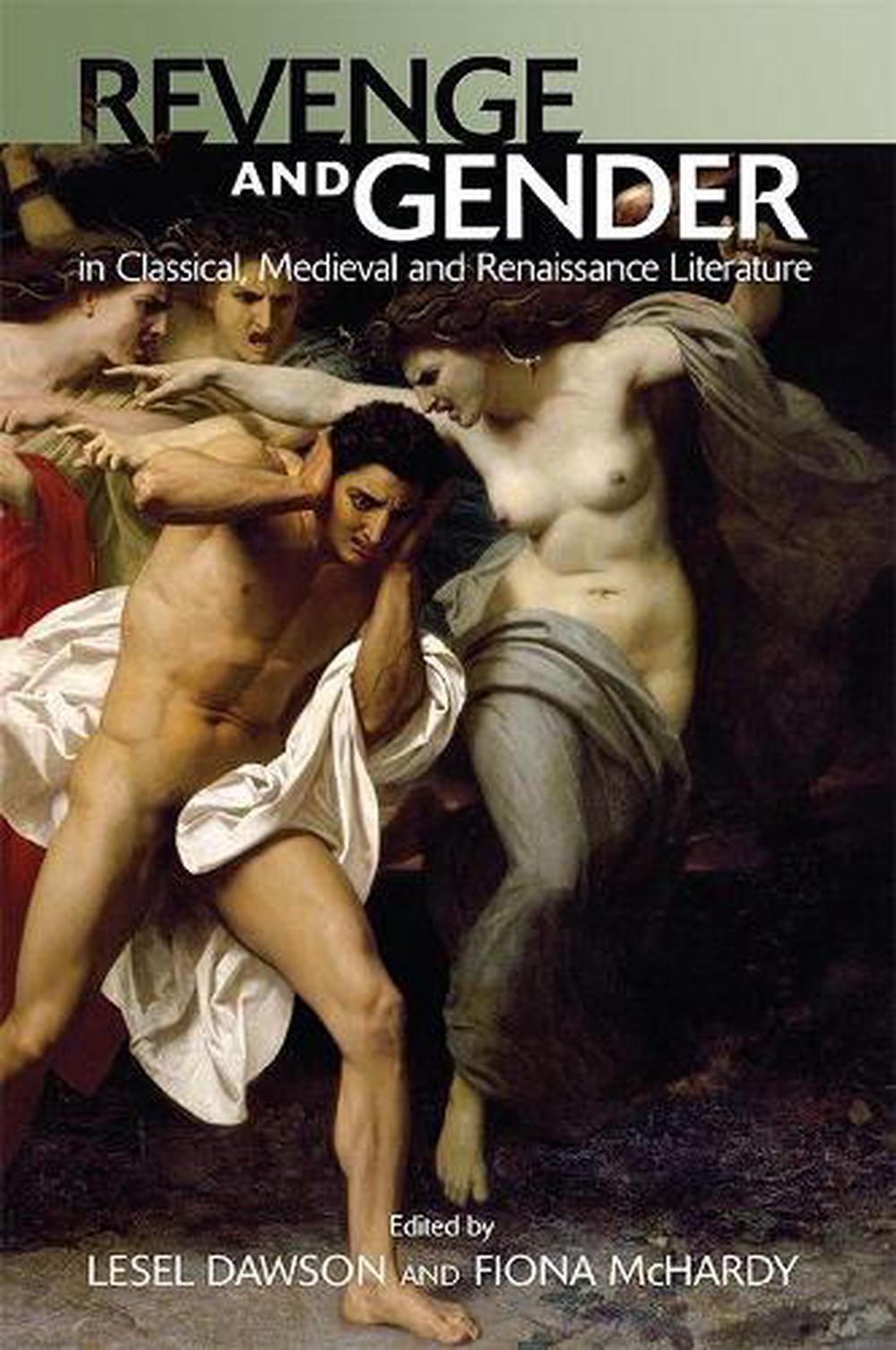
Revenge and Gender in Classical, Medieval, and Renaissance Literature
by Lesel Dawson, Fiona McHardy
This collection explores a range of literary and historical texts from ancient Greece and Rome, medieval Iceland and medieval and early modern England to provide an understanding of wider historical continuities and discontinuities in representations of gender and revenge.
Paperback
English
Brand New
Publisher Description
Explores the representation of revenge from Classical to early modern literature
This collection explores a range of literary and historical texts from ancient Greece and Rome, medieval Iceland and medieval and early modern England to provide an understanding of wider historical continuities and discontinuities in representations of gender and revenge.
It brings together approaches from literary criticism, gender theory, feminism, drama, philosophy and ethics to allow greater discussion between these subjects and across historical periods and to provide a more complex and nuanced understanding of the ways in which ideas about gender and revenge interrelate.
Key features:
The coverage, from classical through to renaissance literature, gives a sense of how the revenge motifs work over time with gender in mind
It will appeal to a wide readership including those working in classics; medieval and renaissance literature; gender studies; revenge and revenge tragedy; the intertextual relations between ancient, medieval and early modern texts
It considers what constitutes the literary revenge tragedy tradition, suggesting points of continuity and difference as well as rethinking the parameters of the genre
Contributors include Edith Hall, Alison Findlay and Janet Clare
Back Cover
'The intersection of gender trouble with the ambivalence of revenge provides a theme sufficiently broad to be of general interest, and yet sufficiently well defined to produce a coherent volume, in which intriguing connections are on display between various cultures, periods and textual genres.'Richard Seaford, University of ExeterExplores the representation of revenge from classical to early modern literatureThis collection explores a range of literary and historical texts from ancient Greece and Rome, medieval Iceland and medieval and early modern England to provide an understanding of wider historical continuities and discontinuities in representations of gender and revenge.It brings together approaches from literary criticism, gender theory, feminism, drama, philosophy and ethics to allow greater discussion between these subjects and across historical periods and to provide a more complex and nuanced understanding of the ways in which ideas about gender and revenge interrelate. Lesel Dawson is a Senior Lecturer at Bristol University. Fiona McHardy is Professor of Classics at the University of Roehampton. Cover image: Adolphe William Bouguereau, French (1825-1905), Orestes pursued by the Furies, 1862, oil on canvas, 91x109 5/8 in. (231.1x2784 cm)
Flap
'The intersection of gender trouble with the ambivalence of revenge provides a theme sufficiently broad to be of general interest, and yet sufficiently well defined to produce a coherent volume, in which intriguing connections are on display between various cultures, periods and textual genres.'Richard Seaford, University of ExeterExplores the representation of revenge from classical to early modern literatureThis collection explores a range of literary and historical texts from ancient Greece and Rome, medieval Iceland and medieval and early modern England to provide an understanding of wider historical continuities and discontinuities in representations of gender and revenge.It brings together approaches from literary criticism, gender theory, feminism, drama, philosophy and ethics to allow greater discussion between these subjects and across historical periods and to provide a more complex and nuanced understanding of the ways in which ideas about gender and revenge interrelate.Lesel Dawson is a Senior Lecturer at Bristol University.Fiona McHardy is Professor of Classics at the University of Roehampton.Cover image: Adolphe William Bouguereau, French (1825-1905), Orestes pursued by the Furies, 1862, oil on canvas, 91x109 5/8 in. (231.1x2784 cm)
Table of Contents
Contents; List of Figures; Acknowledgements and DedicationIntroduction: Female Fury and the Masculine Spirit of Vengeance, Lesel DawsonThe Gendering of Revenge1. Why are the Erinyes Female? or, What is so Feminine about Revenge?, Edith Hall2. Re-marking Revenge in Early Modern Drama, Alison FindlayFriends and Family: 'Revenging Home'3. Vengeance and Male Devotion in Laxdæla saga and Njáls saga, Ian Felce4. 'Now I am Medea': Gender, Identity and the Birth of Revenge in Seneca's Medea, Kathrin Winter5. The Avenging Daughter in King Lear, Marguerite Tassi6. 'Brother Unkind': Annabella's Heart in 'Tis Pity She's a Whore, Sara EatonWomen's Weapons7. Cursing-Prayers and Female Vengeance in the Ancient Greek World, Lydia Matthews and Irene Salvo8. 'The Power of our Mouths': Gossip as a Female Mode of Revenge, Fiona McHardy9. 'Women's Weapons': Education and Female Revenge on the Early Modern Stage, Chloe PreedyWomen Transmogrified10. The Vengeful Lioness in Greek Tragedy: A Posthumanist Perspective, Alessandra Abbattista11. 'She's Turned Fury': Women Transmogrified in Revenge Plays, Janet ClareLamentation, Gender Roles and Vengeance12. A Phrygian Tale of Love and Revenge: Oenone Paridi (Ovid Heroides 5), Andreas N. Michalopoulos13. Lament and Vengeance in the Alliterative Morte Arthure, Annie Baden-Danetree14. What's Hecuba to Shakespeare?, Tanya Pollard15. 'Nursed in Blood': Masculinity and Grief in Marston's Antonio's Revenge, Rebecca Yearling16. Outfacing Vengeance: Heroic Dying in Webster's The Duchess of Malfi and Ford's The Broken Heart, Lesel DawsonDetails of Contributors
Review
[T]his book is an important, and powerful, example of how interdisciplinary and cross-period studies can illuminate otherwise-overlooked points that lead to essential reconsiderations of subjects… -- Melissa Ridley Elmes, Lindenwood University * Bryn Mawr Classical Review *
this book is an important, and powerful, example of how interdisciplinary and cross-period studies can illuminate otherwise-overlooked points that lead to essential reconsiderations of subjects... -- Melissa Ridley Elmes, Lindenwood University * Bryn Mawr Classical Review *
The intersection of gender trouble with the ambivalence of revenge provides a theme sufficiently broad to be of general interest, and yet sufficiently well defined to produce a coherent volume, in which intriguing connections are on display between various cultures, periods, and textual genres. -- Richard Seaford, University of Exeter
Review Quote
The intersection of gender trouble with the ambivalence of revenge provides a theme sufficiently broad to be of general interest, and yet sufficiently well defined to produce a coherent volume, in which intriguing connections are on display between various cultures, periods, and textual genres.
Promotional "Headline"
Explores the representation of revenge from Classical to early modern literature
Description for Reader
Explores the representation of revenge from Classical to early modern literature This collection explores a range of literary and historical texts from ancient Greece and Rome, medieval Iceland and medieval and early modern England to provide an understanding of wider historical continuities and discontinuities in representations of gender and revenge. It brings together approaches from literary criticism, gender theory, feminism, drama, philosophy and ethics to allow greater discussion between these subjects and across historical periods and to provide a more complex and nuanced understanding of the ways in which ideas about gender and revenge interrelate. The coverage, from classical through to renaissance literature, gives a sense of how the revenge motifs appear over time It will appeal to a wide readership including those working in classics, medieval and renaissance literature, gender studies, revenge and revenge tragedy and the intertextual relations between ancient, medieval and early modern texts It considers what constitutes the literary revenge tragedy tradition, suggesting points of continuity and difference as well as rethinking the parameters of the genre Contributors Alessandra Abbattista wrote her PhD on animal metaphors and the depiction of female avengers in Attic tragedy at the University of Roehampton. Her main research interests are ancient Greek language, literature and drama. Anne Baden-Daintree is a Teaching Fellow and Research Associate at Bristol University. Her research interests include elegy, medieval lyric poetry, and late medieval reading and devotional practices. Janet Clare is Professor of Renaissance Literature at the University of Hull. She is the author of Shakespeare''s Stage Traffic: Imitation, Borrowing and Competition in Renaissance Theatre (Cambridge University Press, 2014 and 2017), Revenge Tragedies of the Renaissance, Writers and their Work (Northcote House/British Council, 2006), Drama of the English Republic 1649-1660 (Manchester University Press, 2002 and 2005), ''Art Made Tongue-tied by Authority'': Elizabethan and Jacobean Dramatic Censorship (Manchester University Press, 1999 and 1990). She has also edited many collections, including Republic to Restoration: Legacies and Departures, which will be published by Manchester University Press in 2018. Lesel Dawson is a Senior Lecturer in English at the University of Bristol. She is the author of Lovesickness and Gender in Early Modern Literature (Oxford University Press, 2008) as well as articles on early modern drama, misogyny, menstruation and cruentation. Her research interests include Renaissance psychology and medicine, and she is currently working on a project on early modern ideas about vision, cognition and grief. Sara Eaton was Professor of English Emerita at North Central College in Naperville, Illinois until her death in 2016. She was twice recognised with the Dissinger Award for Distinguished Teaching and Service and she is the author of many articles on early modern drama, gender and courtly love. Ian Felce is the author of William Morris and the Icelandic Sagas (Boydell & Brewer, forthcoming) and several articles on medieval literature and its reception in post-medieval English literature. He is particularly interested in how medieval narratives have been transformed to meet the needs and priorities of later writers. Alison Findlay is Professor of Renaissance Drama at Lancaster University. She is the author of Women in Shakespeare: A Dictionary (Continuum, 2010), Playing Spaces in Early Women''s Drama (Cambridge University Press, 2006), Women and Dramatic Production, 1550-1700 (Longman, 2000), A Feminist Perspective on Renaissance Drama (Blackwell Publishers, 1998), Illegitimate Power: Bastards in Renaissance Drama (Manchester University Press, 1994) as well as a number of edited collections. Edith Hall is Professor in the Classics Department and Centre for Hellenic Studies at King''s College London. She is the author of Introducing the Ancient Greeks (Bodley Head, 2014), Adventures with Iphigenia in Tauris: A Cultural History of Euripides'' Black Sea Tragedy (Oxford University Press, 2012), Greek Tragedy: Suffering under the Sun (Oxford University Press, 2010), The Return of Ulysses: A Cultural History of Homer''s Odyssey (Johns Hopkins University Press, 2008), The Theatrical Cast of Athens (Oxford University Press, 2006), Greek Tragedy and the British Theatre 1660-1914 (Oxford University Press, 2005, co-authored with Fiona Macintosh), Aeschylus'' Persians, edited with translation, Introduction and Commentary (Aris & Phillips, 1996), Inventing the Barbarian: Greek Self-Definition through Tragedy (Clarendon Press, 1989) as well as a number of edited collections. Her new book, Happiness: Ten Ways Aristotle Can Change Your Life, will be published by Bodley Head in 2018. Lydia Matthews is a researcher in Ancient History at Oxford University. Her research interests include Roman history, ancient sexuality and gender, ancient medicine and ancient ethnography. Fiona McHardy is Professor of Classics at the University of Roehampton. She is author of Revenge in Athenian Culture (Duckworth, 2008) and has co-edited three volumes: Women''s Influence on Classical Civilization (Routledge, 2004), Lost Dramas of Classical Athens (University of Exeter Press, 2005) and From Abortion to Pederasty (Ohio State University Press, 2014). She is currently writing a book on gendered violence in ancient Greece with Susan Deacy covering such topics as infanticide, rape, uxoricide and domestic violence. Andreas N. Michalopoulos is Professor of Latin at the Classics Department of the National and Kapodistrian University of Athens. He is the author of Ovid, Heroides 20 and 21: Introduction, Text, Translation, and Commentary (Papadimas, 2013), Ovid, Heroides 16 and 17: Introduction, Text and Commentary (Francis Cairns Publications, 2006) and Ancient Etymologies in Ovid''s Metamorphoses: A Commented Lexicon (Francis Cairns Publications, 2001). He has also written two books with Charilaos N. Michalopoulos: Roman Lyric Poetry: Horace Carmina (HEAL Link, 2016) and Roman Love Elegy (HEAL Link, 2016). His research interests include Augustan poetry, ancient etymology, Roman drama, Roman novel and modern receptions of classical literature. Tanya Pollard is Professor at Brooklyn College and the Graduate Center, City University of New York (CUNY). She is the author of Greek Tragic Women on Shakespearean Stages (Oxford University Press, 2017) and Drugs and Theater in Early Modern England (Oxford University Press, 2005). She is also the editor of a number of scholarly editions and essay collections, including two collections with Tania Demetriou: Homer and Greek Tragedy in Early Modern England''s Theatres, a special issue of Classical Receptions Journal 9.1 (2017) and Milton, Drama, and Greek Texts, a special issue of The Seventeenth Century Journal 31.2 (2016). She is currently co-editing with Marcus Nevitt Reader in Tragedy: An Anthology of Classical Criticism to Contemporary Theory for Bloomsbury. Chloe Kathleen Preedy is a Lecturer in Shakespeare and Renaissance literature at the University of Exeter. She is the author of Marlowe''s Literary Scepticism: Politic Religion and Post-Reformation Polemic (Bloomsbury, 2013). Her new book project explores how sixteenth- and seventeenth-century playwrights utilised aerial and atmospheric imagery to conceptualise theatrical space, and she is currently co-developing a collaborative research project which investigates the twentieth and twenty-first century cultural afterlives of those associated with the Blackfriars Theatre. Irene Salvo is a Research Associate at the University of G
Description for Teachers/Educators
Classics; Medieval Literature; Renaissance Literature and Gender Studies
Details
