
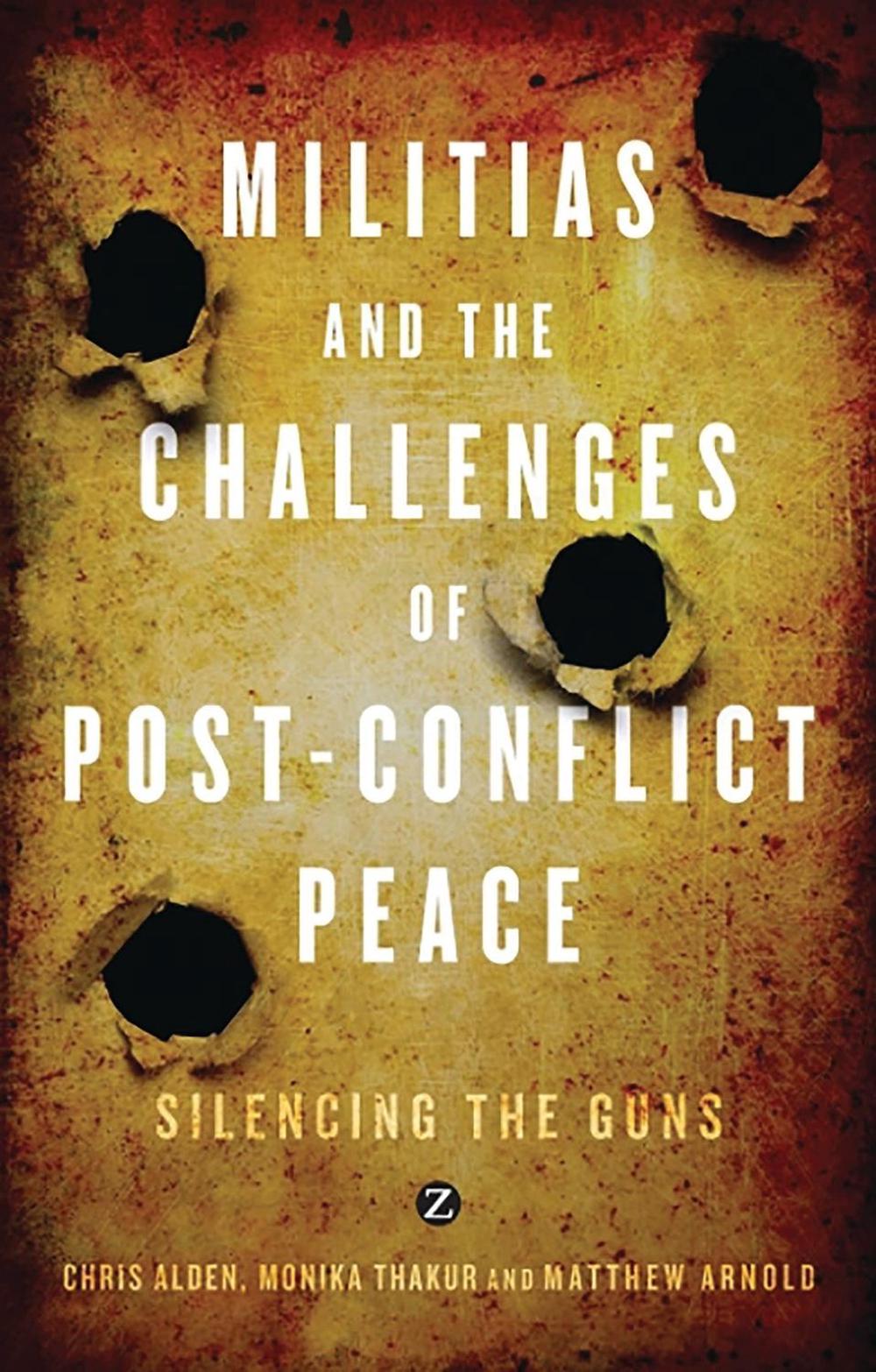
Militias and the Challenges of Post-Conflict Peace
by Chris Alden, Monika Thakur, Matthew Arnold
This book argues that the approach to demilitaristation developed by the international community is ineffective at dealing with the challenges of militias.
Paperback
English
Brand New
Publisher Description
Militias have proven to be a consistent and enduring challenge to achieving peace in war zones around the world. Whether armed by embattled governments in defence of their territory or fostered by external actors in the interests of greed or grievance, these groups occupy an uncertain and deeply controversial position in the changing landscape of conflict.Linked variously to atrocities against civilians or international criminal elements, part of what distinguishes them from more traditional combatants is their willingness to engage in violent tactics that defy international norms as well as a proclivity to embrace expediency in alliance-making. As such, their diversity of form, unorthodox nature and sheer numbers make achieving short-term stability and an enduring peace a consistently difficult proposition.Bringing together the lessons learned from four intensively researched case studies - the Democratic Republic of Congo, Timor-Leste, Afghanistan and Sudan - the book argues that the overly rigid 'cookie-cutter' approach to demilitaristation, developed and commonly implemented presently by the international community, is ineffective at meeting the myriad of challenges involving militias. In doing so, the authors propose a radical new framework for demilitarization that questions conventional models and takes into account on-the-ground realities.
Notes
Focuses on a number of high-profile case studies, including Democratic Republic of Congo, Sudan and Afghanistan.
Table of Contents
List of abbreviationsList of tablesPreface1. Introducing Militias and Demilitarisation2. Conceptualising Militias: A Framework of Analysis3. The South Sudan Defence Force4. The White Army Militias of South Sudan5. The Mutineers of Timor-Leste6. Militias in the Eastern DRC7. Afghanistan's Long and Ongoing Experience with MilitiasConclusion: Militias and the Search for Local SecurityBibliographyNotes
Review
Based on extensive fieldwork, Alden, Thakur and Arnold's analysis of the social basis of militia groups makes a genuine contribution to the growing body of literature questioning conventional DDR models. * Alice Hills, Chair of Conflict and Security, School of Politics and International Studies, University of Leeds *
The question of how to deal with armed groups in post-war settings presents a conundrum for academics and practitioners alike. When heavily armed men operate at the interface of states and society as many militia do, the challenge is especially tricky. This impressive volume combines cutting-edge theoretical insights with original qualitative findings from Afghanistan, the Democratic Republic of Congo, Sudan and Timor-Leste. Taken together, Alden, Thakur and Arnold offer readers a rare glimpse into the inner workings of militia groups and signal a number of innovative ways to promote local security. * Robert Muggah, Vistiing Professor, Graduate Institute of International and Development Studies and Research Director of the Small Arms Survey, Switzerland *
Alden, Thakur and Arnold have done a service to the fields of security studies and peace studies. This book sheds new light on how to cope with the challenge posed by militias in conflict environments, drawing on local research in southern Sudan and the east of the Democratic Republic of Congo as well as Afghanistan and Timor-Leste. * Sumantra Bose, Professor of International and Comparative Politics, London School of Economics and Political Science *
This volume presents a theoretically rigorous and empirically rich analysis of the contemporary phenomena of militias. It is unique in the coherence and rigour with which it approaches this under-theorised and under-researched issue. The interpretive framework developed by the authors will resonate far beyond the individual studies presented here. It is both scholarly and of immediate policy relevance and will be of interest to those involved in issues of post-conflict reconstruction, disarmament, demobilisation and Reintegration (DDR) and security sector reform. * Tim Edmunds, University of Bristol *
Promotional
This book argues that the approach to demilitaristation developed by the international community is ineffective at dealing with the challenges of militias.
Long Description
Militias have proven to be a consistent and enduring challenge to achieving peace in war zones around the world. Whether armed by embattled governments in defence of their territory or fostered by external actors in the interests of greed or grievance, these groups occupy an uncertain and deeply controversial position in the changing landscape of conflict. Linked variously to atrocities against civilians or international criminal elements, part of what distinguishes them from more traditional combatants is their willingness to engage in violent tactics that defy international norms as well as a proclivity to embrace expediency in alliance-making. As such, their diversity of form, unorthodox nature and sheer numbers make achieving short-term stability and an enduring peace a consistently difficult proposition.Bringing together the lessons learned from four intensively researched case studies - the Democratic Republic of Congo, Timor-Leste, Afghanistan and Sudan - the book argues that the overly rigid 'cookie-cutter' approach to demilitaristation, developed and commonly implemented presently by the international community, is ineffective at meeting the myriad of challenges involving militias. In doing so, the authors propose a radical new framework for demilitarization that questions conventional models and takes into account on-the-ground realities.
Review Quote
This volume presents a theoretically rigorous and empirically rich analysis of the contemporary phenomena of militias. It is unique in the coherence and rigour with which it approaches this under-theorised and under-researched issue. The interpretive framework developed by the authors will resonate far beyond the individual studies presented here. It is both scholarly and of immediate policy relevance and will be of interest to those involved in issues of post-conflict reconstruction, disarmament, demobilisation and Reintegration (DDR) and security sector reform.
Promotional "Headline"
This book argues that the approach to demilitaristation developed by the international community is ineffective at dealing with the challenges of militias.
Details
