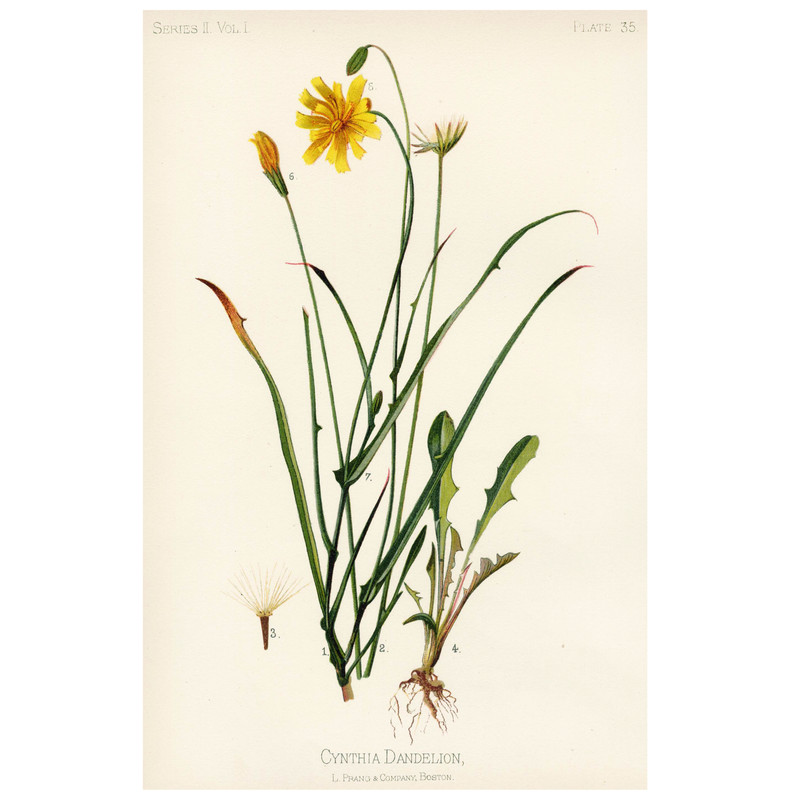
This gorgeously rendered hand-finished botanical chromolithograph originates from the from The Native Flowers & Ferns of the United States, issues in 4 volumes starting in 1878.
These lush, painterly plates were expertly printed from multiple heavy lithographic stones, one for each color, & appear to be often hand-finished with watercolor & heightened with gum arabic. They were lithographed after superb paintings by botanical watercolor painter Alois Lunzer & published by L. Prang & Company, Boston. These look like they all have gilt edges, that gleam of 24 gold shows that this was an extra-special deluxe volume.
The Volumes:
Originally published in 1878, this work provides an in-depth look at native flowers and ferns through the expert lens of Meehan, a professor of vegetable physiology and editor of The Gardeners' Monthly. With detailed descriptions, engaging anecdotes, and scientific insights, the book is a treasure trove of botanical knowledge. It features high-quality illustrations that bring to life the intricate details of each plant, making it an invaluable resource for horticulturists, botanists, and nature lovers.
The volumes cover the wide array of American species, each entry includes historical context, botanical characteristics, and horticultural tips, reflecting Meehan's dedication to both scientific accuracy and popular appeal. The plants are selected not only for their beauty but also for their ecological significance, offering readers a comprehensive understanding of America's botanical heritage.
The Artist:
Alois Lunzer (1840 – 1921) was an Austrian-American watercolor painter. Originally from Hadersdorf, Austria, he immigrated to Philadelphia in 1875 and specialised in doing botanical illustrations. Lunzer collaborated with Thomas Meehan, botanist and author, and Louis Prang, publisher, in producing “The Native Flowers and Ferns of the United States” (the present volume).
The Author:
Thomas Meehan was born in London in 1826. Meehan was self-taught and wrote his first paper when he was twelve. At fifteen he produced his first hybrid fuchsia. He was elected member of the Royal Wernerian Society of Edinboro when he was still an adolescent. He became a student at Kew Gardens and came to America after graduation on his twenty-second birthday, hired in Philadelphia as superintendent of Bartram's Gardens, and later gardener to Caleb Cope. In 1853, he published his first and only complete book, The American Handbook of Ornamental Trees, a book about the trees in Bartram's garden. He established Meehan's Nurseries in 1853. He was editor of the Gardener's Monthly for thirty years beginning in 1859. In 1891, he founded Meehan's Monthly. He was appointed State Botanist by the Governor. He was a member of the Academy of Natural Sciences of Philadelphia, the American Association for the Advancement of Science, American Philosophical Society, the Pennsylvania Horticultural Society, and the Pennsylvania Agricultural Society. He was the author of Native Flowers and Ferns of the United States. He was elected to the Common Council of Philadelphia in 1882 and remained a member until his death. He was a member of the Germantown school board for eighteen years. He died in Philadelphia on November 19, 1901.
The Plates & Technique:
These prints were individually made by hand. The originals were hand-painted watercolor drawings, these images were then drawn onto thick lithographic stones.
They are Stone Chromo-Lithographs, where the image for each color was drawn by hand on heavy slabs of limestone in a water-repellant wax or 'grease'. During printing, water is sponged over the drawn image, which is absorbed into the stone.
When the stone is inked with a roller, it sticks only to the water-repellent drawing, & leaves the bare wet stone clean. The print is then transferred to the paper laid atop the stone & run by hand through a press.
The process is very involved, especially the colored prints, where multiple stones for each color had to line up perfectly with each successive imprint to register perfectly on the page.
Stone lithography allowed for fluid drawing & subtle toning, which were much more difficult to achieve in copperplate engravings, & bypassed the need for an engraver & the tedious inking process of metal plates. Stone lithography is entirely different than present-day offset lithographs, apart from the use of water to resist ink.
Condition:
Excellent condition for a c.150-year-old print. Typical minor antiquarian character.
These prints are very old & may have minor imperfections expected with age, such as some typical age-toning of the paper, spots, text-offsetting, artifacts from having been bound into a book & handled, etc. Please examine the photos & details carefully.
Text Page(s): This one comes without original text pages which were likely published in their own volumes. Included in the photos is a scan of a title page, which is for reference & not part of the listing.
Size: 10"x 6-3/4" approximately.
Combined Shipping:
Yes! Multiple prints can be combine into one Priority Mail flat-rate envelope or package. Larger prints may need to be shipped in tube. eBay should auto-combine your items if you put all of your selections into your shopping cart & check out all together as one order. If you purchase them individually, eBay charges shipping on each, which I then will refund after. If you're assessed multiple shipping charges for one combined package, I will endeavor to refund any overage asap.
Thanks for Visiting!
Please note: The information I've included in this listing is based on my best research & observations as an enthusiast of these works, not a professional historian of antiquarian books & prints. I do like to offer some background information readily available to me but make no claims representations of total accuracy. Any corrections or further information you might offer would certainly appreciated! The scans in the images are my best efforts to accurately show the item. Antique prints & old paper are notoriously tricky to scan accurately. In my experience, scanners tend to be thrown off by the off-whites & gradations in age-toned paper. If the scanner produces a scan that's too dark or too brown, etc, I'll often try to reasonably color-correct to represent the print as accurately as possible. I'm not a professional in color-correcting images yet I try my best to show the print as close to the original as possible. I also find that different monitors show colors differently, & eBay's system can sometimes throw off the colors a bit in the uploaded JPEG images as they appear on their site. Thank you!