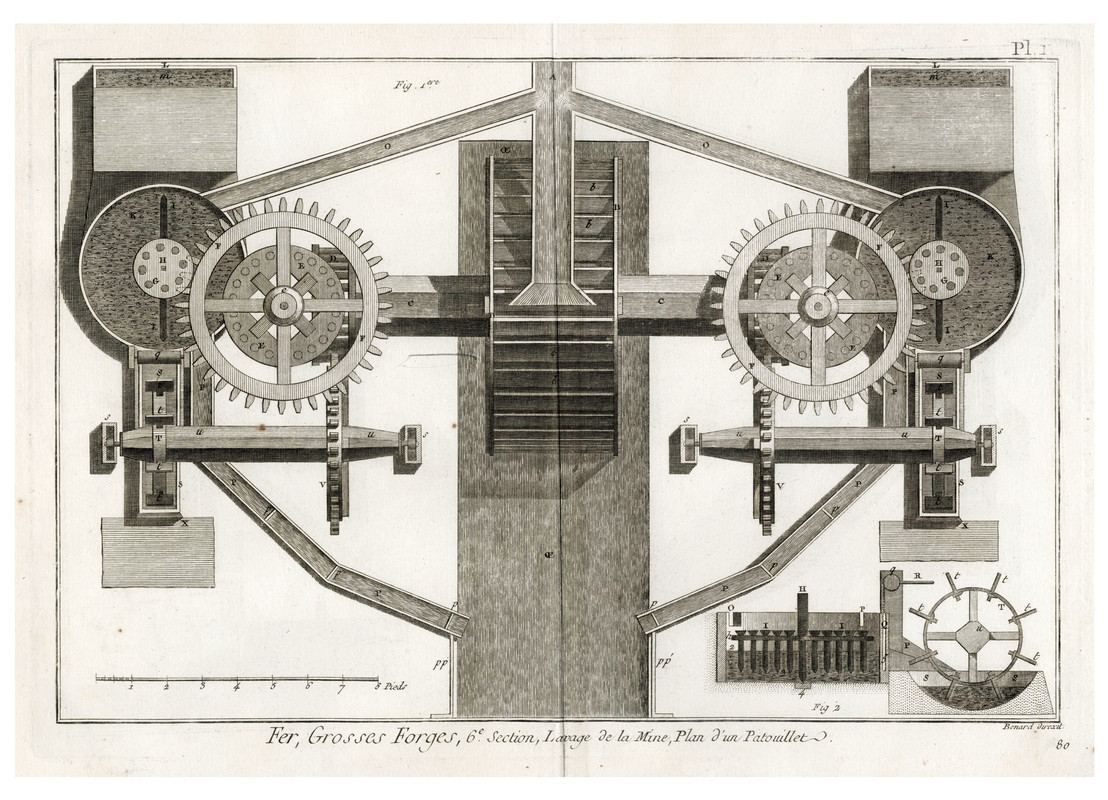
This fascinating engraving originates from the from Charles-Joseph Panckoucke's Encyclopédie Méthodique par ordre des Matières (lit. 'Methodical Encyclopedia by Order of Subject Matter'), the 'Recueil de Planches' (Collection of Plates), originally published in Denis Diderot's famous Encyclopédie.
This one is from the series on Large Forges & the mining & smelting of Iron. This series features some large fold-out folios detailing the workings of some of the giant geared contraptions all made from wood. This one is particularly striking & dynamic in its beautiful bold symmetry & detailed geometry & shading.
These plates are meticulously drawn & engraved in copper, & hand-printed on sumptuous, handmade cotton rag paper with lots of un-trimmed deckeled edges. The detail work & compositions in these plates are exceptional. These prints are treasures.
The Volumes:
The Encyclopédie méthodique par ordre des matières
(lit. 'Methodical Encyclopedia by Order of Subject Matter') was
published between 1782 and 1832 by the French publisher Charles Joseph
Panckoucke, his son-in-law Henri Agasse, and the latter's wife,
Thérèse-Charlotte Agasse.
Arranged by disciplines, it was a revised and much expanded version, in roughly 210 to 216 volumes (different sets were bound differently), of the alphabetically arranged Encyclopédie, edited by Denis Diderot and Jean leRond d'Alembert.
The full title was L'Encyclopédie méthodique ou par ordre de matières par une société de gens de lettres, de savants et d'artistes; précédée d'un vocabulaire universel, servant de table pour tout l'ouvrage, ornée des portraits de MM. Diderot et d'Alembert, premiers éditeurs de l'Encyclopédie.
In about fifty years (1782-1832), more than 200 volumes appeared (159 of text and 47 of plates) containing nearly 100,000 articles. The bookseller-publisher Clément Plomteux, established in Liège, assisted Panckoucke between 1782 and 1789. Upon Panckoucke's death, his son-in-law Henri Agasse and then his daughter Antoinette Pauline Agasse succeeded him.
The Artist & Engraver:
This
one is signed by Jacques Renaud Benard (13 April 1731 – 4 July 1794),
(before 2019 incorrectly called Robert Bénard), who was an important
French engraver & specialized in the technique of copperplate
line-engraving.
Benard is mainly famous for having supplied a
significant amount of plates (at least 1,800) to the Encyclopédie by
Diderot & d'Alembert from 1751. Later, publisher Charles-Joseph
Panckoucke reused many of his productions to illustrate the works of his
catalog. Biographical research established in 2019 that his real name
was Jacques Renaud Benard, that he was born in 1731 at Rosny-sous-Bois,
and that he died in Paris in 1794. The signature "Benard fecit" on
plates probably indicates the work of his own hand; the signatures
"Benard Direx" and "Benard Direxit" indicate the work of the atelier of
engravers he directed for many years.
The Plates & Technique:
Line-engraving
or Copperplate engraving is a highly exacting & labor-intensive
process for intaglio printmaking. The original drawing is cut into the
surface of a copper or steel plate with a hand-held sharp steel point or
burin, with shading created by many fine cut lines, or hatching. Before
printing takes place, the plate is heated, covered with ink. The warm
ink seeps into the finest of depressions and fills the lines and
textures of the drawing. The rest of the plate is cleaned off. The
copper plate is now pressed with a printing press on to moistened paper
which soaks up the ink from the depressions in the plate. The
copperplate-engraving technique is very exacting, time-consuming and
exhausting for the engraver, who needs a lot of strength for it.
Every part of these prints was made by hand: Hand drawn & engraved on Copper or steel which was hand-mined, smelted & rolled, printed onto handmade cotton rag paper, inked & colored with hand-ground pigments individually by hand, & they were usually hand sewn into handmade leather-bound books.
Condition:
Good
condition for a centuries-old engaving. Typical minor antiquarian
character, Very little age-toning. Some chips at the bound edge from
where it was removed from its volume.
These
prints are very old & may have minor imperfections expected with
age, such as some typical age-toning of the paper, oxidation of the old
original watercolors, spots, text-offsetting, artifacts from having been
bound into a book & handled, etc. Please examine the photos &
details carefully.
Text Page(s):
This one comes without original text pages which were likely published
in their own volumes. Included in the photos is a scan of a title page,
which is for reference & not part of the listing.
Size: 12-5/8"x 9" approximately.
Combined Shipping:
Yes!
Multiple prints can be combine into one Priority Mail flat-rate
envelope or package. Larger prints may need to be shipped in tube. eBay
should auto-combine your items if you put all of your selections into
your shopping cart & check out all together as one order. If you
purchase them individually, eBay charges shipping on each, which I then
will refund after. If you're assessed multiple shipping charges for one
combined package, I will endeavor to refund any overage asap.
Thanks for Visiting!
Please note: The information I've included in this listing is based on my best research & observations as an enthusiast of these works, not a professional historian of antiquarian books & prints. I do like to offer some background information readily available to me but make no claims representations of total accuracy. Any corrections or further information you might offer would certainly appreciated! The scans in the images are my best efforts to accurately show the item. Antique prints & old paper are notoriously tricky to scan accurately. In my experience, scanners tend to be thrown off by the off-whites & gradations in age-toned paper. If the scanner produces a scan that's too dark or too brown, etc, I'll often try to reasonably color-correct to represent the print as accurately as possible. I'm not a professional in color-correcting images yet I try my best to show the print as close to the original as possible. I also find that different monitors show colors differently, & eBay's system can sometimes throw off the colors a bit in the uploaded JPEG images as they appear on their site. Thank you!