
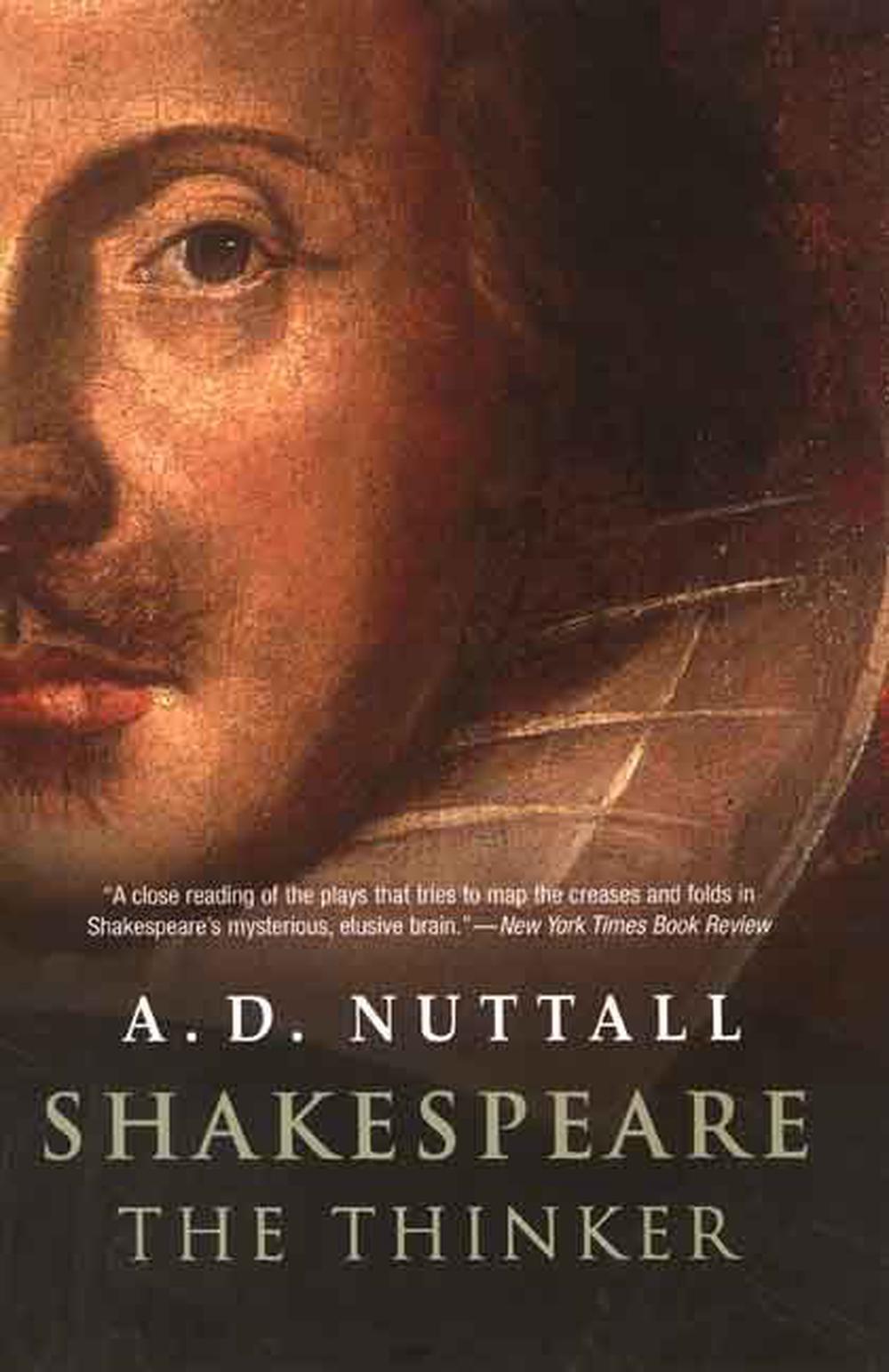
Shakespeare the Thinker
by A.D. Nuttall
Presents a study of Shakespeare's intellectual preoccupations. This book offers guidance to Shakespeare's plays and sheds light on questions that engrossed Shakespeare from his early plays to the late romances: the nature of motive, cause, personal identity and relation, the proper status of imagination, and ethics and subjectivity.
Paperback
English
Brand New
Publisher Description
"A close reading of the plays that tries to map the creases and folds in Shakespeare's mysterious, elusive brain."— New York Times Book Review
A. D. Nuttall's study of Shakespeare's intellectual preoccupations is a literary tour de force and comes to crown the distinguished career of a Shakespeare scholar. Certain questions engross Shakespeare from his early plays to the late romances: the nature of motive, cause, personal identity and relation, the proper status of imagination, ethics and subjectivity, language and its capacity to occlude and to communicate. Yet Shakespeare's thought, Nuttall demonstrates, is anything but static. The plays keep returning to, modifying, and complicating his creative preoccupations. Nuttall allows us to hear and appreciate the emergent cathedral choir of play speaking to play. By the later stages of Nuttall's book this choir is nearly overwhelming in its power and dimensions. The author does not limit discussion to moments of crucial intellection but gives himself ample space in which to get at the distinctive essence of each work.
Much recent historicist criticism has tended to "flatten" Shakespeare by confining him to the thought-clichés of his time, and this in its turn has led to an implicitly patronizing view of him as unthinkingly racist, sexist, and so on. Nuttall shows us that, on the contrary, Shakespeare proves again and again to be more intelligent and perceptive than his 21st-century readers. This book challenges us to reconsider the relation of great literature to its social and historical matrix. It is also, perhaps, the best guide to Shakespeare's plays available in English.
Notes
A study of Shakespeare's intellectual preoccupations, from a distinguished Shakespeare scholar. It examines the Bard's interest in the nature of motive, cause, personal identity and relation, the proper status of imagination, ethics and much more.
Review
"'The delight of Nuttall's book springs not just from the incisiveness of his ideas but from the deftness with which he unfolds scenes and speeches. It is like walking through the countryside with someone who recognises every bird's song and each wild flower.' John Carey, The Sunday Times 'Shakespeare was above all interested in the process of making sense of life... A.D. Nuttall's Shakespeare the Thinker is a marvellously wise and humane account of that mind at work. Always highly intelligent and effortlessly readable, it is a book that draws a firm line under the age of 'theory' in Shakespeare studies.' Jonathan Bate, The Sunday Telegraph '... wonderfully incisive and unstuffy look at the Bard's ideas.' The Sunday Times 'A.D. Nuttall is an attentive, intelligent, common-sense reader of the plays. He has a good ear and a subtle mind, and delights in words and the placement of words.' A.S. Byatt, The Guardian"
Long Description
A. D. Nuttall7;s study of Shakespeare7;s intellectual preoccupations is a literary tour de force and comes to crown the distinguished career of a Shakespeare scholar. Certain questions engross Shakespeare from his early plays to the late romances: the nature of motive, cause, personal identity and relation, the proper status of imagination, ethics and subjectivity, language and its capacity to occlude and to communicate. Yet Shakespeare7;s thought, Nuttall demonstrates, is anything but static. The plays keep returning to, modifying, and complicating his creative preoccupations. Nuttall allows us to hear and appreciate the emergent cathedral choir of play speaking to play. By the later stages of Nuttall7;s book this choir is nearly overwhelming in its power and dimensions. The author does not limit discussion to moments of crucial intellection but gives himself ample space in which to get at the distinctive "essence" of each work. Much recent historicist criticism has tended to 0;flatten1; Shakespeare by confining him to the thought-cliches of his time, and this in its turn has led to an implicitly patronizing view of him as unthinkingly racist, sexist, and so on. Nuttall shows us that, on the contrary, Shakespeare proves again and again to be more intelligent and perceptive than his 21st-century readers. This book challenges us to reconsider the relation of great literature to its social and historical matrix. It is also, perhaps, the best guide to Shakespeare7;s plays available in English.
Review Quote
"Tony Nuttall is my hero! . . . Nuttall's gifts all come together here: wisdom, sheer intelligence, immense learning, and a lifelong descent into the Shakespearean abyss."--Harold Bloom
Author Comments
Q: In recent years there has been a trend of very senior scholars writing big, ambitious books about Shakespeare for the general reader--Stephen Greenblatt's and James Shapiro's biographies, and Harold Bloom's and Sir Frank Kermode's studies. And now A. D. Nuttall of Oxford enters the fray. What more can be said about Shakespeare that hasn't already been said?
Details
