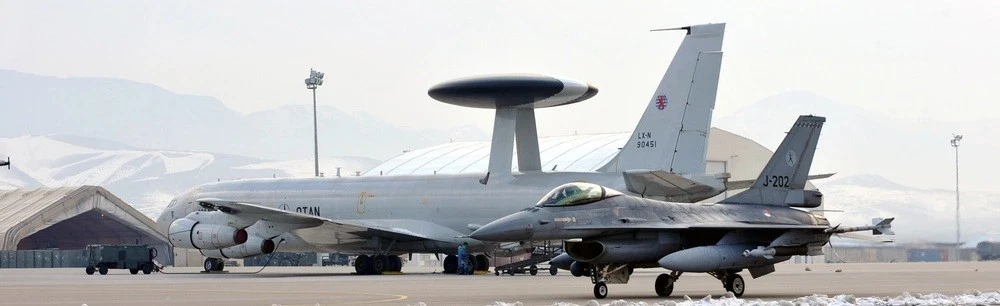
The General Dynamics (now Lockheed Martin) F-16 Fighting Falcon is a single-engine multirole fighter aircraft originally developed by General Dynamics for the United States Air Force (USAF). Designed as an air superiority day fighter, it evolved into a successful all-weather multirole aircraft. Over 4,500 aircraft have been built since production was approved in 1976. Although no longer being purchased by the U.S. Air Force, improved versions are still being built for export customers. In 1993, General Dynamics sold its aircraft manufacturing business to the Lockheed Corporation, which in turn became part of Lockheed Martin after a 1995 merger with Martin Marietta. The Fighting Falcon has key features including a frameless bubble canopy for better visibility, side-mounted control stick to ease control while maneuvering, a seat reclined 30 degrees to reduce the effect of g-forces on the pilot, and the first use of a relaxed static stability/fly-by-wire flight control system which helps to make it a nimble aircraft. The F-16 has an internal M61 Vulcan cannon and 11 locations for mounting weapons and other mission equipment. The F-16's official name is "Fighting Falcon", but "Viper" is commonly used by its pilots, due to a perceived resemblance to a viper snake as well as the Battlestar Galactica Colonial Viper starfighter. In addition to active duty U.S. Air Force, Air Force Reserve Command, and Air National Guard units, the aircraft is also used by the USAF aerial demonstration team, the U.S. Air Force Thunderbirds, and as an adversary/aggressor aircraft by the United States Navy. The F-16 has also been procured to serve in the air forces of 25 other nations. The Belgian Air Component consists of Command COMOPSAIR, one wing to provide training, two tactical aircraft wings, one transport aviation wing, air group intended for Search and Rescue operations and supporting units. The main technology assets are F-16 A/B multipurpose combat aircraft, C-130 Hercules transport aircraft. In addition to the further listed combat aircraft Belgian air force holds in its reserve 32 aircraft F-16 A/B, 12 Mirage 5BA, 12 Mirage 5BR, 3 Mirage 5BD that are stowed preserved. The air component continues to consist of multi-role combat aircraft and transport airplanes. There is no change in the assignment of 72 mid life updated F-16’s to NATO.
Though the current geostrategic environment makes very likely the risk of a major assault against the Alliance, the possibility of such an event in the medium term cannot be totally excluded. The history of the 20th century has enough reminded Belgium. On the other hand, regional security remains subject to a wide variety of military risks and non-military, difficult to predict and which may come from different directions.
The NATO ISAF Air Task Force was a component of the International Security Assistance Force (ISAF) in Afghanistan, responsible for providing air power and support to the mission. ISAF was a NATO-led security mission established by the United Nations in 2001 to assist the Afghan government. The Air Task Force included various aircraft, such as combat aircraft, surveillance and reconnaissance aircraft, and air-to-air refuelling aircraft. It also utilized unmanned aerial vehicles (UAVs) and AWACS (Airborne Warning and Control System) aircraft.
Here's a more detailed breakdown:
ISAF Mission:
ISAF's initial focus was securing Kabul and its surrounding areas to facilitate the establishment of the Afghan Transitional Administration. Later, the UN Security Council expanded ISAF's mission to provide security throughout Afghanistan.
NATO Command:
In 2003, NATO assumed command of ISAF at the request of the UN and the Afghan government. This marked NATO's first major deployment outside of Europe and North America.
Air Task Force Role:
The ISAF Air Task Force provided critical air support, including:
Tactical air control: Issuing orders and taskings to NATO combat aircraft and other air assets.
Surveillance and reconnaissance: Utilizing aircraft like AWACS to monitor airspace and the battlefield.
Air-to-air refuelling: Supporting long-range air operations.
Support for ground operations: Providing close air support, battlefield air interdiction, and combat search and rescue.
Reconnaissance and tactical air transport: Utilizing UAVs and other aircraft for intelligence gathering and troop movement.
End of ISAF:
The ISAF mission concluded on December 28, 2014. It was succeeded by the Resolute Support Mission, a NATO-led mission focused on training, advising, and assisting Afghan forces.
AWACS in Afghanistan:
NATO AWACS aircraft were deployed to Afghanistan to provide air surveillance and tactical battle management support. They played a key role in supporting various ISAF operations. The last NATO AWACS aircraft left Afghanistan in September 2014. The Belgian Air Force played a deterrent role during the Cold War as part of the NATO command in Europe. If the land-based deterrent capability of NATO were to fail, the air force would fight for the defense of the NATO area. Its mission would be to participate in the overall NATO air defensive plan and give air support to the land-based forces.
The air force has three major divisons: the Tactical Air Command, the Training Command, and the Logistics Command. The Tactical Command is responsible for the operational air wings that are assigned to NATO. The majority of flying and technical personnel are volunteers.
In 1984 two all-weather fighter-bomber wings of the air force were equipped with F-16 aircraft, manufactured in part in Belgium. The mixed reconnaissance and fighter-bomber wing was equipped with French-made Mirage 5 aircraft, as was a second fighter-bomber wing. Each of the these four wings consisted of two squadrons. The transport wing was made up of a squadron of C-130H cargo planes and a composite squadron of passenger-type aircraft, including Boeing 727s, Merlin IllAs, and Falcon 20s. The helicopter squadron flew Sea King aircraft on air and sea missions and used large transport helicopters when moving equipment and personnel. The Belgian Air Component consists of Command COMOPSAIR, one wing to provide training, two tactical aircraft wings, one transport aviation wing, air group intended for Search and Rescue operations and supporting units. The main technology assets are F-16 A/B multipurpose combat aircraft, C-130 Hercules transport aircraft. In addition to the further listed combat aircraft Belgian air force holds in its reserve 32 aircraft F-16 A/B, 12 Mirage 5BA, 12 Mirage 5BR, 3 Mirage 5BD that are stowed preserved. The air component continues to consist of multi-role combat aircraft and transport airplanes. There is no change in the assignment of 72 mid life updated F-16’s to NATO.
Though the current geostrategic environment makes very likely the risk of a major assault against the Alliance, the possibility of such an event in the medium term cannot be totally excluded. The history of the 20th century has enough reminded Belgium. On the other hand, regional security remains subject to a wide variety of military risks and non-military, difficult to predict and which may come from different directions.
The Belgian Air Force played a deterrent role during the Cold War as part of the NATO command in Europe. If the land-based deterrent capability of NATO were to fail, the air force would fight for the defense of the NATO area. Its mission would be to participate in the overall NATO air defensive plan and give air support to the land-based forces.
The air force has three major divisons: the Tactical Air Command, the Training Command, and the Logistics Command. The Tactical Command is responsible for the operational air wings that are assigned to NATO. The majority of flying and technical personnel are volunteers.
In 1984 two all-weather fighter-bomber wings of the air force were equipped with F-16 aircraft, manufactured in part in Belgium. The mixed reconnaissance and fighter-bomber wing was equipped with French-made Mirage 5 aircraft, as was a second fighter-bomber wing. Each of the these four wings consisted of two squadrons. The transport wing was made up of a squadron of C-130H cargo planes and a composite squadron of passenger-type aircraft, including Boeing 727s, Merlin IllAs, and Falcon 20s. The helicopter squadron flew Sea King aircraft on air and sea missions and used large transport helicopters when moving equipment and personnel. The air component should be also able to provide capacity for contribution to two independently conducted operations in different regions, made of two F-16 A/B multipurpose combat aircraft units, in maximum total number of 36 machines and 1250 personnel for the period not exceeding four months. For a sustained deployment, the number of aircraft and personnel would require reduced number of aircraft and personnel due to necessary rotation of both systems and personnel.