KC-10 The McDonnell Douglas KC-10 Extender is an American tanker and cargo aircraft that was operated by the United States Air Force (USAF) from 1981 to 2024. A military version of the three-engine DC-10 airliner, the KC-10 was developed from the Advanced Tanker Cargo Aircraft Program.[N 1] It incorporates military-specific equipment for its primary roles of aerial refueling and transport. It was developed to supplement the KC-135 Stratotanker following experiences in Southeast Asia and the Middle East. The KC-10 was the second McDonnell Douglas transport aircraft to be selected by the Air Force following the C-9. A total of 60 KC-10s were produced for the USAF. The Royal Netherlands Air Force operated two similar tankers from 1995 to 2021 designated KDC-10 that were converted from used civilian DC-10, instead of purpose built aircraft.
The KC-10 played a key role in the mobilization of US military assets, taking part in overseas operations far from home. These aircraft performed airlift and aerial refueling during the 1986 bombing of Libya (Operation Eldorado Canyon), the 1990–91 Gulf War with Iraq (Operations Desert Shield and Desert Storm), the NATO bombing of Yugoslavia (Operation Allied Force), War in Afghanistan (Operation Enduring Freedom), and Iraq War (Operations Iraqi Freedom and New Dawn). The KC-10 Extender first flew in July 1980. In October 1980 the first aerial refuel sortie was performed. The KC-10 is largely based on the design of the civilian DC-10-30CF, a convertible cargo/passenger transport variant with an extended range compared to the baseline DC-10-10. For the KC-10, unnecessary features including most windows and lower cargo doors were removed, an improved cargo-handling system was added and the avionics were tailored to the military's needs. The KC-10 retained an 88% commonality with its civilian counterparts, giving it greater access to the worldwide commercial support system.
Early aircraft featured a distinctive light gray and white paint scheme typical of that era. A gray-green camouflage scheme was used on later tankers. The paint scheme was switched to the Air Force standard gray color by the late 1990s. The most notable changes were the addition of the McDonnell Douglas Advanced Aerial Refueling Boom and additional fuel tanks located in the baggage compartments below the main deck. The extra tanks increase the KC-10's fuel capacity to 356,000 pounds (161,000 kg), nearly double the KC-135's capacity. The KC-10 has both a centerline refueling boom—unique in that it sports a control surface system at its aft end that differs from the V-tail design used on previous tankers—and a drogue-and-hose system on the starboard side of the rear fuselage. The KC-10 boom operator cockpit is seated in the rear of the aircraft with a wide window for monitoring refueling rather than prone as in the KC-135. The operator controls refueling operations through a digital fly-by wire system. The refueling boom can deliver fuel to a receiver at the maximum rate of 1,100 U.S. gallons (4,200 liters) per minute, while the centerline drogue system has a maximum fuel offload rate of 470 U.S. gallons (1,800 liters) per minute. Unlike the KC-135, the KC-10's hose-and-drogue system allows refueling of Navy, Marine Corps, and most allied aircraft, all in one mission. The final twenty KC-10s produced included wing-mounted hose-and-drogue pods for added refueling locations. The KC-10 can carry a complement of 75 personnel with 146,000 pounds (66,000 kg) of cargo, or 170,000 pounds (77,000 kg) in an all-cargo configuration. With that, it can transport those weights for an unrefueled range of 4,400 miles (7,100 km). The KC-10 has a large door located just behind the flight deck for loading and unloading cargo. Handling equipment is required to raise and lower loads to the cargo opening. The aircraft can still perform aerial refueling while carrying cargo. The first KC-10 was delivered to the Air Force's Strategic Air Command (SAC) in March 1981 at Barksdale AFB. In 1982 a newly renamed 22d Air Refueling Wing, formerly the 22d Bombardment Wing, was re-equipped with KC-10A Extenders and became the second Air Force unit to operate the new tankers.[citation needed] The 60th and final KC-10 was delivered on 29 November 1988.[19] The KC-10s served with SAC until 1992, when they were reassigned to the newly established Air Mobility Command. In the aerial refueling role, the KC-10s have been operated largely in the strategic refueling of large number of tactical aircraft on ferry flights and the refueling of other strategic transport aircraft. Conversely, the KC-135 fleet has operated largely in the in-theater tactical role. There are 59 KC-10 Extenders in service with the USAF as of 2010.[14][16] The USAF's KC-10s are stationed primarily at Travis AFB, California, and McGuire AFB, now part of Joint Base McGuire-Dix-Lakehurst, in New Jersey.
A US Navy F-14D and two F/A-18Cs prepare to refuel from a KC-10 in 2005 over the Persian Gulf.
When faced with refusals of basing and overflight rights from continental European countries during Operation El Dorado Canyon, the U.S. was forced to use the UK-based F-111s in the 1986 air-strikes against Libya. The KC-10s and KC-135s allowed 29 F-111s, along with other Air Force and Navy aircraft, to reach their targets.[20] The KC-10 again played a key role during Operations Desert Shield and Desert Storm in 1991. KC-10s facilitated the deployment of tactical, strategic, and transport aircraft to Saudi Arabia. In the early stages of Operation Desert Shield, aerial refueling was key to the rapid airlift of materiel and forces. In addition to refueling airlift aircraft, the KC-10, along with the smaller KC-135, moved thousands of tons of cargo and thousands of troops in support of the massive buildup. The KC-10 and the KC-135 conducted about 51,700 separate refueling operations and delivered 125 million gallons (475 million liters) of fuel without missing a single scheduled rendezvous.
A KC-10 Extender of Travis AFB approaching a second KC-10 for refuelling over the Pacific Ocean, 2017
Since then, the KC-10 had participated in other smaller conflicts. In March 1999, NATO launched Operation Allied Force against the government of Yugoslavia. The mobility portion of the operation began in February and was heavily dependent on tankers. By early May 1999, some 150 KC-10s and KC-135s deployed to Europe where they refueled bombers, fighters and support aircraft engaged in the conflict. The KC-10 flew 409 missions throughout the entire Allied Force campaign and continued support operations in Kosovo.[14] Since 11 September 2001, KC-10s had flown more than 350 missions guarding U.S. skies as a part of Operation Noble Eagle. During Operations Enduring Freedom and Iraqi Freedom, KC-10s flew more than 1,390 missions delivering critical air refueling support to numerous joint and Coalition receiver aircraft. As of 2004, KC-10s were expected to serve until 2043.
The Air Force considered retiring its fleet of KC-10 tankers in response to sequestration budget cuts as part of the service's FY 2015 budget. A "vertical chop" to divest all KC-10s was suggested because there are fewer KC-10s than KC-135s, having three different tanker models in service after the introduction of the KC-46 would be costly, and a "horizontal cut" across the refueling fleets would achieve small efficiencies. Some believed retiring the KC-10 would not benefit the Air Force, given that it is equipped with both boom and hose-and-drogue refueling systems and the fleet's relatively young age.
The last U.S. Air Force KC-10 takes off from Travis Air Force Base, California, 26 Sept. 2024.
At first, officials claimed that the initial focus on retiring the KC-10 in September 2013 was a "trial balloon" to call attention to Air Force operating cost issues. As of early 2013, the KC-10 had a per hour flying cost of $21,170 and a mission capable rate of 87 percent. A FY 2015 budget plan did not include cuts to the KC-10.[25] In July 2020, the first US KC-10 to be retired, tail number 86-0036, was transferred to the 309th Aerospace Maintenance and Regeneration Group (AMARG) for storage at Davis-Monthan Air Force Base, Arizona.
In July 2021, the 2d ARS was the first KC-10 squadron to start conversion to the KC-46. In August 2021, the KC-10 took part in the largest non-combatant evacuation in support of Operation Allies refuge and contributing to the safe evacuation of more than 124,000 Afghan refugees.
In January 2023, the USAF announced that all KC-10s are to be retired by 30 September 2024.[29] The KC-10 flew its last combat sortie for the USAF on 5 October 2023. On 26 September 2024, the KC-10 flew its final sortie on tail number 79-1948 bound for the 309th Aerospace Maintenance and Regeneration Group (AMARG) at Davis-Monthan Air Force Base, Arizona.
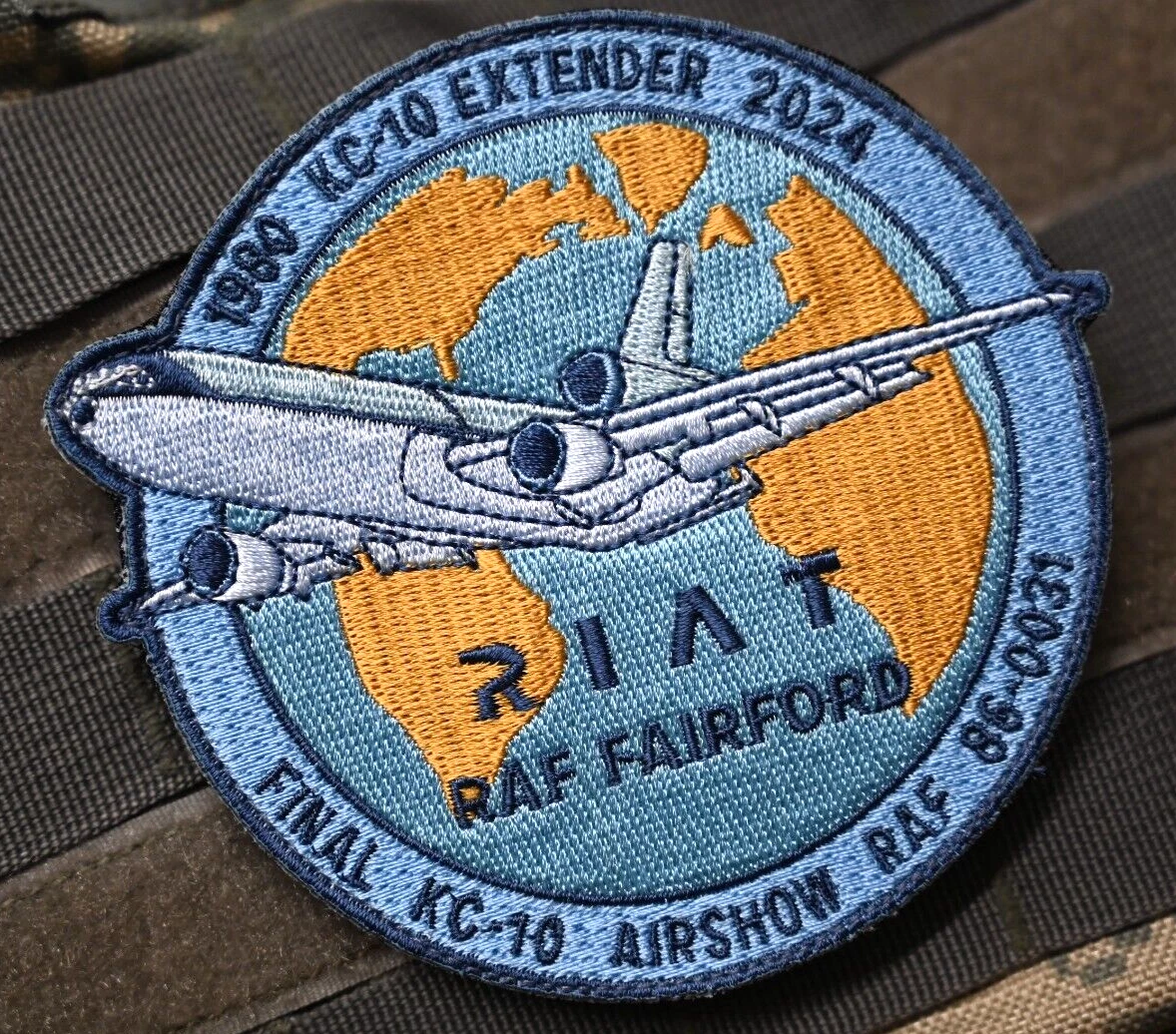
Role at RIAT 2024: At the Royal International Air Tattoo (RIAT) 2024, the KC-10 Extender was part of the static display, commemorating the NATO 75th anniversary. This appearance was particularly significant as it marked one of the final showcases before the aircraft's planned retirement from active service. The KC-10's presence at the event highlighted its long-standing contributions to aerial refuelling and air mobility operations.
Significance of Its Retirement
The retirement of the KC-10 Extender signifies the end of an era, with the USAF transitioning to newer refuelling aircraft like the KC-46 Pegasus. The KC-10's legacy of reliable service and its role in numerous military operations have left a lasting impact on aerial refuelling capabilities. The KC-10 flew its final sortie in a combat deployment in October 2023, with the last airframe forward deployed to CENTCOM departing Prince Sultan Air Base in Saudi Arabia on Oct. 5 of that year. In early 2024, the 9th Aerial Refueling Squadron undertook a farewell tour with KC-10 84-0191, departing Travis AFB and travelling to Hickam AFB, Hawaii, before venturing to New Zealand and Australia. The aircraft then flew via Diego Garcia to Europe, stopping at Sigonella in Italy, Ramstein in Germany and Keflavik in Iceland, returning to the United States via Joint Base McGuire-Dix-Lakehurst.
A final swan song
While the trip to RIAT was the official UK farewell for the KC-10, operational requirements have meant it was not actually the type’s final time on UK soil. On Aug. 9, KC-10 86-0031 landed at RAF Mildenhall as BORA 11 before departing again on Aug. 11 to support a flight of four USAF F-16s returning from refit work in Belgium.
Then, on Aug. 17, KC-10 86-0031 made yet another trip to the UK, landing at Glasgow Prestwick Airport as ROMA 64. The airframe had supported another Coronet mission, delivering F-16s to Bahrain, and stopped overnight at Prestwick on the return leg from Al Udeid, Qatar. ACARS messages between the crew and operations staff for the leg between Moron Air Base and Al Udeid noted the mission as a historic flight, and this could well turn out to be the KC-10’s final Coronet mission as well as its final visit to not only the UK, but also Spain and the Middle East..