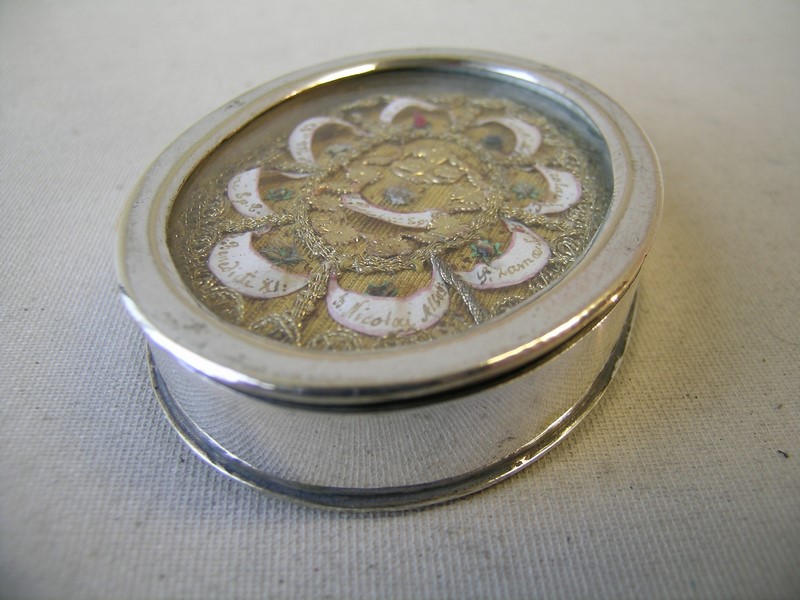
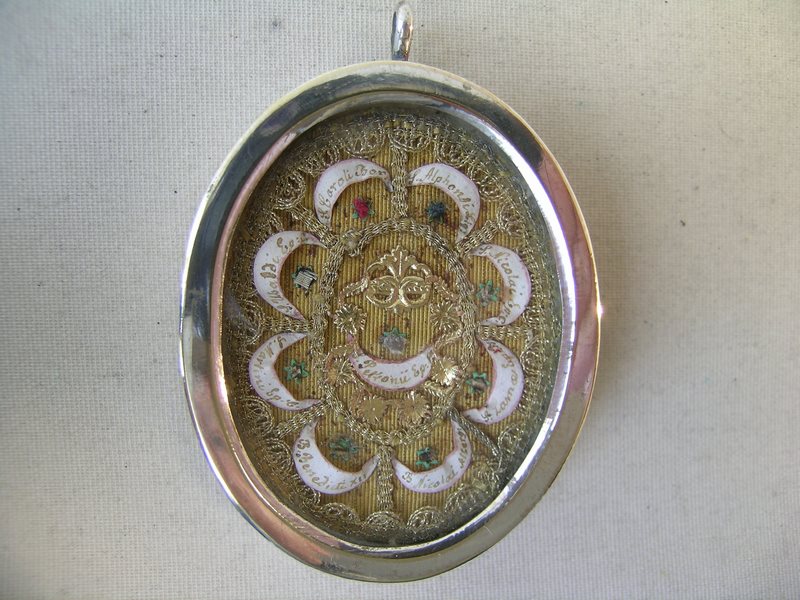
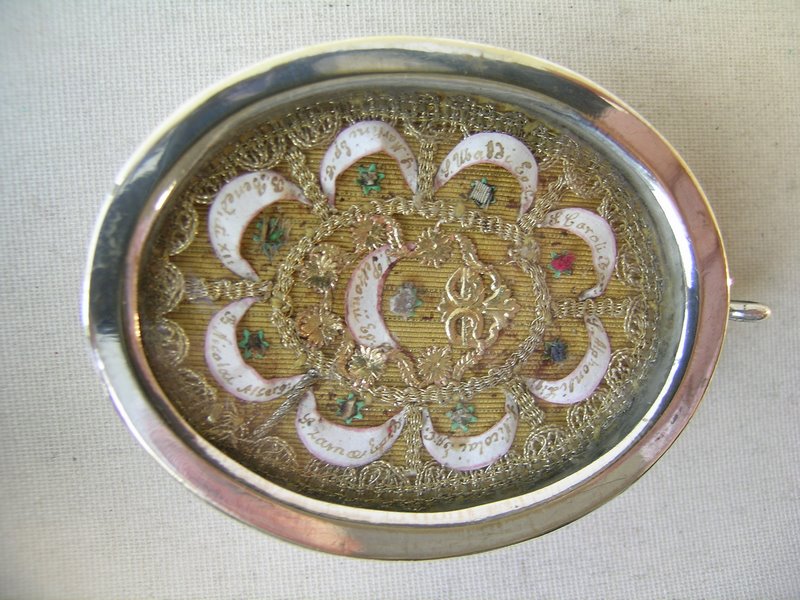
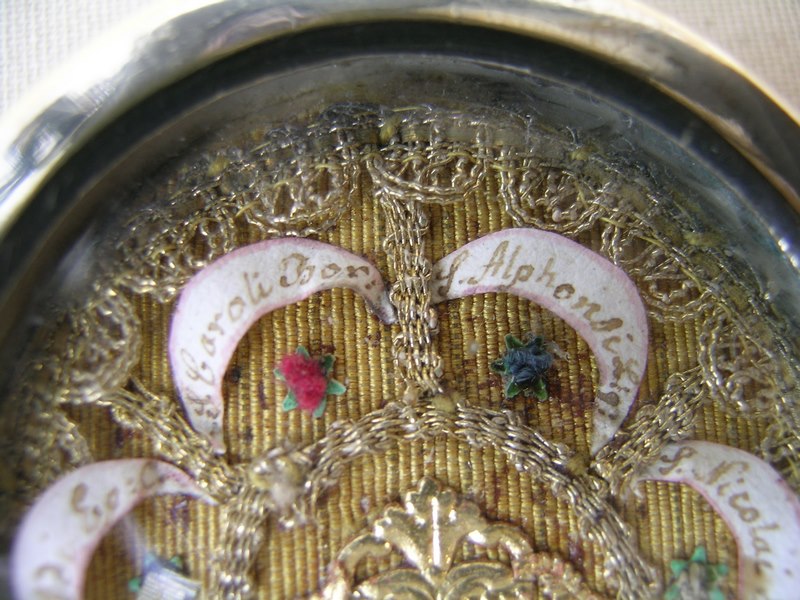
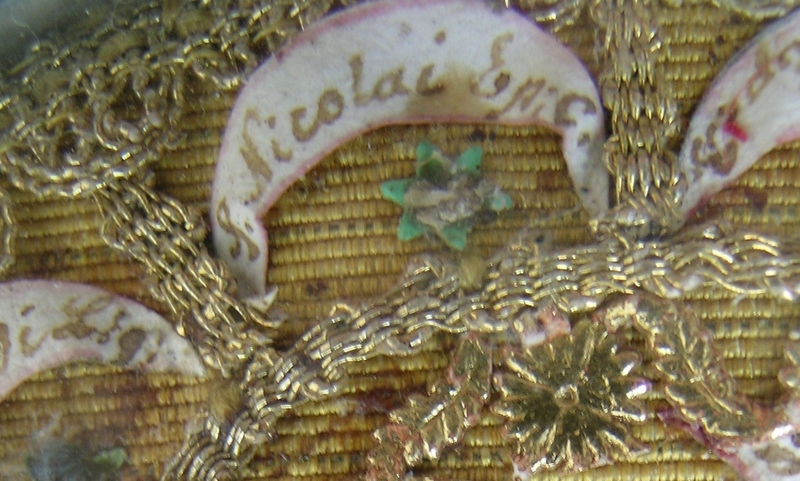
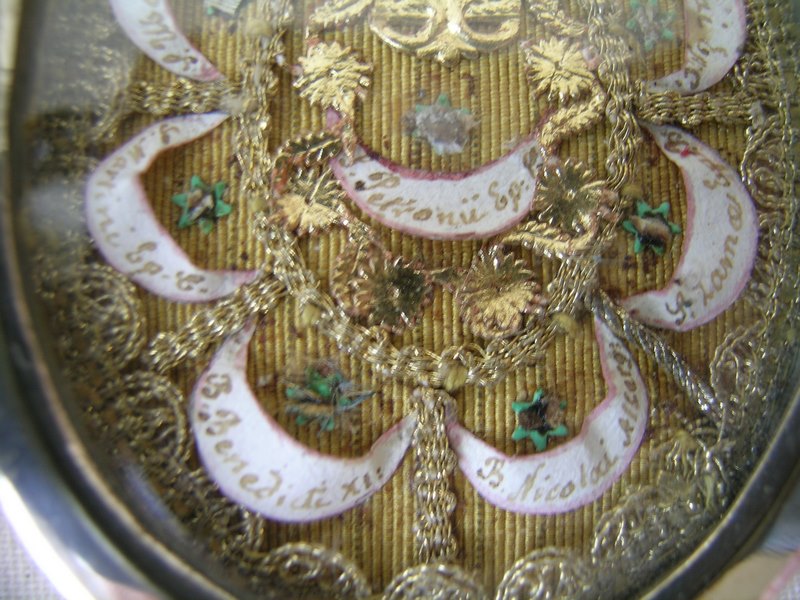
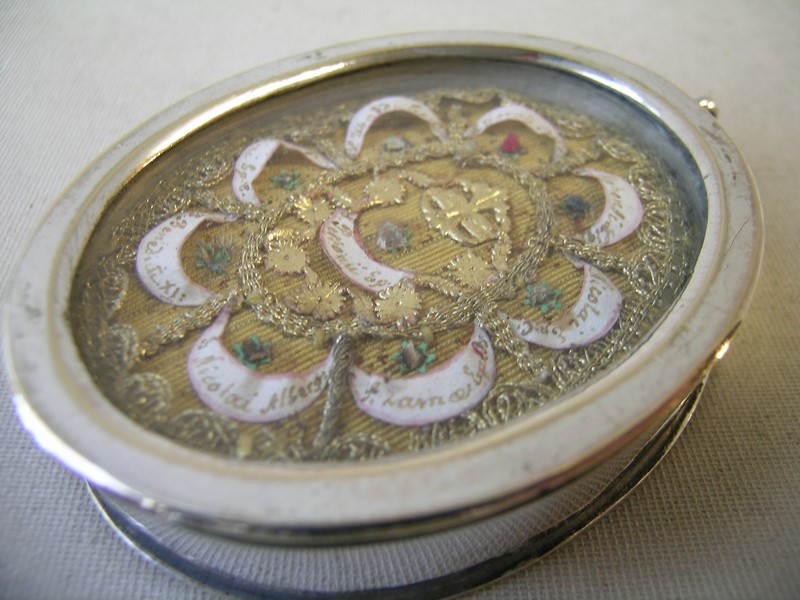
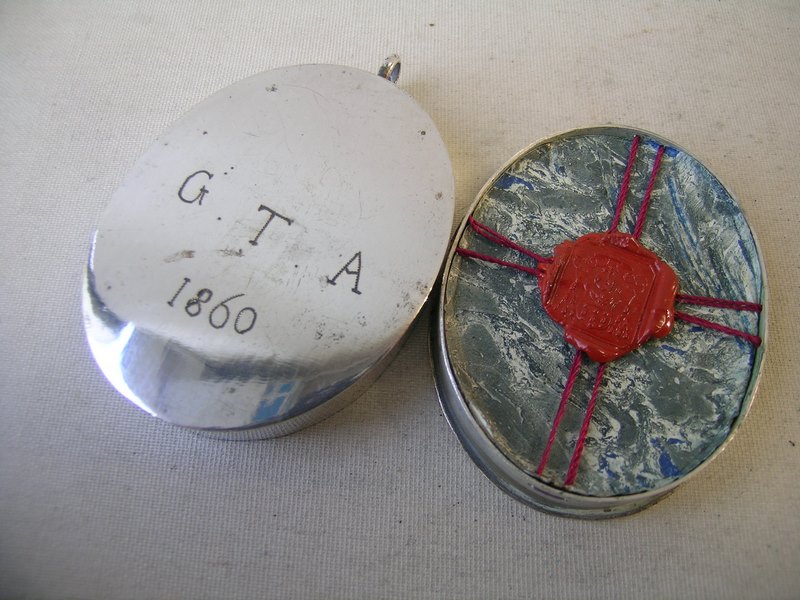
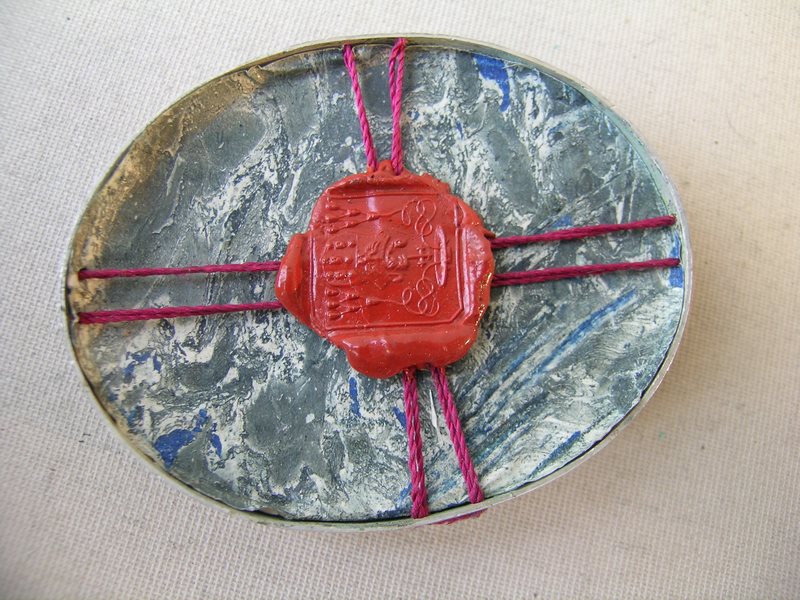
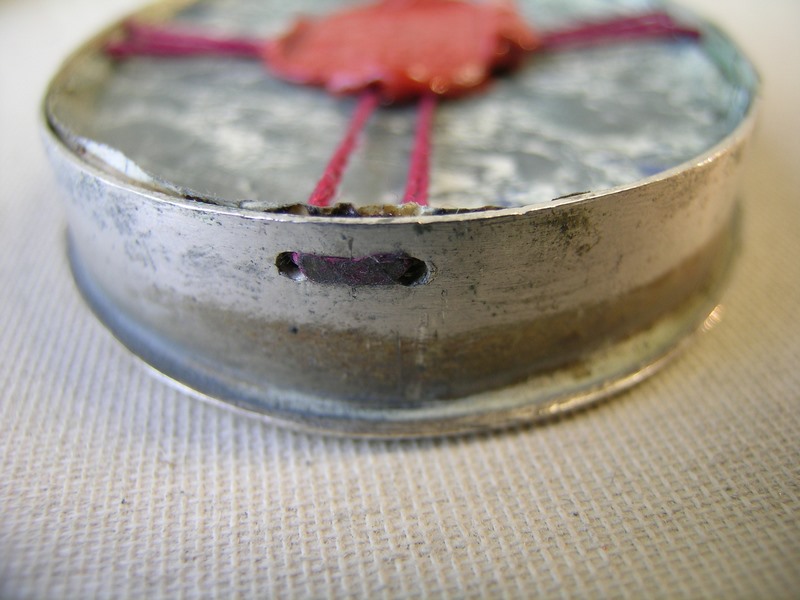
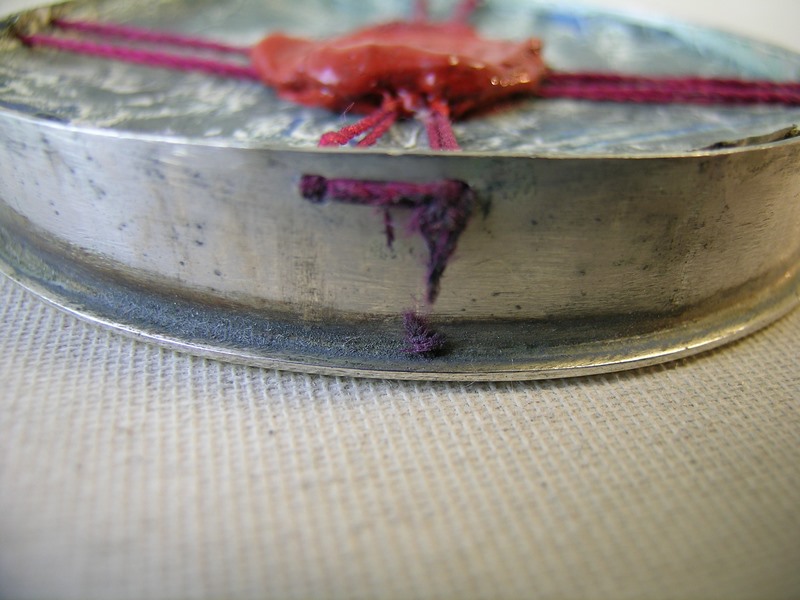
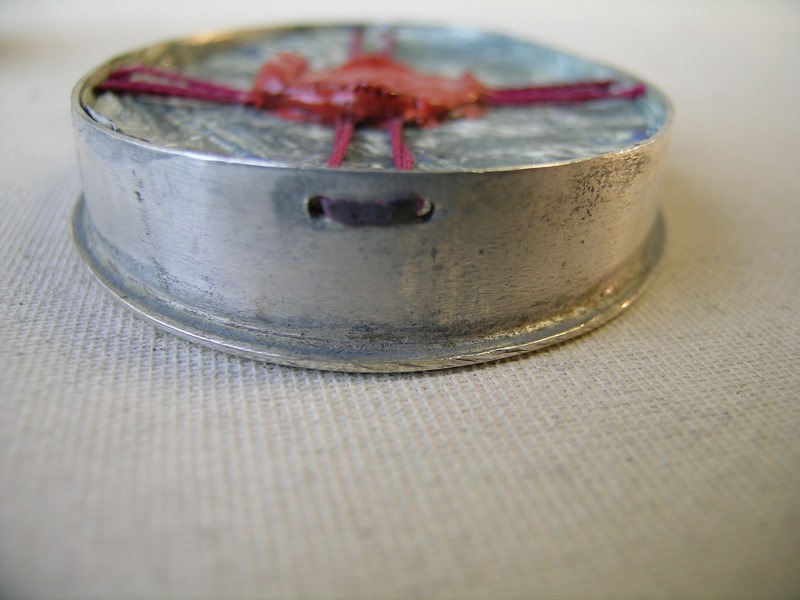
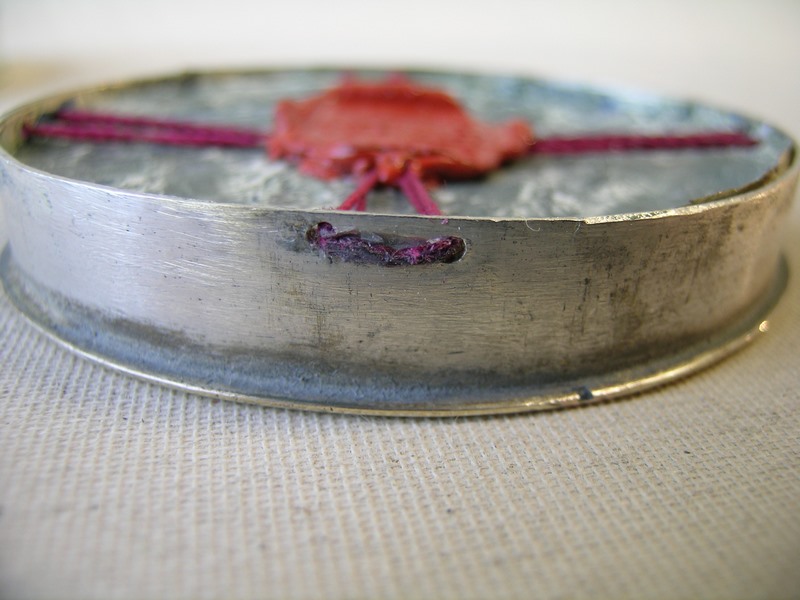
This is a antique metal silverplated pendant,inside
9 important relics of Saint Nicholas of Myra,Saint Martin of Tours,Saint Charles
Borromeo,Saint Petronius of Bologna,Saint Ubaldus Baldassini,Blessed Pope
Benedict XI,Blessed Nicholas Albergati,Saint Zosimus of Syracuse and Saint
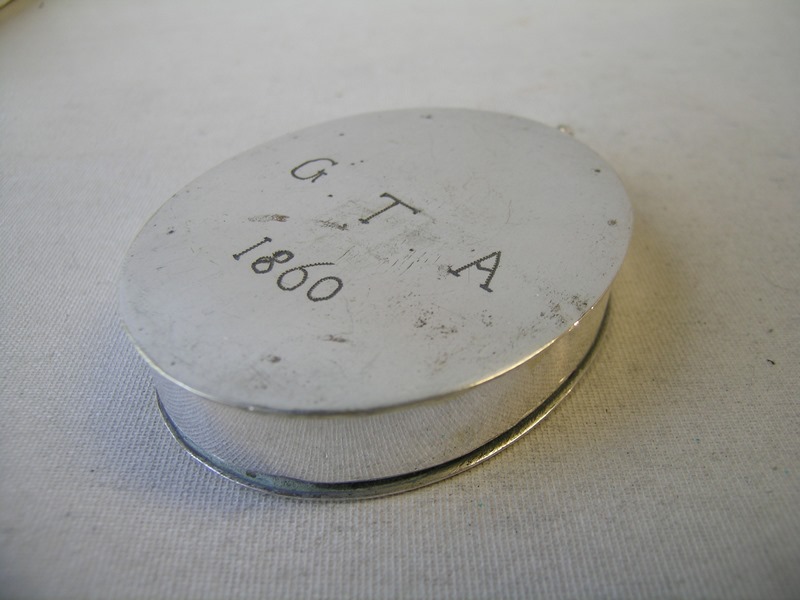
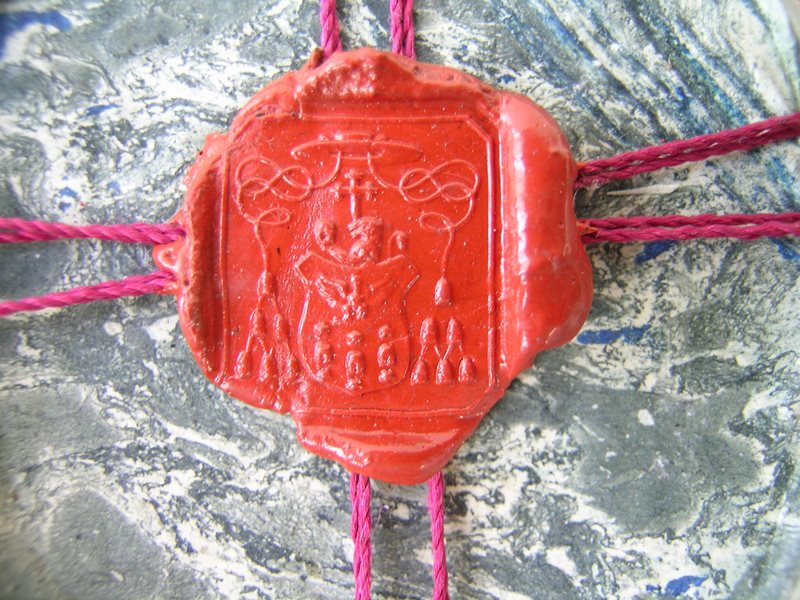
Alphonsus Maria de Liguori. All relics in place and wax seal and threads intact.Dated
at the back 1860.Comes from a convent
in Italy. Measures 3,3x2,3 inch. Shipping and handling
US$ 27.00 by insured priority mail and tracking number. All my items are
securely packet, to avoid all possible damage.Our Non Paying Buyer process is
now automatically managed by Ebay.The process starts four days after auction
end and closes as soon as payment is received.
Please contact me if you have any
questions. Items cannot be returned.
As per Ebay
policy,this reliquary does not contain human remains but only objects of devotion.
The auction is for the theca, the relic is a gift.
Please be carefull when buying relics online. Fake
relics are increasingly more and more of a problem. Most of the relics I sell
are from convents in Belgium and Italy. I have been collecting relics for more
than 25 years. I consider myself an expert. Please contact
me if you have any questions.
I
only sell antique items and no copies or new made fakes!
Please see my other auctions for more
vestments,reliquary’s, relic’s and antique catholic items.
Saint
Nicholas of Myra
Also known as
- Nicholas of Bari
- Nicholas of Lpnenskij
- Nicholas of Lipno
- Nicholas of Sarajskij
- Nicholas the Miracle Worker
- Klaus…
- Mikulas…
- Nikolai…
- Nicolaas…
- Nicolas…
- Niklaas…
- Niklas…
- Nikolaus…
- Santa Claus
Memorial
- 6 December
- 22
May (translation of relics (9 May on the Julian
calendar))
Profile
Priest. Abbot. Bishop of
Myra, Lycia (modern Turkey). Generous to the poor, and special protector
of the innocent and wronged. Many stories grew up around him prior to his
becoming associated with Santa Claus. Some examples
·
Upon
hearing that a local man had fallen on such hard times that he was planning to
sell his daughters into prostitution, Nicholas went by night to the house and
threw three bags of gold in through the window, saving the girls from an evil
life. These three bags, gold generously given in time of trouble, became the
three golden balls that indicate a pawn broker’s shop.
·
He
raised to life three young boys who had been murdered and pickled in
a barrel of brine to hide the crime. These stories led to
his patronage of children in general, and
of barrel-makers besides.
·
Induced
some thieves to return their plunder. This explains his protection
against theft and robbery, and his patronage of them – he’s not
helping them steal, but to repent and change. In the past, thieves have been
known as Saint Nicholas’ clerks or Knights of Saint Nicholas.
·
During
a voyage to the Holy Lands, a fierce storm blew up, threatening the ship.
He prayed about it, and the storm calmed – hence the patronage of sailors and
those like dockworkers who work on the sea.
Died
- c.346 at
Myra, Lycia (in modern Turkey) of natural causes
- relics believed
to be at Bari, Italy
Canonized
- Pre-Congregation
Patronage
- against famine
- against fire
- against imprisonment
- against robberies
- against robbers
- against storms at sea
- against sterility
- against thefts
- altar servers
- archers
- boys
- brides
- captives
- children
- choir boys
- for safe journeys
- girls
- happy marriages
- lawsuits lost unjustly
- lovers
- maidens
- penitent murderers
- newlyweds
- old maids
- paupers
- pilgrims
- poor people
- prisoners
- scholars
- schoolchildren
- students
- penitent thieves
- spinsters
- travellers
- unjustly judged people
- unmarried girls
- apothecaries
- bakers
- bankers
- barrel makers
- boatmen
- boot blacks
- brewers
- butchers
- button makers
- candle makers
- chair makers
- cloth shearers
- coopers
- craftsmen
- dockers
- dock workers
- druggists
- educators
- farm workers
- farmers
- firefighters
- fish mongers
- fishermen
- grain merchants
- grocers
- grooms
- hoteliers
- innkeepers
- judges
- lace merchants
Saint
Alphonsus Maria de Liguori
Also known as
- Alfonso…
- Alfons…
- Alfontso…
- Alphonse…
- Alfonsu…
- Afonso…
Memorial
- 1 August
Profile
Born
to the nobility, Alphonsus was a child prodigy; he became extremely
well-educated, and received his doctorate in law from
the University of Naples at age 16. He had his
own legal practice by age 21, and was soon one of the
leading lawyers in Naples, though he never attended court
without having attended Mass first. He loved music,
could play the harpsichord, and often attended the opera, though he
frequently listened without bothering to watch the over-done staging. As he
matured and learned more and more of the world, he liked it less and less, and
finally felt a call to religious life. He declined an
arranged marriage, studied theology, and
was ordained at age 29.
Preacher and home
missioner around Naples. Noted for his simple, clear, direct style
of preaching, and his gentle, understanding way in
the confessional. Writer on asceticism, theology, and
history; master theologian. He was often opposed by Church officials
for a perceived laxity toward sinners, and by government officials who opposed
anything religious. Founded the Redemptoristines women‘s
order in Scala in 1730. Founded the Congregation of the Most Holy Redeemer (Liguorians; Redemptorists)
at Scala, Italy in 1732.
Appointed bishop of
the diocese of Sant’Agata de’
Goti, Italy by Pope Clement XIII in 1762. Worked
to reform the clergy and revitalize the faithful in
a diocese with a bad reputation. He was afflicted with
severe rheumatism, and often could barely move or raise his chin from his
chest. In 1775 he resigned his see due to ill health,
and went into what he thought would be a prayerful retirement.
In 1777 the
royal government threatened to disband his Redemptorists, claiming that they were covertly carrying on the
work of the Jesuits, who had been suppressed in 1773. Calling on his
knowledge of the Congregation,
his background in thelogy, and his skills as a lawyer, Alphonsus
defended the Redemptorists so
well that they obtained the king‘s approval. However, by this point
Alphonsus was nearly blind, and was tricked into giving his approval to a
revised Rule for the Congregation,
one that suited the king and the anti-clerical government.
When Pope Pius VI saw the changes, he condemned it, and removed
Alphonsus from his position as leader of the Order. This caused Alphonsus
a crisis in confidence and faith that took years to overcome. However, by the
time of his death he had returned to faith and peace.
Alphonsus
vowed early to never to waste a moment of his life, and he lived that way for
over 90 years. Declared a Doctor of the Church by Pope Pius
IX in 1871.
When
he was bishop, one of Alphonsus’s priests led a worldly life,
and resisted all attempts to change. He was summoned to Alphonsus, and at the
entrance to the bishop‘s study he found a large crucifix laid on
the threshold. When the priest hesitated to step in, Alphonsus
quietly said, “Come along, and be
sure to trample it underfoot. It would not be the first time you have placed
Our Lord beneath your feet.”
Born
- 27
September 1696 at Marianelli near Naples, Italy
Died
- 1
August 1787 at Nocera, Italy of natural causes
Venerated
- 1796 by Pope Pius
VI (decree of heroic virtues)
Beatified
- 15 September 1816 by Pope Pius VII
Canonized
- 26 May 1839 by Pope Gregory XVI
Patronage
- against arthritis
- against scrupulosity
- confessors (proclaimed
on 26 April 1950 by Pope Pius XII)
- final perseverance
- moral theologians
- moralists (proclaimed
on 26 April 1950 by Pope Pius XII)
- scrupulous people
- theologians
- vocations
- Sisters of the Holy Redeemer
- in Italy
- Acerra, diocese of
- Agrigento, archdiocese of
- Agrigento, city of
- Cerreto
Sannita-Telese-Sant’Agata de’ Goti, diocese of
- Naples
- Nocera
- Pagani
- Sant’Agata de’ Goti, city of
Saint
Zosimus of Syracuse
Also known as
- Zosimo
- Zozimus
Memorial
- 30 March
Profile
Son
of wealthy land owners. Dedicated to Saint Lucy of Syracuse. Entered
the monastery of Saint Lucy near Syracuse, Sicily at
age seven. At one point as a child, he was unable to bear the quiet of the monastery and
the tedium of his chores, and he ran away. His family sent him back to
the monastery. There he had a vision of Saint Lucy who
seemed angry. In the vision, Our Lady appeared, calmed Lucy, and
welcomed the boy back to the monastery.
Zosimus studied under Saint Faustus
of Syracuse. Monk for thirty years. During one meeting to choose
an abbot, Zozimus was left behind to watch the door and guard the
church’s relics; the bishop decided this was a man humble enough
to be trusted with the task, and made Zozimus abbot. Priest. Chosen
the unwilling bishop of Syracuse in 649. Noted for
his charity to the poor and his work
to educate his parishioners.
Born
- c.570 at Syracuse, Sicily
Died
- 660 of natural causes
Canonized
- Pre-Congregation
Blessed Nicholas Albergati
Also known as
- Niccolò
- Nicolò
Memorial
- 10 May
Profile
Studied law. Carthusian monk in 1394. Prior of
several Carthusian houses. Ordained in June 1404. Chosen as
reluctant bishop of Bologna, Italy on 5
January 1417. Papal diplomat with missions
to France and Lombardy, Italy. Archbishop of Bologna in 1418 against
his will. Elevated to cardinal-priest of Santa Croce in Gerusalemme
on 24 May 1426. Known as a peacemaker. Mediated between the
emperor and Pope Martin V, and
the French king and Pope Eugene IV. Prominent in the Council of Basel and Council of Ferrara-Florence. Active
in the negotiations that brought reunion of the Greek Church with Rome at
Ferrara-Florence. Generous patron of learned
men. Wrote several theological treatises, and encouraged
academics. Chief penitentiary to Pope Eugene
IV. Archpriest of the Basilica of Saint Mary Major in 1440.
Born
- 1373 at Bologna, Italy
Died
- 9
May 1443 at Siena, Italy of natural causes
- buried at
the Carthusian monastery in Florence, Italy
Beatified
- 25
September 1744 by Pope Benedict XIV (cultus
confirmed)
Patronage
- learning
- Bologna, Italy
Blessed Pope Benedict XI
Also known as
- Niccolò Boccasini
Memorial
- 7 July
Profile
Joined
the Dominicans when a young man. Ninth Master-General of
his Order in 1296. Arranged an armistice between Philip
IV of France and Edward I of England.
Created Cardinal–Bishop of Ostia, Italy by Pope Boniface
VIII. Papal legate. Defended Pope Boniface
VIII against William of Nogaret and his allies.
Unanimously
chosen 194th pope in 1303. Removed papal censure from
Philip and France, and absolved the cardinals favoring Colonna
political faction. Accomplished a number of reforms in religious and clerical
life. Believed to have been poisoned by the agents of William of Nogaret. Known
for his lifelong devotion to Dominican spiritual practices. Author of
a volume of sermons and commentaries on the Gospel
of Matthew, the Psalms,
the Book of Job, and Revelations.
Born
- 1240 at Treviso, Italy as Niccolo Boccasini
Papal Ascension
- 22 October 1303
Died
- 7
July 1304 at Perugia, Italy of natural causes
Beatified
- 24
April 1736 by Pope Clement XII (cultus confirmed)
- 1773 by Pope Clement
XIV (beatified)
Patronage
- Perugia, Italy
Saint Martin of Tours
Also known as
- Martin the Merciful
- Martinus Turonensis
- The Glory of Gaul
Memorial
- 11 November
- 4
July (dedication of his basilica; translation of relics)
Profile
Born
to pagan parents; his father was a Roman
military officer and tribune. Martin was raised
in Pavia, Italy. Discovered Christianity, and became
a catechumen in his early teens. Joined the Roman
imperial army at age 15, serving in a ceremonial unit that acted as
the emperor’s bodyguard, rarely exposed to combat. Cavalry officer,
and assigned to garrison duty in Gaul.
Baptised into
the Church at age 18. Trying to live his faith, he refused to
let his servant to wait on him. Once, while
on horseback in Amiens in Gaul (modern France),
he encountered a beggar. Having nothing to give but the clothes on his
back, Martin cut his heavy officer‘s cloak in half, and gave it
to the beggar. Later he had a vision of Christ wearing the cloak.
This incident became iconographic of Martin.
Just
before a battle, Martin announced that his faith prohibited him
from fighting. He was charged with cowardice, was jailed, and his
superiors planned to put him in the front of the battle. However, the invaders
sued for peace, the battle never occurred, and Martin was
released from military service at Worms, Germany. Spiritual
student of Saint Hilary at Poitiers, France.
On
a visit to Lombardy to see his parents, Martin was robbed in the
mountains – but managed to convert one of the thieves. At home he
found that his mother had converted, but
his father had not. The area was strongly Arian, and openly
hostile to Catholics. Martin was badly abused by the heretics, at one
point even by the order of an Arian bishop. Learning that
the Arians had gained the upper hand
in Gaul and exiled Saint Hilary, Martin fled to the
island of Gallinaria (modern Isola d’Albenga).
Learning
that the emperor had authorized the return of Hilary, Martin ran to him
in 361, then became a hermit for ten years in the area now known
as Ligugé. A reputation for holiness attracted other monks, and they
formed what would become the Benedictine abbey of Ligugé. Preached and evangelized through
the Gallic countryside. Many locals held strongly to the old beliefs,
and tried to intimidate Martin by dressing as the old Roman gods and appearing
to him at night; Martin destroyed old temples, built churches on the same land,
and continued to win converts. Friend
of Saint Liborius, bishop of Le Mans, France.
When
the bishop of Tours, France died in 371,
Martin was the immediate choice to replace him. Martin declined, citing
unworthiness. Rusticus, a wealthy citizen of Tours, claimed that
his wife was ill and asking for Martin; tricked by this
ruse, Martin went to the city where he was declared bishop by popular
acclamation, and then consecrated on 4 July 372.
As bishop,
he lived in a hermit‘s cell near Tours.
Other monks joined him, and a new house, Marmoutier, soon formed. He
rarely left his monastery or see city, but sometimes went
to Trier, Germany to plead with the emperor for his city, his
church, or his parishioners. Once when he went to ask for lenience for
a condemned prisoner, an angel woke the emperor to tell him
that Martin was waiting to see him; the prisoner was reprieved.
Martin
himself was given to visions, but even his contemporaries sometimes ascribed
them to his habit of lengthy fasts. An extensive biography of Martin
was written by Sulpicius Severus. He was the first
non-martyr to receive the cultus of a saint.
Born
- c.316 at
Upper Pannonia (in modern Hungary)
Died
- 8
November 397 at Candes, Tours, France of natural
causes
- by his
request, he was buried in the Cemetery
of the Poor on 11 November 397
- his relics rested
in the basilica of Tours, a scene
of pilgrimages and miracles, until 1562 when
the catheral and relics were destroyed by militant
Protestants
- some small
fragments on his tomb were found during construction excavation
in 1860
Canonized
- Pre-Congregation
Patronage
- against alcoholism
- against dysentery
- against impoverishment
- against poverty
- armourers
- barrel makers
- beggars
- cattle
- cavalry
- coopers
- domestic animals
- equestrians
- geese
- horse men
- horses
- hotel-keepers
- infantry in general
- infantry, French (proclaimed
on 25 January 1952 by Pope Pius XII)
- infantry, Italian (proclaimed
on 21 May 1951 by Pope Pius XII)
- innkeepers
- knights
- Pontifical Swiss Guards
- poultry
- quartermasters
- reformed alcoholics
- riders
- soldiers
- tailors
- vintners
- wine growers
- wine makers
Saint Ubaldus Baldassini
Also known as
- Ubaldus of Gubbio
- Ubaldo…
- Ubald…
- Ubalde…
Memorial
- 16 May
Profile
Born
to the nobility. Related to Saint Sperandea. Ubaldo’s father,
Rovaldo Baldassini, died when the boy was very young;
his mother was an invalid, afflicted with what we now consider a
neurological disease. Raised by his uncle. Educated by
the prior of
the cathedral in Gubbio, Italy. Canon regular. Monk at
the Monastery of Saint Secondo in Gubbio for several
years. Dean of the cathedral in Gubio. Ordained in 1115.
Around 1120 he convinced the canons of
his chapter to live a common life together under the rule given by
Peter degli Onesti; this communal life was designed to keep them out of worldly
ways. Ubaldo wanted to be a hermit, but was advised against it, and
in 1128 he accepted the bishopric of Gubbio. Known as
a patient, gentle, and brave pastor to his people. Convinced
Emperor Frederick Barbarossa not to sack Gubbio as he had
done other cities. The tomb and shrine of Ubaldus is still a place of pilgrimage.
Born
- c.1085 at Gubbio near Ancona, Umbria, Italy as Ubaldo Baldassini
Died
- around
sunrise on Monday 16
May 1160 at Gubbio near Ancona, Umbria, Italy of
natural causes
- relics re-interred
on 11 September 1194
- his right
hand little finger is held as a relic in Thann, France
Canonized
- 1192 by Pope Celestine III
Representation
- bishop giving
a blessing as angels carry his crozier
- bishop delivering
a blessing while a devil flees from it
- bishop holding
a model of Gubbio
Patronage
- against autism
- against demonic possession
- against migraine
- against neuralgia
- against obsession
- autistic children
- autistics
- obsessive compulsives
- possessed people
- sick children
- Gubbio, Italy
- Montovi, Italy
Saint Charles Borromeo
Also known as
- Apostle to
the Council of Trent
- Carlo Borromeo
- Father of the Clergy
Memorial
- 4 November
- formerly 5 November
- 3 November (Milan, Italy)
Profile
Born
to a wealthy, noble family, the third of six children, son
of Count Giberto II Borromeo and Margherita de’ Medici. Nephew
of Pope Pius IV. Suffered with a speech
impediment. Studied in Milan, and at
the University of Pavia, studying at one point under
the future Pope Gregory
XIII. Civil and canon lawyer at age 21. Cleric at Milan,
taking the habit on 13
October 1547. Abbot commendatario of San Felino e San
Graziano abbey in Arona, Italy, on 20
November 1547. Abbot commendatario of San Silano di
Romagnano abbey on 10
May 1558. Prior commendatario of San Maria di Calvenzano abbey on 8
December 1558. Protonotary apostolic participantium and referendary of
the papal court to Pope Pius IV on 13
January 1560. Member of the counsulta for
the administration of the Papal States on 22 January 1560.
Appointed abbot commendatario of Nonatola, San Gallo di Moggio,
Serravalle della Follina, San Stefano del Corno, an abbey in Portugal,
and an abbey in Flanders, Belgium on 27
January 1560. Created cardinal on 31
January 1560 at age 22.
Apostolic
administrator of Milan, Italy on 8
February 1560. Papal legate to Bologna and
Romandiola for two years beginning on 26 April 1560. Deacon on 21
December 1560. Vatican Secretary of
State. Governor of Civita
Castellana,Italy in 1561. Governor of Ancona on 1
June 1561. Made an honorary citizen of Rome, Italy on 1
July 1561. Founded the Accademia
Vaticana in 1562. Governor of Spoleto, Italy on 1
December 1562. Ordained on 4 September 1563. Helped
re-open the Council of Trent,
and participated in its sessions during 1562 and 1563.
Named prince of Orta in 1563. Member of the Congregation of the Holy Office. Bishop of Milan on 7
December 1563. President of the commission
of theologians charged by the pope to elaborate the Catechismus Romanus. Worked on the revision of
the Missal and Breviary. Member of a commission to reform
church music. Archbishop of Milan on 12
May 1564. Governor of Terracina, Italy on 3
June 1564. Archpriest of the patriarchal
Liberian basilica in Rome in
October 1564. Count of the Palatine in 1564. Prefect of
the Tridentine Council from 1564 until
September 1565. Papal legate in Bologna, Romandiola,
legate a
latere, and vicar
general in
spiritualibus of
all Italy on 17 August 1565. Grand penitentiary on 7
November 1565. Participated in
the conclave of cardinals in 1565 to 1566 that
chose Pope Pius V; he asked the new pope to take the name.
Protector of the Swiss Catholic cantons; he visited them all
several times worked for the spiritual reform of
both clergy and laymen. Due to his enforcement of strict
ecclesiastical discipline, some disgruntled monks in the Order of the Humiliati hired
a lay brother to murder him on the evening of 26
October 1569; he was shot at, but was not hit. Participated in
the conclave in 1572 that chose Pope Gregory
XIII. Member of the Apostolic
Penitentiary in May 1572. Worked with the sick, and
helped bury the dead during the plague outbreak
in Milan in 1576. Established the Oblates of Saint Ambrose on 26
April 1578. Teacher, confessor and parish priest to Saint Aloysius
Gonzaga, giving him his first communion on 22
July 1580. To help the Swiss Catholics he founded the Collegium Helveticum.
Saint Charles
spent his life and fortune in the service of the people of his diocese. He
directed and fervently enforced the decrees of the Council of Trent, fought tirelessly for peace in the wake of the
storm caused by Martin Luther, founded schools for the poor, seminaries for clerics, hospitals for
the sick, conducted synods, instituted children‘s Sunday school, did
great public and private penance, and worked among
the sick and dying, leading his people by example.
Born
- morning of
Wednesday 2 October 1538 in the castle at
Aron, diocese of Novara, Italy
Died
- 8:30pm
on 3 November 1584 of
a fever at Milan, Italy
- his will
named the Hospital Maggiore of Milan as his heir
- buried in
the metropolitan cathedral of Milan
- relics transferred
to a chapel built by Count Renato Borromeo in piazza
San Maria Podone, Milan on 21 September 1751
Beatified
- 1602 by Pope Clement VIII
Canonized
- 1 November 1610 by Pope Paul V
Patronage
- against abdominal pain
- against colic
- against intestinal disorders
- against stomach diseases
- against ulcers
- apple orchards
- bishops
- catechism writers
- catechists
- catechumens
- clergy
- confessors
- seminarians
- spiritual directors
- spiritual leaders
- starch makers
Saint Petronius of Bologna
Also known as
- Petronius Vescovo
- Petronius the Bishops
- Petronio….
Memorial
- 4 October
Profile
Son
of a Praetorian Prefect in Gaul, and may have been a Roman official
himself. Pilgrim to the Holy Lands and
the ascetics in Palestine in his
youth. Bishop of Bologna, Italy. Built the monastery of
Saint Stephen in Bologna; it was modeled on the holy places
of Jerusalem. A fictional version of his life was popular in the Middle
Ages.
Died
- c.445 of natural causes
Canonized
- Pre-Congregation
Patronage
- in Italy
- Bologna, archdiocese of
- Bologna, city of
- Castel Bolognese