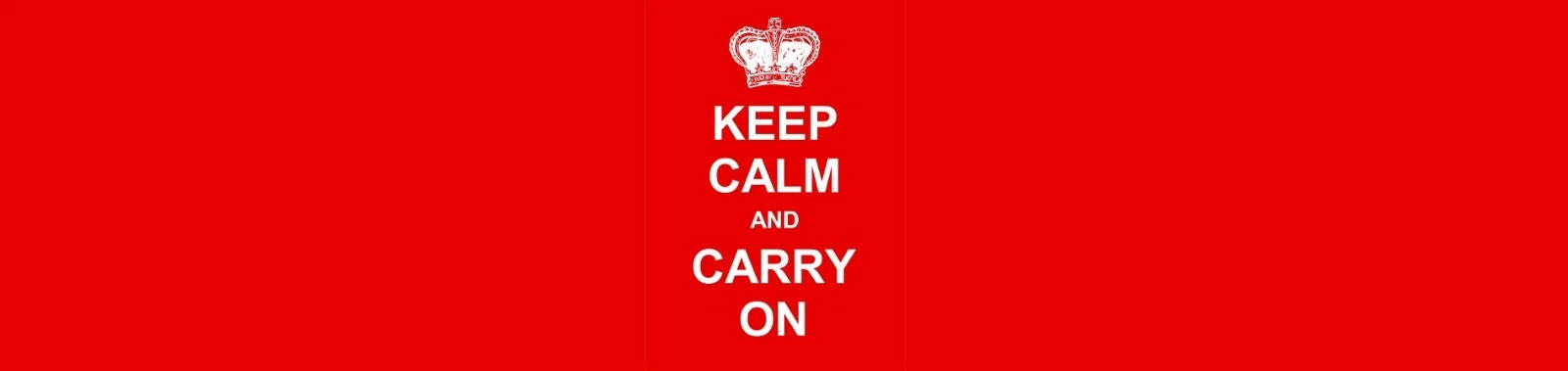
Keep Calm and Carry On was a motivational poster produced by the British government in 1939 in preparation for the Second World War. The poster was intended to raise the morale of the British public, threatened with widely predicted mass air attacks on major cities. Although 2.45 million copies were printed, and although the Blitz happened, the poster was never publicly displayed and was little known about until a copy was rediscovered in 2000. It has since been re-issued by a number of private companies, and has been used as the decorative theme for a range of products. Keep Calm and Carry On was a motivational poster produced by the Government of the United Kingdom in 1939 in preparation for World War II. The poster was intended to raise the morale of the British public, threatened with widely predicted mass air attacks on major cities. Although 2.45 million copies were printed, and the Blitz did in fact take place, the poster was only rarely publicly displayed and was little known until a copy was rediscovered in 2000 at Barter Books, a bookshop in Alnwick.It has since been re-issued by a number of private companies, and has been used as the decorative theme for a range of products.
Evocative of the Victorian belief in British stoicism – the "stiff upper lip", self-discipline, fortitude, and remaining calm in adversity – the poster has become recognised around the world.[5] It was thought that only two original copies survived until a collection of approximately 15 was brought in to the Antiques Roadshow in 2012 by the daughter of an ex-Royal Observer Corps member. A few further examples have come to light since. During 1938, newspapers were sold with a "Keep Calm and Dig" poster. The Keep Calm and Carry On poster was designed by the Ministry of Information from 27 June to 6 July 1939. It was produced as one of three "Home Publicity" posters (the others read "Your Courage, Your Cheerfulness, Your Resolution Will Bring Us Victory" and "Freedom Is in Peril / Defend It With All Your Might"). Each poster showed the slogan under a representation of a Tudor Crown (a symbol of the state). Keep Calm was intended to be distributed to strengthen morale in the event of a wartime disaster, such as mass bombing of major cities using high explosives and poison gas, which was widely expected within hours of an outbreak of war.
A career civil servant named A. P. Waterfield came up with "Your Courage" as one of several suggestions to be used as "a rallying war-cry that will bring out the best in everyone of us and put us in an offensive mood at once". Others involved in the planning of the early posters included John Hilton, Professor of Industrial Relations at Cambridge University, responsible overall as Director of Home Publicity; William Surrey Dane, managing director at Odhams Press; Gervas Huxley, former head of publicity for the Empire Marketing Board; William Codling, controller of HMSO; Harold Nicolson, MP; W. G. V. Vaughan, who became Director of the General Production Division (GPD); H. V. Rhodes, who later wrote an occasional paper on setting up a new government department; Ivison Macadam; "Mr Cruthley"; and "Mr Francis". Ernest Wallcousins was the artist tasked with creating the poster designs.
Detailed planning for the posters had started in April 1939 and the eventual designs were prepared after meetings between officials from the Ministry of Information and HM Treasury on 26 June 1939, and between officials from the Ministry of Information and HMSO on 27 June 1939. Roughs of the poster were completed on 6 July 1939, and the final designs were agreed by the Home Secretary Samuel Hoare, 1st Viscount Templewood on 4 August 1939. Printing began on 23 August 1939, the day that Nazi Germany and the USSR signed the Molotov–Ribbentrop Pact, and the posters were ready to be placed up within 24 hours of the outbreak of war.
The posters were produced in 11 different sizes, ranging from 15 × 10 inches (38 × 25 cm) up to large 48-sheet versions. The background colour was either red or blue. The lettering was probably hand-drawn by Wallcousins: it is similar, but not identical, to humanist sans-serif typefaces such as Gill Sans and Johnston. Almost 2,500,000 copies of Keep Calm and Carry On were printed between 23 August and 3 September 1939 but while Your Courage and Freedom is in peril were both widely distributed, Keep Calm was not sanctioned for immediate public display. It was instead decided that copies should remain in "cold storage" for use after serious air raids (with resources transferred to Your Courage and Freedom is in Peril). Copies of Keep Calm and Carry On were retained until April 1940, but stocks were then pulped as part of the wider Paper Salvage campaign. Some copies do appear to have been displayed, but such instances were rare and unauthorised. An October 1940 edition of the Yorkshire Post reports the poster hung in a shop in Leeds; a photograph discovered in 2016 shows it on the wall of a government laboratory in Bedfordshire; and a large version displayed in a pub appears in a 1941 photograph by Cecil Beaton. An example also features in a drawing of a London Underground station by Floyd MacMillan Davis, published in Life magazine in 1944, suggesting a more widespread distribution.
The posters had been conceived on the assumption that enemy attacks of the civilian population would begin as soon as war was declared, and that there would be a great need for "a copious issue of general reassurance material". In practice, the initial poster campaign co-incided with the Phoney War, and thus to a population as yet completely unaffected by direct encounter with the enemy.
The remainder of the poster campaign was cancelled in October 1939 following criticism of its cost and impact. Mass Observation analysis of the public response to the campaign was overwhelmingly negative. Criticisms of the posters included Your Courage as being too long, confusingly worded, and generally annoying due to the sheer number of posters. In particular some had interpreted the message of Your Courage to imply that the common people would suffer for the benefit of the upper classes. Design historian Susannah Walker regards the campaign as "a resounding failure" and reflective of a misjudgement by upper-class civil servants of the mood of the people. Stuart Manley suggests that the negative reaction to the first two posters resulted in Keep Calm being held back, and that this was an error of judgement: "If they had started with this one, I think it would have been just as popular then as it is now. In late May and early June 1941, 14,000,000 copies of a leaflet entitled "Beating the Invader" were distributed with a message from Prime Minister Winston Churchill. The leaflet begins "If invasion comes..." and exhorts the populace to "Stand Firm" and "Carry On". The two phrases do not appear in one sentence, as they applied to different segments of the population depending on their circumstances, with those civilians finding themselves in areas of fighting ordered to stand firm (i.e., stay put) and those not in areas of fighting ordered to carry on (i.e., continue vital war work). Each mandate is identified as a "great order and duty" should invasion come. The leaflet then lists 14 questions and answers on practical measures to be taken.
As the popularity of the poster in various media has grown, innumerable parodies, imitations and co-optations have also appeared, making it a notable meme. Messages range from the cute to the overtly political. Examples have included "Now Panic and Freak Out" (with an upside-down crown), "Get Excited and Make Things" (with a crown incorporating spanners), "Keep Calm and Have a Cupcake" (with a cupcake icon), "Don't Panic and Fake a British Accent", "Keep Spending and Carry On Shopping", "Keep Calm and Don't Sneeze" during the 2009 swine flu pandemic, "Keep Calm and Call Batman" (with the Batman logo), "Keep Calm and Switch to Linux" (with Tux), and "Keep Calm and Wash Your Hands". The phrase has been modified in many ways, as noted in the title of a book chapter '"Keep Calm and Carry On" – From Wartime Slogan to One of the Most Frequently Modified Proverbs' by Sabine Fiedler.
In March–April 2012, the British pop-rock band McFly undertook a theatre tour entitled "The Keep Calm and Play Louder Tour", promoted with a poster closely based on that of 1939. In late 2012 and early 2013, the "Save Lewisham Hospital" campaign (a protest against proposed cuts in services at University Hospital Lewisham) made widespread use of a poster with the slogan "Don't Keep Calm Get Angry and Save Lewisham A&E". The efforts of Naheed Nenshi, mayor of Calgary, Alberta, Canada, to encourage and motivate his citizens in the wake of the 2013 Alberta floods made him the subject of parody "Keep Calm and Nenshi On" fundraising T-shirts,
Combined Joint Special Operations Task Force - Afghanistan or CJSOTF-A is a task force unit lead by US Army Special Forces. It's headquartered at Bagram Airfield and is part of the Special Operations Joint Task Force - Afghanistan / NATO Special Operations Component Command - Afghanistan. The core tasks of CJSOTF-A include advising the Afghan National Army’s special operations forces and local police, and training forces associated with the Village Stability Operations (VSO) and counterinsurgency (COIN) - a strategy that establishes expanding security and stability in rural villages. The unit also controls highly specialized battalion-level task forces built around US Army Special Forces, Infantry, Marine Special Operators and Navy SEALs. The Special Operations Command Central (SOCCENT) is a sub-unified command of the U.S. Central Command (USCENTCOM). It is responsible for planning special operations throughout the USCENTCOM area of responsibility (AOR), planning and conducting peacetime joint/combined special operations training exercises, and orchestrating command and control of peacetime and wartime special operations as directed. The command is headquartered at MacDill Air Force Base in Tampa, Florida. SOCCENT FWD (formerly known as Combined Forces Special Operations Component Command) is located at Al Udeid in Qatar. The Command's motto is Molon labe (Greek for "Come and take them", was said by King Leonidas I of Sparta before the Battle of Thermopylae in response to the Persian demand to surrender their weapons.) In the initial stages of Operation Enduring Freedom in Afghanistan, the formation's commander was Rear Admiral Albert Calland. SOCCENT stood up Joint Special Operations Task Forces (JSOTFs). Beginning on 5 October 2001, Joint Special Operations Task Force-North (JSOTFN) was established under command of Col Frank Kisner at Karshi-Kanabad (K2), Uzbekistan, and the bombing of Afghanistan began on 7 October. The 5th Special Forces Group, under the command of COL John Mulholland, deployed to K2 and formed the core of this JSOTF, more commonly known as Task Force Dagger. Unconventional Warfarebecame DAGGER’s principal mission. This task force included aviators from the 160th SOAR (A) and Special Tactics personnel from AFSOC. A comparable task force, Task Force K-Bar, deployed to southern Afghanistan. In the leadup to the 2003 invasion of Iraq, SOCCENT assigned 5th Special Forces Group the task of establishing Combined Joint Special Operations Task Force-West (CJSOTF-W), and its three battalions would constitute the bulk of the task force. As operations approached, CJSOTF-W grew to include Australian and British special forces, Psychological Operations (PSYOP) elements from B Company, 9th PSYOP Battalion, and 301st PSYOP Company, with Civil Affairs augmentation. Most U.S. special operations forces left Iraq in May and June 2003. CJSOTF-N/Task Force Viking was deactivated, and CJSOTF-W was re-designated CJSOTF-Arabian Peninsula (CJSOTFAP), having moved to Baghdad in April. By July 2003, CJSOTF-AP had drawn down to the 5th Special Forces Group Headquarters, consisting of one Naval Special Warfare Task Unit (NSWTU) and one FOB. The FOB commanded 14 ODAs, few of them at full strength. The bulk of these forces remained in Baghdad with outstations covering Al Qaim, Ramadi/Fallujah, Najaf/Nasiriyah, Hillah, Kut/Amarah, Tikrit, Balad, Samarra, and Kirkuk. According to a 2006 online edition of Special Operations Technology magazine, SOCCENT, operating with coalition partners as the CFSOCC, consists of two combined joint special operations task forces [CJSOTFs], one Combined Joint Special Operations Aviation Command (also referred to as 'Component'), which seems to be at Balad Air Base, one joint psychological operations task force, one Naval Special Warfare Unit and three Special Operations command and control elements [SOCCEs]. The two CJSOTFs are CJSOTF-Arabian Peninsula, whose headquarters directs United States Army Special Forces and CJSOTF Afghanistan. Combined Joint Special Operations Task Force-Arabian Peninsula (CJSOTF-AP) is a "white," or unclassified, special operations task force that is always organized around the headquarters of 5th Special Forces Group or 10th Special Forces Group.[10] Combined Joint Special Operations Task Force-Arabian Peninsula (CJSOTF-AP), itself answers to While information is scarce, it consists of two battalions of the United States Army Special Forces (the 'Green Berets') and a west coast-based Navy SEAL Team. CJSOTF-AP is task organized into three Special Operations Task Forces (SOTFs): SOTF-Central, SOTF-North, and SOTF-West. CJSOTF Afghanistan's headquarters has been provided in rotation by a number of Army Special Forces Groups, including the 3rd and the 19th. CJSOTF Afghanistan has included elements of the 7th Special Forces Group operating in southern provinces, including Kandahar, as Task Force 71.