Stones: Gypsum Crystal Cluster
Size: 170x120 mm
Weight: 910g
Location: Poltava region of Ukraine
You are purchasing the exact specimen as shown in the photographs.
General Information
GYPSUM is a mineral, a hydrated calcium sulfate. It is the most common sulfate mineral.
PROPERTIES
Symmetry: Monoclinic
Composition (formula): CaSO4?2H2O
Color: Colorless, white, gray, yellowish. Impurities can give it yellow, brown, red, black, or blue hues.
Streak Color: White
Transparency: Opaque, translucent, transparent
Cleavage: Very perfect
Fracture: Splintery, conchoidal, even, stepped
Luster: Greasy, pearly, vitreous, silky
Hardness: 1.5-2 - varies with direction
Density (specific gravity), g/cm3: 2.32
Brittleness: Flexible
Special Properties: Gypsum's hardness may decrease depending on the direction to 1.5.
The mineral dissolves in water.
At elevated temperatures, it can dehydrate into bassanite, becoming white upon dehydration.
It fluoresces under ultraviolet light, with common colors ranging from pale blue to shades of golden-yellow to yellow. Selenite often exhibits zonal fluorescence in the form of "sand-hourglass" patterns, which may go unnoticed under normal light.
MORPHOLOGY
Gypsum forms thin and thick tabular transparent crystals, sometimes prismatic, lens-shaped, needle-like.
Crystals can have a curved surface, be bent or twisted. It often occurs as rosette-shaped clusters of lens-like crystals, veins, stalactitic formations, massive layers, and asbestos-like parallel-fibrous masses (selenite), as well as granular masses (including the variety - alabaster).
ORIGIN
Gypsum is the most common of sulfate minerals. It forms in marine and lacustrine salt basins, caves, fumaroles, weathering crusts, and in zones of oxidation of sulfide deposits. It is formed through the hydration of anhydrite.
Gypsum is found in association with calcite, aragonite, anhydrite, dolomite, sulfur, celestine, halite.
USES
Gypsum is a relatively inexpensive mineral, allowing it to be utilized in various human activities. Today, it is used in construction and architecture, the paper industry, cement production, enamels, paints, and glazes, as well as in medicine and agriculture.
The application of gypsum as an ornamental stone is noteworthy. Its varieties (alabaster, selenite, etc.) are used in the creation of decorative sculptures, figurines, vases, and boxes. Additionally, artisans use it for the production of building panels, blocks, cornices, and reliefs.
Among collectors, exquisite "desert roses," twinned crystals resembling "swallow's tails," and gypsum aggregates in star-shaped forms are highly valued.
HEALING PROPERTIES
Gypsum has been used since ancient times, not only in folk medicine but also in classical medicine. It is believed to:
- Accelerate the processes of bone tissue fusion.
- Alleviate excessive sweating.
- Be used in medicines for the treatment of spinal tuberculosis.
- Improve the appearance of the skin, restoring youthfulness and beauty.
MAGICAL PROPERTIES
Since ancient times, gypsum amulets and talismans have been used as a kind of "medicine" for human pride, arrogance, and excessive self-importance. According to magicians, the mineral can guide its owner on the best course of action in various situations. Gypsum is believed to help attain material well-being and success in all endeavors.
SHIPPING AND SERVICE
We guarantee fast and reliable shipping with tracking. Additionally, we are always ready to answer all your questions and provide additional photos and information upon request.
Don't miss the unique opportunity to acquire this rare and exquisite mineral with an origin from a prestigious deposit. Please feel free to contact us if you have any questions or need further information. Thank you for your interest!
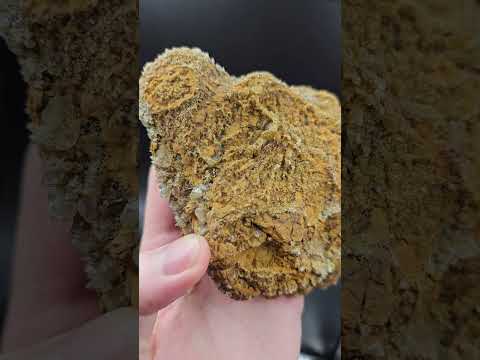
Unique Gypsum Crystal Cluster - White, Gray, Yellow, 626g, Found in Ukraine
Video will open in a new window
Using the eBay App? Paste link into a browser window: