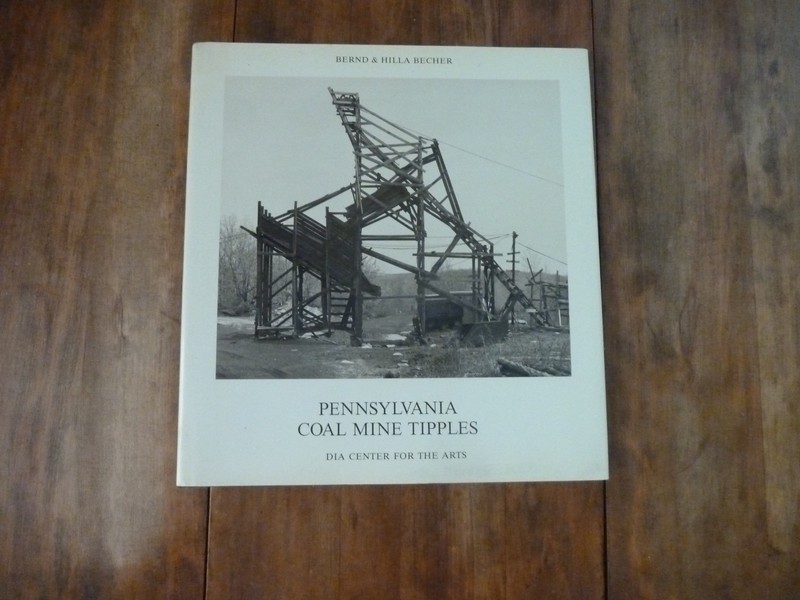


Hilla and Bernd Becher,Pennsylvania Coal Mine Tipples Industrial Photos 1st Ed

product image
product image
product image
product image
product image

Hilla and Bernd Becher, Pennsylvania Coal Mine Tipples, Industrial Photography. DIA Center for the Arts, 1991. Language: English 

This book is devoted to the wooden mineheads of the eastern regions of Pennsylvania. When many mines were forced to close during the Great Depression, jobless miners built clandestine mines in the wooded Appalachian foothills. In the valleys large investments were needed to mine the anthracite coal from deep shafts. In the hills, it was possible to access smaller coal deposits directly from the surface inexpensively. Wooden mineheads, or "tipples," pulled coal cars out of the mining tunnels to the surface. The angle of the coal bed and the slope of the surface determined the shape of the tipple. These pre-industrial-looking structures of varying shapes and heights were built by companies of usually three to five men. Wood was used to save costs. Some are still in operation today and remain the last traces of an extraction method that was used all over the world before mineheads were built of steel. Bernd and Hilla Becher photographed the Pennsylvania Coal Mine Tipples in 1974–75 and 1977–78.

Hilla Becher was a German artist born in 1931 in Siegen, Germany. She was one half of a photography duo with her husband Bernd Becher. For forty years, they photographed disappearing industrial architecture around Europe and North America.

They won the Erasmus Prize in 2002 and Hasselblad Award in 2004 for their work and roles as photography professors at the art academy Kunstakademie Düsseldorf.
How did they become a duo?

They began collaborating together in 1959 after meeting at the Kunstakademie Düsseldorf in 1957. Bernd originally studied painting and then typography, whereas Hilla had trained as a commercial photographer. After two years collaborating together, they married.
Created with GarageSale
 _gsrx_vers_1736 (GS 9.9.5 (1736))