


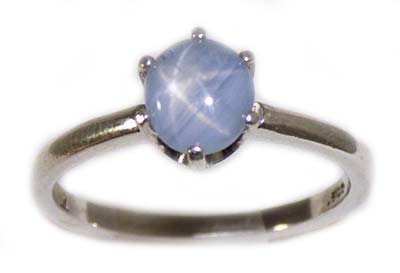
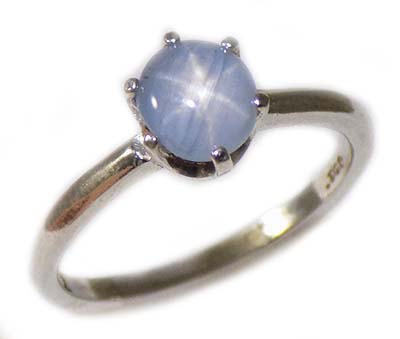
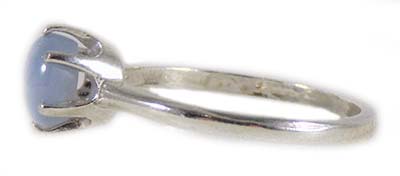
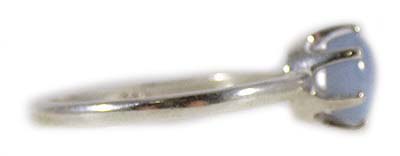
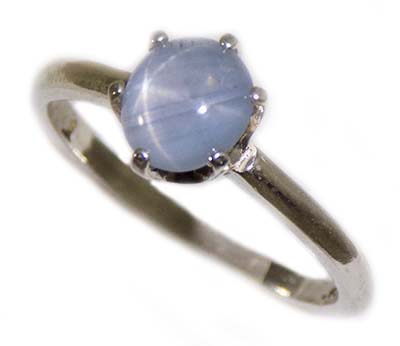
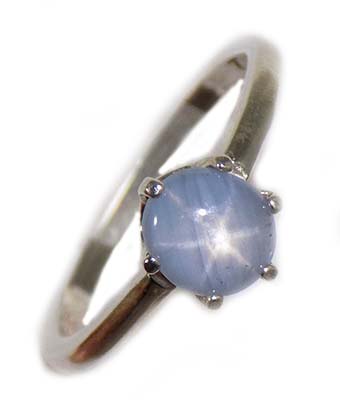
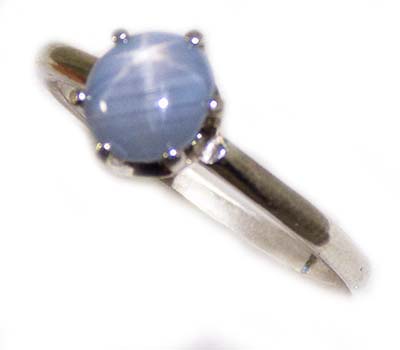
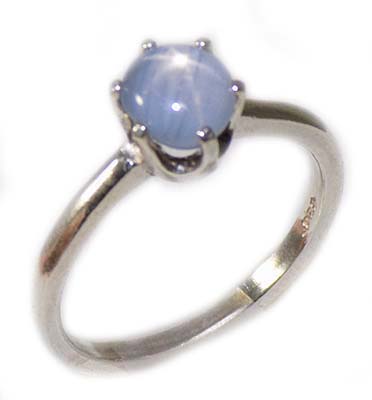
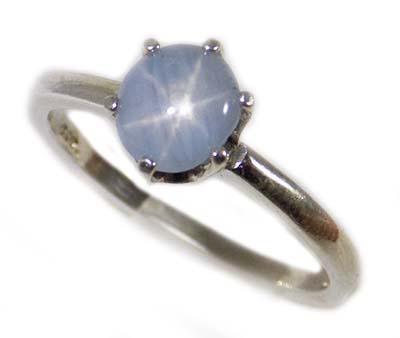
Antique Genuine Natural Burmese One and One-Half Carat Exquisitely Colored Sky Blue-Violet Star Sapphire Oval. Contemporary High Quality Sterling Silver Ring (Size 7½).
CLASSIFICATION: Cabochon Violet-Blue Star Sapphire Oval.
ORIGIN: Handcrafted in 19th Century Siberian Russia.
SIZE: Length: 7mm. Width: 6mm. Depth: 4mm. All measurements approximate.
WEIGHT: 1.51 carats.
DETAIL: In the world of the ancient Mediterranean (including the Greeks, Romans, Persians, Hebrews, and the various Indo-European Celtic tribes), priests and sorcerers honored the sapphire above all other gems, believing that sapphire enabled them to interpret oracles and foretell the future. Medieval sorcerers believed that sapphire enabled them to hear and understand the most obscure oracles. Not only did sapphire help to get in touch with astral and psychic realms, but the stone also provided protection for those who took those journeys. On the flip side, Medieval populations believed that wearing a sapphire as a talisman was an antidote to black magic and effects of evil spirits, and provided protection against sorcery. It was believed to banish evil spirits and send negative spells back to the sender. Sapphires have been since ancient times one of the most highly valued of all gemstones, and references to the gemstone date back to about 800 B.C.
Celebrating this cultural legacy here is a gorgeous and richly colored sky blue colored star sapphire precious gemstone. This particular specimen is a beautiful sky blue with violet undertones – very reminiscent of a late summer’s afternoon sky, just as twilight approaches. It is quite striking, very handsome and rich in tone, the color intense yet still delicate, the star quite beautiful. The gemstone was hand shaped and polished into this very beautiful oval cabochon by a 19th century artisan, part of an heritage renown for the production of the elaborate gemstones and jewelry of the Czars of Medieval, Renaissance, and Victorian Europe. The result is an exquisite and incredibly beautifully colored precious gemstone with lots of depth and gorgeous tone. It is not an absolutely flawless gemstone. Of course it is the alignment of internal blemishes, microscopic blemishes composed of colorless crystals, which creates the star – so star sapphires always have internal blemishes, the question is, how noticeable?
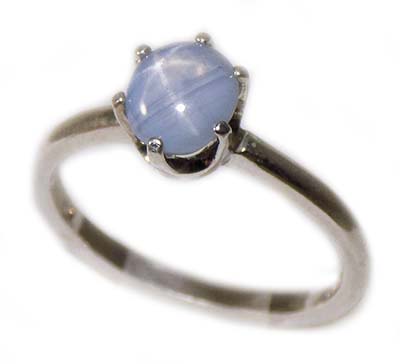
Known as a "star" sapphire because of an optical effect known as an "asterism"; microscopic oriented crystals blemishing the gemstone internally cause this six-rayed-star light effect (the asterism) to form on the surface of these beautiful precious gemstones. Star sapphires have been produced in limited quantities for centuries. They are perhaps 100 times as rare as an ordinary sapphire. The highest quality specimens will be more transparent, lower quality specimens more opaque. Higher quality gemstones will exhibit a more pronounced asterism, lower quality specimens will not. Lower quality specimens will possess significant eye-visible blemishes, higher quality specimens will have fewer, smaller eye-visible blemishes. Good quality star sapphires are in high demand, especially those in color other than navy blue or black, and can be quite costly. Consequentially, many of the star sapphires sold at retail are synthetic – check the fine print!
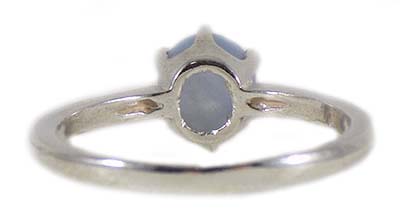
With reference to this particular specimen, to the cursory inspection of the casual admirer, the gemstone is seemingly unblemished. Of course there are minute blemishes, and they are visible when the gemstone is magnified, for instance under a jeweler's loupe, of for that matter, in the accompanying photo enlargements. However to the eye, to casual inspection, it is quite beautiful and seemingly without flaw. The ring setting is contemporary in origin. This is a high-quality solid sterling silver ring setting made right here in the USA, manufactured by one of the USA’s leading semi-custom mount producers, crafted to last a lifetime. It is not cheap, import silver electroplated nickel costume jewelry such as that flooding the USA and European market places from Asia (and oftentimes fraudulently described as "sterling silver"). This is an heirloom quality setting designed to last a lifetime. It is a first-class piece of jewelry throughout.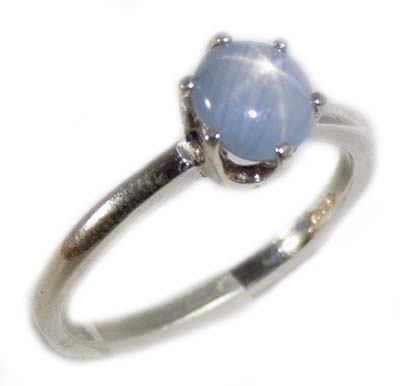
As might be expected under magnification the gemstone shows the unmistakable, hallmark characteristics of having been hand crafted. The coarseness of the 19th century finish is considered desirable to most gemstone aficionados, and is not considered a detriment, or detract from the value of a gemstone. These characteristics are not only expected of hand-finished gemstones, many believe that such antique hand-crafted gemstones possess much greater character and appeal than today's mass-produced, laser-cut gemstones. Unlike today’s computer controlled machine produced gemstones that approach flawlessness in a perfect finish, the cut and finish of an antique, handcrafted gemstone such as this is the legacy of an artisan who lived two centuries ago.
Handcrafted though it may be the gemstone possesses great luster and color, and to the eye is seemingly without blemish, but that is not to inti8mate that it is indeed absolutely flawless. True, the blemishes it possesses are virtually invisible to the naked eye, and to use trade jargon the gemstone can be characterized as "eye clean". To the view of the casual admirer the gemstone is seemingly without blemish. However magnified as it is here in the accompanying photo enlargements you might be able to detect a few minute blemishes within the stone. Of course much the same may said about almost any natural gemstone. An absolutely flawless gemstone simply is not the rule in nature. Most absolutely flawless gemstones will upon close examination be revealed to be synthetic, as perfect gemstones are the realm of laboratory-produced gemstones, not Mother Nature. You might also notice under magnification occasional irregularities in the cut and finish. Naturally these characteristics are not only expected of hand-finished gemstones, you must also consider that two centuries ago the mining techniques even possible then, let alone in practice, did not allow the ultra deep mining operations which are so commonplace today.
Keep in mind two centuries ago mankind was more or less limited to surface deposits or near surface deposits of gemstones. Higher quality gemstones which today are routinely mined from beneath hundreds of meters, even kilometers beneath the earth's surface, were simply inaccessible then. It is precisely for these reasons antique gemstone must be appreciated as antiques first, gemstones second. The relatively superlative quality of contemporary gemstones mined from deep beneath the earth's surface were simply not accessible two centuries ago, or at least, only rarely so. However for most, the unique nature and character of these antique gemstones more than makes up for the blemishes found within the gemstones, as well as the cutting and finishing irregularities common to handcrafted gemstones, all of which are by and large are only visible under magnification.
SAPPHIRE HISTORY: Sapphires have been since ancient times one of the most highly valued of all gemstones, and references to the gemstone date back to about 800 B.C. In the ancient Mediterranean world (including the Greeks, Romans, Persians, Hebrews, and the various Indo-European Celtic tribes), priests and sorcerers honored the sapphire above all other gems. They believed that the sapphire enabled them to interpret oracles and foretell the future. Sapphire is also the original “true blue”, the gem of fidelity and of the soul. In the ancient world, a gift of a sapphire was a pledge of trust, honesty, purity, and loyalty.
The oldest sapphire jewelry unearthed by archaeologists has been of Etruscan origin, about sixth century B.C. The Greeks and Romans are known to have worn sapphires from Ceylon, as described by writers from those times. Though some argue that the name sapphire is derived from its association with the planet and ancient deity Saturn (the name can be roughly be translated to mean “dear to the planet Saturn” in many different languages), most linguists and scholars agree that the name "sapphire" comes from the Latin "sapphirus" and the Greek "sappheiros", which translates to "blue" in both languages. The name sapphire is also a derivative of the ancient Hebrew and Persian word for "blue" as well.
To the ancient Romans however, the word "sapphirus" actually referred to lapis lazuli, another blue gemstone. According to Pliny, the first century Roman naturalist, what the Romans called blue sapphire (“cyanus”, from the Greek “cyan”, or “blue”) translates to "hyacinth"; the green sapphire was "emerald", and the purple sapphire was "amethyst". However the “Saturn” origin theory is appealing in that in ancient Rome Saturn (“Kronos” to the ancient Greeks) was a major god presiding over agriculture and the harvest time. His reign was depicted as a Golden Age of abundance and peace by many Roman authors, a mythical age when Saturn was said to have ruled.
In remembrance and celebration of that age, a great (week-long) feast called Saturnalia was held throughout the Roman Empire during the winter months around the time of the winter solstice. During Saturnalia, roles of master and slave were reversed, moral restrictions loosened, and the rules of etiquette ignored. It is thought that the festivals of Saturnalia and Lupercalia were the roots of the carnival ("Mardi Gras" in the USA). Roman depictions of Saturn generally showed the god with a sickle in his left hand and a bundle of wheat in his right. In the medieval world Saturn was known as the Roman god of agriculture, justice and strength.
The ancient Persians believed that the Earth was embedded into a gigantic blue Sapphire stone, and the sky reflected its beautiful color. They referred to the sapphire as "the gem of the heavens”. In ancient Persia, ground sapphire was used as an all purpose medicine. One ancient recipe to enhance eyesight was to powder the stone and mix it with vinegar. The same recipe was used to treat nosebleeds. Sapphires were also used to treat fevers and rheumatism. When treating boils and external ulcers, they were ground and mixed with milk. The paste was then applied to the afflicted area. Ancient Hebrew legends state that the tablets upon which the Ten Commandments were written were of blue sapphire, and biblical accounts record that King Solomon wore a great sapphire ring. Monarchs of the ancient world wore sapphires around their necks as a powerful talisman protecting them from harm and attracting divine favor.
Archaeological finds tell us that Ceylon is more than likely to be the source for sapphire in the classical world. In ancient Ceylon it was believed that star sapphire (a semi-opalescent gemstone extremely popular Victorian-era jewelry) served as a protective amulet and a guard against witchcraft. Celanese sapphire would have reached the classical Mediterranean cultures via the ancient trading routes that crossed present day Turkey, Iran, Afghanistan and Pakistan to India. Distribution within Europe was achieved using the extensive Roman road network which extended to all the corners of the Roman Empire. It is also possible that some of the sapphire traded in the classical Mediterranean originated in India.
As the centuries passed European royalty came to favor sapphire believing the stone would provide protection from harm. Throughout Medieval Europe, the sapphire was thought to give the wearer strengthened vision, including visions of the future. In particular during the 11th and 12th centuries, sorcerers honored the sapphire more than any other stone as it enabled them to hear and understand the most obscure oracles. Not only did sapphire help to get in touch with astral and psychic realms, but the stone also provided protection for those who took those journeys. Sapphire was regarded as an antidote to black magic and effects of evil spirits, and provided protection against sorcery. It was believed to banish evil spirits and send negative spells back to the sender.
Sapphires were also used as a talisman by medieval travelers, who believed that a sapphire would protect the wearer from poisonous creatures, kill snakes hiding nearby, and provide advance warning against hidden dangers. It was believed that if a sapphire were engraved with the figure of a man or a ram, that sapphire amulet would cure all illness and elevate the owner to a high position. Sapphire was also held to be a symbol of truth and constancy, and in the 12th century, the Bishop of Rennes and Pope Innocent III (who launched the infamous Fourth Crusade which sacked Constantinople) praised the blue of the sapphire as representing heaven, and initiated its use in ecclesiastical rings and other ecclesiastical jewelry as symbolic of the Pontific title and the Seal of Mysteries.
One of the most ancient and well-known sapphires belonged to the England’s Edward the Confessor. According to legend the king met a poor man begging alms. He did not have cash so he gave away his sapphire ring. Many years later, some pilgrims from Jerusalem came to him and gave him back his ring, saying that soon the King would meet the favored beggar in Heaven. It turned out to be true; Edward died soon after that meeting, and his sapphire was buried with him in his grave. Two centuries later his grave was opened, the sapphire recovered, and to everybody's astonishment, the King's body was still intact. After that, the miraculous sapphire was given a cross-shape cut and was placed in the Westminster Abbey where the miracles continued; the stone was known to cure the blind as well as paralytics and epileptics. The “Sapphire of St. Edward” now resides in the Crown of the British Empire next to another famous sapphire, the one of Charles II.
Another unique sapphire can be found among the state insignia of Russia. A 200-carat stone from the Ceylon is set in the top of the orb, which is now kept in the Kremlin Treasury. The Muslim world also has its own sacred sapphire, the “Eye of Allah,” a gemstone that once belonged to the famous 18th century Persian conqueror Nader Shah. Medieval European populations believed wearing a sapphire suppressed negative thoughts, and possessed curative powers over natural ailments. Sapphires were used as medicine for treatment of eye diseases and as an antidote for poison. When touched against the eye, it was believed to remove impurities and restored sight.
"Ivan the Terrible", the (sixteenth century) first Tsar of all Russia and conqueror of Siberia, attributed to sapphire strength of the heart and muscles, endowing the wearer with courage. Sapphires are a member of the corundum family, and close relative to the ruby. In fact, a ruby is simply a red sapphire. The sapphire is considered one of the most valuable of precious stones. The most highly prized were the "cornflower blue" sapphires known as "Kashmir" sapphires, from Northern India. Unfortunately the deposits were exhausted in the late 1800’s. The principal contemporary sources of sapphire are Russia, Siam, Ceylon, Burma, Africa, and Australia. The Museum of Natural History in New York is home to the one of the most notorious sapphires in the world, the “Star of India,” a star sapphire of 563 carats.
Throughout the history of the ancient world, gemstones were believed capable of curing illness and providing protection. Found in Egypt dated 1500 B. C., the "Papyrus Ebers" offered one of most complete therapeutic manuscripts containing prescriptions using gemstones and minerals. Gemstones were not only valued for their medicinal and protective properties, but also for educational and spiritual enhancement. In these as well as other ancient cultures, it was believed that sapphires would aid in ridding oneself of unwanted thoughts, and that they would bring joy and peace of mind, opening the mind to beauty and intuition.
Medicinally sapphire was believed to promote general health, and was oftentimes ground up and consumed. Sapphire was believed to be effective in reducing fevers, protected against mental illness, and to sharpen eyesight. They were also believed to cure ulcers. Psychologically sapphire was believed to aid the maintenance of inner peace, a healthy mental state, to calm nerves, and to promote mental clarity, helping with focus and concentration. As such they were widely used as a remedy for mental and nervous disorders.
On the metaphysical side, sapphires were regarded as a stone of prosperity, sustaining the gifts of life, fulfilling the dreams and desires of the wearer, and eliminating frustration. The sapphire has historically been identified with chastity, piety, and repentance, and was believed to foster wisdom and truth, and to increase perception and the understanding of justice. It was believed conducive to finding peace of mind and serenity, and to promote a life of sincerity, helping preserve one’s innocence while learning life’s truths. Sapphires were also associated with romantic love, representing fidelity, romantic devotion, truth, compatibility, commitment, and mutual understanding.
Sapphire was also worn as a talisman with the belief that it would increase one’s faith, hope, and joy, and would keep thoughts pure and heavenly. Sapphires were also used as talismans for protection, to ward off diseases, and to bring peace, happiness, and intelligence. Sapphire was known as the stone of serenity, helping one to meditate by providing mental calming. As a tool for self improvement, sapphires were regarded to be a powerful and transformative gemstone which would help the wearer connect to the universe, opening the wearer’s internal and spiritual self to the powers of the universe. Sapphire was also thought to increase communication with, connection to, and awareness of spirit guides, or angels.
HISTORY OF SILVER: After gold, silver is the metal most widely used in jewelry and the most malleable. The oldest silver artifacts found by archaeologists date from ancient Sumeria about 4,000 B.C. At many points in the ancient world, it was actually more costly than gold, particularly in ancient Egypt. Silver is found in native form (i.e., in nuggets), as an alloy with gold (electrum), and in ores containing sulfur, arsenic, antimony or chlorine. Much of the silver originally found in the ancient world was actually a natural alloy of gold and silver (in nugget form) known as “electrum”.
The first large-scale silver mines were in Anatolia (ancient Turkey) and Armenia, where as early as 4,000 B.C. silver was extracted from lead ores by means of a complicated process known as “smelting”. Even then the process was not perfect, as ancient silver does contain trace elements, typically lead, gold, bismuth and other metals, and as much as a third of the silver was left behind in the slag. However measuring the concentrations of the “impurities” in ancient silver can help the forensic jewelry historian in determining the authenticity of classical items. From Turkey and Armenia silver refining technology spread to the rest of Asia Minor and Europe.
By about 2,500 B.C. the Babylonians were one of the major refiners of silver. Silver “treasures” recovered by archaeologists from the second and third millenniums demonstrate the high value the ancient Mediterranean and Near East placed upon silver. Some of the richest burials in history uncovered by archaeologists have been from this time frame, that of Queen Puabi of Ur, Sumeria (26th century B.C.); Tutankhamun (14th century B.C.), and the rich Trojan (25th century B.C.) and Mycenaean (18th century B.C.) treasures uncovered by Heinrich Schliemann.
The ancient Egyptians believed that the skin of their gods was composed of gold, and their bones were thought to be of silver. When silver was introduced into Egypt, it probably was more valuable than gold (silver was rarer and more valuable than gold in many Mesoamerican cultures as well). In surviving inventories of valuables, items of silver were listed above those of gold during the Old Kingdom. Jewelry made of silver was almost always thinner than gold pieces, as indicated by the bracelets of the 4th Dynasty (about 2,500 B.C.) Queen Hetephere I, in marked contrast to the extravagance of her heavy gold jewelry.
A silver treasure excavated by archaeologists and attributable to the reign of Amenemhat II who ruled during the 12th Dynasty (about 1900 B.C.), contained fine silver items which were actually produced in Crete, by the ancient Minoans. When the price of silver finally did fall due to more readily available supplies, for at least another thousand years (through at least the 19th dynasty, about 1,200 B.C.) the price of silver seems to have been fixed at half that of gold. Several royal mummies attributable to about 1,000 B.C. were even entombed in solid silver coffins.
Around 1,000 B.C. Greek Athenians began producing silver from the Laurium mines, and would supply much of the ancient Mediterranean world with its silver for almost 1,000 years. This ancient source was eventually supplemented around 800 B.C. (and then eventually supplanted) by the massive silver mines found in Spain by the Phoenicians and their colony (and ultimate successors) the Carthaginians (operated in part by Hannibal’s family). With the defeat of Carthage by Rome, the Romans gained control of these vast deposits, and mined massive amounts of silver from Spain, stripping entire forests regions for timber to fuel smelting operations. In fact, it was not until the Middle Ages that Spain’s silver mines (and her forests) were finally exhausted.
Although known during the Copper Age, silver made only rare appearances in jewelry before the classical age. Despite its infrequent use as jewelry however, silver was widely used as coinage due to its softness, brilliant color, and resistance to oxidation. Silver alloyed with gold in the form of “electrum” was coined to produce money around 700 B.C. by the Lydians of present-day Turkey. Having access to silver deposits and being able to mine them played a big role in the classical world. Actual silver coins were first produced in Lydia about 610 B.C., and subsequently in Athens in about 580 B.C.
Many historians have argued that it was the possession and exploitation of the Laurium mines by the Athenians that allowed them to become the most powerful city state in Greece. The Athenians were well aware of the significance of the mining operations to the prosperity of their city, as every citizen had shares in the mines. Enough silver was mined and refined at Laurium to finance the expansion of Athens as a trading and naval power. One estimate is that Laurium produced 160 million ounces of silver, worth six billion dollars today (when silver is by comparison relatively cheap and abundant). As the production of silver from the Laurium mines ultimately diminished, Greek silver production shifted to mines in Macedonia.
Silver coinage played a significant role in the ancient world. Macedonia’s coinage during the reign of Philip II (359-336 B.C.) circulated widely throughout the Hellenic world. His famous son, Alexander the Great (336-323 B.C.), spread the concept of coinage throughout the lands he conquered. For both Philip II and Alexander silver coins became an essential way of paying their armies and meeting other military expenses. They also used coins to make a realistic portrait of the ruler of the country. The Romans also used silver coins to pay their legions. These coins were used for most daily transactions by administrators and traders throughout the empire.
Roman silver coins also served as an important means of political propaganda, extolling the virtues of Rome and her emperors, and continued in the Greek tradition of realistic portraiture. As well, many public works and architectural achievements were also depicted (among them the Coliseum, the Circus Maximus). In addition many important political events were recorded on the coinage. Roman coins depicted the assassination of Julius Caesar, alliances between cities, between emperors, between armies, etc. And many contenders for the throne of Rome are known only through their coinage.
Silver was also widely used as ornamental work and in other metal wares. In ancient cultures, especially in Rome, silver was highly prized for the making of plate ware, household utensils, and ornamental work. The stability of Rome’s economy and currency depended primarily on the output of the silver mines in Spain which they had wrested from the Carthaginians. In fact many historians would say that it was the control of the wealth of these silver mines which enabled Rome to conquer most of the Mediterranean world. When in 55 B.C. the Romans invaded Britain they were quick to discover and exploit the lead-silver deposits there as well.
Only six years later they had established many mines and Britain became another major source of silver for the Roman Empire. It is estimated that by the second century A.D., 10,000 tons of Roman silver coins were in circulation within the empire. That’s about 3½ billion silver coins (at the height of the empire, there were over 400 mints throughout the empire producing coinage). That’s ten times the total amount of silver available to Medieval Europe and the Islamic world combined as of about 800 A.D. Silver later lost its position of dominance to gold, particularly in the chaos following the fall of Rome. Large-scale mining in Spain petered out, and when large-scale silver mining finally resumed four centuries after the fall of Rome, most of the mining activity was in Central Europe.
By the time of the European High Middle Ages, silver once again became the principal material used for metal artwork. Huge quantities of silver from the New World also encouraged eager buyers in Europe, and enabled the Spanish to become major players in the late Medieval and Renaissance periods. Unlike the ores in Europe which required laborious extraction and refining methods to result in pure silver, solid silver was frequently found as placer deposits in stream beds in Spain’s “New World” colonies, reportedly in some instances solid slabs weighing as much as 2,500 pounds. Prior to the discovery of massive silver deposits in the New World, silver had been valued during the Middle Ages at about 10%-15% of the value of gold.
In 15th century the price of silver is estimated to have been around $1200 per ounce, based on 2010 dollars. The discovery of massive silver deposits in the New World during the succeeding centuries has caused the price to diminish greatly, falling to only 1-2% of the value of gold. The art of silver work flourished in the Renaissance, finding expression in virtually every imaginable form. Silver was often plated with gold and other decorative materials. Although silver sheets had been used to overlay wood and other metals since ancient Greece, an 18th-century technique of fusing thin silver sheets to copper brought silver goods called Sheffield plate within the reach of most people.
At the same time the use of silver in jewelry making had also started gaining popularity in the 17th century. It was often as support in settings for diamonds and other transparent precious stones, in order to encourage the reflection of light. Silver continued to gain in popularity throughout the 18th and 19th centuries, and by the 20th century competed with gold as the principal metal used in the manufacture of jewelry. Silver has the highest thermal and electrical conductivity of any metal, and one of the highest optical reflectivity values. It has a brilliant metallic luster, is very ductile and malleable, only slightly harder than gold, and is easily worked and polished.
When used in jewelry, silver is commonly alloyed to include 7.5% copper, known as “sterling silver”, to increase the hardness and reduce the melting temperature. Silver jewelry may be plated with 99.9% pure ‘Fine Silver’ to increase the shine when polished. It may also be plated with rhodium to prevent tarnish. Virtually all gold, with the exception of 24 carat gold, includes silver. Most gold alloys are primarily composed of only gold and silver. Throughout the history of the ancient world, gemstones were believed capable of curing illness, possessed of valuable metaphysical properties, and to provide protection. Found in Egypt dated 1500 B. C., the "Papyrus Ebers" offered one of most complete therapeutic manuscripts containing prescriptions using gemstones and minerals.
Gemstones were not only valued for their medicinal and protective properties, but also for educational and spiritual enhancement. Precious minerals were likewise considered to have medicinal and “magical” properties in the ancient world. In its pure form silver is non toxic, and when mixed with other elements is used in a wide variety of medicines. Silver ions and silver compounds show a toxic effect on some bacteria, viruses, algae and fungi. Silver was widely used before the advent of antibiotics to prevent and treat infections, silver nitrate being the prevalent form. Silver Iodide was used in babies' eyes upon birth to prevent blinding as the result of bacterial contamination.
Silver is still widely used in topical gels and impregnated into bandages because of its wide-spectrum antimicrobial activity. The recorded use of silver to prevent infection dates to ancient Greece and Rome. Hippocrates, the ancient (5th century B.C.) Greek "father of medicine" wrote that silver had beneficial healing and anti-disease properties. The ancient Phoenicians stored water, wine, and vinegar in silver bottles to prevent spoiling. These uses were “rediscovered” in the Middle Ages, when silver was used for several purposes; such as to disinfect water and food during storage, and also for the treatment of burns and wounds as a wound dressing.
The ingestion of colloidal silver was also believed to help restore the body's “electromagnetic balance” to a state of equilibrium, and it was believed to detoxify the liver and spleen. In the 19th century sailors on long ocean voyages would put silver coins in barrels of water and wine to keep the liquid potable. Silver (and gold) foil is also used through the world as a food decoration. Traditional Indian dishes sometimes include the use of decorative silver foil, and in various cultures silver dragée (silver coated sugar balls) are used to decorate cakes, cookies, and other dessert items.
SHIPPING & RETURNS/REFUNDS: Your purchase will ordinarily be shipped within 48 hours of payment. We package as well as anyone in the business, with lots of protective padding and containers. All of our shipments are fully insured against loss, and our shipping rates include the cost of this coverage (through stamps.com, Shipsaver.com, the USPS, UPS, or Fed-Ex). Please be aware that postal rates are routinely hiked three times each year by the USPS, and have increased exponentially over the past decade. We set shipping rates as low as possible. However eBay charges steep commissions on shipping charges. And we have no control over the draconian rate increases the USPS levies multiple times every year (FOUR TIMES in the past 12 months as of April of 2026). International tracking is provided free by the USPS for almost all countries. Please note that with respect to international shipments, eBay/DHL shipping is typically less expensive than what the US Postal Service charges. But please be aware that DHL shipments generally offer very limited tracking, and inasmuch as shipments go to eBay first, then are consolidated before finally being transferred to DHL, they tend to be pretty slow.
ADDITIONAL PURCHASES do receive a VERY LARGE discount, typically about $5 per item so as to reward you for the economies of combined shipping/insurance costs. We do offer U.S. Postal Service Priority Mail, Registered Mail, and Express Mail for both international and domestic shipments, as well United Parcel Service (UPS) and Federal Express (Fed-Ex). Please ask for a rate quotation. Please note for international purchasers we will do everything we can to minimize your liability for VAT and/or duties. But we cannot assume any responsibility or liability for whatever taxes or duties may be levied on your purchase by the country of your residence. If you don’t like the tax and duty schemes your government imposes, please complain to them. We have no ability to influence or moderate your country’s tax/duty schemes.
If upon receipt of the item you are disappointed for any reason whatever, I offer a no questions asked 30-day return policy. Send it back, I will give you a complete refund of the purchase price; 1) less our original shipping/insurance costs, 2) less any non-refundable eBay fees. Please note that though they generally do, eBay may not always refund payment processing fees on returns beyond a 30-day purchase window. So except for shipping costs and any payment processing fees not refunded by eBay, we will refund all proceeds from the sale of a return item. Obviously we have no ability to influence, modify or waive eBay policies.
ABOUT US: Prior to our retirement we used to travel to Eastern Europe and Central Asia several times a year seeking antique gemstones and jewelry from the globe’s most prolific gemstone producing and cutting centers. Most of the items we offer came from acquisitions we made in Eastern Europe, India, and from the Levant (Eastern Mediterranean/Near East) during these years from various institutions and dealers. Much of what we generate on Etsy, Amazon and Ebay goes to support worthy institutions in Europe and Asia connected with Anthropology and Archaeology. Though we have a collection of ancient coins numbering in the tens of thousands, our primary interests are ancient/antique jewelry and gemstones, a reflection of our academic backgrounds.
Though perhaps difficult to find in the USA, in Eastern Europe and Central Asia antique gemstones are commonly dismounted from old, broken settings – the gold reused – the gemstones recut and reset. Before these gorgeous antique gemstones are recut, we try to acquire the best of them in their original, antique, hand-finished state – most of them originally crafted a century or more ago. We believe that the work created by these long-gone master artisans is worth protecting and preserving rather than destroying this heritage of antique gemstones by recutting the original work out of existence. That by preserving their work, in a sense, we are preserving their lives and the legacy they left for modern times. Far better to appreciate their craft than to destroy it with modern cutting.
Not everyone agrees – fully 95% or more of the antique gemstones which come into these marketplaces are recut, and the heritage of the past lost. But if you agree with us that the past is worth protecting, and that past lives and the produce of those lives still matters today, consider buying an antique, hand cut, natural gemstone rather than one of the mass-produced machine cut (often synthetic or “lab produced”) gemstones which dominate the market today. We can set most any antique gemstone you purchase from us in your choice of styles and metals ranging from rings to pendants to earrings and bracelets; in sterling silver, 14kt solid gold, and 14kt gold fill. When you purchase from us, you can count on quick shipping and careful, secure packaging. We would be happy to provide you with a certificate/guarantee of authenticity for any item you purchase from us. There is a $3 fee for mailing under separate cover. I will always respond to every inquiry whether via email or eBay message, so please feel free to write.